"Clara, don't open that chest."
The voice came from behind the stone wall.
Clara stood motionless, holding the lantern above the iron-bound chest.
Samuel turned sharply.
Silas reached for the shovel he had carried through the drainage tunnel.
The narrow panel opened another inch.
Then a man stepped into the chamber.
His face was gray with exhaustion. Blood had soaked through the bandage around his shoulder. His coat was torn, and smoke had blackened one side of his face.
Daniel Cross.
Clara felt a cold wave of anger.
"You."
Daniel stopped.
"Mrs. Reinhold, please listen."
"You took my children."
His eyes dropped.
"Yes."
"You locked them inside a sawmill."
"I know."
"You let them nearly burn to death."
Daniel flinched.
"I never meant for that to happen."
Clara stepped toward him.
"Neither did Constance mean for Erik to die. Apparently, nobody ever means for anything terrible to happen in this family."
Daniel lowered his head.
Samuel moved closer to Clara.
"Why shouldn't she open the chest?"
Daniel looked toward the heavy iron lock.
"Because someone tampered with it."
Silas frowned.
"How?"
Daniel pointed toward the narrow gap beneath the lid.
"There's a spring-loaded mechanism inside. I saw Pritchard fitting it two nights ago."
Clara stared at the chest.
"A trap?"
Daniel nodded.
"He thought Erik's original papers were inside. He wanted anyone who tried to open it to destroy the evidence."
Samuel set the lantern on a shelf and examined the lock without touching it.
"Destroy it how?"
"An oil-filled glass bottle, fixed above the papers. Break the lock the wrong way, and the bottle shatters. There's a chemical mixture inside that ruins the ink."
Clara felt sick.
Even after Erik's death, someone had continued preparing to erase the truth.
She looked at Daniel.
"Why are you telling us?"
He swallowed.
"Because I have done enough damage."
Clara stared at him.
"That doesn't answer my question."
Daniel glanced toward the dark passage.
"Because I was there the day your husband died."
The chamber became silent.
Clara's fingers tightened around Erik's letter.
"Then you're going to tell me everything."
Daniel looked at Samuel.
Then at Silas.
Finally, he looked back at Clara.
"Yes, ma'am."
Daniel lowered himself onto a stone ledge.
He looked older than Clara remembered.
The confident logging foreman who once walked through the Hargrove yard giving orders had disappeared.
In his place sat a frightened, wounded man.
"Mr. Pritchard hired me to stop Erik's wagon," he began. "He said Erik had stolen private company documents and intended to sell them to competitors."
Clara shook her head.
"Erik would never have done that."
"I know that now."
"You knew him for years."
Daniel closed his eyes.
"That's what makes it worse."
Samuel stood beside the door, watching the passage.
Daniel continued.
"Pritchard told me to bring two men to the north logging road. We were supposed to block Erik's wagon, take the papers, and send him home."
"Who were the other men?" Clara asked.
"One was a mill hand named Curtis Bell. The other was a hired driver, Martin Pike."
"And what happened?"
Daniel's face tightened.
"Erik saw us before we reached the road."
Clara remembered Theodore's words.
He changed his route.
"He turned toward the old timber bridge," Daniel said. "We followed."
Clara felt her pulse quicken.
"Why?"
"Because Pritchard had promised me money if I recovered the documents."
Daniel stared at his hands.
"Erik stopped his wagon beside the bridge. He got down and demanded to know why we were following him."
Clara could almost see it.
Erik standing beside the wagon.
His sandy hair stirred by the wind.
His jaw set in that stubborn way she remembered so well.
"He recognized me," Daniel whispered. "He asked whether his mother had sent us."
Clara closed her eyes.
"What did you say?"
"I lied."
Daniel swallowed.
"I told him we were there on company business."
"And then?"
"He said he was going to Judge Harwood, and nobody was going to stop him."
Clara felt tears fill her eyes.
Daniel continued.
"Bell tried to grab the leather case from the wagon. Erik pushed him away. They struggled."
The foreman's voice became unsteady.
"Pike had left his horse beside a stack of cut timber. The horse panicked when Bell fired a warning shot. It pulled against the rope holding the timber."
Samuel looked up sharply.
"The stacked logs?"
Daniel nodded.
"The rope broke. One of the logs rolled down the slope."
Clara held her breath.
"Erik saw it coming."
Daniel's eyes filled.
"He pushed Bell out of the way."
Clara felt the room tilt.
"The log struck Erik instead."
Daniel nodded.
For several seconds, nobody spoke.
Then Clara asked quietly, "Was he alive afterward?"
Daniel looked at her.
"Yes."
The word nearly brought her to her knees.
"How long?"
"Not long."
"Did you get help?"
Daniel lowered his eyes.
"Bell ran for the doctor. I stayed with Erik."
Clara could barely breathe.
"What did he say?"
Daniel's face crumpled.
"He asked me to tell you he loved you."
Tears spilled down Clara's cheeks.
Daniel continued.
"He said you were stronger than you knew. He told me not to let anyone separate you from the children."
Clara pressed a hand against her mouth.
"And you didn't tell me."
Daniel shook his head.
"No."
"Why?"
"Because Pritchard arrived before the doctor. He told us that if anyone learned we'd followed Erik, we'd all be charged with murder."
Clara stared at him.
"He told you to call it a logging accident."
Daniel nodded.
"And you obeyed."
"Yes."
Clara looked away.
The truth was not the one she had feared most.
Erik had not been deliberately struck down by a man waiting with a weapon.
But he had died because people had been sent to threaten him.
Because money had mattered more than his safety.
Because the men responsible had chosen silence afterward.
Daniel's voice broke.
"I have regretted it every day."
Clara turned back.
"Regret didn't bring my husband home."
"No, ma'am."
"It didn't tell my children why their father died."
"I know."
"And it didn't stop you from taking them yesterday."
Daniel bowed his head.
Clara stepped closer.
"Why did you do it?"
"Pritchard said he needed the ledger. He threatened to have me arrested for Erik's death if I refused."
"So you kidnapped my children."
"I thought if I kept them at the mill, he would come, collect the book, and let them go."
Clara stared at him.
"And when he arrived?"
"He said the children had heard too much."
Daniel's voice became hard.
"He wanted me to leave them in the building."
Clara felt a terrible chill.
"He intended to burn it?"
Daniel nodded.
"I refused. We fought. The gun went off. Then the lantern fell."
He looked toward the blackened bandage on his shoulder.
"I tried to get upstairs, but he shot me. By the time I reached the door, the stairs were burning."
Clara remembered finding him wounded outside.
The abandoned rifle.
The flames.
Nils shouting for his sister.
Daniel continued.
"Pritchard escaped through the rear passage. I followed him as far as the lower tunnel, but I couldn't catch him."
Samuel looked toward the dark opening.
"Where is he now?"
Daniel shook his head.
"I don't know."
Clara stared at him.
"Then you will tell the judge everything."
Daniel nodded.
"Every word."
"And you will accept whatever punishment the court decides."
He lowered his eyes.
"Yes."
Clara looked at the chest.
Then at Erik's letter.
For the first time since her husband died, she knew what had happened on that road.
It did not lessen her grief.
But it ended the terrible uncertainty.
She wiped her face.
"Now help us save his evidence."
Samuel examined the chest carefully.
Daniel showed him the small metal pin Pritchard had installed beneath the lock.
Silas held the lantern while Samuel worked a thin piece of wire into the mechanism.
Clara waited beside the table.
Every second seemed painfully long.
Finally, Samuel heard a faint click.
He drew the wire free.
"That should release the trigger."
Daniel nodded.
Samuel carefully lifted the lid.
Inside, a small glass bottle hung from a wire above several packets of papers.
The bottle remained intact.
Silas let out a slow breath.
Samuel removed it and set it aside.
Then Clara reached into the chest.
The first packet contained old survey drawings.
The second held land agreements bearing the signatures of several early settlers.
The third contained a handwritten declaration.
Clara unfolded it.
At the top were the words:
EASTERN WATERSHED CONSERVATION AGREEMENT — 1874
Beneath the title, Jonas Lindquist's name appeared beside those of twelve neighboring landowners.
Samuel leaned closer.
His eyes widened.
"This is the original agreement."
Clara looked at him.
"What does it mean?"
He took the document carefully.
"The settlers agreed to protect the natural spring and its channels from exclusive commercial control."
Silas studied the signatures.
"My grandfather signed this."
Samuel nodded.
"So did mine."
Clara looked toward the old map.
"Does that mean the spring belongs to everyone?"
"Not exactly," Samuel said. "The land itself belongs to you. The source rises beneath your property, and your deed gives you the right to use it. But this agreement established shared access and restrictions on diverting the water."
Clara thought of the dry farms beyond Miller's Creek.
"The other families have rights too."
"Yes. Rights that may still be enforceable, depending on the later deeds and the county records."
He unfolded another page.
Then his expression changed.
"Here."
Clara leaned closer.
It was a recorded easement.
The document granted neighboring farms limited access to water through designated channels.
It also prohibited any single owner from diverting the main flow in a way that damaged the spring or deprived the other properties of their agreed supply.
Samuel tapped the seal.
"This was entered into the county record."
Clara stared.
"Then how did the Hargroves claim they could redirect it?"
"By relying on later surveys that omitted the easement."
He turned to another page.
The later surveys bore altered boundaries.
The signatures did not match.
Clara recognized Theodore's name.
Beside it was a date from a year when he had been away purchasing timberland.
She remembered that journey.
Erik had told her about it.
Theodore could not have signed the document in Millbrook that day.
Samuel looked at Clara.
"This is what Erik discovered."
Clara felt her heart pound.
"And this proves the spring cannot simply be taken."
"It gives us powerful evidence," Samuel said. "The judge will have to examine the records, but these are exactly the documents we need."
Silas opened the final packet.
Inside was a smaller envelope addressed to Miriam Lindquist.
Clara recognized her grandmother's handwriting on the outside.
She opened it carefully.
The letter inside had been written by Jonas many years earlier.
It explained that the spring had always been intended to support the surrounding community.
Jonas had feared that wealthy buyers would acquire the land and use the water to force neighboring families into selling their farms.
He had hidden the original records because the men trying to purchase the watershed had already begun replacing survey markers.
Clara read the final lines aloud.
"If one day this land returns to our family, let whoever holds it remember why we protected it. Water is not worth much when it is used to make others desperate. Its true value is in what it allows people to grow."
Clara lowered the letter.
She thought of her grandmother sitting beside the fireplace, telling stories about rivers hidden beneath the earth.
She thought of Erik risking everything to preserve the evidence.
And she thought of Nils and Maja digging irrigation trenches in the dry soil.
For the first time, she understood why the spring had been so carefully protected.
It was not merely valuable because someone might pay a fortune for it.
It was valuable because it could keep people alive.
They left the ruined mill before midnight.
Daniel traveled with them.
His shoulder was bleeding again, and Silas insisted he sit in the wagon.
Samuel wrapped the documents in oilcloth.
Clara kept Erik's letter beneath her shawl.
When they reached the cabin, Jonas was waiting beside the fireplace.
Nils and Maja slept beneath clean blankets.
Clara knelt beside them.
She brushed Nils's hair from his forehead.
Then kissed Maja's cheek.
Both children stirred but did not wake.
Clara remained there for several minutes.
She listened to their breathing.
The sound was ordinary.
Soft.
Steady.
And after everything that had happened, it was the most beautiful sound she knew.
Jonas approached.
"Did you find the records?"
Clara nodded.
She showed him the conservation agreement.
The old man's hands trembled as he touched the paper.
"I thought it was gone forever."
Samuel smiled faintly.
"Erik found it."
Jonas closed his eyes.
"That boy."
Clara felt tears rise again.
"He saved it."
Jonas looked at her.
"And you brought it home."
Before dawn, Silas rode to the neighboring county with copies of the evidence and a signed statement from Daniel Cross.
Samuel remained at the cabin.
He helped Clara secure the door and cover the hidden staircase.
Jonas inspected the water channel.
The flow had steadied since they locked the eastern gate, but the damaged mechanism still needed proper repairs.
Clara watched him work.
"Can it be fixed?"
Jonas nodded.
"Yes. With enough men and the right equipment."
"Will the spring survive?"
He looked at the clear water.
"It has survived longer than any of us."
Clara smiled faintly.
"That wasn't my question."
Jonas turned toward her.
"Then yes, Clara. If we protect the channels and stop anyone from forcing the diversion, it should continue flowing."
She looked toward the garden.
The tomatoes were growing.
The squash vines spread across the soil.
The little corn patch stood green against the dry prairie.
She had bought this place because nobody else wanted it.
Now she knew it was worth far more than five dollars.
But she no longer thought about selling.
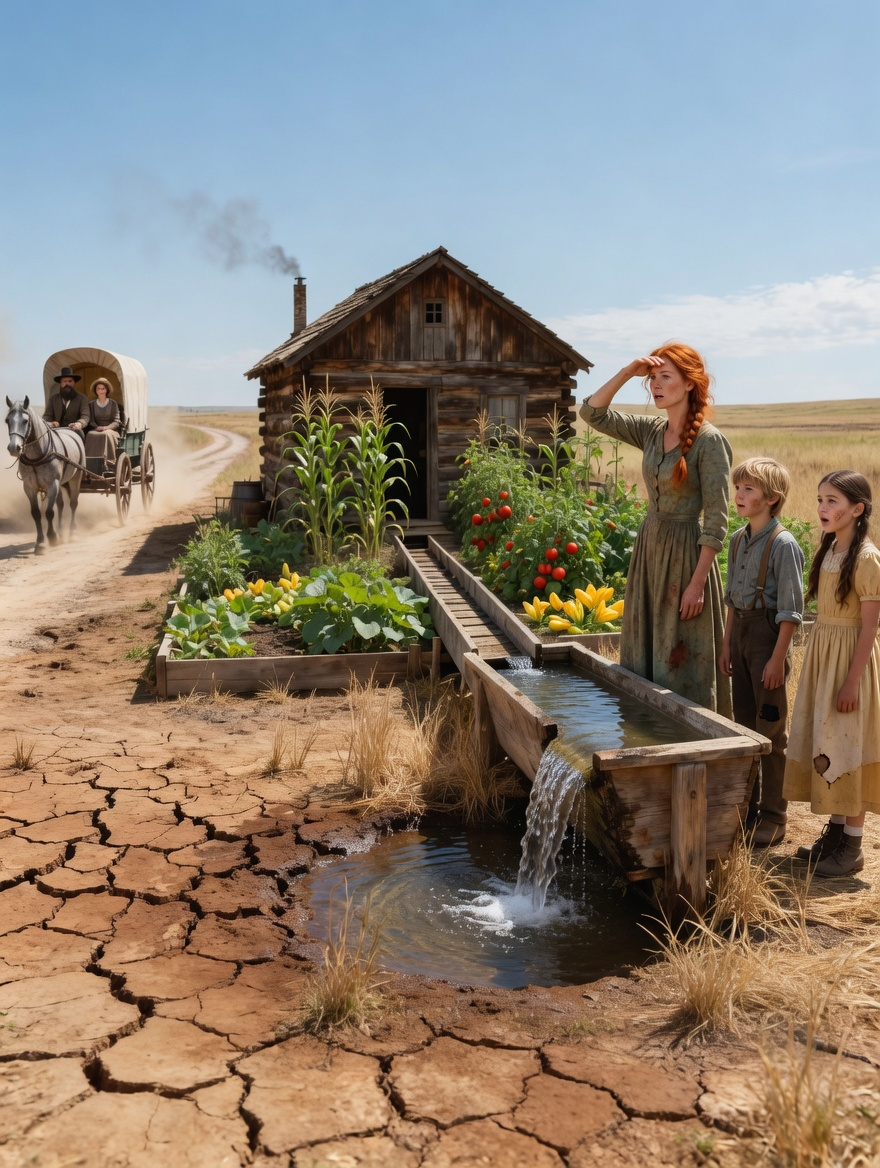
Three days later, Judge Nathaniel Harwood arrived at the cabin.
He came in a covered wagon accompanied by his wife, Eleanor, and two older court officers.
Clara watched them approach from the porch.
The judge was a tall man with silver hair and a weathered face.
His wife carried a basket of food.
When she stepped down from the wagon, she looked toward the garden and smiled.
"So this is the famous spring."
Clara felt embarrassed.
"I don't know about famous."
Eleanor looked at the water flowing through the wooden trough.
"People have been talking about it all the way from the county line."
Judge Harwood approached.
"Mrs. Reinhold?"
"Yes, sir."
He removed his hat.
"I knew your husband."
Clara felt her breath catch.
"You did?"
"He wrote to me shortly before his death. He said he had discovered irregularities in several land transactions and wanted to present evidence."
Clara lowered her eyes.
"He never made it."
"No."
The judge's expression softened.
"I'm sorry."
She nodded.
Then looked toward the papers Samuel had arranged on the table.
"I have what he was trying to bring you."
The judge spent most of the day examining the documents.
He compared the original survey records with the later transfers.
He read the conservation agreement.
He studied the black ledger.
He listened to Daniel Cross's confession, which the officers recorded in writing.
He questioned Samuel, Jonas, Silas, Theodore, and Constance separately.
Theodore had arrived that morning.
Constance came under the supervision of one of the officers.
She looked exhausted.
Her expensive dress was dusty.
Her face had lost its usual color.
When she saw Clara standing beside the spring, she looked away.
The judge reviewed the evidence without raising his voice.
But as the afternoon passed, his expression grew increasingly severe.
Finally, he closed the ledger.
"Mrs. Hargrove," he said, "these records indicate a deliberate effort to obtain land through false representations and forged documents."
Constance lifted her chin.
"I acted to protect my husband's business."
"That does not excuse fraud."
"The company employs dozens of families."
"Nor does it excuse intimidation."
Constance said nothing.
The judge continued.
"Mr. Pritchard's involvement in the road incident and the attempted destruction of evidence will require criminal investigation."
Clara looked toward Daniel.
He stood beside one of the officers.
His face was pale.
Judge Harwood turned to him.
"Mr. Cross, your confession will be entered into the record. Your cooperation will be considered, but it does not erase your participation."
Daniel nodded.
"I understand."
The judge then looked at Theodore.
"Mr. Hargrove, you will need to produce the company's complete land records."
Theodore lowered his head.
"I will."
"And you will not interfere with Mrs. Reinhold's property."
"No, sir."
Constance looked sharply at her husband.
But Theodore did not look back.
Judge Harwood turned toward Clara.
"Your deed appears valid. The conservation agreement and recorded easements provide substantial grounds to challenge the company's diversion claims."
Clara felt her knees weaken.
"Does that mean they cannot take the spring?"
"Pending the court's final determination, I am ordering the diversion work stopped. No one is to alter the water channels or interfere with your possession of this land."
Clara closed her eyes.
For the first time in weeks, she felt something loosen inside her chest.
The judge continued.
"The original records will be preserved and examined. If the forged transfers are confirmed, the affected property rights can be restored."
Clara looked toward Jonas.
The old man's eyes were wet.
Samuel stood beside him, smiling.
Silas removed his hat.
Then Eleanor Harwood stepped forward.
"Mrs. Reinhold, I believe your children would enjoy something from my basket."
Maja appeared in the doorway.
"Is it cake?"
Eleanor laughed.
"As a matter of fact, it is."
For the first time in many days, the cabin filled with laughter.
The legal proceedings took several weeks.
Clara traveled to the neighboring county twice to give testimony.
Samuel accompanied her.
Silas cared for the children when she had to be away.
Jonas remained at the cabin, slowly regaining his strength.
The investigation confirmed that several land transfers had been falsified.
Theodore's signature had been forged on documents he had never approved.
Other transactions bore the names of people who had already died.
The black ledger recorded payments connected to the scheme.
Pritchard was arrested after officers found him hiding in a boardinghouse two counties away.
He was charged in connection with the fraud, the kidnapping, the sawmill fire, and the attempted destruction of evidence.
Daniel Cross admitted his role in stopping Erik's wagon and concealing the circumstances of his death.
His testimony helped establish what had happened.
The court held him accountable for his crimes.
Clara did not ask for revenge.
She asked for the truth to be entered into the record.
And it was.
Erik Reinhold had died after being confronted by men sent to seize evidence of wrongdoing.
The falling timber had struck him during the struggle.
The original report had concealed the confrontation.
When Clara heard the findings read aloud, she cried quietly.
Not because the words brought Erik back.
They never could.
But because her children would no longer grow up believing their father had simply been careless.
He had been brave.
He had tried to protect his family.
And in his final moments, he had saved another man's life.
Constance's involvement in the forged transfers and intimidation scheme was established through the documents and witness testimony.
She was convicted of fraud and conspiracy and received a prison sentence.
Theodore was required to cooperate with the investigation and surrender the company's disputed claims.
The Hargrove business lost much of its wealth.
Several mills were sold.
The remaining operations were reorganized under new management.
Theodore moved into a modest house near Millbrook.
He no longer possessed the grand estate that had once made him seem untouchable.
One afternoon, he came to Clara's cabin.
He stood beside the porch, holding his hat.
Nils watched him from the garden.
Maja remained close to Clara.
Theodore looked at the children.
"May I speak with you?"
Clara hesitated.
Then nodded.
He knelt before Nils.
"I owe you an apology."
The boy looked at him.
"For what?"
"For not protecting your mother when I should have."
Nils was quiet.
Theodore turned toward Maja.
"And for letting you believe you had no place to go."
Maja studied him.
Then asked, "Are you going to make Mama leave again?"
Theodore's face crumpled.
"No, sweetheart."
He looked toward Clara.
"Never again."
Clara watched him carefully.
She could not erase what he had failed to do.
But she could see that he was trying to become a different man.
"You may visit the children," she said. "If they want you to."
Theodore nodded.
"Thank you."
"And you will respect our home."
"I will."
He looked toward the water channel.
Then said quietly, "Erik would have loved this place."
Clara felt a familiar ache.
"Yes."
She looked toward the garden.
"He would have."
By the beginning of autumn, the eastern gate had been repaired.
Samuel and Jonas supervised the work.
Several neighboring farmers volunteered their labor.
Silas brought timber.
Others brought tools, stone, and food.
Together, they reinforced the underground supports and secured the diversion mechanism against unauthorized use.
The spring continued flowing.
The court confirmed Clara's ownership of the forty-acre property and recognized the recorded water-access agreements.
The Hargrove company's disputed diversion claims were set aside.
Clara worked with the neighboring families to establish a small water association.
Each farm received access according to the old agreements and the amount of water available.
The channels were maintained collectively.
No family could secretly divert the flow.
No wealthy buyer could simply shut off the supply.
And Clara remained the owner of the land where the spring rose.
The first new irrigation trench reached the Mercer farm in September.
Silas stood beside it as clear water moved slowly across his dry field.
He removed his hat.
For a long moment, he said nothing.
Then he looked at Clara.
"My father tried to grow corn here."
Clara smiled.
"Perhaps you can try again."
Silas wiped his eyes.
"I believe I will."
Other families followed.
Gardens returned to land that had been dry for years.
Children carried buckets without walking miles to distant wells.
Women planted beans, squash, and cabbage.
Farmers repaired fences and cleared fields they had nearly abandoned.
The drought had not ended.
The sky remained stubbornly blue.
But the valley was no longer helpless.
And at the center of it stood a little log cabin that everyone had once considered worthless.
One morning, Clara found Nils beside the spring.
He was building a new wooden channel.
Maja sat nearby, arranging purple flowers in a small clay pot.
Clara watched them for a moment.
"What are you two doing?"
Nils looked up.
"Making another path for the water."
"Why?"
"Because the flowers need some."
Maja nodded seriously.
"Purple flowers are important."
Clara laughed.
"They certainly are."
Nils adjusted the wooden trough.
Water began flowing toward the flower bed.
He smiled.
"Look, Mama!"
Clara crouched beside him.
The water moved gently through the channel.
Clear.
Steady.
Full of life.
She remembered the first day they arrived.
The flooded floor.
The cracked earth.
The broken roof.
The fear.
The uncertainty.
She remembered telling the children that they would not fight the water.
They would give it a path.
Now Nils had learned to do exactly that.
Clara placed a hand on his shoulder.
"Your father would be proud of you."
Nils looked toward the cabin.
"Do you think he can see us?"
Clara felt her throat tighten.
"I don't know, sweetheart."
She looked at the flowers.
The garden.
The little house they had repaired with their own hands.
"But I think he would be very happy to know how we're living."
Nils nodded.
Then returned to his work.
Maja looked up.
"Mama?"
"Yes?"
"Are we rich now?"
Clara smiled.
"Why do you ask?"
"Because we have so much water."
Clara looked toward the spring.
Then at the children.
"We have something very valuable."
Maja considered this.
"More valuable than Grandmother's big house?"
Clara drew her close.
"Much more."
Maja smiled.
"Good. I like our little house better."
"So do I."
The following spring, Clara stood on the porch of a cabin that no longer leaked.
Samuel had helped build a proper wooden floor above the water passage.
The roof had been replaced.
The walls had been repaired.
A small kitchen had been added beside the original room.
Nils had his own bed.
Maja had a little shelf for her dolls.
And beside the front door, Clara had planted a climbing rose.
The garden stretched across the fertile ground.
Rows of vegetables grew beside carefully maintained irrigation channels.
A young apple tree stood near the fence.
Its branches were still small.
But its first blossoms had opened.
Clara watched Maja run toward it.
"Mama! Look!"
The little girl pointed at the white flowers.
Clara smiled.
"I see them."
Nils came running from the field.
"Mr. Mercer says the corn is growing twice as fast this year!"
Clara laughed.
"Then we'd better make sure he has enough baskets."
Samuel approached from the road.
Jonas walked beside him, leaning on a polished wooden cane.
The two old men had become almost inseparable.
They argued about survey measurements.
They argued about timber.
They argued about the best way to repair a fence.
But every afternoon, they sat together beside the spring and watched the water flow.
Clara smiled as they approached.
"Good morning."
Samuel tipped his hat.
"Beautiful day."
Jonas looked toward the garden.
"Miriam would have loved this."
Clara felt a gentle ache.
"Yes."
The old man reached into his coat.
He removed a small wooden box.
"I have something for you."
Clara stared.
"What is it?"
"Something your grandmother asked me to keep."
He placed it in her hands.
Inside was a simple silver brooch shaped like a river stone.
Clara recognized it immediately.
Her grandmother had worn it every Sunday.
She touched the smooth silver.
"I thought it was lost."
Jonas smiled.
"Miriam gave it to me before I left. She said that if the land ever returned to the family, I should give it to the person who made it a home again."
Clara felt tears rise.
She lifted the brooch.
Then fastened it to her dress.
"Thank you."
Jonas looked toward the spring.
"No, Clara."
His voice softened.
"Thank you."
That evening, the neighboring families gathered beneath the cottonwood trees.
They had brought bread, roasted vegetables, pies, and fresh milk.
Children played beside the fence.
Farmers talked about planting schedules.
Eleanor Harwood had sent a basket of preserves.
Silas brought a large wooden sign.
He carried it toward the porch.
Clara looked at him.
"What's that?"
Silas smiled.
"Something we've been working on."
He turned the sign around.
Carved into the wood were the words:
REINHOLD SPRING
Beneath them, in smaller letters:
WATER FOR THE VALLEY — ESTABLISHED IN TRUST
Clara stared.
For a moment, she could not speak.
Silas cleared his throat.
"We thought the place deserved a proper name."
Samuel nodded.
"And the family who saved it deserved to be remembered."
Clara looked at the sign.
Reinhold.
Erik's name.
Her children's name.
Her own name.
Not the Hargrove name that had once been used to remind her of everything she lacked.
The name of the family she had fought to keep together.
Nils approached.
"Can we put it by the road?"
Clara smiled through her tears.
"Yes."
Maja clapped.
"Then everyone will know where we live!"
Silas laughed.
"That's the idea."
Together, they carried the sign toward the entrance.
Samuel held it steady while Nils helped drive the wooden posts into the ground.
Maja placed a small bunch of purple flowers beneath it.
Clara watched.
The evening sun spread gold across the prairie.
The water moved through the channels.
The garden rustled in the breeze.
And the little cabin stood strong against the wide open sky.
When the work was finished, everyone gathered beneath the cottonwood trees.
Silas raised his cup.
"To Clara Reinhold."
Clara shook her head, embarrassed.
But Silas continued.
"To a woman who arrived with five dollars and two children and somehow gave an entire valley a future."
The neighbors applauded.
Clara felt tears fill her eyes.
She looked toward Nils.
Then Maja.
Then Samuel and Jonas.
She thought of Erik.
Of the man who had believed the truth mattered.
Of the husband who had loved her enough to leave behind the evidence she would need.
She wished he could stand beside her.
She wished he could see their children laughing.
But she knew that much of what they had built had begun with his courage.
Clara raised her cup.
"To Erik," she said softly.
The gathering grew quiet.
"To the people who helped us when we had nothing. And to everyone who believes a family deserves a chance to begin again."
Silas lifted his cup.
"To Erik."
The others repeated his name.
Clara looked toward the spring.
For a moment, the water caught the last sunlight and shone like silver.
Later that night, after the neighbors had gone home, Clara sat on the porch.
Nils and Maja were asleep inside.
The house was quiet.
The air smelled of fresh earth and spring flowers.
She held the five-dollar bill Constance had given her.
It had been returned to her during the investigation, recovered among the old county purchase papers as a record of the original payment.
Clara had asked to keep it.
Not because she needed the money.
But because she wanted to remember.
She looked at the faded paper.
Five dollars.
That was what Constance had believed she was worth.
Five dollars to leave.
Five dollars to disappear.
Five dollars to surrender her children and admit defeat.
Clara folded the bill carefully.
Then placed it inside a small wooden frame Samuel had made.
Beside it, she placed a copy of the deed.
Forty acres.
A flooded cabin.
A spring nobody had understood.
She hung the frame inside the doorway.
Not as a reminder of humiliation.
But as proof that the value of a life could never be measured by the amount of money someone chose to give it.
Clara stepped outside again.
The stars were bright.
Water whispered beneath the porch.
She walked toward the garden.
The irrigation channels gleamed in the moonlight.
The apple tree moved gently in the breeze.
She stopped beside the spring and looked toward the dark prairie.
For years, she had believed security meant belonging to a wealthy family.
A large house.
A respected name.
A place at a polished dining table.
But the grand Hargrove house had never truly been hers.
This little cabin was.
Every repaired board.
Every planted seed.
Every trench carved through the earth.
Every drop of water that reached a thirsty field.
She had earned her place here.
And no one could take that away.
Behind her, the cabin door opened.
Nils stepped onto the porch.
"Mama?"
She turned.
"Why are you awake?"
He rubbed his eyes.
"I couldn't sleep."
Clara walked toward him.
"Bad dream?"
He shook his head.
"I was thinking about Papa."
She took his hand.
"So was I."
Nils looked toward the spring.
"Do you think he knew we'd find this place?"
Clara considered the question.
"I think he hoped we would."
Nils nodded.
Then he looked up at her.
"Are we going to stay here forever?"
Clara smiled.
"As long as we want."
He looked relieved.
"Good."
She brushed his hair from his forehead.
"Why?"
"Because Maja likes the flowers."
Clara laughed softly.
"And you?"
Nils looked toward the water channel.
"I like making things grow."
She pulled him close.
They stood together beneath the stars.
A moment later, Maja appeared in the doorway, dragging her blanket.
"You forgot me."
Clara smiled.
"Never."
The little girl hurried toward them.
Clara wrapped the blanket around both children.
Then she sat on the porch steps with Nils on one side and Maja on the other.
The spring continued flowing beneath their feet.
The garden rested in the darkness.
And beyond the fence, the valley stretched toward a future none of them could yet imagine.
Maja leaned against her mother.
"Mama?"
"Yes, sweetheart?"
"Are we home?"
Clara looked at the little cabin.
At the flowers.
At the sign beside the road.
At the children who had survived everything with her.
She kissed Maja's forehead.
"Yes, my darling."
Then she looked at Nils and smiled.
"We're home."






Comments 0