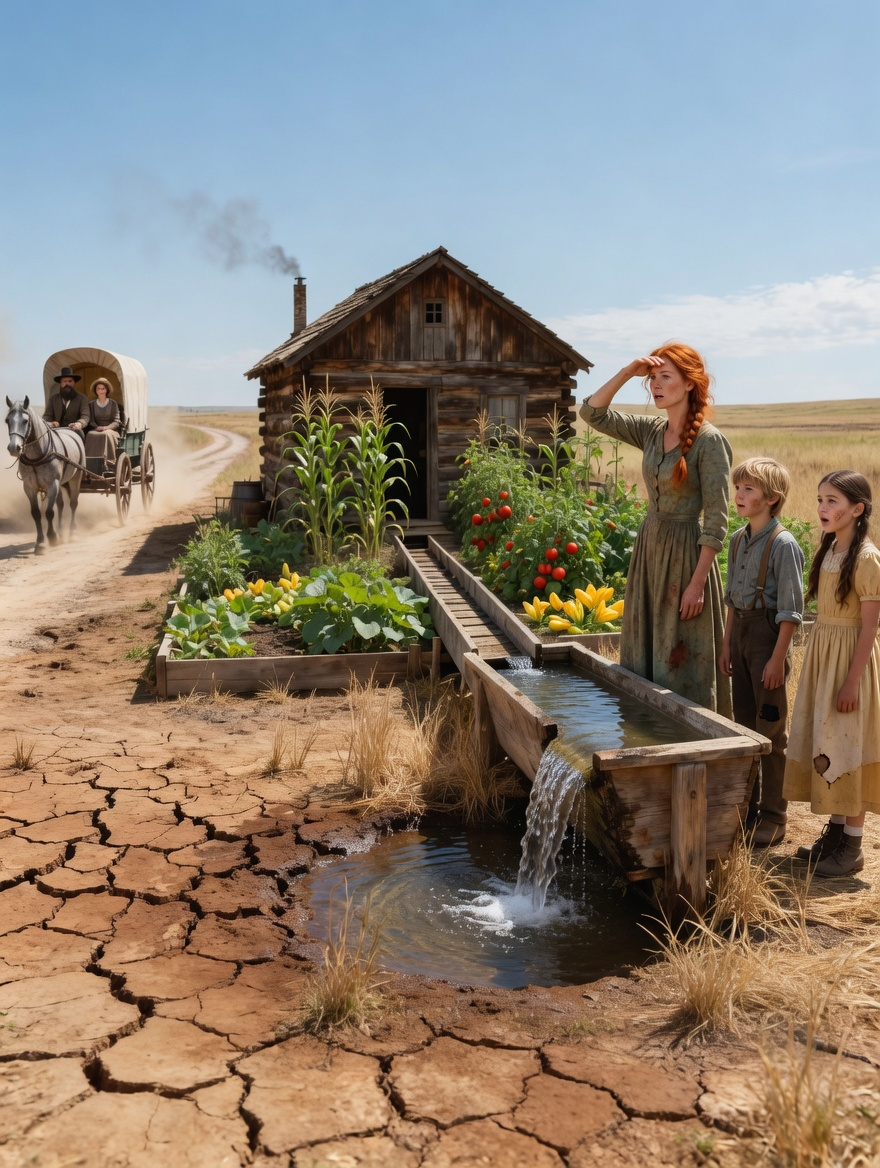
"Don't open that door, Mama!" Nils whispered, grabbing his mother's skirt.
Clara tightened her grip around Erik's pocketknife.
Outside, the stranger stood with one hand resting against the wooden door.
Then he spoke again.
"Miriam told me you would come."
Clara felt a chill move through her body.
Her grandmother had been dead for more than twenty years.
And yet a stranger had appeared at midnight, on the first night Clara owned the abandoned cabin, claiming to carry a message from her.
"Step away from the door," Clara said.
Her voice was quiet.
The man obeyed.
She heard his boots scrape against the porch.
"I'm not here to hurt you."
"Then you won't mind answering a few questions."
"Ask them."
"Who are you?"
A pause.
"My name is Samuel Whitaker."
Clara searched her memory.
The name meant nothing.
"What do you want?"
"To explain why you should never have been allowed to buy this land."
Nils pressed closer to her.
Clara felt the boy trembling.
She gently moved him behind her.
"That sounds like a matter for the county clerk."
"It was supposed to be."
"Then speak to him."
"I already did."
Clara's stomach tightened.
The man continued.
"He told me a woman had purchased the Lindquist property this morning. When he mentioned your name, I knew I had to come."
"Why?"
"Because your grandmother made me promise something."
Clara stared at the door.
She could hear the horse shifting outside.
The stranger's lantern cast a narrow line of yellow light beneath the threshold.
"What promise?"
"That if a woman named Clara ever came looking for the Lindquist land, I would tell her the truth."
Clara's heart began to pound.
For several seconds, she could not speak.
Then she asked the question that mattered most.
"How did you know my grandmother?"
Samuel Whitaker did not answer immediately.
When he finally spoke, his voice had changed.
"I was a boy when I met her. My father worked as a surveyor. Your grandmother helped him measure the underground water on this property."
Clara looked toward the northwest corner.
The hidden stone chamber.
The wooden channel.
The steady current.
"You know about the spring."
"Yes."
"Then why does everyone say this land is worthless?"
"Because somebody spent a great deal of money making sure they believed it."
Clara felt the room grow smaller.
Behind her, Maja stirred beneath the blanket.
"Mama?"
Clara glanced back.
Her daughter sat up, rubbing her eyes.
"Who's talking?"
"Someone who says he knew Great-Grandmother."
Maja looked toward the door.
"Is he nice?"
Clara wished she knew.
She turned back.
"Mr. Whitaker, if you expect me to trust you, you'll need to give me a reason."
"I understand."
"Start with something only my grandmother would know."
Silence.
Then Samuel said, "She used to call you her little river stone."
Clara stopped breathing.
Nobody had called her that since childhood.
Miriam had given her the nickname when Clara was five.
One summer, Clara had fallen into a shallow stream while trying to rescue a kitten.
She had emerged soaking wet, furious, and still clutching the animal.
Her grandmother had wrapped her in a blanket and laughed.
"You're my little river stone," Miriam had said. "The water can push you around, but it can't wash you away."
Clara remembered the smell of her grandmother's kitchen.
Fresh bread.
Dried lavender.
Wood smoke.
She remembered the old woman's hands, rough from work, gently drying her hair.
And suddenly, the stranger's words felt less like a threat.
More like a door opening into a forgotten part of her life.
"How did you know that?" Clara whispered.
"Your grandmother told my father. She said you were stubborn enough to survive anything."
Clara lowered the knife slightly.
Not completely.
"Move away from the doorway."
Samuel stepped back.
"Leave the lantern where I can see it."
He placed it on the ground.
Clara lifted the wooden latch.
Then she opened the door only a few inches.
The stranger stood several feet away.
He was older than she had expected.
Perhaps sixty-five.
His beard was mostly gray, and deep lines surrounded his eyes.
He wore a dark wool coat, dusty trousers, and a broad-brimmed hat that had seen better years.
His horse stood near the garden, its head lowered.
Samuel held both hands where Clara could see them.
"Mrs. Reinhold."
Clara studied him.
"You came a long way to deliver a message."
"Not as far as you might think."
"Where do you live?"
"About six miles east."
"Then why didn't you come during daylight?"
Samuel glanced toward the road.
"Because I wasn't certain who might be watching."
Clara followed his gaze.
Nothing moved beyond the garden.
Only dry grass bending in the wind.
"Watching what?"
"The cabin."
Clara felt the knife grow heavier in her hand.
"Who would watch an abandoned cabin?"
Samuel looked directly at her.
"Someone who knows what lies beneath it."
For a moment, neither spoke.
Then Clara stepped aside.
"You may come in. But my children stay beside me, and the knife stays in my hand."
Samuel nodded.
"Fair enough."
He entered slowly.
His eyes moved across the room.
The fireplace.
The damp floorboards.
The children's blanket.
The open trapdoor panel Clara had not yet secured completely.
When he saw the northwest corner, his expression changed.
"You found it."
Clara closed the door.
"The spring?"
Samuel approached the stone chamber.
He crouched beside it and touched the water.
For several seconds, he said nothing.
Then he removed his hat.
"After all these years."
Clara watched him carefully.
"You sound surprised."
"I am."
"Why?"
"Because the channel is still working."
"Someone built it well."
Samuel gave a faint smile.
"Jonas Lindquist did most of the stonework himself."
Clara moved closer.
"My grandmother's brother?"
"Yes."
"You knew him?"
"Very well."
"What happened to him?"
Samuel's expression darkened.
"That is a longer story."
"We have nowhere to go."
He looked at the children.
Nils stood with his arms crossed.
Maja clutched her cloth doll.
Samuel's gaze softened.
"Your husband?"
Clara swallowed.
"Dead."
"I'm sorry."
She nodded once.
"Four months ago."
Samuel lowered his eyes.
"I heard about the accident."
Clara looked up sharply.
"You knew Erik?"
"Not personally. But I knew the Hargrove logging operation."
The name changed the air between them.
Clara felt it immediately.
Samuel noticed.
"Your husband's family sent you away?"
"Yes."
"And you bought this place with what they gave you?"
"Five dollars."
Samuel closed his eyes.
For a moment, he seemed unable to speak.
Then he let out a long breath.
"Five dollars."
Clara watched him.
"Does that surprise you?"
"No."
He looked toward the water.
"What surprises me is how much history can turn on such a small amount of money."
Nils stepped forward.
"Is our house worth more than five dollars?"
Samuel looked at him.
"Young man, I believe your mother may have purchased the most misunderstood property in this county."
Nils straightened.
Clara felt a flicker of hope.
But she refused to let it carry her away.
"Explain."
Samuel settled onto the broken chair beside the fireplace.
It creaked beneath him.
He removed a folded map from his coat.
Clara recognized it immediately.
The same paper she had seen him examining outside.
He spread it across the old table.
The map was yellowed and brittle.
Thin lines crossed the page.
Some were drawn in black ink.
Others in blue.
Small handwritten notes filled the margins.
At the center was a square marked with a tiny drawing of a cabin.
Samuel pointed.
"This is where we're sitting."
Clara leaned closer.
Nils came beside her.
Maja climbed onto the blanket and watched from a safe distance.
Samuel traced a blue line with his finger.
"This is the spring beneath the foundation."
Clara followed the line.
It extended northwest.
Then curved beneath a low ridge.
Then disappeared into a larger shaded area.
"What does that mean?" she asked.
"It means the water doesn't begin here."
"Where does it begin?"
"Farther underground. Much farther."
Clara frowned.
"An underground stream?"
"Something like that. The water moves through layers of stone beneath the prairie. Jonas believed the spring was fed by a large natural reservoir."
"How large?"
Samuel looked at her.
"We never established its full extent."
"Then how do you know it exists?"
"Because the flow never stopped."
He tapped the map.
"Not during the drought of '72. Not during the winter freeze of '74. Not even when Miller's Creek ran nearly dry."
Clara looked toward the water.
It continued moving through the chamber.
Steady.
Patient.
As if it had no knowledge of the trouble it was causing aboveground.
Samuel continued.
"Your grandmother understood something most people around here didn't."
"What?"
"Water doesn't become worthless because it appears in the wrong place."
Clara remembered Miriam's voice.
Water that moves is water that lives.
Samuel looked at her.
"She used to say that, didn't she?"
Clara nodded.
"All the time."
He smiled sadly.
"She said it to my father too."
Clara touched the edge of the map.
"Then why did Jonas abandon the property?"
Samuel's smile disappeared.
"He didn't want to."
"What happened?"
"Men came."
"What men?"
"Investors. Land agents. People who heard rumors about a reliable water source in a county where drought could ruin a farm."
Clara frowned.
"Wouldn't that make the land valuable?"
"Very."
"Then why did nobody buy it?"
Samuel hesitated.
"Because Jonas refused to sell."
Clara stared at him.
"That doesn't explain why the cabin was abandoned."
"No."
Samuel folded his hands.
"Jonas believed the spring belonged to the land. He wanted to use it to irrigate the surrounding fields and eventually help neighboring farms."
"That sounds reasonable."
"It was."
"What went wrong?"
"Someone offered him money to give up the water rights."
"How much?"
"More than he had ever seen."
"And he refused?"
"Yes."
"Why?"
"Because the offer came with conditions."
Clara waited.
Samuel looked toward the children.
Then back at her.
"The buyers wanted exclusive control of the spring. They planned to charge nearby farmers for access."
Clara felt her jaw tighten.
"During a drought?"
"Especially during a drought."
Nils frowned.
"That's mean."
Samuel looked at him.
"Yes, son. It is."
Clara studied the map.
"Who were the buyers?"
Samuel's expression became guarded.
"Some of the names were hidden behind companies."
"Some?"
"Others were not."
Clara felt a cold certainty begin to form.
"Was Theodore Hargrove involved?"
Samuel did not answer.
That silence was enough to make her stomach turn.
"Mr. Whitaker."
He looked at her.
"Was my father-in-law involved?"
Samuel took a slow breath.
"Not when the first offer was made."
Clara waited.
"But later?"
"Later, Hargrove money appeared in several land purchases near the eastern ridge."
Clara looked down at the map.
The eastern ridge.
The same words she had discovered impressed into the deed.
"Why would he buy land near a spring he supposedly knew nothing about?"
Samuel shook his head.
"I can't tell you what Theodore knew."
"But you suspect something."
"I know he purchased adjoining acreage through an agent. I don't know whether he understood what was beneath it."
Clara thought of Theodore standing beside the parlor desk.
His silence.
The envelope he had almost given her.
The way he had lowered his hand when Constance appeared.
Had he known?
Had he watched his wife throw Clara out while knowing that the five dollars might lead her toward something connected to his own business?
Or was this simply another cruel coincidence?
Clara looked at Samuel.
"Tell me what happened to Jonas."
Samuel stared at the map.
For a long time, he said nothing.
Then he began.
"Jonas built this cabin with two other men. He knew the spring was strong, but he didn't want water flooding the living space. So he built a stone chamber beneath the foundation and a wooden channel to carry the flow outside."
Clara nodded.
"I found it."
"He intended to build more channels. One toward the garden. Another toward the eastern fields."
"The second channel."
Samuel looked up sharply.
"What did you say?"
Clara reached into her bag and removed the deed.
She unfolded it.
"There's an impression on this paper. It mentions a second channel and the eastern ridge."
Samuel took the document.
He held it near the firelight.
His eyes widened.
"Where did you get this?"
"The land office."
"This exact paper?"
"Yes."
Samuel stared at the faint markings.
Then he whispered, "Jonas's survey notes."
Clara felt her pulse quicken.
"You recognize them?"
"I recognize the wording."
He placed the deed beside the map.
"The second channel was never completed."
"Why not?"
"Because the trouble began before Jonas could finish it."
"What trouble?"
Samuel rubbed his forehead.
"One morning, someone came to the cabin and offered Jonas a final price for the property. He refused."
"And then?"
"That night, the storage shed burned."
Clara looked toward the dark window.
"Was anyone hurt?"
"No. But the next week, the fences were cut. Then his tools disappeared. Then someone damaged the first drainage channel."
Clara stared at the flowing water.
"Someone tried to make the land unlivable."
Samuel nodded.
"Jonas repaired the channel. But the threats continued."
"Did he report them?"
"Of course."
"What did the sheriff do?"
"Nothing useful."
Clara felt anger rise.
Samuel continued.
"Eventually, Jonas left the property for a few months. He said he needed to find help and secure his papers."
"Did he come back?"
"Not to live here."
"Why?"
Samuel looked away.
"By the time he returned, the cabin had been broken into. Some of his records were missing. He believed someone was searching for his survey maps."
Clara looked at the paper on the table.
"And this one survived?"
"Apparently."
"Where was it kept?"
"Your grandmother had copies."
Clara felt a sudden ache.
Miriam.
All those years.
All those stories.
Had she been protecting something Clara never understood?
"Why didn't she tell me?" Clara whispered.
Samuel's face softened.
"Perhaps she wanted you to have a childhood without carrying other people's battles."
Clara looked at the children.
Nils was studying the map with intense concentration.
Maja had fallen asleep again, her doll pressed against her cheek.
Clara understood the impulse.
She would have given anything to protect them from the cruelty that had brought them here.
Samuel folded the map.
"Your grandmother believed the truth would eventually matter."
"Why?"
"Because she knew the water was still there."
Clara looked toward the stone chamber.
"Even after Jonas left?"
"Yes."
"Then why didn't anyone use it?"
Samuel gave a weary sigh.
"Because most people saw a flooded cabin and stopped looking."
Clara thought about the county clerk.
The laughter.
The warnings.
The stories about cursed land.
She had nearly believed them herself.
Samuel continued.
"Over time, the property became a joke. People said the Lindquist family had built a house on a swamp. Nobody wanted to admit there might be something valuable beneath it."
Clara looked at the garden outside.
"But someone planted vegetables."
Samuel nodded.
"Jonas did. Years ago. Some plants reseeded themselves. Others survived because the soil remained moist."
"Then the land is fertile?"
"Parts of it are."
"Could we grow enough food for three people?"
Samuel considered.
"With careful irrigation, probably much more."
Clara felt hope rise again.
This time, she allowed herself to hold it.
Not as a dream.
As a problem that could be solved.
Water.
Soil.
Seeds.
Labor.
Those were things she understood.
She had managed accounts for a logging business.
She had kept a household functioning through illness, winter shortages, and grief.
She could learn to manage a farm.
She would have to.
Samuel stood.
"You need to protect the spring."
Clara looked up.
"From whom?"
"Anyone who realizes what you have."
"Do you think someone will try to take it?"
Samuel hesitated.
"Mrs. Reinhold, people have killed for less."
The words settled heavily in the room.
Nils moved closer to his mother.
Clara placed a hand on his shoulder.
"Then what should I do?"
"First, keep the deed safe."
She nodded.
"Second, don't sign anything anyone brings you."
"I won't."
"Third, learn exactly where the water flows before you begin changing the channels."
Clara glanced toward the map.
"Can you help me?"
Samuel looked surprised.
"You'd trust me?"
"Not completely."
He gave a short laugh.
"Fair enough."
"But you know more about this property than anyone I've met."
"That's true."
"And my children need a home."
Samuel looked at Nils.
Then at Maja sleeping beside the fire.
His expression softened.
"I can come back tomorrow."
Clara felt relief.
"Thank you."
"I'll bring some tools."
"I can't pay you."
"Didn't ask."
Clara looked at him.
Those words sounded familiar.
Silas Mercer had said the same thing.
She wondered how many people Erik had quietly helped during his lifetime.
And how many were now trying to repay kindness to the family he had left behind.
Samuel reached for his hat.
"There's something else."
Clara waited.
"Don't tell anyone about the map."
"Why?"
"Because if certain people learn it survived, they may come looking for it."
Clara folded the paper carefully.
"Then I'll hide it."
Samuel nodded.
He walked toward the door.
Clara followed.
Outside, the sky had begun to pale slightly in the east.
The night was nearly over.
Samuel untied his horse.
Before mounting, he turned back.
"Your grandmother was a remarkable woman."
Clara smiled faintly.
"She was."
"She believed people could build something good from land others had abandoned."
Clara looked toward the cabin.
"I hope she was right."
Samuel placed one foot in the stirrup.
Then stopped.
"Mrs. Reinhold?"
"Yes?"
"If anyone asks how much water you've found, tell them you don't know."
Clara frowned.
"But I don't know."
"Good."
He mounted.
"And if someone offers to buy the property?"
"I won't sell."
Samuel studied her for a moment.
Then he nodded.
"Your grandmother would have liked that answer."
He turned his horse toward the road.
Clara watched him ride away.
Only when he disappeared beyond the bend did she close the door.
Nils stood beside the fireplace.
"Mama?"
"Yes?"
"Are we in danger?"
Clara looked at her son.
She wanted to tell him no.
She wanted to promise that nothing bad would ever happen again.
But she had learned the cost of promises nobody could keep.
"I don't know," she said.
Nils nodded slowly.
Then he looked toward the trapdoor.
"But we have the spring."
Clara followed his gaze.
"Yes."
"And the land."
"Yes."
"And each other."
Clara knelt and pulled him into her arms.
"Always."
The next morning, Clara woke before sunrise.
She built a small fire and boiled water in the tin cup Silas had given them.
Then she stepped outside.
The prairie was quiet.
A thin mist hovered above the shallow pool where the spring water collected.
The vegetables glistened with moisture.
Clara walked slowly around the cabin.
She studied the foundation.
The channel.
The garden beds.
The direction of the slope.
Samuel's map had shown the water moving beneath the land toward the eastern ridge.
But Clara wanted to understand what she could see with her own eyes.
She picked up the stick from the previous evening.
Then she began drawing lines in the dirt.
One channel toward the existing vegetables.
Another toward the open field.
A third leading to a shallow storage pond.
She remembered helping Erik plan timber shipments.
Every log had needed a route.
Every wagon had needed a road.
Every expense had needed a purpose.
Water, she realized, was not so different.
It needed direction.
Nils emerged from the cabin carrying the shovel.
"What are we doing today?"
Clara smiled slightly.
"Building."
His face brightened.
"What?"
"A path for the water."
He looked at the cracked ground.
"Can I dig?"
"You can help."
Maja appeared behind him.
Her lavender dress was wrinkled from sleeping.
She carried her doll beneath one arm.
"Can I dig too?"
Clara handed her a small wooden spoon from their belongings.
"You can make the first little channel."
Maja beamed.
For the next two hours, they worked.
Clara used the shovel to cut a shallow trench from the wooden channel toward the nearest garden bed.
Nils carried loose soil away in a small wooden box.
Maja scraped tiny grooves in the damp earth and proudly announced each one was a river.
The work was slow.
Their tools were poor.
The soil grew harder farther from the spring.
But Clara refused to rush.
She remembered Samuel's warning.
Learn where the water flows.
Don't force it.
Guide it.
By midmorning, the first narrow trench was ready.
Clara removed a small wooden plug from the side of the existing channel.
Water slipped into the new path.
At first, it moved only a few inches.
Then it reached a low spot.
The current strengthened.
It traveled along the trench, darkening the soil as it went.
Nils watched with wide eyes.
"It's working!"
Clara crouched beside the water.
"Not too much," she said. "We don't want to flood the roots."
She adjusted the opening with a flat stone.
The flow slowed.
Then settled into a steady trickle.
Maja clapped.
"Our river!"
Clara looked at the small channel.
It was hardly impressive.
A shallow ditch.
A few feet of moving water.
But it was the first thing she had built since leaving the Hargrove house.
Something useful.
Something that belonged to her children.
She felt a strange warmth spread through her chest.
For a moment, she allowed herself to imagine the future.
Rows of vegetables.
A repaired roof.
A dry floor.
Perhaps chickens.
Perhaps a cow.
Perhaps enough food to sell at the market.
And someday, maybe, a home where Nils and Maja would never have to worry about being unwanted.
Then she heard the sound of wheels.
Clara looked up.
A wagon was approaching along the road.
At first, she thought Samuel had returned.
But the wagon was larger.
Painted black.
Pulled by two dark horses.
The driver wore a stiff coat and a narrow-brimmed hat.
Beside him sat a man Clara recognized immediately.
Mr. Pritchard.
The Hargrove family's attorney.
Clara stood slowly.
Nils followed her gaze.
"Mama?"
She brushed the dirt from her hands.
"Take your sister inside."
"Why?"
"Please."
Nils hesitated.
Then he took Maja's hand and led her toward the cabin.
The wagon stopped beside the garden.
Mr. Pritchard climbed down.
He was a thin man with carefully trimmed sideburns and a habit of smiling without warmth.
He carried a leather document case.
"Mrs. Reinhold."
Clara stood beside the water channel.
"Mr. Pritchard."
He looked around.
His gaze moved from the cracked ground to the cabin.
Then to the flowing water.
For one brief moment, his expression changed.
Surprise.
Then calculation.
He recovered quickly.
"I see you've settled in."
"We arrived yesterday."
"Indeed."
He stepped closer to the wooden channel.
"Interesting property."
Clara said nothing.
Pritchard crouched.
He touched the water.
Then looked toward the cabin foundation.
"Very interesting."
Clara felt Samuel's warning echo in her mind.
If anyone asks how much water you've found, tell them you don't know.
Pritchard stood.
"I've come on behalf of Mrs. Hargrove."
Clara folded her arms.
"What does she want?"
"To make certain the children are safe."
"They are."
He looked toward the cabin.
"Are they?"
Clara held his gaze.
"Yes."
Pritchard opened his document case.
"Mrs. Hargrove is concerned about the circumstances under which you have chosen to raise them."
Clara felt anger stir.
"She threw us out."
"Mrs. Hargrove would describe the situation differently."
"I'm sure she would."
He removed a folded paper.
"She has asked me to explain your options."
Clara looked at the document.
"What options?"
"Return the children to the Hargrove household, where they will receive proper care, education, and financial support."
"No."
Pritchard blinked.
"Mrs. Reinhold, perhaps you should hear the entire proposal."
"I heard enough."
He smiled thinly.
"Your circumstances are difficult. Surely you understand that."
Clara looked toward the cabin.
The broken chair.
The damp floor.
The patched roof.
Then she looked back at him.
"My circumstances are temporary."
Pritchard's smile faded.
"Temporary?"
"Yes."
He glanced toward the water again.
"That remains to be seen."
Clara noticed the way his eyes lingered on the channel.
Too long.
Too carefully.
"What exactly did Constance send you here to do?"
Pritchard straightened.
"To offer assistance."
"Then why are you studying my property?"
He looked surprised.
"Your property?"
"Yes."
Clara reached into her apron and removed the deed.
"Forty acres. Purchased legally. Recorded yesterday."
Pritchard stared at the paper.
For a moment, he seemed genuinely unsettled.
"You purchased this land?"
"Yes."
"With what money?"
Clara looked directly at him.
"The five dollars Mrs. Hargrove gave me."
Pritchard's face changed.
He took one step closer.
"May I see that deed?"
"No."
His eyes narrowed.
"Mrs. Reinhold—"
"The county clerk has the official record. You may examine it there."
Pritchard looked toward the cabin again.
Then he slowly closed his document case.
"I think you may have made a serious mistake."
Clara felt her heartbeat quicken.
"Why?"
"Because this land has a complicated history."
"So I've heard."
"There may be questions regarding its ownership."
"The clerk said the deed was clear."
"Clerks make mistakes."
Clara stood very still.
"Are you threatening me?"
Pritchard gave a small laugh.
"Certainly not."
"Then what are you doing?"
"Offering advice."
"Advice I didn't request."
His expression hardened.
"Mrs. Reinhold, you would be wise not to make enemies of people who have the means to help you."
Clara thought of Constance.
Of the five-dollar bill.
Of the woodshed.
Of the boardinghouses that had refused them.
Then she looked at the water flowing steadily through the wooden channel.
"I believe I've already learned what their help is worth."
Pritchard stared at her.
For several seconds, neither spoke.
Then he turned toward the wagon.
"I'll inform Mrs. Hargrove of your decision."
"Please do."
He climbed into the seat beside the driver.
But before the wagon moved, he looked back.
His eyes settled on the spring.
Then on the green vegetables.
Then on Clara.
Something cold passed across his face.
"One last thing, Mrs. Reinhold."
She waited.
"Did you happen to find any old papers inside the cabin?"
Clara felt every muscle in her body tighten.
Samuel's map was hidden beneath a loose stone beside the fireplace.
The deed was inside her apron.
And the stranger standing before her had just asked the one question she feared most.
She kept her voice steady.
"What kind of papers?"
Pritchard watched her closely.
"Survey records. Maps. Anything bearing the Lindquist name."
Clara shook her head.
"Nothing useful."
He studied her face.
Then smiled.
"Of course."
The wagon began to move.
Clara watched it disappear down the road.
Only then did she realize her hands were trembling.
Nils emerged from the cabin.
"Mama?"
She turned.
"Yes?"
"That man was lying."
Clara looked at him.
"Why do you say that?"
"Because he kept looking at the water."
Clara glanced toward the channel.
Nils continued.
"He didn't care about our beds. Or our food. Or whether Maja was cold."
Clara felt a strange mixture of pride and sadness.
Her son was learning too quickly.
"You're right," she said.
Nils looked worried.
"Will he come back?"
Clara watched the empty road.
"I think he might."
That afternoon, Samuel Whitaker returned as promised.
He brought a shovel, a hand saw, several wooden boards, a coil of rope, and a small sack of dried beans.
When Clara told him about Pritchard, his expression changed immediately.
"He asked about maps?"
"Yes."
Samuel set down the tools.
"Exactly what did he say?"
Clara repeated the conversation.
Samuel listened without interrupting.
When she finished, he looked toward the eastern ridge.
"Then they know."
Clara felt a chill.
"Know what?"
"That the old records may still exist."
"Who knows?"
Samuel hesitated.
"The people who wanted the water."
Clara stared at him.
"But Jonas disappeared decades ago."
"Some interests outlive the men who begin them."
She looked toward the road.
"Do you think Theodore Hargrove sent him?"
"I think Pritchard rarely acts without instructions."
Clara felt anger rise.
"Constance threw us out with five dollars. Now her attorney comes here asking about my land."
Samuel nodded slowly.
"That may not be a coincidence."
Clara folded her arms.
"What should I do?"
Samuel looked at the cabin.
"First, we make this place livable."
He picked up the saw.
"Then we find out what Jonas left behind."
They worked until evening.
Samuel showed Nils how to cut a board safely.
He helped Clara repair a section of the wooden channel.
Together, they lifted the trapdoor and examined the stone chamber.
Samuel pointed to the northwest wall.
"See that?"
Clara leaned closer.
A narrow seam ran between two stones.
"Yes."
"Jonas used fitted stonework here. But this section is different."
He tapped it gently.
The sound was hollow.
Clara stared.
"What's behind it?"
Samuel shook his head.
"I don't know."
Nils crouched beside them.
"Can we open it?"
Samuel studied the seam.
"Perhaps."
Clara looked at the water.
"Will it flood the cabin?"
"Not if we divert the current first."
They spent another hour strengthening the drainage channel.
Then Samuel wedged a flat iron tool between the stones.
He applied pressure.
Nothing moved.
He tried again.
A small fragment of mortar broke loose.
Water seeped through the gap.
Samuel stopped.
"Careful," Clara said.
He nodded.
"One more try."
The stone shifted.
Just slightly.
Then it moved forward.
Behind it was a narrow hollow space.
Clara held the lantern closer.
Something lay inside.
Not gold.
Not coins.
A small wooden box wrapped in oilcloth.
Samuel stared.
"Good Lord."
Clara reached into the opening.
The box was damp but intact.
She lifted it carefully.
Nils leaned forward.
"What is it?"
Clara placed the box on the table.
The wood was dark with age.
A small brass clasp held it shut.
On the lid, someone had carved two initials.
M.L.
Miriam Lindquist.
Clara's grandmother.
Her hands began to tremble.
Samuel stood beside her.
"Open it."
Clara lifted the clasp.
Inside lay a folded letter, a narrow brass key, and a small leather notebook.
The letter was addressed in handwriting Clara recognized instantly.
To Clara, if the water ever brings you home.
Clara stared at the words.
Her grandmother had written her name.
Not her mother's.
Not Jonas's.
Hers.
She unfolded the letter.
The paper crackled softly.
The first line made her breath catch.
My dearest little river stone,
Clara pressed a hand to her mouth.
For a moment, she was fourteen again, sitting beside her grandmother's bed, listening to the old woman tell her that courage was not the absence of fear.
It was the decision to keep moving while afraid.
Samuel watched silently.
Nils moved closer.
"What does it say, Mama?"
Clara swallowed.
She began reading aloud.
"My dearest little river stone, if this letter has reached you, then the land has found its way back into our family."
Her voice shook.
She continued.
"I do not know what circumstances brought you here. I pray they were kinder than those that drove Jonas away."
Clara looked at Samuel.
His face had gone pale.
She returned to the letter.
"Your great-uncle believed the spring could sustain more than one household. He spent years measuring its flow and planning channels that would carry water to the fields."
Clara paused.
The next lines were written more heavily, as though Miriam had pressed the pen hard against the paper.
"But there were men who saw the water differently. They saw not a gift, but a means of controlling those who needed it."
Samuel closed his eyes.
Clara continued.
"Jonas refused their offers. He would not surrender the spring. When threats failed, they began destroying his work."
Nils looked toward the floor.
Clara read on.
"He hid his most important records because he feared they would be used to claim the land by deception."
The room fell silent.
Outside, the water continued flowing.
Clara turned the page.
There were only three lines remaining.
The key opens what the map cannot show.
Follow the second channel.
And never trust the man who carries the black ledger.
Clara stopped.
Samuel opened his eyes.
"What?"
She looked at him.
"The black ledger."
His expression changed.
"Read that again."
Clara repeated the final sentence.
Samuel took a slow step backward.
"No."
Clara stared.
"What is it?"
He looked toward the door.
Then toward the small brass key.
"Samuel?"
He swallowed.
"I thought that ledger had been destroyed."
Clara felt her heartbeat quicken.
"What ledger?"
Samuel looked at her.
"The one that recorded every secret payment made to force Jonas off this land."
Clara stared at the letter.
Then she remembered something.
Theodore Hargrove's parlor.
The leather-bound property ledger.
The small notation beneath Erik's name.
Widow's allowance: $5.00.
A black ledger.
Clara felt the room tilt.
"Samuel," she whispered, "my father-in-law keeps a black ledger in his office."
Samuel went completely still.
For several seconds, he did not speak.
Then he reached for the letter.
"Mrs. Reinhold, I need you to tell me exactly what that book looks like."
Clara opened her mouth.
But before she could answer, Nils shouted from the window.
"Mama!"
Clara turned.
Her son stood frozen beside the glass.
"What is it?"
Nils pointed toward the road.
"The black wagon."
Clara hurried to the window.
Far beyond the garden, a wagon had stopped near the bend.
Two men stood beside it.
One was Mr. Pritchard.
The other wore a dark coat and carried a long wooden case.
Samuel stepped beside Clara.
He saw the men.
Then he saw the case.
His face drained of color.
"Get the children away from the windows."
Clara turned toward him.
"Why?"
Samuel did not answer.
Outside, the second man opened the wooden case.
And slowly lifted something from inside.






Comments 0