The clerk pressed his finger against the faded line in the ledger.
Clara leaned closer.
For a moment, she thought she had misread the handwriting.
Then she saw it again.
Miriam Lindquist.
Her grandmother.
The woman who had taught her to read before she was old enough to attend school. The woman who had filled her childhood with stories about wild rivers, hidden springs, and the strange ways the earth provided for those willing to listen.
Clara had not heard that name spoken in nearly twenty years.
"Where did you get this?" she whispered.
The clerk looked uncomfortable.
"It's part of the original county survey."
"Why is my grandmother's name here?"
"Your grandmother?"
"Yes."
He studied her face.
"You're certain?"
Clara pointed toward the signature.
"Miriam Lindquist was my mother's mother. She lived near the northern timber country before moving east. She died when I was fourteen."
The clerk looked down at the document.
"Well, that is certainly unusual."
Clara hardly heard him.
Beneath her grandmother's name was another line, written in smaller letters.
Water observation recorded. Northwest foundation. Original channel preserved.
The clerk frowned.
"Looks like some kind of survey note."
"Can I see the rest?"
He turned the page.
There was nothing.
No map.
No explanation.
Only a date, a signature, and the county surveyor's seal.
Clara stared at the words.
Northwest foundation.
The same phrase appeared on the back of the deed.
Twice.
Two separate records.
Both referring to the same corner of the cabin.
"Who owned the property before it was abandoned?" she asked.
The clerk checked another ledger.
"Jonas Lindquist."
Clara's breath caught.
"Jonas?"
"That's what it says."
"My grandmother had a brother named Jonas."
The clerk glanced up.
"Then perhaps this was family land."
Clara shook her head slowly.
She remembered Uncle Jonas only through stories.
Her grandmother had described him as a stubborn man who could repair anything made of wood, iron, or leather but could never manage to keep his own boots properly tied.
He had disappeared from family correspondence long before Clara was born.
Some said he had gone west.
Others said he had died.
Her grandmother never explained.
Whenever Clara asked about him, Miriam would simply look toward the window and say, "Some people spend their whole lives searching for what was beneath their feet."
Clara had never understood those words.
Now she wondered whether they had meant something more.
"Did Jonas Lindquist die on the property?" she asked.
The clerk shook his head.
"Not according to our records. He stopped paying taxes. The county eventually reclaimed the land."
"Was there an estate?"
"Nothing recorded."
"Any family claims?"
"None."
Clara looked at the five-dollar bill lying on the counter.
She thought of Constance Hargrove.
Of the cold parlor.
Of her children sleeping on the floor of a woodshed.
And of the strange possibility that her grandmother's name had been waiting for her in a forgotten county ledger.
"How much?" she asked.
The clerk blinked.
"For what?"
"The property."
"Five dollars, as advertised."
"That includes the cabin?"
"Such as it is."
"And all forty acres?"
"Yes."
Clara reached for the pen.
"Then please prepare the deed."
The clerk hesitated.
"Mrs. Reinhold, I don't think you understand. Whatever your grandmother may have written, that cabin is still flooded. People have tried to drain it. They've tried digging ditches, filling the foundation, even blocking the water with stones. Nothing worked."
"Did anyone ever find where the water came from?"
"No."
"Then perhaps they were trying to solve the wrong problem."
He gave her a puzzled look.
Clara signed her name.
Her hand trembled slightly.
Not from fear.
From the knowledge that she was about to spend the last money she possessed.
The clerk counted the five dollars, stamped the papers, and pushed the deed across the counter.
"Congratulations, Mrs. Reinhold."
His tone suggested he was offering condolences.
Clara folded the document carefully.
"Thank you."
He looked at Nils and Maja.
"Are you really taking those children out there?"
Clara placed the deed inside her bag.
"Yes."
"There's no store nearby."
"We'll manage."
"No neighbors within a comfortable walk."
"We'll manage."
"And the road gets muddy after rain."
Clara looked him directly in the eyes.
"Sir, yesterday my children slept in a woodshed. Today they own forty acres and a house. I believe that is an improvement."
For the first time, the clerk had no reply.
Outside, Nils tugged at her sleeve.
"Mama, did you buy it?"
Clara crouched and showed him the folded deed.
"I did."
"All forty acres?"
"All forty."
Maja's eyes widened.
"Is that bigger than Grandmother's garden?"
Clara almost laughed.
"Much bigger."
"Can we have a cow?"
"Not today."
"A chicken?"
"Not today."
"A pony?"
Nils rolled his eyes.
"Maja, we don't even have beds."
His sister looked disappointed.
Clara put an arm around each child.
"We'll begin with a roof. Then we'll see about the rest."
But as they walked away from the land office, Clara felt the weight of the empty pocket where her last five dollars had been.
She owned land.
She owned a cabin.
And she could no longer afford a loaf of bread.
By noon, the children were hungry again.
Clara had saved a small piece of the previous evening's bread, but it was barely enough for Maja.
She gave it to her daughter.
Nils noticed.
He always noticed.
"You're not eating," he said.
"I had something earlier."
"No, you didn't."
Clara looked at him.
He looked back.
For a moment, she saw Erik so clearly in his son's expression that she had to turn away.
"We'll find something," she said.
They walked toward the edge of town.
Near the blacksmith's shop, an old man was unloading sacks of grain from a wagon.
Clara recognized him.
Silas Mercer.
He had worked for Theodore Hargrove years earlier, before a logging accident left him with a permanent limp.
Erik had once helped him secure a small pension after the company tried to dismiss his claim.
Silas looked up as they approached.
"Mrs. Reinhold?"
"Good afternoon, Mr. Mercer."
He glanced at the bags.
Then at the children.
His weathered face tightened.
"I heard what happened."
Clara said nothing.
Silas set down the sack he was carrying.
"Folks have been talking."
"I imagine they have."
"Most of them don't know when to keep their mouths shut."
He looked toward the Hargrove supply warehouse across the street.
"Where are you headed?"
Clara hesitated.
"Past Miller's Creek."
Silas went still.
"Why?"
"I purchased a property."
"What property?"
"The Lindquist cabin."
The old man stared at her.
Then he removed his hat.
"Lord help us."
Nils frowned.
"Is it really that bad?"
Silas looked at the boy.
"Depends on what you call bad."
"Does it have a roof?"
"Last I saw."
"Does it have a door?"
"Yes."
"Then it's better than a woodshed."
Silas looked at Clara.
Something moved across his face.
Pity, perhaps.
Or shame.
"Come with me," he said.
He led them behind the blacksmith's shop to a narrow shed.
Inside were old tools, harness straps, wooden crates, and a broken handcart.
Silas pulled a canvas covering from the cart.
"One wheel needs a little grease, but it'll carry your bags."
Clara shook her head.
"I can't pay you."
"Didn't ask."
"Mr. Mercer—"
"Erik helped me when I had nobody else."
His voice roughened.
"He made certain my wife had food that winter. Never told his father. Never asked for a thing."
Clara felt her throat tighten.
Silas pushed the cart toward her.
"Let me do something for his children."
She accepted.
He found a small sack of potatoes, three bruised apples, a length of rope, and a tin cup.
Clara tried to refuse the food.
Silas ignored her.
Then he handed Nils a short-handled shovel.
"Every homestead needs one."
Nils took it with both hands.
"Thank you, sir."
Silas smiled faintly.
"Use it well."
As Clara turned to leave, the old man caught her arm.
"One more thing."
She stopped.
Silas lowered his voice.
"That cabin. Don't let anybody convince you to sell it before you've spent some time there."
Clara frowned.
"Why would anyone want to buy it?"
He glanced toward the street.
"Just don't."
"Do you know something about the property?"
Silas looked away.
"I knew Jonas Lindquist."
Clara's pulse quickened.
"You did?"
"Long time ago."
"What was he like?"
"Quiet. Clever. Stubborn as a mule."
Clara smiled despite herself.
"That sounds like my grandmother's description."
Silas nodded.
"Jonas was always measuring things. Land. Rainfall. Water levels. Used to carry a notebook everywhere."
"What happened to him?"
The old man's expression darkened.
"He left."
"Why?"
Silas hesitated.
"Some men wanted something he wasn't willing to give them."
"What something?"
Before he could answer, the blacksmith called from the front of the shop.
"Silas! Your wagon's ready!"
Silas stepped back.
"Best get those children moving before dark."
"Mr. Mercer—"
"Be careful out there, Clara."
He turned away.
She watched him go.
Something about his warning troubled her.
But the afternoon was advancing, and the cabin lay miles beyond town.
There was no time to investigate.
They started walking.
The road curved north through fields of dry grass and scattered oak trees.
Nils pushed the handcart when the ground was level.
Clara helped whenever the path climbed.
Maja walked between them, her cloth doll tucked beneath one arm.
For the first hour, the children treated the journey like an adventure.
They counted fence posts.
They watched a hawk circle above a distant field.
Maja collected three smooth stones and insisted each was a treasure.
Then the road grew rough.
The sun climbed higher.
Their feet began to ache.
And the excitement slowly faded.
"Mama," Maja said, "how much farther?"
Clara looked at the road ahead.
"Not too much."
"You said that before."
"I know."
"Is the house pretty?"
Clara thought about the clerk's description.
"I don't know yet."
"Will it have flowers?"
"Maybe someday."
"Can we plant purple ones?"
"If they'll grow."
Maja considered this.
"Then I'll plant lots."
Nils remained quiet.
Clara could tell he was worried.
He had been studying the road, the empty fields, and the dwindling distance between the sun and the horizon.
Finally, he asked, "What if the house is broken?"
"We'll repair it."
"What if the roof leaks?"
"We'll patch it."
"What if there's no food?"
Clara looked at him.
"We'll grow some."
He glanced at the dry grass.
"How?"
She had no answer.
Not yet.
By late afternoon, they reached Miller's Creek.
The creek was little more than a ribbon of muddy water winding between stones.
The drought had reduced it to a shallow trickle.
Clara helped Maja cross the narrow wooden bridge.
On the far side, a weathered sign leaned against a fence post.
The writing had almost disappeared.
LINDQUIST ROAD — 3 MILES.
Nils read it aloud.
"Three miles."
Maja groaned.
"My feet are going to fall off."
Clara crouched beside her.
"Would you like to ride in the cart?"
Maja nodded immediately.
Nils looked at the bags.
"Will it hold her?"
"We'll make room."
They rearranged the belongings and settled Maja between the sacks.
She held her doll on her lap like a tiny passenger.
Nils took one handle.
Clara took the other.
Together, they pushed the cart along the narrow road.
The prairie opened around them.
The land was drier than anything Clara had seen near Millbrook.
Deep cracks ran through the soil.
Dead grass bent beneath the wind.
A few stubborn weeds clung to the edges of the road.
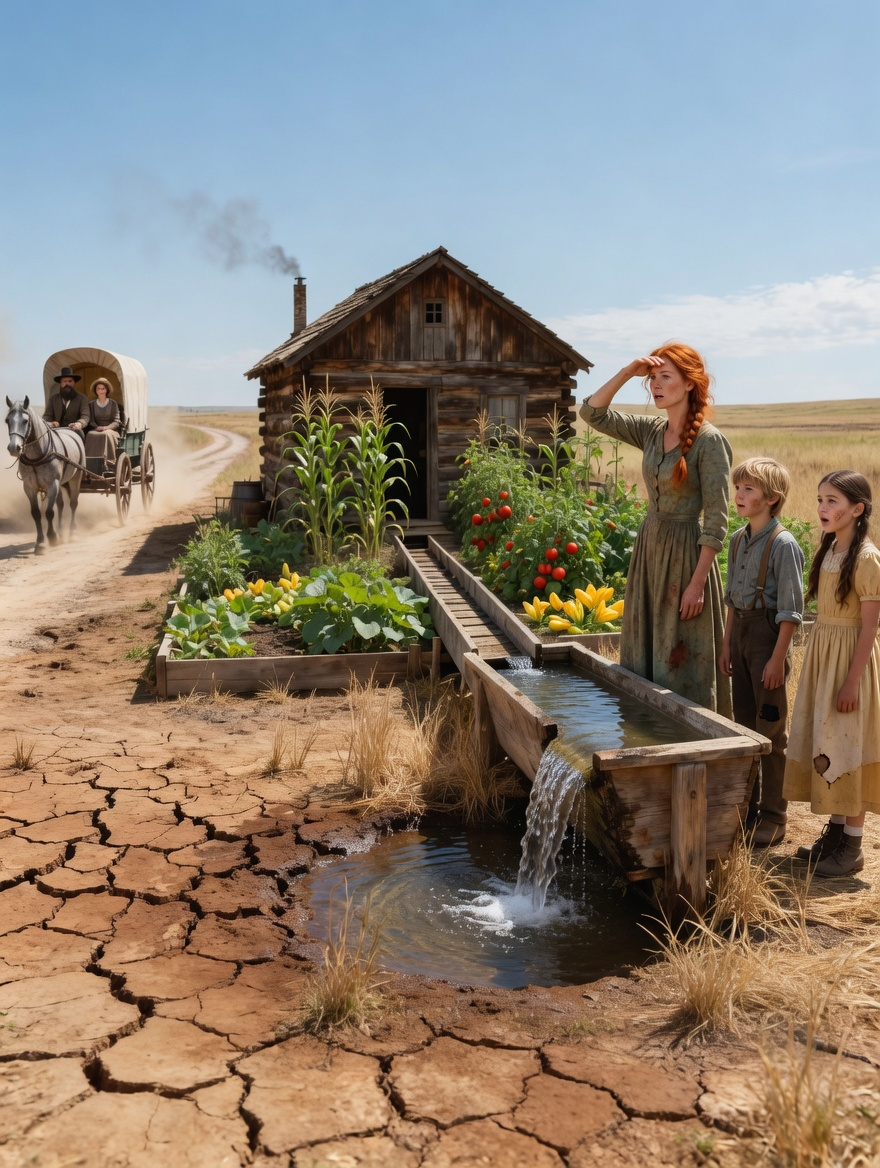
Far away, a covered wagon moved slowly across the horizon, pulled by a gray horse.
An elderly man sat at the reins.
Beside him was a woman wearing a dark bonnet.
They were too far away to speak to, but the sight of other travelers made Clara feel less alone.
Then the road turned.
And the cabin appeared.
Nils stopped pushing.
Maja sat upright.
Clara stood motionless.
The building was smaller than she had imagined.
Its dark logs had weathered unevenly, and the wooden shingles on the roof looked as though they had endured a hundred storms.
A narrow chimney rose from one side.
The front doorway stood open.
A small square window beneath the roofline stared out across the prairie like a tired eye.
The surrounding ground was cracked and bare.
But beside the cabin, something unexpected caught Clara's attention.
Green.
Not a few scattered weeds.
Not the pale green of struggling grass.
Deep, healthy green.
Tall corn stalks rose beside the wall.
Tomato vines sprawled across a neglected wooden garden bed.
Broad leaves covered the ground near the foundation.
Yellow squash rested beneath them.
Clara stared.
"That can't be right," she whispered.
Nils followed her gaze.
"Mama?"
She began walking faster.
The children hurried after her.
As they approached, Clara heard a sound.
Water.
Not wind.
Not insects.
Running water.
She rounded the corner of the cabin.
And stopped.
A long wooden channel extended from beneath the foundation.
Clear water flowed through it.
Steadily.
Continuously.
The channel ended above a shallow muddy pool, where the water spilled over the edge in a narrow stream.
Clara stared at it.
The land around the cabin was parched.
The grass was dead.
The road was powdery with dust.
Yet water was flowing from beneath the building as though the drought did not exist.
Nils came to stand beside her.
"Where's it coming from?"
Clara shook her head.
"I don't know."
Maja climbed down from the cart.
She approached the shallow pool and touched it with one boot.
"It's cold!"
"Don't go too close," Clara said.
Maja stepped back.
Nils crouched beside the wooden channel.
"Is this why nobody wanted the house?"
"Perhaps."
"But why would water be bad?"
Clara looked toward the open doorway.
"Let's find out."
She took Erik's pocketknife from her bag and held it at her side.
Then she stepped inside.
The smell surprised her.
She had expected rot.
Mold.
Stagnant water.
Instead, the air smelled of damp timber and clean earth.
Sunlight entered through gaps in the wall.
The cabin contained a stone fireplace, a narrow wooden shelf, a broken chair, and the remains of an old table.
Water covered much of the floor.
It was not deep.
Perhaps two or three inches in most places.
But it moved.
Clara could see it slipping between the floorboards.
The current traveled from the northwest corner toward the opposite wall, where it disappeared beneath the foundation.
Nils stood in the doorway.
"Mama… the house has water inside it."
Maja stepped past him.
Her boots splashed.
"It's cold!"
Clara watched the ripples spread around her daughter's feet.
Then she knelt.
She placed her palm flat against the water.
It was clear enough that she could see the grain of the wood beneath it.
She lifted her hand and smelled her fingers.
Nothing unpleasant.
No sulfur.
No decay.
No stagnant odor.
She watched a tiny fragment of leaf drift across the floor.
It moved steadily toward the eastern wall.
Clara's breathing slowed.
Something stirred in her memory.
A summer afternoon from her childhood.
Her grandmother sitting beneath an apple tree, shelling peas into a wooden bowl.
Clara had asked why the water in the stone trough behind their house never turned green.
Miriam had smiled.
"Because it doesn't sleep."
"What does that mean?"
"Still water can become sick, child. But water that moves is water that lives."
Clara had repeated those words for years without thinking about them.
Now, kneeling inside a ruined cabin, she heard her grandmother's voice as clearly as if the old woman stood beside her.
Water that moves is water that lives.
Clara rose slowly.
She looked toward the northwest corner.
The floorboards there were darker.
Water slipped through narrow spaces between them.
Not in random puddles.
In a consistent direction.
A steady current.
Nils watched her.
"What is it?"
Clara did not answer.
She crossed the room and knelt beside the corner.
The boards were old but solid.
Someone had once fitted them carefully around a rectangular opening.
She traced the edge with her fingers.
Then she noticed something else.
A small iron ring.
Almost hidden beneath the water.
She pulled.
Nothing happened.
She tried again.
The ring shifted slightly, but the wooden panel did not lift.
Nils hurried over.
"Can I help?"
"Yes. Bring me the shovel Mr. Mercer gave you."
He ran outside.
Clara examined the boards.
They were not ordinary floorboards.
The edges formed a square.
A removable panel.
A trapdoor.
When Nils returned, she slid the shovel's edge beneath the wood and gently applied pressure.
The panel lifted an inch.
A stronger stream of water pushed through the gap.
Maja gasped.
Clara stopped.
For a moment, she considered lowering it again.
The cabin was already flooded.
Opening the panel might make things worse.
But the water was moving.
And somewhere beneath that floor was the reason.
She looked at Nils.
"Stand back."
He obeyed.
Clara braced her feet and lifted the panel.
Water rushed around its edges.
Not violently.
Not like a burst pipe.
It rose with steady pressure, then spread across the floor.
Beneath the opening was a shallow stone-lined chamber.
The stones had been fitted together with remarkable care.
Clear water entered through a narrow passage in the earth.
Another passage carried it away.
Clara stared.
Someone had built this.
Someone had known the water was here.
And someone had designed the cabin around it.
Nils leaned closer.
"Is that a well?"
Clara shook her head.
"No."
"Then what?"
She reached into the water.
It was colder beneath the floor.
She felt smooth stones and a strong, continuous current.
Then she looked at the old wooden channel outside.
At the green vegetables.
At the cracked earth beyond the cabin.
And suddenly, everything made sense.
"It's a spring," she whispered.
Nils frowned.
"Like the creek?"
"Not exactly."
"Where does it come from?"
"From underground."
"How much water is there?"
Clara looked at the steady current.
"I don't know."
Maja crouched beside her.
"Can we drink it?"
Clara hesitated.
"We'll need to make sure it's safe first."
Nils looked toward the doorway.
"Does that mean we can grow food?"
Clara turned.
Through the open door, she could see the green corn moving in the breeze.
The tomatoes.
The squash.
The healthy leaves thriving in the middle of a drought.
Her heart began to pound.
"Yes," she said quietly. "I believe we can."
Nils smiled for the first time that day.
Maja clapped her hands.
"We can have purple flowers!"
Clara almost laughed.
But her attention returned to the stone chamber.
The water was flowing through a passage that someone had deliberately constructed.
Why had the previous owners abandoned it?
Why had people called the land worthless?
Why had nobody recognized the value of a reliable spring during years when neighboring farms struggled for water?
She remembered the clerk's words.
People tried blocking it.
Of course they had.
They had treated the water as an enemy.
They had tried to force it away.
But the original builder had done something different.
He had given it a path.
Clara carefully lowered the wooden panel.
Then she stepped outside.
The children followed.
She walked beside the channel, studying its construction.
The timber had darkened with age, but much of it remained sound.
Someone had cut shallow grooves along the inside to guide the current.
At the far end, the water spilled into a pool surrounded by damp soil.
Clara knelt and pressed her fingers into the earth.
Soft.
Cool.
Moist.
Only a few feet away, the ground was cracked hard as fired clay.
She picked up a stick.
Nils watched.
"What are you doing?"
"Thinking."
She drew a line in the dirt from the channel toward the nearest vegetable bed.
Then another line toward the open ground beyond it.
Nils crouched beside her.
"Are those roads?"
"Water paths."
"Like little rivers?"
"Exactly."
She drew another line.
"And if we guide the water carefully, we may be able to grow more than what's already here."
Nils studied the drawing.
"Even when it doesn't rain?"
"Especially then."
Maja sat beside them.
"Can I help?"
Clara handed her a second stick.
"Draw where you want your flowers."
Maja immediately began making crooked circles.
Nils laughed.
"Those aren't flowers."
"They will be."
Clara watched them.
For the first time since Erik's funeral, she felt something other than grief or fear.
Not happiness.
Not yet.
Something quieter.
Possibility.
She looked toward the cabin.
The walls needed repair.
The roof required attention.
The floor had to be raised or drained properly.
They had no furniture, no livestock, no tools beyond a shovel and a pocketknife, and almost no food.
But they had land.
They had water.
And they had one another.
Clara stood.
"We need to make a place to sleep before dark."
The children helped carry their belongings inside.
She found a section of floor near the fireplace that remained mostly dry.
They spread the blanket there.
Nils collected loose pieces of wood from behind the cabin.
Clara checked the chimney carefully before building a small fire.
Smoke rose through the flue.
The room began to warm.
They ate two potatoes roasted in the ashes and shared the last apple.
Maja fell asleep with her doll tucked beneath her chin.
Nils remained awake.
He sat beside Clara, watching the fire.
"Mama?"
"Yes?"
"Do you think Grandmother knows about the spring?"
Clara considered the question.
"I don't know."
"Would she have let us come here if she knew?"
Clara looked at the flames.
"Your grandmother believed this land was worthless."
"Maybe she was wrong."
Clara turned toward him.
"Yes," she said. "Maybe she was."
Nils looked pleased.
Then his expression became serious.
"Papa used to say you were the smartest person he knew."
Clara felt a sudden ache.
"He was being kind."
"No, he wasn't."
Nils shook his head.
"He said you could see things other people missed."
Clara looked away.
Her eyes burned.
Nils continued.
"He said that was why he married you."
A tear slipped down Clara's cheek before she could stop it.
She wiped it away.
Then she put her arm around her son.
"Your father was a very good man."
Nils leaned against her.
"I miss him."
"So do I."
They sat together until the fire burned low.
Outside, the water continued flowing.
Steady.
Patient.
Uninterrupted.
Later, when both children were asleep, Clara took the deed from her bag.
She unfolded it beside the fire.
The words on the back were still there.
Northwest foundation. Do not seal.
She studied the faded handwriting.
Then she looked toward the trapdoor.
The chamber beneath it had clearly been built by someone who understood the spring.
Perhaps Jonas Lindquist.
Perhaps her grandmother had helped him.
But why had they left so little explanation?
Clara remembered Silas Mercer's warning.
Don't let anybody convince you to sell it.
And his strange remark about Jonas.
Some men wanted something he wasn't willing to give them.
She turned the deed over.
The firelight caught the paper at an angle.
There, near the lower edge, she noticed a faint indentation.
Not ink.
An impression left by writing on another sheet.
She brought the document closer to the flames.
Carefully, she tilted it.
A few letters became visible.
Then a number.
Then another word.
Clara held her breath.
The impression appeared to read:
Second channel — eastern ridge.
She stared.
Second channel?
The water beneath the cabin already seemed substantial.
If another channel existed, where did it lead?
She looked toward the dark window.
Beyond it stretched forty acres of land.
Most of it dry.
Most of it unexplored.
And somewhere beneath that ground, there might be more water than anyone imagined.
Clara folded the deed.
She would investigate in the morning.
For now, the children needed rest.
She added one last piece of wood to the fire and lay beside them.
But sleep came slowly.
Every time she closed her eyes, she saw her grandmother's name.
Miriam Lindquist.
She remembered the old woman's stories about rivers beneath mountains and springs that never froze.
Stories Clara had once believed were merely lessons disguised as fairy tales.
Now she wondered whether her grandmother had been trying to tell her something.
Near midnight, the wind changed.
The cabin creaked.
Clara opened her eyes.
The fire had burned down to embers.
The children were sleeping.
Water whispered beneath the floor.
Then she heard another sound.
A horse.
She sat up.
The sound came again.
Hooves moving slowly over hard ground.
Clara reached for Erik's pocketknife.
Through the small window, she saw a faint shape approaching along the road.
A rider.
Alone.
The horse stopped near the garden.
Clara held her breath.
The rider dismounted.
For several seconds, the figure stood motionless, studying the cabin.
Then a lantern flared.
Its light revealed a man wearing a dark coat and a broad-brimmed hat.
He walked toward the wooden water channel.
Knelt.
Touched the water.
Then stood abruptly.
Clara watched from the darkness.
The man turned toward the cabin.
He seemed to know exactly where to look.
His gaze settled on the northwest corner.
Clara's grip tightened around the knife.
Then the stranger reached into his coat and withdrew a folded paper.
He opened it beneath the lantern.
Even from the window, Clara could see that it was a map.
The man studied it.
Looked toward the cabin.
Then looked toward the eastern ridge.
Clara felt her stomach tighten.
The second channel.
Was that what he was searching for?
She stepped away from the window.
Nils stirred behind her.
"Mama?"
"Go back to sleep."
"What's wrong?"
"Nothing. Stay with your sister."
Clara moved toward the door.
She did not intend to confront the stranger.
She only wanted to secure the entrance.
But before she reached it, the man called out.
"Mrs. Reinhold?"
Clara froze.
He knew her name.
She had purchased the property only that morning.
How could a stranger already know where to find her?
"Mrs. Clara Reinhold," he called again.
His voice was low and controlled.
"I know you're inside."
Clara did not answer.
The man approached the doorway.
His boots stopped just beyond the threshold.
"I need to speak with you about the land."
Clara remained still.
The stranger waited.
Then he said something that made the blood turn cold in her veins.
"Your grandmother left something here."
Clara stared at the door.
The man continued.
"Something she never intended the Hargroves to find."
A floorboard creaked beneath Clara's foot.
Outside, the stranger fell silent.
Then he reached for the door.
Clara lifted the knife.
The latch began to move.
And from the darkness beyond the threshold, the stranger whispered a name she had not heard since her grandmother's funeral.
"Miriam told me you would come."






Comments 0