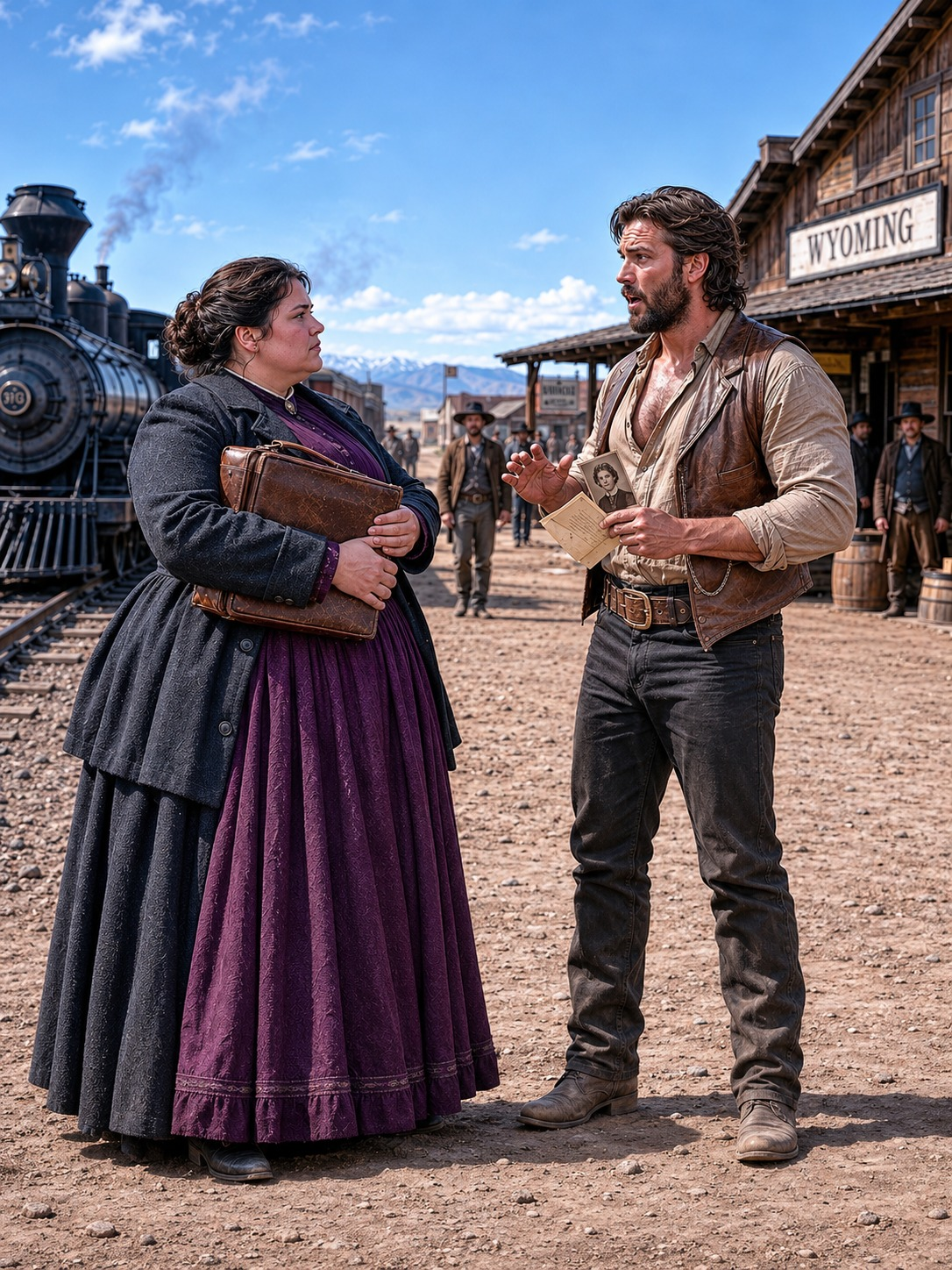
"Keep your hands off those papers, woman."
Caleb Rourke stood in the kitchen doorway, his boots leaving muddy tracks across the floor Martha had scrubbed only an hour earlier.
Martha calmly folded the invoice she had been examining.
"Good morning, Mr. Rourke."
"I asked what you're doing."
"And I heard you."
Caleb stepped farther into the room.
He was carrying a coil of rope over one shoulder, but his attention remained fixed on the small stack of receipts beside Martha's notebook.
"Those are ranch records."
"They are household supply receipts."
"Same difference."
"Not to a person responsible for keeping the household supplied."
Caleb's jaw tightened.
For a moment, Martha thought he might reach across the table and snatch the papers from her hands.
Instead, he smiled.
It was the kind of smile that made a person instinctively check whether the door behind them was locked.
"You're new here, Mrs. Higgins. Maybe nobody's explained how things work."
"Then by all means, explain."
"Josiah runs the cattle. I run the men. You run the kitchen."
"An admirably simple arrangement."
"Keep it that way."
Martha looked directly into his pale eyes.
"Is that advice, Mr. Rourke, or an instruction?"
His smile disappeared.
"Take it however you like."
He turned and walked out.
Martha waited until his footsteps faded.
Then she opened her notebook and wrote three words beneath the list of missing supplies.
Caleb Rourke. Investigate.
She underlined them once.
Not twice.
Her father had always said that unnecessary emphasis was the refuge of people who lacked evidence.
Martha preferred evidence.
And she intended to find some.
By the end of her first week at Broken Ridge, Martha had learned more about the ranch than Josiah realized.
She knew which workers rose before dawn and which lingered in their bunks until the breakfast bell rang.
She knew Samuel Boone had a bad knee, that Peter Boone hated onions, and that Thomas Bell could no longer lift heavy feed sacks without considerable pain.
She knew young Eli Turner sent half his wages to a widowed mother in Nebraska.
And she knew that Caleb Rourke seemed to have an extraordinary amount of money for a man whose employer was struggling to pay wages.
His boots were new.
His saddle was expensive.
He wore a silver watch chain that would have cost more than a ranch hand earned in several months.
Most troubling of all, he appeared to spend very little time actually supervising the cattle.
Martha noticed these things while doing exactly what Josiah had hired her to do.
She cooked.
She cleaned.
She organized the pantry.
She washed bedding that had not seen proper soap in months.
And she listened.
People were remarkably careless about what they said around a woman they considered unimportant.
Especially when that woman was large, middle-aged by the standards of fashionable society, and occupied with a bucket of soapy water.
On Thursday morning, while Martha scrubbed the dining room floor, Samuel Boone and Thomas Bell entered through the back door.
They hadn't noticed her behind the half-open pantry door.
"Another three head down near the south pasture," Samuel said.
Thomas sighed.
"That makes eight this month."
"Boss knows?"
"Caleb says he told him."
"Funny thing."
"What?"
"Those cattle were healthy last week."
Thomas lowered his voice.
"Keep that to yourself."
"Why?"
"Because men who ask too many questions around here have a habit of finding themselves unemployed."
Martha stopped scrubbing.
Samuel muttered something she couldn't hear.
Then the men left.
She remained motionless for several seconds.
Eight cattle.
Possibly more.
At current prices, even a small number of lost animals represented serious money.
And Josiah's ranch was already in trouble.
She set down the brush.
For the first time since arriving in Wyoming, Martha wondered whether the disorder at Broken Ridge was not simply the result of neglect.
Perhaps someone was making certain the ranch failed.
That evening, Josiah came home with blood on his sleeve.
Martha saw it as he entered the kitchen.
"You're injured."
"It's nothing."
"Sit down."
He looked at her.
"Mrs. Higgins—"
"Your sleeve is bleeding."
"It's a scratch."
"Then it will take very little time to clean."
He stared at her for a moment.
Then, with the weary resignation of a man who had spent the day arguing with stubborn animals, he sat.
Martha fetched warm water, clean cloth, and a small bottle of spirits.
She rolled back his sleeve.
The cut was shallow but ugly.
"What happened?"
"Broken fence wire."
"Which pasture?"
"South."
Her hands paused.
"Is that where the cattle have been getting sick?"
Josiah looked up sharply.
"Who told you that?"
"No one."
"Then how do you know?"
"I've noticed their condition."
He leaned back.
"You're here to manage the house."
"And the house depends upon the ranch."
"That's my concern."
Martha resumed cleaning the wound.
"Very well."
Her calm agreement seemed to irritate him more than an argument would have.
"You think I don't know my own cattle?"
"I haven't said that."
"You think some woman from Philadelphia can tell me how to run a ranch?"
"No."
"Then what?"
Martha tied the bandage.
"I think you're exhausted, Mr. Higgins."
He fell silent.
She continued gently.
"I think you're trying to manage too many problems with too little help. And I think you're so accustomed to people disappointing you that you've forgotten how to recognize assistance when it's offered."
Josiah stared at her.
For a moment, the hard expression left his face.
He looked older.
Not forty-two.
Fifty, perhaps.
A man worn down by years of disappointment.
"My mother used to say things like that," he murmured.
Martha lowered her eyes.
"She sounds like a sensible woman."
"She was."
He looked toward the darkened hallway.
"She kept this place running. Better than I ever could."
"Then perhaps she understood something you haven't yet learned."
"What's that?"
"That a ranch is more than cattle."
Josiah said nothing.
Martha finished securing the bandage.
"There. Try not to tear it open again."
He rose slowly.
At the doorway, he paused.
"That bread you made yesterday."
"Yes?"
"Best I've had since Ma died."
Martha looked up.
But he had already gone.
The second week brought the first frost.
Martha woke to find the kitchen windows edged with delicate white crystals.
The garden behind the house looked hopeless.
Weeds covered the planting beds.
The soil had hardened.
The wooden fence leaned badly.
But beneath the dead vines, Martha discovered several surviving rows of carrots, onions, and late potatoes.
She also found an old rain barrel, a rusted watering can, and a stack of gardening tools beneath the porch.
Thomas Bell watched her examine the ground.
"That garden hasn't been worth much since Mrs. Higgins passed."
"Who tended it afterward?"
"Nobody regular."
"Why not?"
Thomas shrugged.
"Men figured it wasn't important."
Martha looked toward the kitchen.
"Vegetables cost money."
"That's true."
"And transporting them from town costs more."
"Also true."
"Then a garden that produces food is important."
Thomas smiled.
"Reckon it is when you put it that way."
She pointed toward the broken fence.
"Could it be repaired?"
"Sure. With a little lumber."
"Would you help me?"
Thomas hesitated.
"Caleb doesn't like us working on anything but cattle."
"Does Caleb own the ranch?"
"No, ma'am."
"Then I believe Mr. Higgins can decide whether his household garden deserves a fence."
Thomas chuckled.
"You're something else, Mrs. Higgins."
Martha bent to examine a surviving carrot.
"I've been told."
By the end of the second week, the kitchen had changed completely.
The shelves were organized.
Every sack and barrel had been inspected.
Food was measured carefully.
Leftovers became soup rather than waste.
Martha began preparing weekly menus, allowing her to purchase only what the household needed.
She introduced a simple system for recording supplies.
Nothing left the pantry without being noted.
Nothing entered without being counted.
At first, the ranch hands complained.
Then they noticed something unexpected.
The meals improved.
There was fresh bread almost every morning.
The coffee was stronger.
The stew contained more meat.
And somehow, despite all that, the household was spending less.
Josiah noticed too.
One Sunday evening, he found Martha seated at the kitchen table, calculating expenses.
"What's that?"
"The household accounts."
He glanced at the page.
"Looks complicated."
"Not particularly."
She turned the notebook toward him.
"Your household spent thirty-eight dollars less this week than it did during the same period last month."
Josiah frowned.
"How?"
"Less waste. Better purchasing. Accurate portions."
"Thirty-eight dollars?"
"Thirty-eight dollars and forty-six cents."
He stared at the figures.
"That's nearly two weeks' wages for one of the men."
"Yes."
Josiah pulled out a chair.
For the first time, he sat beside her voluntarily.
"Show me."
Martha did.
She explained the spoiled flour, the unnecessary coffee orders, the missing deliveries, and the savings achieved by preparing meals more efficiently.
Josiah listened.
He asked questions.
Real questions.
Not the dismissive challenges she had come to expect.
When she finished, he remained quiet.
Then he said, "You did all this in two weeks?"
"I had very little else to occupy my evenings."
He laughed.
It was a sudden, genuine sound.
Martha looked at him in surprise.
Josiah shook his head.
"You're a strange woman, Martha Caldwell."
"Mrs. Higgins," she corrected mildly.
His smile faded into something more thoughtful.
"Right."
He looked at her.
"Mrs. Higgins."
It was the first time he had spoken her married name without making it sound like an administrative inconvenience.
That night, Caleb Rourke returned from town after dark.
Martha heard his horse before she saw him.
She was closing the kitchen shutters when he rode into the yard.
Another rider accompanied him.
The stranger wore a dark coat and carried the same leather document case Martha had noticed during her first morning at Broken Ridge.
The men stopped beside the barn.
Martha remained behind the curtain.
Caleb dismounted.
The stranger stayed on his horse.
"He's getting suspicious," Caleb said.
"Of what?"
"The losses."
"Then make sure he stays confused."
Caleb spat into the dirt.
"That woman isn't helping."
The stranger's head turned.
"What woman?"
"The bride. She's been counting everything."
A pause followed.
Then the stranger asked, "Counting what?"
"Supplies. Bills. Deliveries."
"Has she seen the main ledger?"
"Not that I know."
The stranger leaned forward.
"Then keep it that way."
Martha felt a cold sensation settle in her stomach.
She had suspected dishonesty.
Now she knew someone was actively concealing information.
The stranger continued.
"The bank is growing impatient."
"Tell them to wait."
"They've waited long enough."
"Josiah's nearly finished."
"Not nearly enough."
Caleb looked toward the house.
"What about the woman?"
The stranger's voice dropped.
"Find out what she knows."
Martha stepped back from the window.
Her heart was beating hard.
She waited until the horses moved away before closing the shutter.
Then she sat at the kitchen table and opened her notebook.
She wrote down every word she could remember.
She recorded the approximate time.
The stranger's clothing.
The direction from which he had arrived.
The fact that Caleb appeared to know him well.
Then she added another observation.
The stranger had spoken about the bank as though he represented it.
But why would a bank official meet secretly with a ranch foreman after dark?
On Monday, Martha began asking questions.
Carefully.
She started with Eli Turner.
The young ranch hand was helping carry firewood into the kitchen.
"Eli, may I ask you something?"
"Of course, ma'am."
"Who keeps track of the cattle sold from Broken Ridge?"
"Mr. Higgins, mostly."
"And Mr. Rourke?"
"He handles the drives."
"Does he prepare the sales receipts?"
"Sometimes."
"Who delivers the money?"
Eli hesitated.
"Depends."
"On what?"
"Who's buying."
Martha placed another log beside the stove.
"Have you noticed anything unusual about the cattle lately?"
Eli's face changed.
"What do you mean?"
"Sickness. Poor condition. Missing animals."
He glanced toward the door.
"Ma'am, I don't think I ought to—"
"Eli."
He looked at her.
"I'm not asking you to accuse anyone."
The young man swallowed.
"Some of the cattle go missing before they're counted."
"How many?"
"I don't know."
"Approximately?"
"Maybe twenty. Maybe more."
Martha kept her expression calm.
"Over what period?"
"Since summer."
"Have you told Mr. Higgins?"
"Caleb says he handles it."
"And do you trust Caleb?"
Eli stared at the floor.
That was answer enough.
The following afternoon, Josiah rode into town to meet a supplier.
Caleb and the Boone brothers were working the north pasture.
Thomas was repairing a stable door.
For the first time since arriving, Martha found herself alone inside the house.
She had already finished the kitchen.
The parlor was clean.
The bedrooms were aired.
There was no urgent household task remaining.
She stood in the hallway.
At the far end, Josiah's study door was slightly open.
Martha remembered his instruction.
Stay out of my business.
She also remembered the sick cattle.
The missing supplies.
The mysterious stranger.
The whispered warning about the main ledger.
She approached the study.
The room smelled of old paper, tobacco, and leather.
Dust covered the shelves.
Stacks of invoices leaned precariously across the desk.
A heavy oak chair stood beneath the window.
Martha began cleaning.
She dusted the shelves.
Straightened the books.
Gathered loose papers into careful piles without disturbing their order.
Then a receipt slipped from beneath a leather-bound volume.
It floated to the floor.
Martha bent and picked it up.
The heading read:
BILL OF SALE — SIXTY HEAD OF CATTLE.
Buyer: Harlan & Pike Trading Company.
Destination: Omaha, Nebraska.
Date: October 16, 1883.
Martha frowned.
October 16.
Three days earlier.
She knew the date because she had been keeping careful household records since arriving.
No cattle drive had left Broken Ridge that week.
No large shipment had been prepared.
And sixty cattle could not simply disappear without someone noticing.
She examined the signature.
Caleb Rourke.
Then she noticed another name.
Josiah Higgins.
The ranch owner's signature appeared beneath Caleb's.
Martha held the paper closer to the light.
Something was wrong.
She had seen Josiah's handwriting on household notes, supply requests, and a letter left beside the kitchen stove.
His capital H was distinctive.
It began with a sharp upward stroke.
The signature on this receipt had no such stroke.
It was a careful imitation.
But not a perfect one.
Martha sat slowly in Josiah's chair.
She opened the heavy leather-bound ledger resting on the desk.
Page after page contained cattle purchases, feed expenses, bank payments, and sales records.
The figures were untidy.
Some entries had been crossed out.
Others were written over.
Several pages appeared to have been removed.
Martha turned back to the beginning of the year.
She compared the sales figures with the receipt in her hand.
Then she found something that made her stop breathing for a moment.
The same sixty cattle had already been recorded as sold.
Six weeks earlier.
To a different buyer.
For a different amount.
Martha checked the dates again.
Then she checked the signatures.
Two sales.
The same cattle.
Two payments.
One ranch.
She reached for her notebook.
At that exact moment, a floorboard creaked behind her.
Martha looked up.
The study door was closing.
And someone was turning the key from the outside.






Comments 0