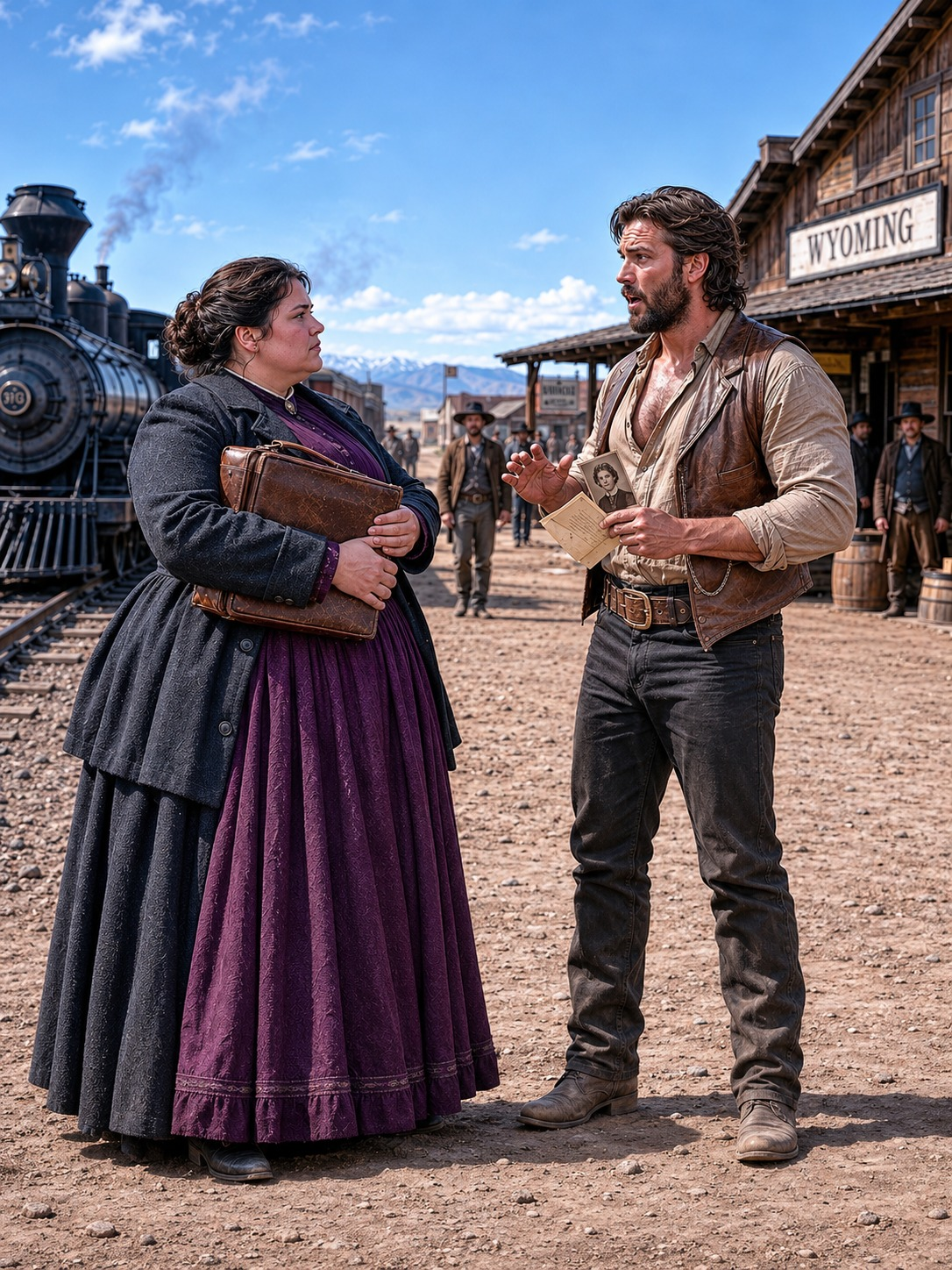
"Get that woman off my train!" the conductor shouted.
Josiah Higgins stepped forward with a folded railway ticket in his hand.
Someone had written two words across its back.
RETURN FARE.
Martha Caldwell looked at the ticket.
Then she looked at the man who had paid for her journey.
She wasn't going anywhere.
The conductor's face reddened as several passengers turned to watch.
"I said, clear the steps, ma'am. Other folks need to get off."
Martha Caldwell stood at the bottom of the iron railway steps, one gloved hand gripping the handle of a battered leather suitcase. Her dark purple dress had gathered dust during the long journey from Philadelphia, and the charcoal wool coat stretched across her broad shoulders was plainly made for warmth rather than fashion.
She had spent four days traveling west.
Four days enduring narrow seats, uncomfortable glances, whispered jokes, and the particular cruelty of strangers who believed a large woman must also be deaf.
Now, standing on the wooden platform of a Wyoming railway station in October 1883, she discovered that the man who had summoned her across half a continent was staring at her with the same expression she had seen on a hundred other faces.
Disappointment.
Josiah Higgins was taller than she expected.
His weathered brown vest hung over a cream-colored work shirt, and his dark beard was streaked with dust. He wore a battered Stetson, worn boots, and the exhausted expression of a man who had forgotten what a full night's sleep felt like.
He held the folded ticket between two fingers.
"Miss Caldwell?"
"Mr. Higgins, I presume?"
His eyes moved briefly over her figure.
Martha saw it.
Of course she saw it.
She had spent thirty years learning to recognize that particular glance.
It was the quick assessment of her weight, followed by the assumption that her body revealed everything worth knowing about her character.
"You're not quite what I pictured," Josiah said.
Martha tightened her grip on her suitcase.
"I am aware."
Behind them, a woman in a brown bonnet gave a sharp little laugh.
Martha didn't turn.
Josiah removed his hat, then put it back on.
"I need someone who can manage a large house. Cooking, cleaning, laundry. There are six men working the ranch, sometimes more. The work isn't easy."
"I read your advertisement."
"It's twelve miles outside town."
"I read that as well."
"Winters are hard."
"So I've been told."
Josiah studied her.
"You understand what I'm saying?"
"Perfectly."
Martha paused.
"You believe my size makes me incapable of doing the work."
The woman behind them stopped laughing.
Josiah's jaw tightened.
"I didn't say that."
"No," Martha replied. "You were considerably more polite."
A railway worker nearby coughed into his sleeve.
Martha continued, her voice even.
"My letters promised a woman capable of organizing your household, managing provisions, and enduring the isolation of ranch life. I made no promises regarding the circumference of my waist."
Josiah looked away.
She gave him a moment.
Then she said, "If you are dissatisfied, I can return to Philadelphia on the morning train, provided you purchase the ticket."
That silenced him.
The truth was that Josiah Higgins could barely afford the ticket that had brought her west.
Broken Ridge Ranch, once one of the most promising cattle operations outside Laramie, was sinking beneath a mountain of debt.
Three brutal winters, falling cattle prices, and a string of mysterious losses had brought him close to ruin.
He needed someone to restore order to the ranch house.
He needed someone who wouldn't demand expensive dresses, social visits, or a life he could no longer provide.
He had advertised for a practical wife willing to manage his home.
Martha Caldwell's letters had been precise, intelligent, and refreshingly free of romantic nonsense.
He had imagined a thin, middle-aged spinster with nervous hands and a grateful disposition.
Instead, he had received a woman whose calm gaze made him feel as though he were the one being interviewed.
"The wagon's this way," he finally muttered.
He reached for her suitcase.
Martha hesitated, then released it.
The case was heavier than he expected.
"What have you got in here? Bricks?"
"Books."
Josiah glanced at her.
"Books?"
"Among other things."
He grunted and started walking.
Martha followed.
Behind them, the woman in the brown bonnet leaned toward the railway clerk.
"Abigail Thatcher," she whispered, identifying herself as though her name carried official authority. "I own the mercantile. And I give that marriage three weeks."
The clerk watched Martha cross the platform.
"Why?"
Abigail pursed her lips.
"Because Josiah Higgins needs a ranch wife, not a Philadelphia parade float."
She laughed at her own joke.
Neither noticed Martha pause beside the waiting wagon.
Neither noticed that she had heard every word.
And neither could have guessed how thoroughly they would come to regret underestimating her.
The twelve-mile ride to Broken Ridge Ranch was miserable.
The wagon's wooden wheels struck every rut in the road.
Each jolt sent pain through Martha's lower back.
She kept her hands folded in her lap and refused to complain.
Josiah drove without speaking.
The land stretched around them in long, rolling waves of golden grass. Far beyond the plains, mountains rose beneath the pale autumn sky.
Martha had never seen so much open country.
In Philadelphia, buildings crowded against one another, and even the wealthiest families lived within shouting distance of their neighbors.
Here, a person might scream for help and receive no answer but the wind.
She found the thought strangely comforting.
After nearly an hour, Josiah broke the silence.
"Ever lived on a ranch?"
"No."
"Ever handled cattle?"
"No."
"Ever cooked for a dozen hungry men?"
"Not a dozen."
He gave her a sideways glance.
"Then what exactly qualifies you?"
Martha looked toward the distant mountains.
"My father owned a mercantile business in Philadelphia. By fifteen, I was managing his accounts. By twenty, I was overseeing inventory, suppliers, payroll, and deliveries."
Josiah shifted on the wagon seat.
"That's not ranch work."
"No. But feeding people, organizing supplies, and preventing waste are not exclusively urban accomplishments."
He said nothing.
"My father believed a business survived on three things," Martha continued. "Honest records, careful management, and knowing when someone was lying to you."
Josiah gave a humorless chuckle.
"Sounds like a smart man."
"He was."
"What happened to him?"
"He died."
Josiah glanced at her.
"I'm sorry."
"Thank you."
Martha looked down at her hands.
She could have told him more.
She could have explained how her father's creditors had arrived before the funeral flowers wilted.
How men who had praised her father's intelligence suddenly treated his daughter as though she could barely count.
How they had persuaded a grieving woman to sign documents she had not been permitted to examine.
How she had eventually discovered that several debts had been inflated, others invented, and at least one signature forged.
But that story belonged to Philadelphia.
She had come west to escape it.
At least, that was what she told herself.
Broken Ridge Ranch appeared shortly before sunset.
Martha saw the house first.
It stood on a low rise, a sprawling two-story structure with a wide porch and weathered white paint.
Behind it stood a barn, a blacksmith shed, several corrals, and a cluster of smaller buildings.
The property must once have been impressive.
Now the fences leaned at awkward angles.
A broken wagon wheel lay beside the barn.
The garden behind the house had disappeared beneath weeds.
Several cattle stood near a water trough, their ribs showing beneath dull coats.
Martha noticed the animals immediately.
She also noticed the trough.
It was barely half full.
"Is there a water shortage?" she asked.
Josiah's shoulders stiffened.
"Why?"
"The cattle."
"We've had a dry season."
"I see."
But she continued watching the animals.
Something about their condition troubled her.
The ranch house was worse.
When Josiah opened the front door, Martha was greeted by the smell of stale grease, damp wool, and old ashes.
Dust covered the mahogany furniture.
Mud had dried across the Persian rug.
A cracked plate sat beneath a chair.
The fireplace contained enough ash to suggest it had not been properly cleaned in months.
Martha stood in the doorway.
Josiah watched her expression.
"Well?"
She looked toward the kitchen.
"Where are your cleaning supplies?"
For the first time that afternoon, he appeared genuinely surprised.
"Kitchen cupboard, I suppose."
"And the pantry?"
"Through there."
"How many men eat here regularly?"
"Six, including me. More during roundups."
"Any dietary restrictions?"
Josiah stared at her.
"Any what?"
"Foods they cannot eat."
"Not unless you count vegetables."
Martha nodded.
"Then I should like to inspect the kitchen before supper."
Josiah removed his hat.
"There's something else."
She waited.
"This arrangement is practical. I want that understood."
"So do I."
"I didn't send for romance."
"Neither did I."
His mouth opened slightly.
Martha continued.
"You need a household manager. I need honest employment and a respectable home. Marriage provides the legal and social arrangement necessary for both. I believe we understand one another."
Josiah looked almost offended by how little she appeared to expect from him.
"Fine."
"Fine."
"The parlor is yours," he said. "Keep the house, cook the meals, and stay out of my business."
Martha looked toward a half-open door at the end of the hallway.
Beyond it stood a desk buried beneath papers.
"Your business?"
"The ranch accounts. The cattle. The bank. None of that concerns you."
"Understood."
He turned toward the door.
"One more thing."
"Yes?"
"Don't expect the men to make things easy."
Martha removed her gloves.
"I rarely expect strangers to be kind, Mr. Higgins."
Something in her tone made him look back.
But she had already turned toward the kitchen.
The ranch hands met Martha that evening.
There was Caleb Rourke, the foreman, a broad-shouldered man with pale eyes and a smile that never quite reached them.
There was young Eli Turner, barely nineteen, whose nervous manner suggested he had not yet grown accustomed to the harshness of ranch life.
There were brothers Samuel and Peter Boone, experienced cattlemen with weathered faces.
And there was Thomas Bell, an older stable hand who walked with a slight limp.
Caleb was the first to speak.
"So you're the bride."
Martha placed a pot of stew on the table.
"Mrs. Higgins, yes."
He looked her up and down.
"Well, I'll be damned."
Eli lowered his eyes.
Caleb laughed.
"Boss, you sure the railway didn't charge extra freight?"
The Boone brothers exchanged uncomfortable glances.
Josiah's face darkened.
"That's enough, Caleb."
But Martha simply placed the serving spoon beside the pot.
"Mr. Rourke, is it?"
"That's right."
"Then I hope your appetite is as impressive as your manners."
Eli nearly choked on his water.
Caleb's smile vanished.
Martha sat down.
"Please eat before the stew gets cold."
For several moments, nobody moved.
Then Thomas Bell picked up his spoon.
"Smells mighty fine, ma'am."
"Thank you, Mr. Bell."
Within minutes, the room filled with the sounds of hungry men eating.
The stew was simple.
Beef, potatoes, onions, carrots, and a little barley.
But it was seasoned properly.
The bread was fresh.
And for the first time in months, the table had been wiped clean before anyone sat down.
Josiah noticed.
He said nothing.
Martha worked until midnight.
She washed the dishes, swept the kitchen, inspected the pantry, and made a list of everything the household lacked.
She found three sacks of flour infested with insects.
Two barrels of salted meat had been improperly sealed.
A crate of potatoes was rotting beneath the stairs.
The kitchen shelves contained enough wasted provisions to feed the entire household for weeks.
She sat at the kitchen table with a pencil and a small notebook.
By the time she finished her calculations, she had identified nearly forty dollars in preventable losses.
Forty dollars.
In Philadelphia, it would once have seemed a modest sum.
Here, judging by the condition of the ranch, it might mean the difference between survival and foreclosure.
She closed the notebook.
Upstairs, the house settled around her.
A floorboard creaked.
Then another.
Martha looked toward the hallway.
Josiah stood near the study door, holding an oil lamp.
"You're still awake?"
"Clearly."
"What are you writing?"
"A household inventory."
He frowned.
"At midnight?"
"I prefer to know what I have before deciding what I need."
He looked at the notebook.
"Seems like a lot of trouble for a kitchen."
Martha smiled faintly.
"A kitchen is a business, Mr. Higgins. It simply has fewer customers and more complaints."
For the first time, his mouth twitched.
It wasn't quite a smile.
But it came close.
"Don't stay up too late," he said.
Then he disappeared into his study.
Martha watched the door close.
A moment later, she heard him unlock a drawer.
Papers rustled.
Then came a sound she recognized immediately.
The unmistakable sigh of a man staring at numbers he could no longer bear to face.
The next morning, Martha rose before sunrise.
She baked bread, prepared breakfast, and began sorting the pantry.
By noon, she had discovered that someone had been ordering twice as much coffee as the ranch actually consumed.
She also found several receipts for supplies that had never arrived.
At first, she assumed carelessness.
Then she examined the dates.
The same supplier appeared repeatedly.
Harlan & Pike Trading Company, Cheyenne.
The handwriting on the receipts was unusually consistent.
So were the quantities.
Martha frowned.
She had seen that kind of pattern before.
In her father's mercantile, repeated identical invoices had once exposed an employee who was charging the business for deliveries that never existed.
She placed the receipts in a neat stack.
Then she heard voices outside the kitchen window.
Caleb Rourke stood near the barn, speaking to a stranger in a dark coat.
The stranger carried a leather document case.
Martha couldn't hear everything.
But she heard enough.
"The woman arrived yesterday," Caleb said.
The stranger answered quietly.
"Does she know anything?"
Caleb laughed.
"She's a housekeeper. Nothing more."
The stranger looked toward the house.
"Make certain of it."
Martha stepped away from the window.
Her pulse quickened.
She looked down at the receipts in her hand.
Then she heard the stranger speak again.
This time, his words carried clearly through the open window.
"Because if she finds the old accounts, we're finished."
Martha slowly turned toward Josiah's locked study.
Someone was afraid of what she might discover.
And that someone already knew she was here.






Comments 0