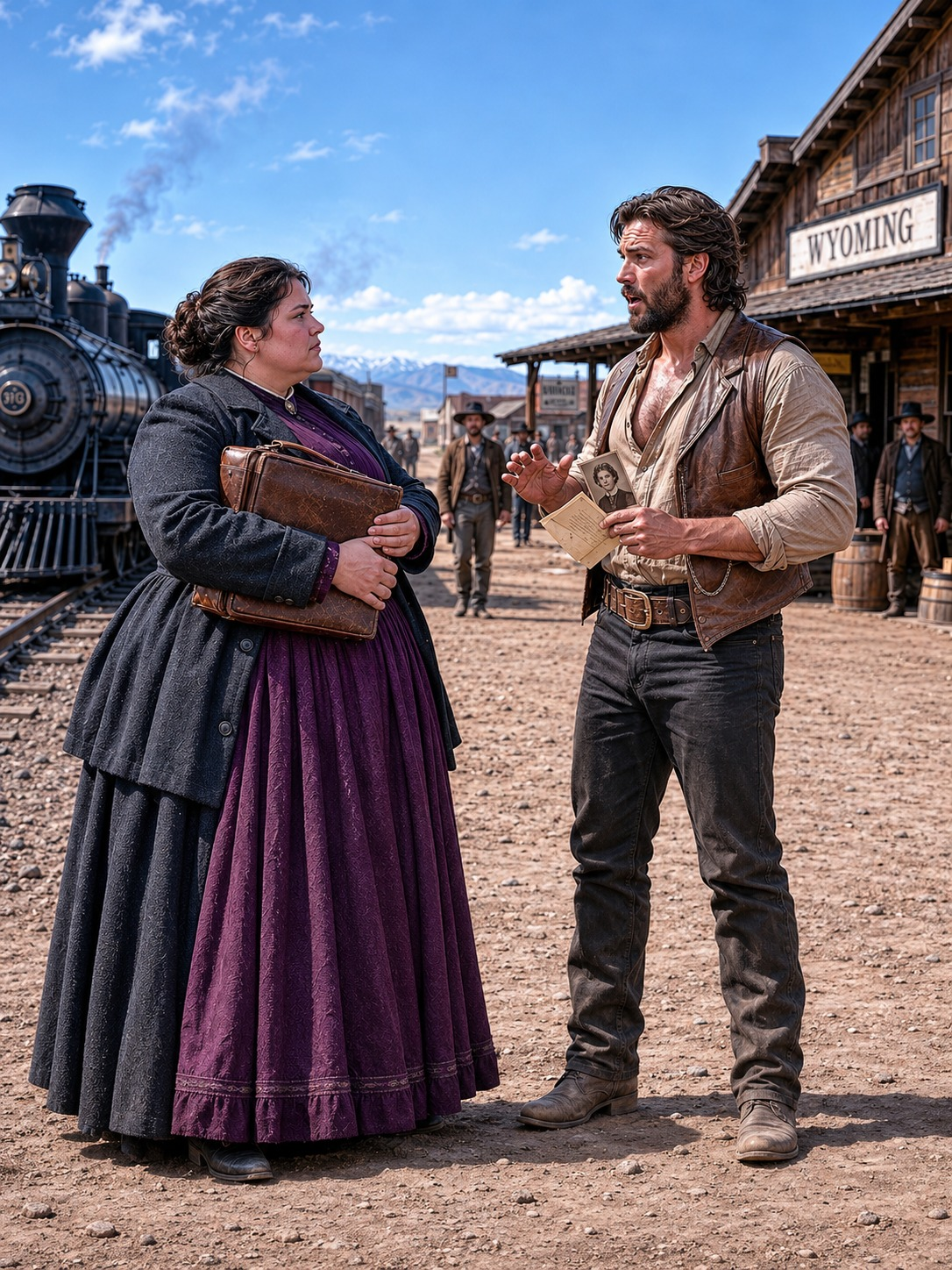
The key turned once.
Then twice.
Martha Caldwell sat perfectly still in Josiah Higgins's study, a forged cattle receipt trembling slightly between her fingers.
Someone had locked her inside.
For three long seconds, she listened to the footsteps retreating down the hallway.
Then she heard a man's voice.
"That ought to teach her."
Caleb Rourke.
Martha closed her eyes.
Of course.
She should have expected him.
A man who warned a woman against examining financial records was unlikely to appreciate discovering her seated at the ranch owner's desk with an open ledger.
But what troubled Martha wasn't the locked door.
It was the realization that Caleb had been watching her closely enough to know precisely when she entered the study.
She carefully placed the receipt on the desk.
Then she stood.
"Mr. Rourke?"
No answer.
She approached the door and tested the handle.
Locked.
"Mr. Rourke, I know you're there."
His boots scraped against the floorboards outside.
"Then you know better than to go snooping where you don't belong."
Martha rested one hand against the door.
"I was cleaning my husband's study."
"Funny way of cleaning. Sitting at his desk with your nose in his papers."
"Someone has been falsifying his accounts."
Silence.
It lasted just long enough to confirm that her words had struck something important.
Then Caleb laughed.
"Careful, Mrs. Higgins. That's a mighty serious accusation."
"Yes," Martha replied. "It is."
"You got proof?"
She looked toward the desk.
"Enough to begin asking questions."
The floorboards creaked.
Caleb had moved closer.
"Listen to me, woman. Josiah's got enough troubles without you filling his head with nonsense."
"Then he should welcome an opportunity to separate nonsense from fact."
"You think you're clever."
"I think sixty cattle cannot be sold twice without someone noticing."
The silence that followed was different.
Heavy.
Dangerous.
Martha could almost picture Caleb standing outside the door, his pale eyes narrowing as he considered what she had discovered.
Finally, he spoke.
"You ought to be careful what you say."
"Why?"
"Because folks around here don't take kindly to strangers calling honest men thieves."
Martha's fingers tightened around the door handle.
"Then honest men have nothing to fear."
Caleb struck the door with his palm.
The sudden crack echoed through the room.
Martha flinched despite herself.
"Stay out of ranch business!"
His footsteps moved away.
This time, they did not return.
Martha waited until the house fell silent.
Then she returned to the desk.
Fear was useful only when it sharpened the mind.
Her father had taught her that during a particularly difficult winter in Philadelphia, when a warehouse fire had destroyed nearly half their inventory.
She had been seventeen.
The insurance agent had insisted the business was ruined.
Her father had handed her the surviving records and told her to calculate what remained.
"Never let another person's panic become your own," he had said.
Martha remembered those words now.
She looked around the study.
There were two windows.
One faced the front yard.
The other overlooked the neglected garden behind the house.
Neither was especially high above the ground, but both were narrow, and Martha knew better than to imagine she could force her broad body through one without risking injury.
She crossed to the rear window.
Outside, Thomas Bell was repairing the garden fence.
His gray head bent over a wooden post.
Martha raised the window.
"Mr. Bell!"
Thomas looked up.
"Mrs. Higgins?"
"Would you be kind enough to come around to the front entrance?"
He straightened.
"Something wrong?"
"I appear to have been accidentally locked in the study."
Thomas stared.
"Locked in?"
"Yes."
"How'd that happen?"
"A question I intend to investigate."
Thomas set down his hammer.
"Be right there, ma'am."
Martha lowered the window.
Then she returned to the desk.
She had perhaps two minutes before Thomas arrived.
Two minutes were sufficient to learn something.
She opened the ledger again.
The first suspicious entry recorded sixty cattle sold to a buyer named Walter Braddock on September 4.
The second recorded the same number sold to Harlan & Pike Trading Company on October 16.
Both transactions referenced the same herd identification.
Both carried Josiah's authorization.
But only one payment appeared in the ranch's income column.
Martha turned several pages.
There were other irregularities.
A payment for twenty-five cattle that had supposedly died of disease.
A shipment of feed charged twice.
A veterinary bill for services provided on a day when the veterinarian had been out of town.
She knew that last detail because Thomas had mentioned the man's absence during breakfast.
Martha's pulse quickened.
This wasn't ordinary carelessness.
Someone had created an elaborate system for draining money from Broken Ridge.
And whoever was responsible understood the ranch's financial records well enough to conceal the theft.
She found an envelope beneath the ledger.
Inside was a bank notice.
CHEYENNE TERRITORIAL BANK
FINAL DEMAND FOR PAYMENT
The amount made her stomach tighten.
Eight thousand four hundred dollars.
It was an enormous sum.
Enough to destroy a ranch.
The notice stated that unless payment was received before December 1, the bank would begin proceedings to seize the property.
Martha read it twice.
Then she noticed the date.
October 12.
Four days before the second suspicious cattle sale.
She slowly laid the notice beside the receipt.
The timing was too convenient.
A ranch facing foreclosure.
Cattle disappearing.
Records being altered.
And a foreman who met secretly with a stranger carrying a banker's document case.
Martha reached for her notebook.
A sharp metallic click interrupted her.
The study door opened.
Thomas Bell stood in the doorway, holding a ring of keys.
"Found these hanging by the back door," he said.
Martha looked past him.
"Was anyone there?"
"No, ma'am."
"Did you see Mr. Rourke?"
Thomas hesitated.
"Rode out toward the south pasture about ten minutes ago."
Martha studied his face.
The older man looked genuinely uncomfortable.
"Mr. Bell, may I ask you something?"
"Sure."
"Do you believe Mr. Rourke is an honest man?"
Thomas's expression changed.
He looked toward the hallway.
Then he stepped inside and quietly closed the door.
"Mrs. Higgins," he whispered, "that's a question you ought not ask unless you're prepared to hear the answer."
Thomas Bell had worked at Broken Ridge for nearly eighteen years.
He had known Josiah's father.
He had helped build the original cattle pens.
He had stood beside Josiah when his mother was buried beneath the cottonwood trees beyond the house.
And he had watched the ranch slowly deteriorate after Caleb Rourke became foreman.
"Caleb came here four years ago," Thomas explained. "Boss needed someone who could handle the drives. Caleb had experience and good references."
"From whom?"
"Some outfit down near Cheyenne."
"Do you remember its name?"
Thomas shook his head.
"Never paid much attention."
Martha gestured toward a chair.
"Please sit."
He remained standing.
"Wouldn't feel right, ma'am. This is the boss's office."
"Then we shall both stand."
Thomas gave a faint smile.
But it disappeared quickly.
"Things started going wrong after Caleb took over the south herd."
"What sort of things?"
"Missing cattle. Bad feed. Men quitting."
"Why did they quit?"
"Some said wages weren't paid right. Others said Caleb treated them rough."
"Did Josiah know?"
"Caleb always had an explanation."
Martha folded her arms.
"And Mr. Higgins believed him?"
"Boss was dealing with the bank. Didn't have time to chase every complaint."
Thomas looked down.
"That's how trouble gets started. One man gets too busy, another gets too much power."
Martha remembered her father's creditors.
The signatures.
The forged documents.
The men who had assured her everything was perfectly legitimate.
"Have you ever seen Caleb meet with a stranger wearing a dark coat?" she asked.
Thomas went very still.
"Where'd you see him?"
"Near the barn."
"When?"
"Twice."
Thomas moved toward the window.
He looked outside before answering.
"That'll be Nathaniel Pike."
Martha felt her heartbeat quicken.
"Pike?"
"Works with the bank. Or so he says."
"Harlan & Pike Trading Company?"
Thomas turned sharply.
"You know that name?"
"I've seen it on several invoices."
The older man's face lost color.
"Mrs. Higgins, listen carefully. Don't mention that company to Caleb."
"Why?"
"Because the last man who asked about it disappeared."
Martha stared at him.
"Disappeared?"
"His name was Daniel Mercer. Worked cattle here two summers back."
"What happened?"
"He found something wrong with the shipping records. Told Caleb he wanted to speak to Josiah."
"And?"
"Next morning, his bunk was empty."
"Perhaps he left."
"Without his wages? Without his horse?"
Martha said nothing.
Thomas lowered his voice.
"Caleb claimed Daniel stole money and ran."
"Did you believe him?"
"No."
"Why not?"
Thomas swallowed.
"Because I found Daniel's hat beside the old creek bed three days later."
Josiah returned shortly before sunset.
He entered the house carrying a sack of nails and a small parcel wrapped in brown paper.
Martha was preparing supper.
He placed the parcel on the kitchen table.
"From town."
She looked at it.
"For me?"
"Abigail Thatcher said you asked about sewing needles."
"I did."
"She sent these."
Martha unwrapped the parcel.
Inside were needles, thread, and a small pair of scissors.
There was also a folded scrap of paper.
She opened it.
For the new Mrs. Higgins. May you find the strength to survive frontier life.
Martha almost smiled.
Abigail's condescension was remarkably persistent.
"How thoughtful."
Josiah grunted.
"She talks too much."
"An unfortunate condition."
He removed his hat.
Then he noticed the expression on Martha's face.
"Something wrong?"
She considered her answer.
She could tell him everything.
The locked door.
Caleb's threats.
The duplicate cattle receipts.
The missing worker.
But she had spent enough years dealing with dishonest businessmen to understand the danger of presenting an accusation before securing the evidence.
Josiah trusted Caleb.
And Caleb knew how to manipulate that trust.
"I found several irregularities in the household records," she said.
Josiah frowned.
"What kind?"
"Supplies charged for but never delivered."
"Caleb handles purchasing."
"I know."
He watched her carefully.
"Are you accusing him of something?"
"I'm asking whether you personally verify his invoices."
Josiah's face hardened.
"I hired Caleb because I trust him."
"Trust is admirable."
"What's that supposed to mean?"
"It means trust should not prevent arithmetic."
He stared at her.
Martha continued calmly.
"If a man tells you he purchased ten sacks of flour, but only six arrive, the missing four sacks are not a matter of loyalty. They're a matter of counting."
Josiah set his hat down.
"You've been here three weeks."
"Yes."
"Caleb's worked for me four years."
"Then he should have no difficulty explaining four years of accurate records."
Josiah's jaw tightened.
For a moment, Martha thought he might order her out of the kitchen.
Instead, he pulled out a chair.
"Show me."
She hesitated.
Then she retrieved her household notebook.
She showed him the missing coffee.
The spoiled supplies.
The duplicated charges.
The deliveries recorded on days when no wagon had arrived.
Josiah examined the figures.
His expression grew darker.
"Could be mistakes."
"Certainly."
"Could be the suppliers."
"Possibly."
"Could be—"
"Mr. Higgins."
He looked up.
"How many mistakes must occur before you consider the possibility that they are deliberate?"
Josiah leaned back.
The question hung between them.
Finally, he said, "I'll speak to Caleb."
Martha's stomach tightened.
"Please don't."
His eyes narrowed.
"Why?"
"Because if someone is stealing from you, warning him before examining the records would give him time to destroy the evidence."
Josiah stared at her.
For several seconds, neither spoke.
Then he asked quietly, "What exactly have you found?"
Martha looked toward the hallway.
The study door stood closed.
She took a slow breath.
"Something involving your cattle."
Josiah followed her into the study.
Martha placed the two sales entries before him.
She explained the dates.
The identical herd identification.
The inconsistent payments.
And the suspicious signature.
Josiah listened without interrupting.
When she finished, he took the receipt and held it close to the lamp.
"That's my name."
"Yes."
"I signed no such paper."
Martha felt a small measure of relief.
"Then the signature is forged."
Josiah's face darkened.
"Sixty head."
"At least."
He opened the ledger.
His fingers moved rapidly across the pages.
"These cattle were supposed to be sold in September."
"They were recorded as sold in September."
"What's the difference?"
"We don't yet know whether either sale actually occurred."
Josiah looked up.
Martha continued.
"One transaction may be genuine. Both may be false. Or someone may have sold your cattle and kept the proceeds."
He pushed back from the desk.
"Caleb handled that drive."
"Yes."
"You're saying Caleb stole from me?"
"I'm saying the records demand an explanation."
Josiah stood.
His chair scraped sharply against the floor.
"That son of a—"
"Josiah."
He stopped.
It was the first time she had spoken his given name without hesitation.
"Anger will not recover your money."
His breathing was heavy.
"Then what will?"
"Evidence."
She placed her notebook beside the ledger.
"We need to establish how many cattle you owned, how many were sold, who received payment, and whether the bank's figures are accurate."
Josiah looked at the enormous stack of papers.
"That could take weeks."
"Then we should begin tonight."
He stared at her.
"You'd do that?"
Martha met his eyes.
"This is my home now, Mr. Higgins. Whatever happens to Broken Ridge happens to me as well."
Something shifted in his expression.
The guarded suspicion softened.
For a moment, he looked at her not as a hired housekeeper, not as an inconvenient bride, but as a partner.
Then his gaze moved toward the bank notice.
"There's something you don't know."
Martha waited.
"My father borrowed money against the ranch twelve years ago."
"How much?"
"Five thousand dollars."
"And the balance is now eight thousand four hundred?"
Josiah nodded.
"Interest. Penalties. Missed payments."
Martha frowned.
"Have you seen the original loan agreement?"
"Not in years."
"Where is it?"
"Bank has the original. I have copies somewhere."
"Have you kept receipts for the payments?"
"Most of them."
Martha leaned forward.
"Then we must find them."
Josiah opened the bottom drawer of his desk.
Inside lay a battered wooden document box.
He lifted it onto the table.
The brass clasp was tarnished.
A small label on the lid read:
HIGGINS FAMILY ACCOUNTS — 1868–1875.
Martha's eyes narrowed.
"Your father's records?"
"Everything he kept before he died."
Josiah opened the box.
Inside were letters, receipts, land deeds, and several small account books tied with faded ribbon.
Martha carefully lifted the first bundle.
A yellowed envelope slipped free.
She caught it before it reached the floor.
Across the front, written in a woman's elegant handwriting, were the words:
For Josiah. Only when the time is right.
Josiah went completely still.
Martha looked at him.
"Whose handwriting is this?"
His voice was barely audible.
"My mother's."
She held out the envelope.
Josiah did not take it.
For a long moment, he simply stared.
Then he whispered, "She told me she'd destroyed everything."
Martha felt the room grow strangely quiet.
"Destroyed what?"
Josiah reached toward the envelope.
Before his fingers touched it, someone pounded on the front door.
Three violent blows.
Then a man's voice shouted from the porch.
"JOSIAH HIGGINS! OPEN UP! I'VE GOT SOMETHING YOU NEED TO SEE!"
Josiah snatched up the oil lamp.
Martha followed him into the hallway.
The pounding came again.
Josiah pulled the door open.
Eli Turner stood outside, pale and shaking.
His shirt was torn.
There was blood on his sleeve.
And in his trembling hands, he held a leather satchel Martha recognized from the mysterious stranger at the barn.
"Boss," Eli gasped. "I found this near the south creek."
Josiah stared at the satchel.
"Where's Caleb?"
Eli swallowed.
"That's what I'm trying to tell you."
He opened the satchel.
Inside was a folded document bearing the seal of the Cheyenne Territorial Bank.
Across its front, someone had written Josiah Higgins's name in red ink.
Eli unfolded the first page.
Then he looked at Martha.
"Mrs. Higgins," he whispered, "there's another name on this paper."
He turned it toward the lamplight.
And the name written beneath Josiah's was—






Comments 0