"I was beginning to think you'd never find me."
Caleb Rourke stepped fully into the lantern light.
His revolver was aimed at Martha's chest.
For a moment, nobody moved.
Behind them, gunshots echoed through the abandoned mining shaft. Dust drifted from the timber supports. Somewhere in the darkness, a wounded deputy groaned.
But Martha scarcely heard any of it.
She stared at the man who had helped arrange her marriage.
The man who had recommended the Philadelphia newspaper to Josiah.
The man who had stolen cattle, forged signatures, and spent years pretending to serve the Higgins family.
Caleb smiled.
"Surprised, Mrs. Higgins?"
Martha held Eleanor's notebook against her chest.
"Not particularly."
His smile faltered.
Josiah stepped in front of her.
"Put the gun down, Caleb."
"Not until she gives me that book."
"You're not getting it."
Caleb's expression hardened.
"Then I'll take it off her body."
Josiah raised his revolver.
Caleb immediately shifted his aim.
"Careful, boss. You might hit your wife."
Martha felt Josiah tense beside her.
She touched his arm.
"Don't."
Caleb laughed.
"There's the sensible woman I ordered for you."
Martha looked directly at him.
"You ordered nothing, Mr. Rourke. You arranged an advertisement and hoped you could control the result."
"I arranged more than that."
"I know."
He narrowed his eyes.
"Do you?"
Martha took a slow breath.
"You knew my father's estate was connected to Broken Ridge. You knew the bank needed both families' interests to control the land trust. And you believed bringing me here would make it easier to obtain my signature."
Caleb's face changed.
Only slightly.
But Martha saw it.
"Who told you?"
"Your own records did."
He spat onto the floor.
"Always the damned numbers."
"Yes," Martha said. "Numbers have a troublesome habit of remembering what dishonest men wish everyone would forget."
Caleb tightened his grip on the revolver.
"Enough talking. Give me the notebook."
Martha glanced toward the chamber behind him.
A narrow wooden staircase climbed toward a ventilation opening. Daylight filtered through gaps between the boards.
An escape route.
Caleb had positioned himself between them and the only clear way out.
She looked back at him.
"Before I give you anything, I want to know what happened to Thomas Higgins."
Josiah turned sharply.
"Martha—"
Caleb laughed.
"His father should've minded his own business."
Josiah's face went white.
"What did you say?"
Caleb looked at him.
"Your father thought he could expose men who owned half the territory. He thought a few receipts would make them afraid."
"Did you kill him?"
"No."
Caleb smiled.
"My father did."
The words struck Josiah harder than any bullet.
He took a step forward.
Caleb raised the revolver.
"Don't."
Martha caught Josiah's sleeve.
"Listen to him."
Caleb's expression became almost proud.
"Matthew Rourke was paid five hundred dollars to arrange an accident during the cattle drive. Thomas Higgins was thrown into a ravine. Nobody asked too many questions."
Josiah stared at him.
"My father trusted yours."
"That was his mistake."
Martha felt anger rise, cold and steady.
"And Arthur Bellamy?"
Caleb shrugged.
"Bellamy wanted to confess. He'd signed the mortgage satisfaction and kept copies. They couldn't let him reach Cheyenne."
"So they murdered him."
"My father and two others."
"And buried him beneath the mine."
Caleb's eyes flickered.
"Seems you found him."
Martha looked at Eleanor's notebook.
"Your father killed Thomas Higgins and Arthur Bellamy. Then your employers kept stealing from the family."
Caleb's smile returned.
"You're forgetting something."
"What?"
"Your father."
Martha went still.
Caleb leaned closer.
"Charles Caldwell knew too much. Sloane handled that problem himself."
The room seemed to contract.
Martha thought of her father's final days.
The pain.
The weakness.
The medicine Henry had brought.
Her hands tightened around the notebook.
"Edwin Sloane ordered his poisoning."
Caleb shrugged.
"That's what the ledger says."
Josiah moved beside her.
Caleb swung the revolver toward him.
"Last warning."
Martha looked at Caleb's gun.
Then at the lantern beside his boot.
The floor was uneven.
A loose board lay near the wall.
She remembered something her father had taught her long ago.
When a dishonest man believes he has won, he becomes careless.
She lowered her eyes.
"Very well."
Josiah turned.
"Martha?"
She placed a hand on his arm.
"Let me handle this."
Caleb grinned.
"Finally."
Martha stepped forward with the notebook.
"One condition."
Caleb laughed.
"You aren't in a position to bargain."
"Then shoot me."
The grin vanished.
Martha continued.
"But if you kill me, the land trust remains disputed. My father's will has already been presented to a lawyer. Judge Alden has copies of the bank records. And my husband will spend the rest of his life making certain you hang."
Caleb stared at her.
She held out the notebook.
"Or you can take this and leave."
For a moment, he hesitated.
Then greed overcame caution.
He reached for the book.
Martha let it fall.
Caleb instinctively looked down.
She kicked the lantern toward him.
The glass shattered.
Flame flashed across spilled oil.
Caleb stumbled backward.
Josiah lunged.
The revolver fired.
The shot struck the ceiling.
A timber cracked.
Martha threw herself against the wall as Josiah and Caleb crashed onto the floor.
The two men struggled.
Caleb struck Josiah across the face.
Josiah answered with a blow that sent Caleb sprawling.
The revolver skidded beneath the stairs.
Martha grabbed the fallen notebook.
Then she seized a length of rope hanging from a wooden peg.
"Josiah!"
He looked up.
She threw him the rope.
Caleb tried to rise.
Josiah caught him by the collar and drove him against a support post.
"You're going to answer for my father."
Caleb spat blood.
"You can't prove a thing."
A voice came from the passage.
"Actually, he can."
Sheriff Haskins stepped into the chamber.
His coat was torn.
Blood stained one sleeve.
But his revolver remained steady.
Behind him stood Samuel Whitcomb and one of the deputies.
The sheriff looked at Caleb.
"I heard enough."
Caleb's face drained of color.
Haskins stepped forward.
"Caleb Rourke, you're under arrest."
They escaped through the ventilation passage as smoke filled the chamber.
The fire was contained before it could spread beyond the small room, but the old supports had become dangerously unstable.
Haskins ordered everyone outside.
The wounded deputy was carried to safety.
Daniel Mercer emerged last, supported by Thomas Bell, who had followed the sheriff's party into the mine after hearing the shooting.
Martha stood on the hillside, breathing the cold Wyoming air.
Josiah approached.
His cheek was bruised.
Blood marked his knuckles.
But he was alive.
She went straight into his arms.
For several moments, neither spoke.
Then Josiah whispered, "You could've been killed."
"So could you."
He held her tighter.
"I thought I'd lost you."
Martha looked up.
"You haven't."
He brushed soot from her cheek.
"Promise me something."
"What?"
"Next time you decide to throw a lantern at an armed man, give me some warning."
Despite everything, Martha laughed.
"I'll try."
He kissed her forehead.
Then he kissed her properly.
Around them, the deputies secured Caleb's hands.
The foreman no longer looked powerful.
He looked like a frightened man who had finally discovered that the people he betrayed were no longer afraid of him.
The evidence recovered from the mine changed everything.
Inside the oilcloth bundles were original bank receipts, correspondence between the investors, copies of fraudulent mortgages, and a list of payments made to men who had threatened or killed witnesses.
Arthur Bellamy's remains were formally identified through his engraved watch, personal effects, and surviving dental records described by his family physician.
His death had never been an accident.
Neither had Thomas Higgins's.
Eleanor's notebook contained the account she had spent years assembling.
She had discovered that Matthew Rourke arranged her husband's fatal fall during the cattle drive.
She had also learned that Caleb, then a young man working under his father's direction, helped conceal evidence afterward.
Eleanor had tried to expose the conspiracy.
But her letters were intercepted.
Her home was searched.
And the bank continued threatening foreclosure.
Her final entries described increasing illness and fear.
She believed someone had been tampering with the medicine delivered to her household.
Dr. Edmund Vale later examined the surviving descriptions and concluded that poisoning was possible, although the passage of time prevented certainty.
The legal investigation established that Caleb had arranged suspicious deliveries and concealed records relating to Eleanor's illness.
He eventually admitted that Sloane had ordered him to keep Eleanor from reaching a lawyer.
He denied administering poison himself.
But his confession, together with the documents, established his role in the campaign against the Higgins family.
Martha read Eleanor's final notebook entry three days after the mine was searched.
I cannot protect Josiah forever. I can only leave him the truth and hope that someone brave enough to understand it will come.
Martha sat beside the kitchen window with tears in her eyes.
Josiah stood behind her.
"She would've loved you," he said quietly.
Martha touched the page.
"I wish I'd known her."
He rested a hand on her shoulder.
"In a way, you do."
Martha looked at him.
"How?"
"She believed people could be trusted with the truth."
He smiled sadly.
"So do you."
The arrests began in Cheyenne the following week.
Nathaniel Pike was taken into custody after Judge Alden issued warrants supported by the recovered documents and testimony from Caleb Rourke.
Edwin Sloane attempted to leave the territory by train.
He was stopped before reaching the Colorado border.
Judge Frederick Harrow resigned from the bench when the evidence against him became public.
His resignation did not protect him.
Investigators discovered that he had approved fraudulent property transfers, suppressed complaints, and accepted payments from the land company.
He was arrested as well.
The Cheyenne Territorial Bank's disputed claims against Broken Ridge were suspended, and a court-appointed examiner began reviewing its records.
The bank's directors, eager to distance themselves from Pike, surrendered additional documents.
Those records confirmed what Eleanor Higgins had written years earlier.
The original five-thousand-dollar mortgage had been paid in full on December 2, 1874.
Every subsequent demand for payment had been improper.
The supposed eight-thousand-four-hundred-dollar debt did not exist.
The forged deed bearing Martha's signature was declared invalid.
The court also recognized the original Caldwell and Higgins Land Trust agreement, supported by the recovered records and Charles Caldwell's authenticated will.
The spring and associated water rights remained protected under the trust.
Neither the bank nor any outside investor could seize them.
Josiah owned Broken Ridge Ranch free of the false mortgage.
Martha inherited her father's legitimate interest in the trust, including the adjoining eastern property.
The land that had once been used to hide stolen cattle now belonged to the woman whose arrival the conspirators had tried to manipulate.
When Whitcomb explained the ruling, Josiah stared at him.
"You're telling me the ranch is ours?"
The lawyer smiled.
"Legally, it always was."
Josiah looked at Martha.
She smiled through tears.
"Then perhaps we should stop letting other people tell us otherwise."
The criminal proceedings took longer.
Winter came to Wyoming before the first major trial concluded.
Snow covered the hills.
The roads became difficult.
But the witnesses remained.
Daniel Mercer testified about the stolen cattle and the threats that forced him into hiding.
Thomas Bell described the old bank records and the suspicious activity he had witnessed over the years.
Eli Turner testified about the forged authorization recovered near the creek and the riders who pursued him.
Sheriff Haskins described Caleb's confession in the mine.
Dr. Vale presented his original medical notes and testified about the circumstances of Charles Caldwell's death.
Henry Caldwell also took the witness stand.
His testimony was painful.
He admitted delivering the medicine that preceded his brother's final collapse.
He acknowledged that Edwin Sloane had supplied it.
And he confessed that fear had kept him silent.
Martha listened without looking away.
When Henry finished, he approached her outside the courtroom.
"I don't expect forgiveness."
She studied him.
For years, she had imagined confronting the people responsible for her father's suffering.
She had expected anger to make the moment easier.
It did not.
"I believe you were frightened," she said.
Henry lowered his eyes.
"I was."
"But you had choices."
"I know."
"You chose silence."
He nodded.
Martha took a slow breath.
"I cannot pretend that didn't cost my father his life."
Tears filled Henry's eyes.
"I understand."
She looked at him for a long moment.
"Tell the truth whenever you're asked. Don't hide anything else."
"I won't."
"Then perhaps someday I can think of you as family."
Henry nodded.
It was not complete forgiveness.
But it was an honest beginning.
Edwin Sloane was convicted of conspiracy, fraud, and crimes connected to Charles Caldwell's death after testimony and corroborating evidence established his role in procuring the poison and arranging its delivery.
Nathaniel Pike was convicted of fraud, forgery, and conspiracy related to the ranch seizures and stolen cattle.
Frederick Harrow was convicted of corruption and participation in the fraudulent property scheme.
Caleb Rourke was convicted for his role in the cattle thefts, forged documents, violent intimidation, and the conspiracy surrounding the deaths of Thomas Higgins and Arthur Bellamy.
The court imposed substantial prison sentences.
The stolen cattle were traced through shipping records and recovered where possible.
Funds obtained through the fraudulent sales were ordered returned.
Martha's Philadelphia inheritance was also reviewed.
The investigation established that Edwin Sloane had used false debts and altered estate inventories to seize property that belonged to her.
Some of the original goods and money could not be recovered.
But the court ordered restitution from assets belonging to Sloane and his associates.
Martha received enough to restore a meaningful portion of what her father had left her.
She did not celebrate the money.
Instead, she took the final accounting to her father's grave in Philadelphia the following spring.
Josiah accompanied her.
They stood beneath the trees while a warm breeze moved through the cemetery.
Martha placed a small bouquet of white flowers beside the headstone.
"Your books balanced in the end, Father," she whispered.
Josiah stood quietly beside her.
She looked at the grave for a long time.
Then she smiled through her tears.
"And I married a good man."
Josiah took her hand.
Martha squeezed it.
For the first time in years, she left the cemetery without feeling that something essential had been stolen from her forever.
By the summer of 1884, Broken Ridge Ranch had changed.
The fences were repaired.
The herd was growing.
The accounts were organized.
The old barn had been restored, and the underground spring was carefully maintained.
Martha arranged a fair water-sharing agreement with neighboring ranchers, ensuring that smaller operations could bring their cattle through during dry months without surrendering their property rights.
Josiah supervised the cattle work.
Martha managed the books, contracts, and supplies.
They argued occasionally.
Usually about money.
Sometimes about whether Josiah had eaten enough breakfast.
But their arguments ended in laughter more often than anger.
Eli Turner became the ranch's assistant foreman.
With steady wages and Martha's help arranging reliable remittances, he was finally able to provide his widowed mother with a comfortable home in Nebraska.
Samuel and Peter Boone remained at Broken Ridge.
Thomas Bell retired from the hardest stable work but refused to stop giving advice.
Daniel Mercer recovered from his injuries and accepted responsibility for the eastern grazing land.
He proved capable, loyal, and deeply grateful to the family that had helped him reclaim his life.
Abigail Thatcher became one of Martha's closest friends.
She still offered opinions nobody requested.
Martha had learned to enjoy them.
Even Samuel Whitcomb visited occasionally.
He claimed the ranch had the best coffee in Wyoming.
Martha suspected he came for the pie.
One warm evening in August, Martha stood on the porch watching the sunset.
The prairie stretched before her in long waves of gold.
Cattle grazed beyond the repaired fences.
Smoke rose gently from the bunkhouse chimney.
The air smelled of grass and fresh bread.
Josiah approached from the barn.
His sleeves were rolled to his elbows.
Dust covered his boots.
He stopped beside her.
"Beautiful evening."
Martha smiled.
"It is."
He leaned against the porch railing.
"Remember the day you arrived?"
She laughed.
"How could I forget?"
Josiah looked embarrassed.
"I was a fool."
"You were certainly impolite."
He groaned.
"You're never going to let me forget that, are you?"
"Probably not."
He shook his head.
Then his expression softened.
"I looked at you that day and thought you weren't the woman I'd asked for."
Martha turned toward him.
"And now?"
Josiah took her hands.
"Now I know you were the woman I needed."
Her eyes filled.
He continued.
"You saved this ranch."
"We saved it."
"You saved me."
Martha shook her head gently.
"No, Josiah. You gave me somewhere to belong when I thought I'd lost everything."
He drew her closer.
"You belonged here from the moment you stepped off that train. I was just too stubborn to see it."
She laughed softly.
He kissed her.
Then he reached into his pocket.
Martha raised an eyebrow.
"What are you doing?"
Josiah looked suddenly nervous.
"Something I should've done properly months ago."
He withdrew a small velvet box.
Inside was a simple gold ring.
A tiny blue stone rested in the center.
Martha stared.
"Josiah."
He swallowed.
"We got married in a hurry. There was no proper courtship. No real proposal. And I wasn't nearly the husband you deserved."
She shook her head.
"You've become a wonderful husband."
"Then let me ask you something."
He took her hand.
"Martha Caldwell Higgins, if you had the choice all over again, knowing everything that's happened, would you still marry me?"
Tears slipped down her cheeks.
She smiled.
"Yes."
Josiah exhaled.
"Good."
She laughed.
"Good?"
He grinned.
"Because I was hoping you'd say that."
He slipped the ring onto her finger.
It fit perfectly.
Martha looked at him.
"How did you know my size?"
Josiah smiled.
"Mrs. Thatcher."
Martha burst into laughter.
"Of course."
He kissed her again.
And this time, neither hurried.
That autumn, they held a celebration at Broken Ridge.
It was not a second wedding in the legal sense.
Their marriage had never been in doubt.
It was simply the gathering they had never enjoyed the first time.
Neighbors arrived from miles away.
The Boone brothers decorated the porch with autumn flowers.
Eli helped prepare the tables.
Thomas Bell insisted on supervising the cooking, although Abigail Thatcher repeatedly ordered him out of the kitchen.
Daniel Mercer brought a fiddle player from Laramie.
Samuel Whitcomb arrived wearing a new coat and carrying a bottle of fine whiskey.
Sheriff Haskins came with his wife.
Judge Alden sent a letter wishing the couple happiness and congratulating them on the successful restoration of their property.
Martha wore a deep blue dress she had chosen herself.
It fitted comfortably and made her feel beautiful.
For years, strangers had treated her size as though it were the most important thing about her.
In Philadelphia, people had whispered that she was too large to find a husband.
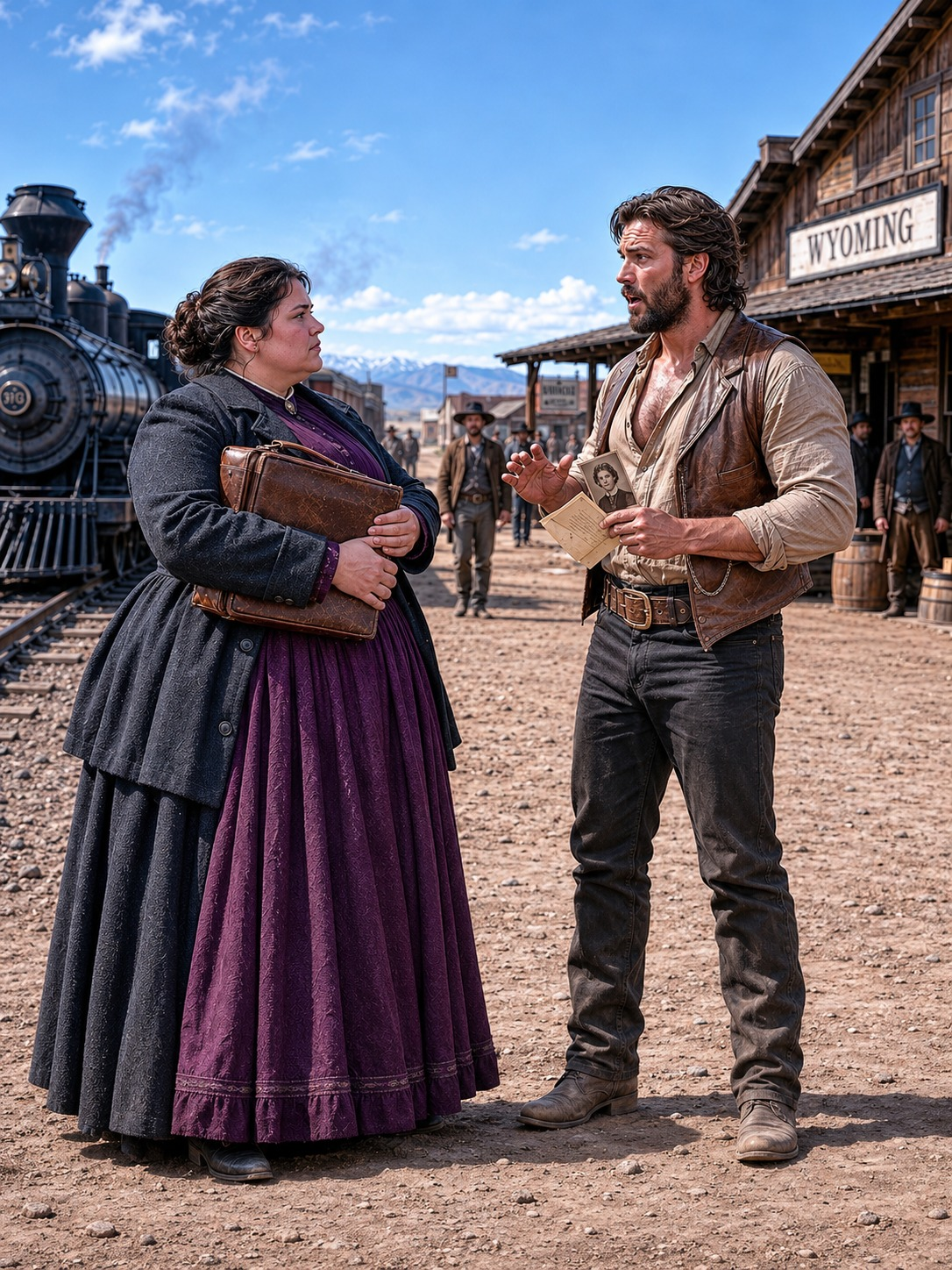
When she stepped off the train in Wyoming, Josiah had looked at her with disappointment.
Now he stood across the yard watching her with an expression that made every old insult seem small.
When she approached, he offered his arm.
"Mrs. Higgins."
She smiled.
"Mr. Higgins."
He looked at her.
"Would you care to dance?"
Martha glanced toward the musicians.
"Are you certain?"
"Never been more certain of anything."
She took his hand.
They moved slowly beneath the lanterns.
Josiah was not an elegant dancer.
Martha stepped on his boot twice.
He laughed both times.
Around them, their friends smiled.
And when the music ended, Josiah kissed her in front of everyone.
The yard erupted in applause.
Martha blushed.
Josiah grinned.
"Reckon they approve."
She laughed.
"I believe they do."
Later that night, after the guests had gone and the lanterns were being extinguished, Martha and Josiah sat together on the porch.
The stars spread across the Wyoming sky.
The ranch was quiet.
Martha rested her head against his shoulder.
Josiah held her hand.
"Any regrets?" he asked.
She considered the question.
There had been grief.
Danger.
Fear.
Years of loneliness.
But there had also been courage, friendship, justice, and love.
"I regret the people we lost," she said softly.
Josiah nodded.
"So do I."
"And I wish our parents could have seen this."
He looked toward the dark hills.
"Maybe they knew what they were trying to leave us."
Martha smiled.
"A ranch?"
"More than that."
She lifted her head.
"What?"
Josiah looked at her.
"A chance to build something honest."
Martha considered his words.
Then she looked across the land.
The fields were secure.
The spring flowed freely.
The workers were safe.
The fraudulent debts had been erased.
The men who had stolen from their families had faced justice.
And the home that had once felt cold and empty was filled with warmth.
She turned back to her husband.
"I think we've done that."
Josiah smiled.
"Yes, ma'am."
He kissed her forehead.
Then he stood and offered his hand.
"Come inside, Martha."
She took it.
Together, they entered the house.
The kitchen smelled faintly of cinnamon and fresh bread.
A lamp burned beside the neatly arranged account books.
On the mantel stood two photographs.
One of Charles Caldwell.
The other of Thomas and Eleanor Higgins.
Beside them lay a small wooden plaque Martha had commissioned from a craftsman in Laramie.
It bore the words:
BROKEN RIDGE RANCH
ESTABLISHED IN HONESTY. KEPT BY LOVE.
Martha paused before the mantel.
Josiah stood beside her.
For a moment, she imagined her father smiling.
She imagined Eleanor Higgins standing in the doorway, satisfied that her son had finally found someone who would stand beside him.
She imagined Thomas Higgins looking across the repaired fences with pride.
Then Martha turned toward Josiah.
"Do you know what I want most now?"
He smiled.
"What?"
"Ordinary days."
Josiah laughed softly.
"After everything we've been through?"
"Especially after everything."
He drew her into his arms.
"Then ordinary days you shall have."
And they did.
There were mornings filled with work, evenings filled with laughter, winters when snow buried the fences, and summers when the prairie turned golden beneath the sun.
There were disagreements over cattle prices and celebrations when calves were born.
There were neighbors to help, books to balance, meals to share, and friends who became family.
In time, Martha and Josiah welcomed two orphaned children from a family they had known in Laramie, giving them the safe and loving home both children needed.
The ranch grew.
Their family grew.
And the love between them deepened with every passing year.
Martha never forgot the woman who had stepped off the train believing she might have to spend the rest of her life earning a stranger's acceptance.
But she no longer looked back on that woman with sorrow.
She looked back with pride.
Because the woman everyone had underestimated had uncovered a conspiracy, restored two families' honor, and helped save a ranch.
More importantly, she had found a husband who loved her not despite who she was, but because of who she was.
And Josiah Higgins, who had once ordered a quiet mail-order bride, spent the rest of his life thanking heaven that the woman who arrived had never been quiet at all.






Comments 0