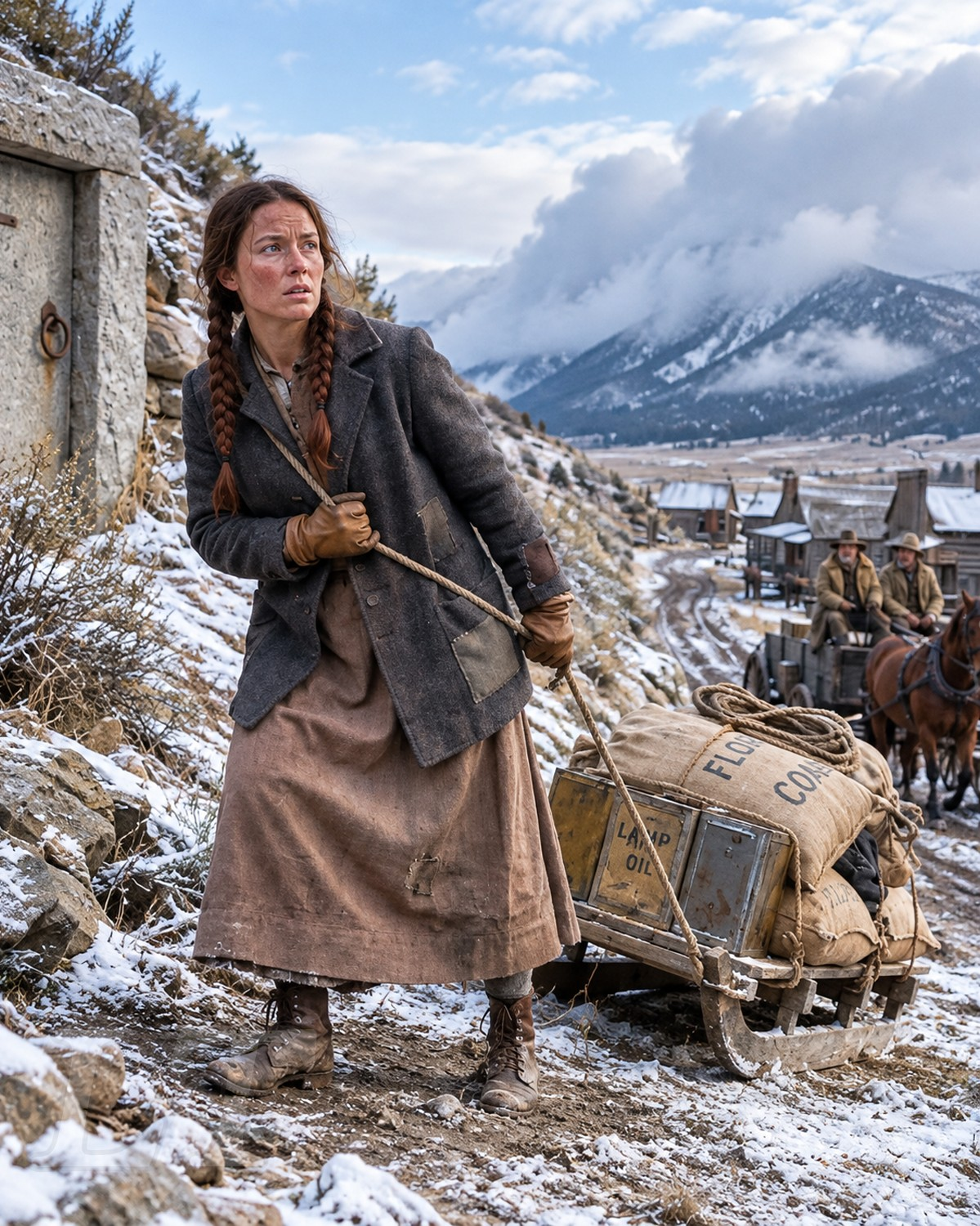
The first spring rain fell on Cinder Gap seven months after the great blizzard.
Norah Vale stood outside the High Room, watching droplets slide down the granite entrance.
The mountain looked different.
Not because the snow had disappeared, or because the trees had begun growing new leaves.
It looked different because, for the first time in her life, she no longer felt she had to face it alone.
Behind her, Eli was repairing the wooden door.
Wade was unloading supplies from a wagon.
Margaret was speaking with Adah near the new water channel.
And somewhere inside the shelter, two little boys were arguing over the last piece of apple pie.
Norah smiled faintly.
Then she looked at the small brass marker in her hand.
Fifty.
The number had troubled her grandfather for weeks.
But today, she finally understood what it represented.
Not another secret.
Not another hidden passage.
It was the number of families who had officially joined the new mountain water cooperative.
Fifty families.
Fifty households that had agreed to protect the springs together.
The mountain had finally become what her great-grandmother intended it to be.
A place belonging to everyone.
Norah placed the marker beside the entrance.
Then she heard her father's voice.
"Are you coming, sweetheart?"
She turned.
Eli stood beside the door, holding two cups of coffee.
For a moment, she simply looked at him.
Eleven months earlier, she had believed she would never see him again.
Now he was standing in front of her, older and thinner, but alive.
Norah accepted the cup.
"I'm coming."
And together, they walked inside.
The weeks following the storm had been difficult.
The snow had buried roads, damaged ranches, and destroyed several buildings in town.
Some families had lost nearly everything.
But nobody in Cinder Gap had been left without food.
Norah's supplies had made the difference.
The flour, beans, coal, dried onions, salt, and lamp oil she had dragged uphill had sustained twenty-three people during the worst days of the blizzard.
When the rescue teams finally reached the valley, they found the High Room functioning as a temporary shelter.
The chimney had remained clear.
The food had lasted longer than expected.
And the hidden water chamber had provided clean water when the town's pipes froze.
The story spread beyond the mountain.
Newspapers from neighboring counties wrote about the eighteen-year-old girl who had prepared for a winter everyone else had dismissed.
Some called her courageous.
Others called her unusually intelligent.
Norah disliked both descriptions.
She had simply listened to her father.
And when nobody believed her, she had kept working.
The townspeople eventually stopped laughing.
But Norah never asked them to apologize.
She was too busy rebuilding.
The investigation into Cal Rusk and Sheriff Hollis lasted several months.
The original railway documents were examined by the county land office.
The signatures were compared.
The fraudulent agreements were exposed.
Investigators discovered that Cal and Hollis had been working together for years, using forged property records to claim control over the northern water system.
Their plan had depended on keeping the original agreement hidden.
They had also used threats, intimidation, and false reports to silence anyone who questioned their ownership claims.
Arthur Pike provided testimony.
He admitted his involvement in bringing Daniel to the underground passage.
He also explained how Cal had threatened his family.
Arthur was not excused for what he had done.
But he cooperated fully with the investigation and helped recover several missing documents.
The evidence against Hollis was overwhelming.
He was convicted of fraud, conspiracy, unlawful detention, and several other offenses.
Cal was convicted for his role in the scheme, including his involvement in the attack on Eli and his threats against the residents.
Neither man would ever again have the authority to control Cinder Gap.
The original water agreement was officially restored.
The northern springs belonged to the people.
And for the first time in generations, nobody could secretly sell what the entire town depended on.
Thomas Rusk survived his injury.
The bullet had passed through his upper arm without damaging the bone.
He spent several weeks recovering at the county hospital.
During that time, he finally told the complete story of the night Eli's wagon went over the northern road.
He admitted that he had helped arrange the meeting between Eli and Cal.
He had believed the dispute could be settled peacefully.
But when the second wagon appeared, he realized the meeting had been a trap.
He had pulled Eli from the wreckage and hidden him at the abandoned railway camp.
When Cal's men began searching the mountain, Thomas helped Eli escape into the lower chamber.
He had remained there for months, occasionally bringing food and supplies through the hidden passages.
His brother Samuel had also helped him.
That was why two men had appeared with the same face.
They had deliberately used their resemblance to confuse Cal's men.
Thomas had pretended to be dead.
Samuel had allowed people to believe he was Thomas.
The deception had kept both brothers alive.
Norah visited Thomas before he returned to the valley.
She found him sitting beside the hospital window.
His injured arm rested in a sling.
"You look better," she said.
He smiled.
"I've been told that before."
She sat beside him.
"Why didn't you tell me everything?"
Thomas looked down.
"Because I was ashamed."
"Of what?"
"Of helping people who intended to hurt your father."
Norah was quiet.
Then she said:
"You helped him survive."
Thomas looked at her.
"That doesn't erase what I did."
"No. But it matters."
He nodded.
For a long moment, neither spoke.
Then Thomas reached into the bedside drawer and removed a small brass token.
It was the original railway marker.
Forty-seven.
"I believe this belongs with your father's records."
Norah accepted it.
"Thank you."
Thomas smiled.
"Your father always said you would know what to do with it."
Norah placed the token inside her coat.
For the first time, she felt that the past was finally being returned to the people who had lived through it.
Arthur Pike returned to Cinder Gap in early spring.
He had lost his blacksmith's shop during the storm.
The roof had collapsed beneath the weight of the snow.
For several weeks, he considered leaving town.
Then Daniel Bell came to see him.
The boy stood outside the damaged workshop, holding a small wooden horse.
Arthur looked at him.
"What have you got there?"
Daniel held it up.
"You made this for me."
Arthur nodded.
"I remember."
"Can you fix it?"
Arthur accepted the toy.
One leg had broken.
He examined it carefully.
"Yes. I can."
Daniel watched him work.
After a few minutes, the boy asked:
"Are you still a bad man?"
Arthur stopped.
He looked at Daniel.
Then he answered honestly.
"I made a bad choice."
"Are you going to make another one?"
Arthur shook his head.
"No."
Daniel considered that.
Then he nodded.
"Good."
Arthur repaired the wooden horse and handed it back.
Daniel smiled.
"Thank you."
The boy turned to leave.
Arthur watched him go.
Then he looked at the empty workshop.
He had spent years believing that a single mistake could define a person forever.
Now he understood that making things right required more than regret.
It required work.
The following week, he began rebuilding his shop.
Norah helped him carry the first timber beam.
Neither mentioned the past.
They simply worked.
Adah Pike became the first official medical coordinator for the mountain cooperative.
Her years as a midwife had made her one of the most trusted people in the valley.
She organized emergency supplies, taught families how to prepare for severe weather, and helped establish a small medical room inside the High Room.
Her sister Eleanor's history was finally documented.
The county archives confirmed that Eleanor Pike had been one of the original custodians of the northern water trust.
She had not died in 1872.
She had disappeared after refusing to surrender the original agreement to the railway investors.
She had spent the rest of her life protecting the document and ensuring that it would one day return to the people of Cinder Gap.
The old man's photograph and the recovered records confirmed her role.
Adah placed a framed copy of Eleanor's portrait inside the High Room.
Beneath it, she wrote:
She protected what belonged to everyone.
Norah often stopped to read those words.
She wondered how many people had quietly protected the town without ever receiving recognition.
Now their names would remain.
The most difficult reconciliation was with Wade.
For a long time, Norah could not look at her brother without remembering the northern road.
She remembered the money.
The silence.
The way he had allowed her to believe their father was dead.
But she also remembered the fear in his voice when he explained how Cal had threatened Nell and the children.
One afternoon, Wade came to the High Room alone.
Norah was repairing a shelf.
He stood near the doorway.
"Can we talk?"
She put down the hammer.
"Of course."
He looked uncomfortable.
"I've been thinking about what happened."
Norah waited.
"I should never have accepted the money."
"No."
"I should have told you the truth."
"Yes."
"And I should never have let you leave our house without making sure you had somewhere safe to go."
Norah lowered her eyes.
Wade continued.
"I can't change what happened. But I want you to know that I am sorry."
She looked at him.
For the first time, he did not offer an excuse.
He did not blame Cal.
He did not mention the mortgage or the children.
He simply accepted responsibility.
Norah took a breath.
"I missed you."
Wade's eyes filled.
"I missed you too."
She looked toward the shelves.
"Those boys are still my nephews."
He smiled faintly.
"They ask about you every day."
"Then bring them tomorrow."
Wade nodded.
He turned to leave.
Norah called after him.
"Wade?"
He stopped.
"Don't ever make me choose between family and the truth again."
He looked at her.
"I won't."
Norah nodded.
That was not complete forgiveness.
Not yet.
But it was a beginning.
Nell recovered fully.
Her pregnancy had been difficult during the winter, but the local doctor confirmed that both mother and child were healthy.
In May, she gave birth to a baby girl.
They named her Hope.
Wade brought the baby to the High Room three days later.
Norah held her carefully.
The little girl slept against her shoulder.
Nell sat beside them.
For a while, they watched the baby breathe.
Then Nell spoke.
"I owe you an apology too."
Norah looked at her.
Nell lowered her eyes.
"When you were living with us, I was frightened about the future. I thought there wasn't enough food for everyone. I thought another person meant another burden."
Norah remained quiet.
"I should never have treated you like you didn't belong."
Norah looked at the sleeping baby.
"I understand being afraid."
Nell nodded.
"But fear doesn't excuse what I did."
"No," Norah agreed.
Nell reached for her hand.
"I hope we can start again."
Norah looked at her sister-in-law.
Then she smiled gently.
"We can."
Outside, Wade was teaching Samuel how to repair a broken wagon wheel.
Daniel was chasing the younger boys around the yard.
And for the first time, Norah could see her family gathered in one place without anyone looking for an excuse to leave.
Margaret needed longer to find her place again.
She had spent years hiding from the people who wanted the water records.
Even after Cal and Hollis were arrested, she sometimes woke at night convinced that someone was standing outside the door.
Eli understood.
He had lived with the same fear.
But they agreed that their daughter deserved a different life.
They stopped keeping secrets.
They spoke about the years they had lost.
They admitted where they had failed each other.
And they began rebuilding their marriage slowly.
One afternoon, Margaret asked Norah to help her plant flowers beside the old shelter.
Norah brought a small shovel.
"What are we planting?"
"Wild mountain flowers."
Margaret opened a cloth bag.
Inside were several packets of seeds.
Norah recognized the handwriting.
Her mother's.
"You kept these?"
Margaret nodded.
"They were from our old garden."
Norah touched the packets.
She remembered the garden behind their childhood home.
The yellow flowers beside the fence.
The wooden bench where her mother used to sit.
The small patch of herbs.
"Can we plant them here?"
Margaret smiled.
"That's why I brought them."
They worked for several hours.
When they finished, the soil was dark and soft.
Margaret looked toward the mountain.
"I used to think I had lost my family forever."
Norah placed the shovel down.
"You haven't."
Margaret turned.
Norah took her hand.
"We're here."
Her mother began crying.
Norah embraced her.
This time, neither of them let go too quickly.
Eli changed too.
He stopped trying to carry every responsibility alone.
He taught the younger residents how to inspect the water channels.
He helped Jonah restore the old railway survey equipment.
And he began keeping a public record of every decision concerning the mountain.
Nothing would be hidden again.
One afternoon, Norah found him sitting at the entrance to the High Room.
He was repairing the old wooden sled.
The same sled she had used to carry supplies uphill.
She sat beside him.
"Why are you fixing that?"
Eli smiled.
"Because it deserves another winter."
Norah looked at the worn wood.
The runners were scratched.
One handle had been repaired several times.
The rope was almost completely replaced.
It had carried flour, beans, coal, and oil.
It had carried her determination.
"It worked well," she said.
"Better than well."
Eli turned the sled over.
"Your mother told me how far you dragged this."
Norah looked away.
"It was necessary."
"I know."
He placed a hand on her shoulder.
"I wish I had been there."
Norah looked at him.
"So do I."
Eli nodded.
Then he returned to the sled.
They worked together until sunset.
By June, the northern water channel was fully restored.
The springs flowed again.
The cooperative built a covered storage area beside the High Room.
Families contributed flour, beans, salt, fuel, and medical supplies.
Nobody was required to contribute more than they could afford.
The records were kept publicly.
The supplies were counted every month.
And every household had access to the emergency shelter.
Norah was appointed the first permanent caretaker.
She accepted the responsibility on one condition.
The position would never belong to one family forever.
Every few years, the residents would choose a new caretaker.
The agreement was approved unanimously.
Norah also insisted that the children be taught how to prepare for severe weather.
They learned how to store food.
How to check the chimney.
How to recognize changes in animal behavior.
How to repair simple tools.
And how to help neighbors who were struggling.
She wanted them to grow up understanding that survival was not an individual achievement.
It was something a community built together.
In October, exactly one year after Norah had first seen ice floating in Mr. Bell's water bucket, the town held a celebration.
The main street had been repaired.
The church roof was new.
Arthur's blacksmith shop had reopened.
Mr. Bell had expanded his general store.
The ranchers had brought their cattle back to the lower pastures.
And the northern springs were flowing cleanly.
People gathered outside the church.
A wooden sign had been placed beside the road.
It read:
THE HIGH ROOM COMMUNITY SHELTER
Beneath it were the names of the fifty participating families.
Norah stood beside her grandfather.
He leaned on his walking stick.
"You did well."
She smiled.
"We all did."
He looked at the sign.
"Your great-grandmother would have been proud."
Norah looked toward the mountain.
"Do you think she knew it would turn out this way?"
Her grandfather smiled.
"She hoped."
Then he handed Norah a small envelope.
Inside was a photograph.
It showed Eleanor Pike standing beside the original water chamber.
On the back were four words.
Keep the door open.
Norah folded the photograph carefully.
She understood.
The shelter was never meant to be a secret refuge for a chosen few.
It was meant to be a promise that nobody would be abandoned when winter arrived.
That evening, the town gathered around a long table outside the general store.
There was stew, bread, roasted vegetables, and apple pie.
Norah sat between Eli and Margaret.
Wade sat opposite her with Nell and the children.
Adah was telling Daniel a story about the old railway workers.
Arthur was laughing with Jonah.
Thomas and Samuel Rusk stood near the fire, arguing about which brother had been the better shot.
For once, the two men looked exactly alike in the same warm light.
Mr. Bell raised a glass.
"To the girl who saw winter coming."
People began applauding.
Norah lowered her eyes.
She was not comfortable being the center of attention.
Then her grandfather stood.
"To the girl who listened when everyone else laughed."
The applause grew louder.
Norah looked around the table.
She saw the people who had doubted her.
The people who had helped her.
The people who had survived.
And the people who had finally learned to stand together.
She stood.
"I didn't save this town."
The crowd became quiet.
"I just carried what I could."
She looked at the table.
"Everyone here carried something too. Food. Firewood. Medicine. Children. Memories. Hope."
Her voice softened.
"That's what saved us."
For a moment, nobody spoke.
Then Adah raised her glass.
"To everyone who carried something."
The town repeated her words.
And the celebration continued.
Later that night, Norah walked up the familiar path toward the High Room.
The moon shone over the ridge.
The air was cold.
But not threatening.
She opened the wooden door.
Inside, the stove was burning.
The shelves were full.
The blankets were folded.
The ledger rested on the table.
She opened it to the final page.
There were no more calculations about how little food one girl could survive on.
No more desperate notes about coal.
No more records of days spent alone.
Instead, she wrote:
October.
The shelter is ready.
The water is flowing.
Fifty families are protected.
The doors are open.
She paused.
Then she added one final sentence.
And this time, nobody has to face winter alone.
She closed the ledger.
Outside, Eli called her.
"Norah! We're going home!"
She turned off the lantern.
Then she stepped through the doorway.
Her mother waited beside her father.
Wade stood near the wagon with the children.
Adah was laughing.
The town lights glowed below the mountain.
Norah looked back at the High Room.
For a brief moment, she remembered the first night she had entered it.
The dust.
The cold stone.
The tears she had tried to hide.
She remembered dragging the sled uphill while people laughed.
She remembered believing she had nobody left.
Now the same doorway stood open.
Warm light spilled across the snow.
And there were people waiting for her.
Norah smiled.
Not because she had won.
Not because the mountain had surrendered its secrets.
But because she finally had a place where she belonged.
She took her father's hand.
Her mother's hand found hers on the other side.
Together, they walked down toward Cinder Gap.
Behind them, the High Room remained open.
And for the first time in generations, the mountain's greatest secret was no longer hidden.
It was shared.






Comments 0