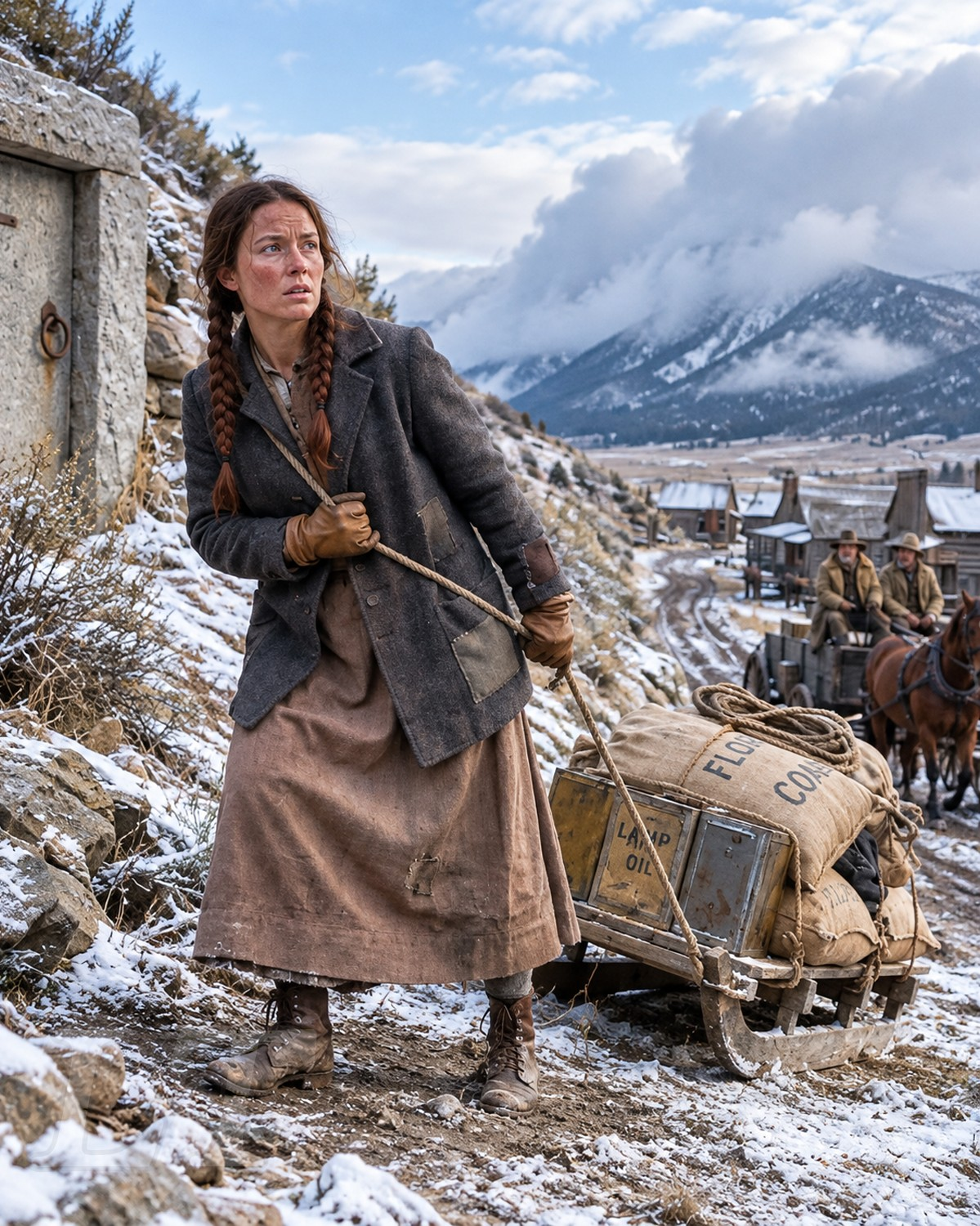
The stone door began moving.
Norah raised the splitting maul above her shoulder.
"Don't come any closer!"
A man's hand appeared through the narrow opening.
It was covered in blood.
Then a weak voice called her father's name again.
"Eli Vale... told me to find you."
Norah stepped backward.
The lantern lay on the floor, its flame trembling against the stone walls. Shadows moved across the timber supports as the hidden door slowly opened.
She could hear someone breathing on the other side.
The stranger sounded exhausted.
"Who are you?" she demanded.
No answer.
"Tell me your name!"
A faint cough came from the passage.
"Jonah Mercer."
Norah stared into the darkness.
She had never heard that name before.
But the stranger knew her father.
And somehow, he knew she was here.
The door opened another few inches.
Norah tightened her grip on the maul.
"Stay where you are."
"I can't."
"Then tell me why you're here."
The man gave a weak laugh that immediately turned into a painful cough.
"Your father used to say you had his stubbornness."
Norah felt something tighten in her chest.
"Don't talk about my father."
"I'm sorry."
"How do you know him?"
There was a pause.
Then the stranger answered.
"I worked with him."
"Where?"
"Up here. On the railway survey."
Norah glanced at the old maps scattered across the table.
The railway survey.
Her father's hidden chamber.
The strange symbol.
The second passage.
Everything suddenly seemed connected.
She moved closer, keeping the maul raised.
"How long ago?"
"Years."
"Why didn't he ever mention you?"
"He did."
"No, he didn't."
The man sighed.
"Perhaps he thought there was no reason to."
Norah studied the narrow opening.
She could see part of a dark coat and one shoulder.
The stranger was leaning heavily against the wall.
There was something dark running down his sleeve.
Blood.
"You're injured."
"Not badly."
"You're bleeding."
"That's a different matter."
Norah did not lower the maul.
"How do I know you're not lying?"
"You don't."
His answer surprised her.
He continued.
"Your father taught me something about trust. He said a person shouldn't expect it simply because he asks for it."
Norah remembered Eli saying something similar.
She hated that the stranger knew so many things about him.
"What do you want?"
"To make sure you survive."
The words were quiet.
But they frightened her more than his appearance.
"Why?"
The man shifted his weight.
A piece of loose stone fell somewhere behind him.
"Because winter is coming."
Norah looked toward the northern wall.
Outside, the wind had begun moving through the trees.
It sounded like distant machinery.
"Everyone says that," she replied.
"Not the winter you're expecting."
He paused.
Then he said something that made Norah's fingers tighten around the wooden handle.
"Your father believed this mountain was about to experience the worst storm in living memory."
Norah finally lowered the maul a few inches.
Not because she trusted the stranger.
Because she wanted answers.
"Open the door."
"I can't."
"Why?"
"My leg."
She looked at the opening.
"Move away from the other side."
There was a scraping sound.
Then a dull thud.
Norah approached carefully.
She pushed against the iron latch.
The hidden door moved another foot.
A man collapsed forward.
Norah jumped backward.
The stranger landed on one knee.
He was perhaps sixty years old, with a narrow face, gray hair, and a thick beard that had not been trimmed in weeks.
His dark wool coat was torn at the shoulder.
One hand pressed against his left leg.
His trousers were soaked with blood near the knee.
He looked as though he had been living outside for several days.
Norah held the maul between them.
"Don't move."
The man looked up.
His eyes were tired but alert.
"You're Eli's daughter."
Norah said nothing.
He studied her face.
Then he nodded slowly.
"You have his eyes."
She felt anger rise unexpectedly.
"Everybody keeps saying that."
The man lowered his gaze.
"I suppose they would."
Norah noticed that he was holding something beneath his coat.
A small leather pouch.
"What is that?"
The stranger looked down.
Then he carefully removed it.
He placed it on the floor between them.
"Something your father asked me to keep."
Norah did not touch it.
"What's inside?"
"His instructions."
"My father is dead."
"I know."
The stranger's expression changed.
For the first time, his face showed something other than exhaustion.
Regret.
"I was supposed to reach him before the accident."
Norah stared at him.
"What accident?"
"The wagon."
Her stomach tightened.
"How do you know about that?"
Jonah looked toward the stone floor.
"Because I was waiting for him that morning."
Silence filled the chamber.
Norah felt as though the room had suddenly become smaller.
Her father had died on a narrow road eleven months earlier.
People had told her the wagon overturned because of ice.
There had been no reason to question it.
But this stranger had been waiting for him.
"Why?"
Jonah slowly raised his eyes.
"Because I had found something."
"What?"
He hesitated.
Then he looked toward the blocked passage.
"Something your father never wanted the town to discover."
Norah stepped away.
She was no longer certain whether she wanted to hear the answer.
"You're going to explain everything."
"I will."
"Now."
Jonah tried to stand.
His injured leg gave way.
He grabbed the wall and struggled to remain upright.
Norah instinctively moved forward, then stopped herself.
"Sit down."
He looked at her.
"Please."
She pointed toward the wooden bench beside the stove.
Jonah slowly crossed the chamber and lowered himself onto it.
Norah retrieved the fallen lantern.
She placed it on the table.
Then she examined the man's leg.
The wound was deep enough to require attention, but it did not appear to be life-threatening.
"How did this happen?"
"Fell on the ridge."
"That's all?"
"Something caught my boot."
Norah looked at the torn fabric.
A sharp piece of metal had cut through the cloth.
She fetched a clean strip of linen and a small bottle of alcohol from her supplies.
"You're going to feel this."
Jonah nodded.
She cleaned the wound carefully.
He clenched his jaw but made no sound.
"How long have you been in the passage?"
"Two days."
Norah stopped.
"Two days?"
"I couldn't get the upper door open."
"Why didn't you use the main entrance?"
"Because someone was watching it."
Norah looked up.
"Who?"
Jonah shook his head.
"I couldn't see clearly."
"How many?"
"Two, perhaps three."
Her thoughts returned to the footprints beside the twisted fir.
The two men she had seen approaching the shelter.
They had been looking for something.
Perhaps they had known about the hidden entrance all along.
Norah finished tying the bandage.
"Why were you hiding?"
"Because the wrong people must not know I'm here."
"Who are the wrong people?"
Jonah looked toward the entrance.
Then he answered quietly.
"Cal Rusk."
Norah froze.
Cal.
The blacksmith who had laughed at her in the street.
The man who had watched her dragging supplies uphill.
She stared at Jonah.
"What does Cal have to do with this?"
"His father knew about the railway chamber."
Norah remembered the photograph.
Eli standing beside Thomas Rusk.
The four words on the back.
Trust the second entrance.
"Thomas Rusk is dead."
Jonah looked at her for a long moment.
"That's what people were told."
Norah felt the blood drain from her face.
"What does that mean?"
Jonah leaned forward.
"Your father and Thomas Rusk discovered something while surveying this mountain. Something valuable enough that several people were willing to lie about it."
"What?"
"Not here."
"Why not?"
"Because these walls aren't as private as you think."
He pointed toward the blocked passage.
"Somebody has been using the lower tunnel."
Norah turned toward the stove.
The iron panel beneath it was closed.
She remembered the fresh marks on the stone steps.
Someone had walked through recently.
Perhaps Jonah.
Perhaps the other men.
Perhaps someone else.
"How many entrances are there?" she asked.
"Three."
Norah stared at him.
"Three?"
Jonah nodded.
"The main stone door. The passage behind the stove. And an emergency opening on the western ridge."
She retrieved her father's survey drawing.
"Where?"
Jonah examined it.
His expression changed when he saw the paper.
"Where did you get this?"
"My father left it."
"Did he leave the brass key too?"
Norah nodded.
Jonah closed his eyes briefly.
"Then he trusted you with more than I realized."
He pointed toward the lower corner of the map.
"That mark identifies the western entrance."
Norah studied the diagram.
It showed a narrow line running beneath the ridge, eventually connecting to a point beyond the cemetery.
"Why would he build so many passages?"
"Because the railway workers needed somewhere to store their equipment. Later, your father realized the chamber could serve another purpose."
"What purpose?"
Jonah looked directly at her.
"A place to survive when the mountain closes."
Norah thought about the sacks of flour.
The coal.
The beans.
The sled.
Her father had known.
He had prepared for something.
But she still did not understand why he had kept it secret.
"Why didn't he tell me?"
Jonah's expression softened.
"Perhaps he wanted you to have a normal childhood."
Norah looked away.
She did not want to hear another explanation that made her father seem wise and mysterious.
She wanted him back.
She wanted to ask him why he had left her with eleven dollars and a collection of unfinished instructions.
Instead, she folded the map.
"You're going to tell me everything you know."
Jonah nodded.
"Yes."
"Starting with the accident."
He took several minutes before speaking.
Then he began.
"Your father and I worked together for nearly twenty years. We surveyed mountain routes, repaired old railway equipment, and helped maintain the northern trails."
Norah sat opposite him.
"Thomas Rusk was part of the crew?"
"Yes. He was the best engineer among us."
"What happened?"
Jonah looked at the lantern.
"During one winter, we discovered an underground water channel beneath the ridge. It ran through a series of natural stone chambers."
Norah remembered the second entrance.
"The tunnel?"
"Part of it. The mountain has more empty spaces than people realize."
He continued.
"Thomas believed the railway company could use the water channel to construct a safer route through the mountain. But the company abandoned the project before the work was completed."
"Why?"
"Money. Politics. Arguments over ownership."
"Then what?"
"Thomas disappeared from the project. Your father kept the survey papers."
Norah glanced at the photograph.
"Why did my father keep them?"
"Because he knew the mountain better than the men who wanted to sell it."
Jonah shifted on the bench.
"Years later, we discovered that the upper chambers could remain dry even during severe snowfall. The rock formations protected them from the worst of the weather."
"So my father turned this place into a shelter."
"Yes."
"Then why did he never tell anyone?"
Jonah gave a tired smile.
"Because people don't always appreciate what they don't understand."
Norah thought of Cal's laughter.
The sheriff's dismissive expression.
The ranchers at the hotel.
She understood.
"Did he think a storm was coming?"
"Not just a storm."
Jonah reached into his coat.
He removed a folded piece of paper.
It was old and stained.
The handwriting was Eli's.
Norah recognized it immediately.
Her father had written:
The animals have begun moving earlier than expected. The spring is changing. If the northern clouds form before the first hard frost, the valley may lose every road leading out.
Norah read the sentence twice.
Jonah watched her.
"He wrote that six weeks before he died."
"Did he show it to anyone?"
"Only me."
"Why?"
"Because I had seen the same signs."
Norah lowered the paper.
"Then why didn't you warn the town?"
"I did."
"What happened?"
Jonah looked at her.
"They laughed."
For a moment, Norah could not speak.
Then she let out a quiet breath.
"Of course they did."
Jonah remained in the High Room that evening.
Norah gave him a bowl of beans and a cup of warm water.
She could not afford to waste supplies, but she could not leave an injured man hungry.
He ate slowly.
Between mouthfuls, he examined the room.
The shelves.
The stacked flour.
The coal.
The patched walls.
"You've done good work."
Norah continued arranging the supplies.
"I had to."
"Your father would have been proud."
She stopped.
"Please don't."
Jonah lowered his spoon.
"I'm sorry."
Norah turned away.
She did not want her father's name used as comfort.
Not by a stranger.
Not by anyone.
After supper, she gave Jonah a place near the stove.
He insisted he could sleep sitting up.
Norah brought him an old blanket.
Then she checked the entrance and secured the wooden bar.
Outside, the wind had grown stronger.
The trees moved violently along the ridge.
Jonah listened.
"That's not ordinary autumn wind."
Norah looked at him.
"What does it sound like?"
"Like the beginning of something."
She remembered Adah's warning.
A widow's smile.
Beautiful until it takes everything.
Norah added another piece of wood to the stove.
Then she opened her father's ledger.
She wrote down the new supplies.
After a moment, she added another line.
One injured man.
One additional mouth to feed.
Jonah watched her.
"Still counting everything?"
"Someone has to."
He smiled faintly.
"Your father used to say the same thing."
Norah closed the ledger.
"Did he ever tell you why he built the second passage?"
Jonah looked toward the stove.
"Not entirely."
"Why?"
"Because he believed somebody might eventually need to come through it without being seen."
Norah frowned.
"Who?"
Jonah did not answer.
Instead, he looked toward the western wall.
The next morning, Norah climbed outside to inspect the main entrance.
The snow had begun falling lightly.
She found fresh footprints near the twisted fir.
Two sets.
One pair belonged to a man wearing heavy work boots.
The other appeared smaller.
She crouched and examined them.
The prints led toward the entrance.
Then they stopped.
Someone had stood there for several minutes.
Norah followed the trail around the granite wall.
Near the roots of a pine tree, she discovered a small object half buried beneath the snow.
A brass button.
She picked it up.
The surface was scratched.
A small symbol had been engraved on the back.
The same circle crossed by two lines.
Norah turned it over.
There was a tiny letter stamped into the metal.
R.
She slipped it into her pocket.
When she returned to the chamber, Jonah was awake.
He was standing beside the table, examining the photograph of Eli and Thomas Rusk.
Norah placed the brass button in front of him.
"Do you recognize this?"
Jonah stared at it.
His expression changed immediately.
"Where did you find that?"
"Outside."
He picked it up.
His fingers began trembling.
"That's impossible."
"Why?"
Jonah looked toward the stone entrance.
Then toward the blocked passage.
"Because I saw this button eleven months ago."
Norah felt her heart begin to race.
"Where?"
"On the coat of the man who came to your father's house the night before the accident."
She stepped closer.
"Who was he?"
Jonah opened his mouth.
Then he stopped.
A faint sound came from beneath the floor.
Three knocks.
Norah turned toward the stove.
Jonah went completely still.
Another three knocks followed.
This time, they were louder.
Norah reached for the splitting maul.
"Is someone down there?"
Jonah did not move.
His face had become pale.
Then a voice emerged from beneath the stone panel.
A voice Norah recognized.
It belonged to someone she had heard laughing in town.
"Norah Vale."
She stared at the floor.
The voice spoke again.
"Open the passage."
Jonah grabbed her wrist.
"Whatever you do," he whispered, "don't let him inside."
Norah looked at him.
"Who is it?"
Jonah swallowed.
Then he spoke a name.
"Cal Rusk."
And beneath the stove, the iron lock began turning.






Comments 0