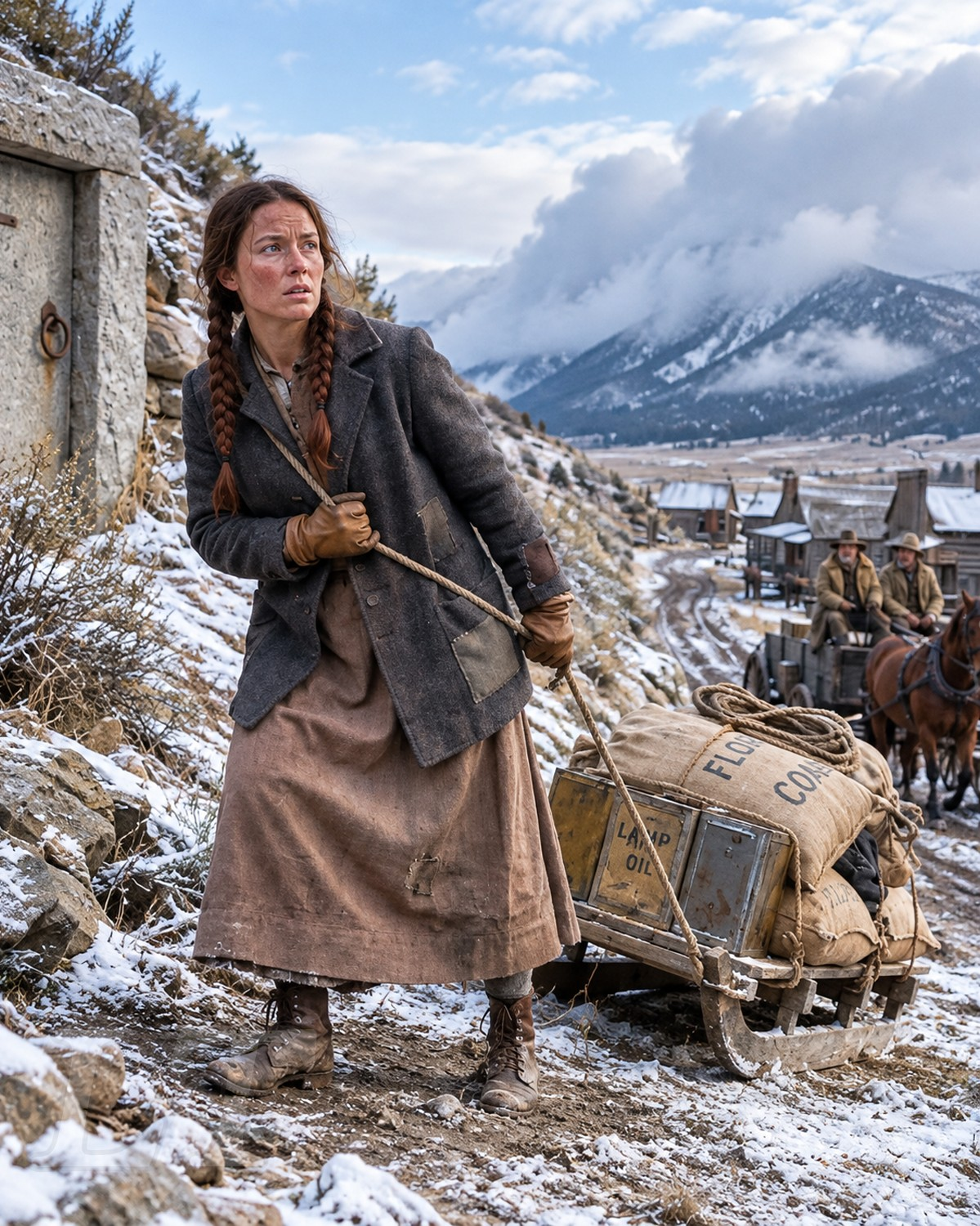
A young woman dragged a heavy wooden sled through the snow, her hands bleeding beneath her gloves.
"Keep walking, Norah! Maybe the bears will appreciate your winter groceries!"
Cal Rusk laughed from the doorway of his blacksmith shop.
Sheriff Hollis stood beside him, holding a small leather ledger that belonged to Norah's dead father.
But there was something written inside its back cover.
Something neither man had bothered to read.
Norah Vale kept pulling.
She did not turn around.
The rope cut into her palms as the sled dragged across the frozen ground. A sack of flour shifted against a wooden crate, and the entire load nearly tipped sideways.
She stopped, planted her boots, and pulled again.
Behind her, the laughter continued.
Norah was eighteen years old.
She had no home, no money worth mentioning, and no family willing to take responsibility for her.
But she had something the people of Cinder Gap did not.
She believed winter was coming.
And she believed it would be worse than anything the town had ever experienced.
Eleven months earlier, Norah had still belonged somewhere.
Her father, Eli Vale, had been alive then.
He was a quiet man who repaired fences, hunted in the high country, and knew the mountains better than most men knew their own kitchens.
He had taught Norah to recognize animal tracks, read clouds, mend broken equipment, and stretch a sack of flour through an unexpectedly long winter.
He never taught her that knowledge made people respect you.
That lesson came later.
Eli had a habit of checking the weather before breakfast.
He never trusted a clear sky simply because it looked beautiful.
Sometimes he stood outside their small cabin for several minutes, watching the trees.
Other times, he would walk down to the creek and place his fingers in the water.
When Norah was younger, she thought these habits were amusing.
One afternoon, she asked him why he watched the mountains so carefully.
Eli had crouched beside her and brushed a strand of hair away from her face.
"Because the mountain tells you things before people understand what's happening."
"What kind of things?"
"Whether animals are frightened. Whether water is changing. Whether the wind is moving the wrong way."
He had smiled faintly.
"Most people wait until something happens before they believe it."
Norah remembered those words more often after he died.
The accident had happened during a routine trip down a narrow mountain road.
A wagon had overturned on an icy bend.
Eli never returned home.
After the funeral, Norah's world became smaller.
Her mother had died years earlier. There were no grandparents nearby, no aunts waiting to take her in, and no close relatives who offered a permanent place to stay.
The only person left was her older half-brother, Wade.
Wade Vale was married to Nell, and they had two young boys.
At first, they welcomed Norah.
There was a bed in the spare room.
There was a bowl of stew at supper.
Nell even gave her an old blanket that smelled faintly of lavender.
Norah helped around the house without being asked.
She cooked, washed clothes, repaired torn shirts, and watched the boys whenever Wade went out to work.
She did not want to become a burden.
But the months passed.
Grain became more expensive.
Firewood became harder to find.
Nell discovered she was pregnant again.
The house seemed to grow smaller every week.
Then, one evening, Wade sat at the kitchen table counting their remaining flour.
Norah was mending one of the boys' coats near the stove.
Wade looked at the sacks.
Then he looked at her.
"You have two weeks to find somewhere else."
The needle stopped between Norah's fingers.
She thought she had misunderstood.
"What?"
Wade did not raise his voice.
"We can't keep feeding another person. Nell and the boys need more room. The baby is coming."
Norah looked at the two children sleeping beside the stove.
"Where am I supposed to go?"
Wade rubbed his forehead.
"I don't know. You're eighteen now."
That was all.
No argument followed.
No apology.
Norah finished mending the coat.
The following morning, she packed her father's old coat, a blanket, a skillet, a few personal belongings, and eleven dollars.
She left before anyone woke up.
For three nights, Norah slept in an abandoned hayloft outside town.
The place offered little protection from the wind, but at least nobody could tell her to leave.
She used part of her money to buy bread.
She rationed the rest.
On the third night, while trying to sleep beneath her blanket, she remembered something her father had shown her when she was nine.
A hidden stone room above the cemetery.
Eli had called it the High Room.
He had taken her there once during a hunting trip.
They had followed a narrow trail beyond the cemetery, crossed a rocky ridge, and reached an enormous granite wall.
At first, Norah had seen nothing unusual.
Then her father had pulled aside some branches and revealed a small iron ring hidden beneath the roots of a twisted fir.
He had explained that old railway survey workers had constructed a stone chamber there decades earlier.
The railway project had been abandoned.
The workers had left behind a reinforced room with timber supports, a narrow chimney, and a second passage partially blocked by an old support beam.
Eli had spent several summers repairing it.
He had shown Norah how to open the entrance and how to keep the chimney clear.
"Why would anyone need a place like this?" she had asked.
Her father had looked toward the valley.
"Someday, this place may matter more than people know."
At the time, she had laughed.
Now, lying in the cold hayloft, she understood that she had nowhere else to go.
The next morning, she climbed toward the cemetery.
The trail was difficult.
Her boots were worn, and she had eaten almost nothing.
But she remembered every turn.
When she finally reached the twisted fir, she dropped to her knees and searched beneath the roots.
Her fingers found cold iron.
She pulled.
Nothing happened.
She adjusted her position and pulled again.
A deep scraping sound came from inside the granite wall.
The hidden stone door moved.
A narrow black opening appeared.
Norah stood completely still.
For several seconds, she could only stare.
Then she stepped inside.
The smell reached her first.
Dust.
Cold stone.
Old timber.
And something else.
A faint trace of smoke from the chimney her father had once used.
Norah lowered her blanket onto the floor.
She sat down.
Her shoulders began to shake.
She covered her mouth with one hand and cried.
Not loudly.
Not for long.
She cried because she missed her father.
Because she was frightened.
Because she had finally found somewhere nobody could order her to leave.
When the tears stopped, she wiped her face.
Then she stood up.
There was work to do.
The High Room was not comfortable.
The floor was uneven granite.
The walls had small gaps where cold air entered.
The chimney was clogged with debris, and several wooden shelves had collapsed.
But the structure was strong.
Eli had made sure of that.
Norah spent the next two days cleaning.
She removed old branches, swept dust into piles, and cleared the chimney.
She collected moss and clay from nearby rocks to seal the gaps.
Using boards from an abandoned mine structure farther down the ridge, she repaired the shelves.
She found an old piece of canvas and placed it beneath her blanket to protect herself from the cold stone.
By the third evening, the shelter was usable.
It still needed food.
And fuel.
A great deal of both.
Norah counted her money.
Eleven dollars.
She had to spend carefully.
At Mr. Bell's general store, she bought flour, beans, dried onions, salt, coal, lamp oil, and a few basic supplies.
Mr. Bell watched her arrange everything on the counter.
"That's quite a list."
"I need provisions."
"For what?"
"Winter."
He glanced through the window.
The afternoon sun was shining.
"Winter is still a long way off."
Norah did not argue.
She asked for the cheapest burlap sacks.
She bought only what she could afford.
When she finished, there was almost nothing left of her eleven dollars.
She loaded the supplies onto a small wooden hand sled.
The first journey nearly broke her.
The trail was steeper than she remembered.
The sled runners caught on rocks.
The sacks shifted whenever the ground tilted.
Her coat was too thin to protect her from the wind.
By the time she reached the High Room, her shoulders were trembling.
She unloaded everything.
Then she returned to town.
The second trip was harder.
The third was worse.
But she continued.
She learned to balance the heavier sacks toward the front of the sled.
She wrapped rope around the crates to keep them from sliding.
She stopped at certain rocks to rest her back.
Each evening, she climbed into the shelter, counted what she had carried, and wrote the numbers in her father's old pocket ledger.
Flour.
Beans.
Coal.
Lamp oil.
Salt.
She recorded every pound.
She knew exactly how much food she had and how quickly she could use it.
There was no room for careless decisions.
By the fifth day, people had started noticing.
Norah was no longer simply a girl walking through town.
She was the girl dragging supplies up the mountain.
Some watched from their windows.
Others stopped what they were doing.
A few laughed.
Cal Rusk was the first to make a joke directly to her.
He stood outside his blacksmith shop with two other men.
Norah was struggling to pull a crate containing lamp oil and several smaller supplies.
Cal leaned against the doorway.
"Where are you taking all that?"
"Up the mountain."
"Planning to open a grocery store for the squirrels?"
His companions laughed.
Norah kept moving.
Cal stepped into her path.
"Come on, girl. Tell us. What's the big plan?"
"Winter provisions."
He looked toward the bright sky.
"Winter provisions? In October?"
"Yes."
"Then I suppose you'll be selling snow to the mountains next."
More laughter.
Norah adjusted the rope around her shoulder.
Cal looked at the supplies.
"You know, if you need help finding a place to sleep, there are easier ways than feeding bears."
Norah finally looked at him.
"I'm not feeding bears."
"Then what are you doing?"
She tightened her grip on the rope.
"Preparing to survive."
For a moment, Cal said nothing.
Then the men laughed even harder.
Norah walked past them.
She could hear them repeating her words behind her.
Preparing to survive.
By supper, the joke had spread.
Someone at the hotel pretended to pull an imaginary sled through the dining room.
Another man suggested the town should build a road for Norah's imaginary army.
Even children repeated the phrase.
Norah heard some of it from the ridge.
She kept working.
The following afternoon, she visited the hotel.
Several ranchers were gathered around a table, discussing cattle prices.
Sheriff Hollis stood near the fireplace.
Norah waited until they finished speaking.
Then she approached.
"I think people should start preparing for a severe winter."
The sheriff looked at her.
"Who says?"
"My father taught me to watch the mountain."
A rancher chuckled.
"Your father was a good man, but that doesn't make you a weather expert."
Norah remained calm.
"The animals are moving differently. The geese left early. Deer are coming down into the valley during daylight."
Hollis folded his arms.
"And what makes you certain this means anything?"
"The water at Mr. Bell's store froze beside a burning stove."
One of the men laughed.
"A frozen bucket taught you more than a lifetime of ranching?"
The room erupted.
Norah looked around.
Nobody appeared interested.
She tried again.
"The mountain spring has stopped flowing. Smoke isn't rising properly from some of the chimneys. Something is changing."
Hollis shook his head.
"You're frightened because you don't have a proper home. That doesn't mean the whole town needs to panic."
Norah felt the words land.
But she refused to show how much they hurt.
"I'm not asking anyone to panic. I'm asking people to prepare."
The sheriff moved aside.
"We have work to do."
The conversation was over.
Norah turned toward the door.
As she stepped outside, she heard another joke behind her.
She did not stop.
Only one person followed her.
Adah Pike was an elderly midwife who had lived in Cinder Gap longer than most of the men in the hotel had been alive.
She walked slowly, carrying a small basket.
"Norah."
The girl turned.
Adah looked toward the northern mountains.
"My mother used to call weather like this a widow's smile."
Norah frowned.
"What does that mean?"
"Beautiful until it takes everything."
The old woman looked at her face.
"You've been watching the animals."
Norah nodded.
"And the water?"
"Yes."
Adah reached for Norah's wrist.
Her grip was surprisingly strong.
"Then keep carrying."
Norah looked at her.
"You believe me?"
"I believe the mountain deserves more respect than those men give it."
Adah released her wrist.
"Don't waste time trying to convince people who have already decided they know everything."
Norah nodded.
Then she started up the path again.
That evening, she returned to the High Room with another load of coal.
The sun was disappearing behind the ridge.
Her legs ached.
Her hands were sore.
She placed the coal beside the stove and opened her father's ledger.
She wrote the new totals.
Fifty-two pounds of flour.
Twenty-nine pounds of beans.
Six tins of lamp oil.
She checked the remaining space on the shelves.
There was room for more.
Not much.
But enough for another few days of supplies.
Norah closed the ledger.
For a moment, she thought about Wade's boys.
She imagined them sitting at the kitchen table, eating supper.
The younger one always dipped his bread into the gravy.
The older one liked molasses.
She wondered whether they believed she had chosen to leave them.
The thought made her chest tighten.
She had not wanted to abandon them.
She had simply run out of places where she was welcome.
Norah pulled her father's coat closer around her shoulders.
Then she stood.
There was one more load she wanted to bring up before morning.
She opened the stone entrance.
The wind moved through the trees.
Somewhere below the ridge, a fox cried.
Norah listened.
For a moment, she almost answered.
She wanted to hear another voice.
Instead, she picked up the rope.
She stepped outside.
And began pulling the sled uphill again.
She did not see the two men watching from the edge of the cemetery.
They had been standing there for several minutes.
One wore a dark coat and a wide-brimmed hat.
The other carried a lantern.
They watched Norah disappear along the narrow trail.
Then the man with the lantern looked toward the granite wall.
"That's where she goes?"
The other man nodded.
"Every day."
"What's up there?"
"I don't know."
The lantern swung slightly.
"Then perhaps we should find out."
The two men began walking toward the twisted fir.
And for the first time since Norah had discovered the High Room, someone else was heading toward its hidden entrance.
But they weren't carrying food.






Comments 0