The iron ring moved.
A low scraping sound came from beneath the twisted fir tree.
The man holding the lantern immediately stepped backward.
"Did you hear that?"
His companion raised one hand.
"Quiet."
They stood beside the granite wall, staring at a narrow line that had appeared between two enormous stones.
Neither man spoke.
Then the older one reached forward and pulled the iron ring again.
The hidden door shifted.
A breath of cold air escaped from the darkness.
The younger man lifted his lantern.
"Someone's been living in there."
The older man looked at the fresh marks in the snow.
"Not just living."
He pointed toward the narrow trail.
"Someone's been preparing for something."
Norah had no idea anyone had approached the High Room.
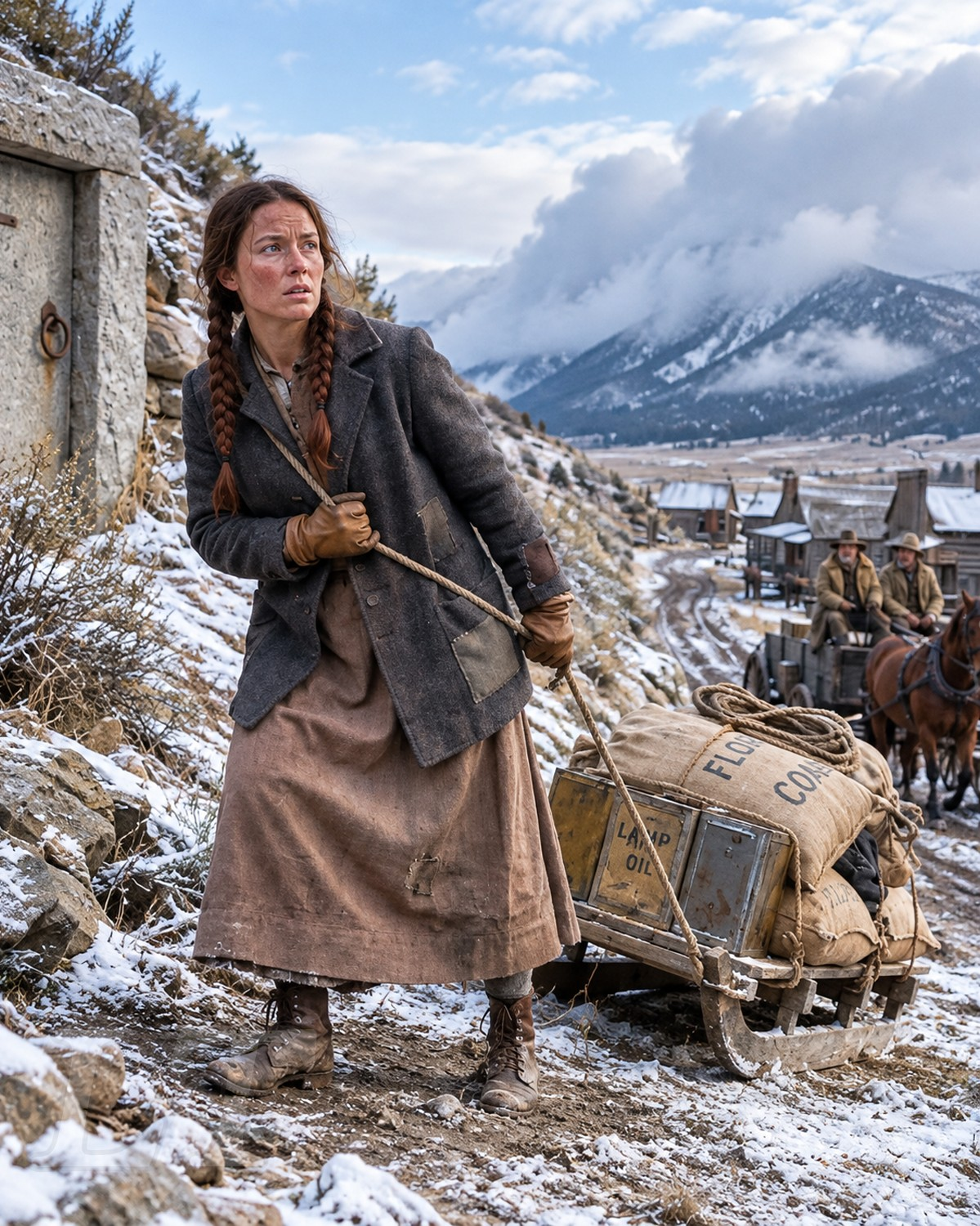
She was halfway down the mountain, pulling her empty sled toward town.
The rope dragged behind her.
Her shoulders ached, and her fingers had begun to sting beneath her gloves. She had spent nearly the entire afternoon carrying coal, flour, and two wooden crates uphill.
She had planned to return before sunset.
But the last crate had slipped from the sled halfway along the trail, forcing her to stop and rearrange everything.
Now the sky was turning gray.
Norah glanced toward the northern ridge.
The clouds looked different.
They were not the soft white clouds that usually gathered over the peaks. These were thick, low, and strangely motionless.
She remembered her father's warning.
When the mountain behaves strangely, don't wait for the sky to explain it.
She pulled the sled faster.
There were still several things she needed from Mr. Bell's store.
Salt.
Dried onions.
A small sack of oats.
And perhaps another blanket, if she could find one cheaply enough.
She had counted her money three times that morning.
After paying for the coal, she had only a few coins left.
She would have to be careful.
Inside the general store, Mr. Bell was arranging jars on a shelf.
He looked up when Norah entered.
"Back again?"
"Yes, sir."
"Didn't you buy enough food yesterday?"
"Not enough yet."
He glanced toward the window.
The afternoon sunlight had almost disappeared behind the mountains.
"You know, most people are buying things to bring down into town."
Norah placed several coins on the counter.
"I'm taking mine uphill."
Mr. Bell sighed.
He was not a cruel man, but he had little patience for what he considered unnecessary trouble.
"Your father never carried on like this."
Norah looked at him.
"Yes, he did."
Mr. Bell stopped arranging the jars.
For a moment, neither spoke.
"Your father was different," he finally said.
"Different how?"
"He understood these mountains. People listened when he spoke."
Norah lowered her eyes.
"People don't listen to me."
Mr. Bell did not answer.
She selected a small bag of salt and asked for the cheapest oats he had.
As he wrapped the supplies, he studied her.
"Norah, how long do you intend to stay up there?"
"As long as I need to."
"You're eighteen. You shouldn't have to live alone in the mountains."
"I didn't choose to be alone."
The words came out more sharply than she intended.
Mr. Bell looked down at the counter.
Norah immediately regretted speaking that way.
She gathered her purchases.
"Thank you."
Before she left, Mr. Bell called after her.
"Your father left some things here."
She turned.
"What things?"
"A box. Old papers, I think. He asked me to keep them until you were old enough."
Norah stared at him.
"Why didn't you tell me before?"
"I forgot."
"When did he leave them?"
"About a month before the accident."
Norah took a step closer.
"Can I see them?"
Mr. Bell hesitated.
Then he disappeared into the back room.
When he returned, he carried a small wooden box.
It was no larger than a loaf of bread.
The lid was scratched, and a narrow leather strap held it closed.
Norah recognized the initials carved into the top.
E.V.
Her father's initials.
She touched them with her thumb.
"What's inside?"
"Never opened it."
Norah looked at him.
"Why?"
"Your father asked me not to."
She slowly loosened the strap.
Inside lay several folded papers, a small brass key, and a photograph.
The photograph showed Eli standing beside the granite wall above the cemetery.
He was younger.
Beside him stood another man.
Norah leaned closer.
She recognized her father immediately.
But she had never seen the other man before.
On the back of the photograph, Eli had written four words.
Trust the second entrance.
Norah read them twice.
Then a third time.
"Mr. Bell, do you know who this man is?"
He leaned forward.
His expression changed.
"I think..."
He stopped.
Norah waited.
Mr. Bell looked toward the store entrance.
Then he lowered his voice.
"I think that's Thomas Rusk."
"Who?"
"Cal Rusk's father."
Norah looked at the photograph again.
Thomas Rusk had been dead for years.
At least, that was what people in town believed.
She took the box with her.
The walk back toward the mountain felt longer than before.
Her father's photograph remained tucked inside her coat.
The words on its back kept returning to her thoughts.
Trust the second entrance.
She knew the High Room had a second passage.
Eli had shown it to her when she was nine.
But he had never explained where it led.
The passage had been blocked by a crooked timber support, and he had told her not to move it.
"Why can't we open it?" she had asked.
"Because some things are better left until they're needed."
"What things?"
Her father had simply smiled.
"Things that might keep someone alive."
At the time, Norah had assumed it was another one of his strange mountain sayings.
Now she wondered whether he had been trying to tell her something important.
She reached the cemetery shortly before dusk.
The trail was quiet.
No birds called from the trees.
A thin layer of snow covered the ground.
Norah stopped near the twisted fir.
Something looked wrong.
The branches had been moved.
She stared at them.
She was certain she had left them in the same position that morning.
She crouched beside the roots.
There were fresh marks in the dirt.
A boot print.
Then another.
Norah's stomach tightened.
Someone had been here.
She looked toward the granite wall.
The iron ring was no longer hidden beneath the roots.
It lay exposed.
She approached carefully.
Her fingers closed around it.
The stone door moved more easily than she expected.
A narrow opening appeared.
Norah pulled the door wider.
Inside, the shelter looked almost exactly as she had left it.
The stove was cold.
The supplies remained stacked against the wall.
Her blanket lay folded beside the bed.
But something was different.
A small piece of wood had been placed on the table.
Norah stopped.
She had not left it there.
She slowly approached.
It was a thin rectangular piece of timber, carefully cut and sanded.
Someone had carved a small symbol into one side.
A circle.
With two short lines crossing its center.
Norah recognized it.
She had seen the same symbol on the old railway survey maps her father kept in his cabin.
She picked up the wood.
There was writing on the other side.
The chimney must stay clear.
Norah stared at the words.
The handwriting was unfamiliar.
She turned toward the chimney.
The firebox had been cleaned.
A small pile of dry kindling had been arranged beside it.
She had not done that.
Norah immediately reached for the splitting maul resting near her bed.
She held it with both hands.
"Who's there?"
Her voice echoed through the chamber.
Nothing answered.
She moved toward the entrance.
The stone door stood open.
Beyond it, the snow-covered trail was empty.
Norah stepped outside.
She looked toward the cemetery.
Then toward the trees.
No movement.
No voices.
But the footprints were unmistakable.
Two people had been near the entrance.
One had walked around the wall.
The other had approached the door.
Norah returned inside and carefully closed it.
She pushed the wooden bar into place.
Then she sat beside the stove, holding the maul across her knees.
She did not light the fire.
Not yet.
That night, Norah barely slept.
Every small sound seemed important.
The wind moving through the fir trees.
The distant cracking of frozen branches.
The occasional shifting of the timber supports.
She kept thinking about the photograph.
Her father had known Thomas Rusk.
Perhaps he had known him well.
Perhaps the hidden room had not been his secret alone.
She took the photograph from her pocket.
The two men stood beside the granite wall.
Eli wore his old hunting coat.
Thomas Rusk held a rolled sheet of paper.
Behind them, a narrow section of the granite wall appeared to have been opened.
Norah brought the photograph closer to the lamp.
There was something she had missed.
At the bottom corner, just above the date, her father had written a small number.
47.
She frowned.
Forty-seven.
She searched through the papers in the box.
There were three old survey sheets.
One showed the mountain ridge.
Another marked the abandoned railway route.
The third contained a rough drawing of the High Room.
Norah unfolded it.
Her father's handwriting ran along the edges.
Most of the words were faded, but one sentence remained clear.
The room was never intended to be the end of the line.
Norah read it again.
The room was never intended to be the end.
She looked toward the blocked passage.
A cold feeling moved through her.
The following morning, she began investigating.
She had to ration her supplies, but she also needed to understand what her father had left behind.
She placed the three survey sheets on the table.
The drawing showed the stone chamber from above.
The main entrance was marked with a small square.
The chimney appeared near the western wall.
And behind the stove, a narrow line continued into the mountain.
The second passage.
Norah moved toward it.
The crooked support beam stood exactly where she remembered.
It was thicker than the other timbers.
Its lower end had been wedged between two stones.
A pile of old rocks blocked the passage beyond it.
She crouched and examined the beam.
There were fresh scratches along one side.
Someone had touched it recently.
Norah placed her palm against the wood.
It felt solid.
She tried moving it gently.
Nothing happened.
She pushed harder.
A faint creaking sound came from inside the wall.
She immediately stepped away.
Her father had told her never to move the support.
She had no idea whether the mountain above it was stable.
She could not risk collapsing the entire shelter.
But the survey drawing suggested there was something beyond it.
Something important.
She returned to the table and studied the map.
Near the lower edge, a small handwritten note had been almost completely covered by a stain.
Norah tilted the paper toward the light.
She could make out only a few words.
If the upper door is buried...
The rest was unreadable.
She turned the paper over.
Nothing.
Then she noticed a thin line running along the edge.
It looked like a crease.
She carefully unfolded the paper again.
A second sheet had been attached to the back.
Norah slowly separated them.
The hidden page contained a rough diagram of the mountain.
There were two entrances.
One was the granite door she had already discovered.
The other was marked beneath a large tree on the opposite side of the ridge.
A small handwritten arrow pointed toward it.
Beside the arrow were the words:
Emergency passage.
Norah sat down.
Her father had not simply built a shelter.
He had built a way out.
Or a way in.
She looked toward the blocked passage.
For the first time, she wondered whether the High Room had been designed to protect more than one person.
Over the next two days, Norah continued hauling supplies.
The weather grew colder.
The wind became more persistent.
The animals were harder to find.
At Mr. Bell's store, she noticed that several shelves were nearly empty.
People were finally beginning to buy extra provisions.
But they still laughed when they saw her.
Cal Rusk was especially amused.
He had started telling customers that Norah intended to spend the winter entertaining imaginary railway workers.
She ignored him.
She had more important things to do.
One afternoon, she found Adah Pike waiting near the cemetery.
The old woman carried a small cloth bundle.
"I brought you something."
Norah stopped.
"What is it?"
"Dry herbs. Some medicinal roots. A little dried mint."
Norah accepted the bundle.
"Thank you."
Adah studied her face.
"You look tired."
"I haven't been sleeping much."
"Why?"
Norah hesitated.
She did not know how much to reveal.
"Someone has been near my shelter."
Adah's expression became serious.
"Did you see them?"
"No."
"Did they take anything?"
"No. They left something."
Norah described the wooden piece with the railway symbol.
Adah listened carefully.
When Norah finished, the old woman looked toward the granite wall.
"I remember that mark."
Norah turned.
"You do?"
Adah nodded slowly.
"My husband worked with the railway survey crew before he died. He used to draw that symbol on his equipment."
"Do you know what it means?"
"Not exactly. But I remember him saying it marked a place where one passage connected to another."
Norah felt her pulse quicken.
"The second entrance?"
Adah looked at her.
"Your father showed you that?"
Norah nodded.
The old woman was quiet for a long moment.
Then she took Norah's hands.
"Listen carefully. If someone is helping you, be grateful. But don't assume every person who knows about that room has good intentions."
Norah thought about the footprints.
"I understand."
Adah squeezed her hands.
"And don't let anyone frighten you into leaving."
Norah nodded.
The old woman turned toward town.
After several steps, she stopped.
"One more thing."
Norah looked up.
"Your father came to see me shortly before the accident."
Norah's heart seemed to pause.
"What did he say?"
Adah looked toward the mountains.
"He asked me whether I remembered the winter of 1872."
Norah shook her head.
"I wasn't born."
"Neither was I. But my mother told me about it."
Adah lowered her voice.
"She said the snow buried the old road so deeply that people couldn't find their own fences. Families survived because they had stored food before the first storm."
Norah stared at her.
"Did my father think that would happen again?"
Adah did not answer directly.
Instead, she said something that Norah would remember for the rest of her life.
"Your father was afraid of something he couldn't explain."
That evening, Norah returned to the High Room with another load.
She had purchased more coal and two sacks of beans.
Her hands were sore.
Her boots were damp.
But she felt strangely encouraged by Adah's words.
Someone else remembered the old winter.
Someone else understood why preparation mattered.
She unloaded the sled.
Then she opened her father's ledger.
The numbers were beginning to look better.
She had enough flour for several weeks.
Enough beans for longer.
Coal remained her greatest concern.
She would need more if the temperature dropped as quickly as she expected.
Norah wrote the new totals.
Then she examined the stove.
The chimney was working well.
The mysterious visitor had apparently cleaned it more thoroughly than she had.
She touched the stovepipe.
It was cold.
There was something comforting about knowing that someone had helped her without asking for anything.
But she still wanted to know who.
She placed a small piece of wood into the stove and lit it.
The flame caught.
Smoke moved through the pipe.
Norah watched carefully.
It rose cleanly.
No blockage.
No unusual smell.
She sat beside the stove and opened the old survey drawing again.
The second passage continued to trouble her.
She wanted to inspect it.
But she would not move the support beam without understanding how it worked.
She needed a safer way.
Perhaps the emergency entrance could be reached from outside.
Perhaps there was another opening somewhere along the ridge.
She examined the drawing once more.
Then she noticed something.
A small mark appeared near the western wall.
It was almost hidden beneath a fold.
A circle.
With two short lines crossing its center.
The same symbol as the wooden piece.
Norah slowly raised her eyes.
The mark was directly behind the stove.
She moved closer.
The stove stood on a flat stone platform.
She had cleaned around it several times.
But she had never moved it.
Norah gripped the iron handle.
It was heavier than she expected.
She pulled.
The stove shifted slightly.
A faint scraping sound came from beneath it.
She pulled again.
The platform moved.
A narrow crack appeared in the stone floor.
Norah froze.
She lowered the lantern.
There was a small iron ring beneath the stove.
Her father's hidden passage might not have been behind the support beam after all.
It might have been beneath the very place where she had been sleeping.
She spent the next hour examining the floor.
The iron ring was attached to a square stone panel.
She tried lifting it.
Nothing happened.
She searched for a release mechanism.
Then she remembered the brass key from her father's box.
She hurried to the table and retrieved it.
The key was old and dark.
A small number had been stamped into its handle.
47.
Norah stared at it.
The same number as the photograph.
She returned to the floor.
A narrow keyhole was hidden beneath a layer of dust beside the iron ring.
She inserted the key.
It turned.
A small metallic click echoed through the room.
Norah stepped backward.
For several seconds, nothing happened.
Then the stone panel shifted upward by less than an inch.
A breath of stale air escaped.
Norah covered her mouth.
She had discovered another entrance.
She gripped the iron ring with both hands and pulled.
The panel resisted.
She braced one boot against the floor and tried again.
It moved farther.
A dark opening appeared beneath it.
She lowered the lantern.
Stone steps descended into the mountain.
There were at least six visible steps.
The rest disappeared into darkness.
Norah's heart began beating faster.
She remembered her father's words.
Things that might keep someone alive.
She leaned over the opening.
"Hello?"
Her voice traveled downward.
No answer.
She lowered the lantern.
A narrow passage appeared.
Its walls were reinforced with old timber.
There were marks on the floor.
Fresh marks.
Not old dust.
Someone had walked through there recently.
Norah tightened her grip on the lantern.
She looked toward the stone entrance.
Then toward the open floor panel.
She was no longer certain she was alone in the High Room.
She decided not to descend immediately.
The passage could be unstable.
There might be loose rocks or rotten supports.
She needed more rope and a second lantern.
She carefully closed the panel and moved the stove back into place.
Then she checked the stone entrance.
The wooden bar was still secured.
Nothing had been disturbed.
But as she turned away, a sound came from the wall.
Three soft knocks.
Norah stopped.
The sound came again.
Three knocks.
Slow.
Deliberate.
Not from the main entrance.
Not from the chimney.
From somewhere behind the blocked passage.
She stood motionless.
The splitting maul was beside her bed.
She reached for it.
"Who's there?"
Silence.
Then a faint scraping sound.
Something moved on the other side of the wall.
Norah took one step backward.
Her eyes fixed on the crooked support beam.
A thin line of dust fell from its upper edge.
Then another.
She lifted the lantern.
The beam had shifted.
Only slightly.
But enough for her to notice.
She remembered the survey drawing.
The second entrance.
The emergency passage.
The strange symbol.
And the warning written in her father's handwriting.
The room was never intended to be the end of the line.
Norah approached the wall.
She raised the lantern toward a small gap between two stones.
Something metallic reflected the light.
It looked like the edge of a latch.
She reached forward.
Before her fingers could touch it, the knocking stopped.
A voice came from the other side.
It was low.
Weak.
And unmistakably human.
"Norah?"
She dropped the lantern.
It struck the stone floor.
The flame flickered.
Norah stared at the wall.
Nobody in town should have known she was inside.
Nobody should have known about the second passage.
Then the voice spoke again.
This time, it said her father's name.
"Eli Vale told me to find you."
Norah's blood ran cold.
She slowly lifted the splitting maul.
And from behind the stone wall came the sound of an iron lock turning.
Then something began pushing the hidden door open.






Comments 0