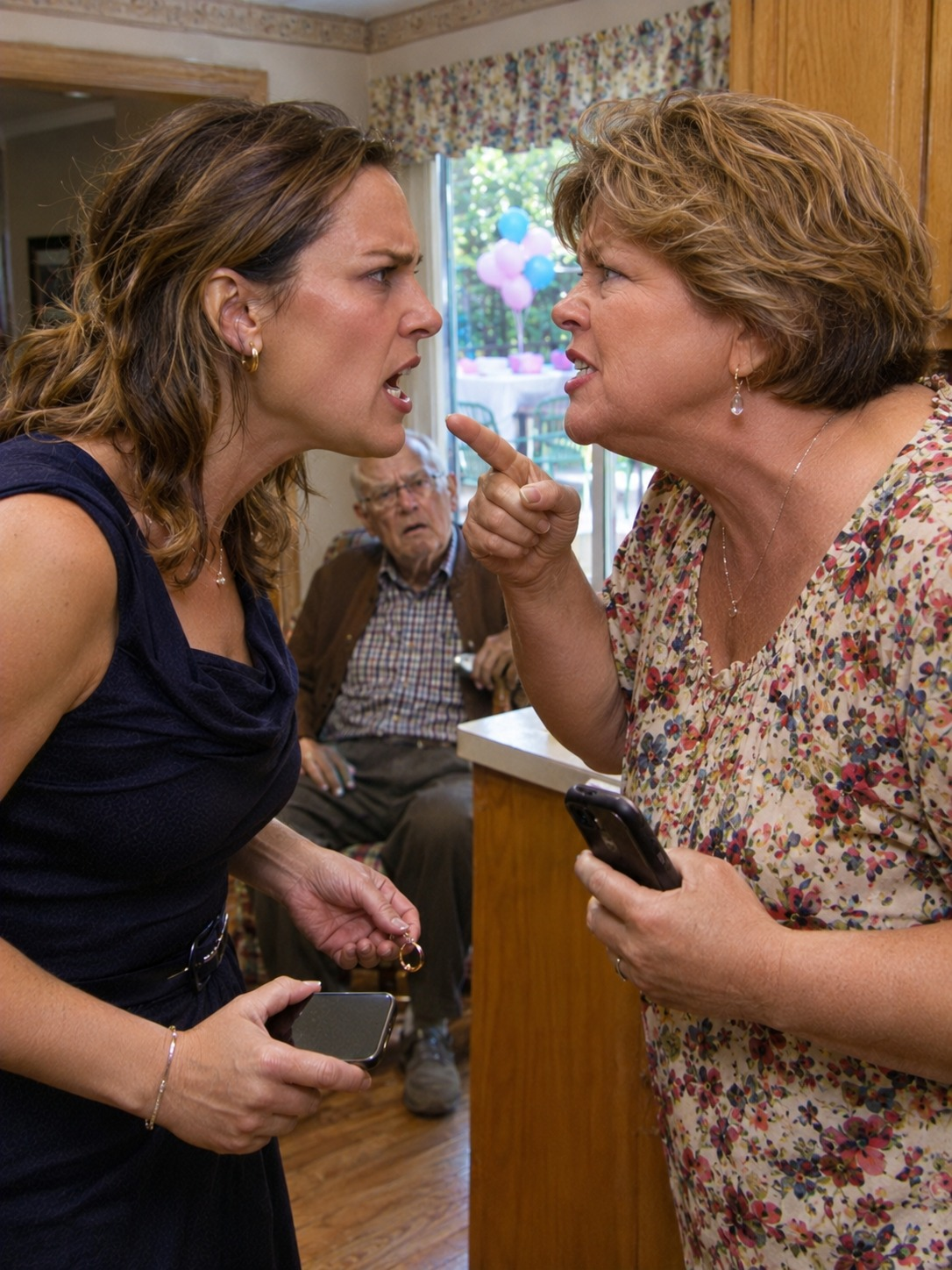
My mother arrived at Eleanor's office carrying a blue folder, two bank statements, and a confession that would finally explain why my grandfather's house had become the center of our family's worst betrayal.
She looked older than I remembered.
Her hair was pulled into a loose bun, and her hands trembled as she placed the folder on the conference table. My father sat beside her, staring at the floor. Pop sat across from them, his cane resting against his chair. I was beside him, with Eleanor and David on either side.
Nobody spoke until Mom finally looked at her father.
"Frank, I need to tell you the truth."
Pop adjusted his glasses.
"Then tell it."
Mom opened the folder.
"The money wasn't supposed to save Curtis's business."
I felt my stomach tighten.
Dad closed his eyes.
Mom continued.
"Several years ago, I borrowed money from someone I shouldn't have. I thought I could repay it before anybody found out."
Pop remained still.
"How much?"
"Thirty-one thousand dollars."
I stared at her.
"Why?"
She looked at me.
"I was trying to help Britney."
Britney wasn't there, but her name seemed to fill the room.
Mom explained that Britney had accumulated substantial debts after a failed business venture. She had been struggling financially, and Mom had secretly borrowed money to help her cover the losses.
The original plan had been to repay everything through monthly payments.
But the debt grew.
Interest accumulated.
Eventually, Mom began looking for another solution.
She remembered the Carrick property.
She knew it was valuable, mortgage-free, and rented to the Faulkners.
She believed that if Pop authorized Curtis to manage the property, they could use it as security for a loan.
Dad had agreed.
When Grandma Dorothy refused to sign the necessary documents, they continued looking for another way.
"Why didn't you simply ask Pop?" I whispered.
Mom looked down.
"Because I knew he would say no."
Pop nodded slowly.
"At least you knew me well enough to understand that."
She began crying.
"I thought I could fix everything before you found out."
"By using my name?"
Mom covered her face.
"I was afraid."
Pop looked at her for a long time.
Then he asked the question I had been waiting to hear.
"Did Britney know where the money came from?"
Mom shook her head.
"Not at first. She thought I was helping her with savings."
"And when did she find out?"
"Recently."
I remembered Britney bringing the documents to our house and admitting that she had believed Mom's explanation about the property.
I also remembered her voice message.
She had not known the entire plan.
But she had accepted the possibility of receiving a house without speaking to the person who owned it.
That mattered too.
Eleanor asked Mom whether she had any records supporting her explanation.
Mom handed over the bank statements.
David examined them carefully.
They showed the original transfers, subsequent payments, and the remaining debt.
There were also emails between Mom and the lender.
The money had indeed been borrowed to cover Britney's financial obligations.
But the attempted property authorization had been intended to secure a separate refinancing arrangement.
Eleanor explained that the records would be reviewed independently and that any legal responsibility would be handled through the appropriate process.
Pop listened.
Then he looked at my mother.
"Sharon, I would have helped you find a way to solve your problems."
She cried harder.
"I know."
"But you didn't ask me."
"I know."
"You decided that because I was old, my house was available."
Mom shook her head.
"No, Dad."
"Then why did you do it?"
She had no answer.
For the first time, I understood that her silence wasn't because she lacked an explanation.
It was because no explanation could make what she had done acceptable.
The following weeks were difficult, but the truth finally stopped changing.
The original property authorization had never been validly completed.
The acknowledgment bearing Pop's signature was formally disputed, and the evidence showed that he had never authorized it.
Walter's statement supported the conclusion that he had refused to witness the signature.
The original law firm's records confirmed that Dorothy had objected to Curtis receiving property authority.
The proposed deed transferring the Carrick house to Britney was never executed or recorded as a completed transfer.
The financial transaction involving Pop's account had also been stopped before the money was transferred.
The care coordination office formally closed the referral after receiving Pop's written objection and confirmation of his wishes.
Eleanor coordinated the necessary notices, and David helped finalize the property and trust records.
The trust's existing provisions remained in force.
Pop retained his position as trustee.
I remained the named successor trustee under the conditions Dorothy had established.
And nobody in the family could simply decide to sell, transfer, or occupy the property.
Dad and Mom also had to face the consequences of their actions.
The financial institution reviewed the disputed authorization.
The attorney preserved the evidence.
The debt Mom had concealed remained her responsibility, not Pop's.
She and Dad eventually arranged a repayment agreement using their own resources and independent financial advice.
They sold one of their vehicles and downsized their household expenses.
Nobody took Pop's savings.
Nobody took his house.
And nobody was permitted to pretend that the matter had simply been a misunderstanding.
Britney came to see Pop on a Sunday afternoon.
She brought a box of pastries and a small stuffed animal for the baby she and Kyle were expecting.
Pop invited her into the living room.
She sat beside him.
"Grandpa, I want to apologize again."
He nodded.
"I heard you the last time."
"I know. But I still feel terrible."
He looked at her.
"Feeling terrible won't fix anything."
She lowered her eyes.
"What should I do?"
"Start telling the truth. Even when it's uncomfortable."
She nodded.
"I will."
He pointed toward the stuffed animal.
"What's that?"
"A little bear for the baby."
Pop smiled.
"Looks like a decent fellow."
Britney laughed through her tears.
Then she told him that she and Kyle had found a smaller house they could afford. It wasn't as large as the Carrick property, but it had two bedrooms, a little backyard, and enough room for their growing family.
They were arranging their finances without borrowing from anyone else.
Pop listened carefully.
When she finished, he reached for her hand.
"I want you and your baby to have a good life."
Britney began crying.
"I want that too."
"But you have to build it honestly."
"I understand."
He squeezed her hand.
They didn't solve everything that afternoon.
There were still apologies to make, trust to rebuild, and consequences to accept.
But they finally spoke to each other without pretending the past hadn't happened.
That was a beginning.
My mother visited Pop the following week.
She came alone.
I was preparing dinner when I heard her knock.
For a moment, I considered letting Pop decide whether he wanted to see her.
He answered the door himself.
"Hello, Dad."
"Hello, Sharon."
She stood awkwardly on the porch.
"May I come in?"
He stepped aside.
She sat in the living room and looked around.
Her eyes rested on Grandma's photograph.
"I miss her," she whispered.
Pop nodded.
"So do I."
Mom began crying.
"I know she wouldn't have approved of what I did."
"No, she wouldn't."
"I wish I could speak to her."
Pop looked at the photograph.
"Your mother always believed people could make things right if they stopped lying to themselves."
Mom wiped her cheeks.
"Do you think you can forgive me?"
Pop didn't answer immediately.
Then he said, "I can work toward forgiving you. But that doesn't mean everything goes back to how it was."
She nodded.
"I understand."
"You'll have to earn my trust again."
"I will."
He looked at her.
"And you'll never bring another document for me to sign without explaining every word."
She managed a small, tearful smile.
"I promise."
Pop held out his hand.
She took it.
I watched from the kitchen doorway.
It wasn't a perfect reconciliation.
But it was honest.
And that mattered more.
Three months later, my promotion dinner finally happened.
Helen had originally planned to celebrate with me on the Friday evening when my family attempted to turn my house into a gender-reveal venue.
We had postponed it because of everything happening with Pop.
This time, I wore the same navy dress.
The dress still had pockets.
I put my speech in the left one.
Pop insisted on accompanying me.
Deb came early, checked his medications, and promised to call if anything needed attention.
Before we left, Pop handed me a small cream envelope.
"Open it after dinner."
I smiled.
"Another set of orders?"
"Something like that."
The restaurant was downtown, with large windows overlooking the evening traffic.
Helen stood when I arrived.
She hugged me.
Then the nursing directors and department supervisors gathered around our table.
There were congratulations, stories, and more laughter than I had expected.
When Helen introduced me, she mentioned the sixteen years I had spent at St. Brendan Regional Medical Center.
She talked about the nurses I had supported, the patients whose care I had helped improve, and the teams I would now lead across nine units.
I stood to speak.
For a moment, I thought about the first time I had walked into the hospital wearing my new nursing badge.
I remembered being twenty-two, terrified of making a mistake, and calling my supervisor because I couldn't find the key to a supply cabinet.
Then I remembered Grandma Dorothy.
I remembered Pop applauding at my graduation.
I remembered the dinner that had almost been taken away by thirty unexpected guests.
I looked around the table.
"Sixteen years ago, I started as a nurse who thought being responsible meant solving every problem herself," I said.
A few people laughed.
"Over time, I learned that leadership isn't about controlling every decision. It's about making sure people are heard, respected, and given the support they need to make their own choices."
Helen smiled.
I continued.
"I've also learned that the people who matter most aren't always the ones who speak the loudest. Sometimes they're the people who quietly stand beside you and remind you who you are."
My eyes moved toward Pop.
He raised his glass.
I finished my remarks.
Everyone applauded.
And this time, my family had stayed.
After dinner, Pop and I returned home.
He waited until we were sitting in the kitchen before reminding me about the cream envelope.
I opened it.
Inside was a handwritten note.
It was from him.
To my Sergeant,
Your grandmother used to say you had a stubborn streak.
I told her it was a strength, provided you learned when to use it.
She was right about many things.
I am proud of the woman you became, not because of your title, but because you never forgot that people deserve to be heard.
You protected my choices when others tried to make them for me.
But remember something. You do not have to carry every burden alone.
You have spent years taking care of other people.
Now allow yourself to enjoy the life you worked so hard to build.
Love,
Pop.
I read it twice.
Then I folded it carefully.
Pop watched me.
"Well?"
I smiled.
"You're getting sentimental."
"Don't tell anybody."
I laughed and hugged him.
For a long moment, neither of us spoke.
The following spring, the Faulkners moved out of the Carrick house.
They left the property clean, repaired the small damage to the hallway wall, and handed over the keys exactly as promised.
Pop decided not to sell.
He wanted to keep the house.
But he also wanted it to serve a purpose.
After discussing the options with Eleanor and reviewing the trust provisions, he decided that the property would eventually provide affordable housing support through a properly administered arrangement.
For now, he continued receiving the rental income.
He also visited the house whenever he felt up to it.
I drove him there one Saturday morning.
The front porch needed a little paint, and the tomato garden had become overgrown.
Pop stood in the backyard, looking at the place where Grandma had once planted her vegetables.
"She'd like this," he said.
I looked around.
"Maybe we should plant tomatoes again."
He smiled.
"You're going to do the digging."
"Of course."
We spent the afternoon clearing the garden.
Pop gave instructions from a lawn chair while I did most of the work.
At one point, he laughed so hard that he had to put down his cane.
It was the happiest I had seen him in months.
By the time summer arrived, the family had found a new rhythm.
Britney and Kyle welcomed their baby, a healthy little boy.
They named him Daniel.
Pop visited them at the hospital and held his great-grandson carefully.
He looked at the baby for a long time.
Then he whispered, "You have a lot to learn about this world, little man."
Britney smiled.
"Grandpa, he'll learn."
Pop looked at her.
"Then teach him that love isn't something you use to get what you want."
She nodded.
"I will."
My parents attended the visit.
Things between them and Pop were still not the same, but they were improving.
Dad had accepted responsibility for his role in the disputed paperwork and stopped trying to justify it.
Mom continued working through the financial consequences of her decisions.
Neither received authority over Pop's property or accounts.
They understood that trust would take time.
Pop didn't demand that everyone pretend the past had disappeared.
He simply allowed room for honest efforts to do better.
As for me, I continued leading the nine units at St. Brendan.
The work was demanding, but I loved it.
I had learned that being strong didn't mean never needing help.
And I had learned that family wasn't measured by how loudly someone claimed to care.
It was measured by whether they respected your choices when respecting them was difficult.
One Saturday evening, Pop and I sat beside his kitchen window.
The crossword was open on his little table.
His beige landline rested beside him.
I had replaced the broken screen-door handle he had complained about for months.
He noticed the repair.
"Finally."
I laughed.
"You've only mentioned it about forty times."
"Forty-two."
I shook my head.
Then he looked at me.
"Sergeant?"
"Yes?"
"Do you think Dorothy would be happy?"
I looked at her photograph.
The same photograph that had watched over the kitchen throughout the entire ordeal.
"I think she'd be proud of you."
He smiled.
"She'd be proud of you too."
I reached across the table and held his hand.
Outside, the evening light settled over the neighborhood.
There were no unexpected visitors waiting to claim a room.
No documents hidden in folders.
No financial requests disguised as family favors.
Just Pop, his crossword, the old telephone, and the quiet home where he had chosen to live.
He had not lost his independence.
He had not lost his property.
And he had not lost the right to decide what happened to his own life.
I had spent sixteen years helping people find their voices in hospital rooms.
That summer, I finally understood that the most important thing I had done wasn't protecting a house or challenging a document.
It was standing beside someone I loved until the world remembered to listen to him.
Pop picked up his pencil.
"What's a six-letter word for home?"
I smiled.
"Family?"
He shook his head.
"Too many letters."
I laughed.
He looked toward Grandma's photograph.
Then he wrote his answer.
Belong.
And for the first time in a very long while, everyone in our family understood what that word meant.
Comments 0