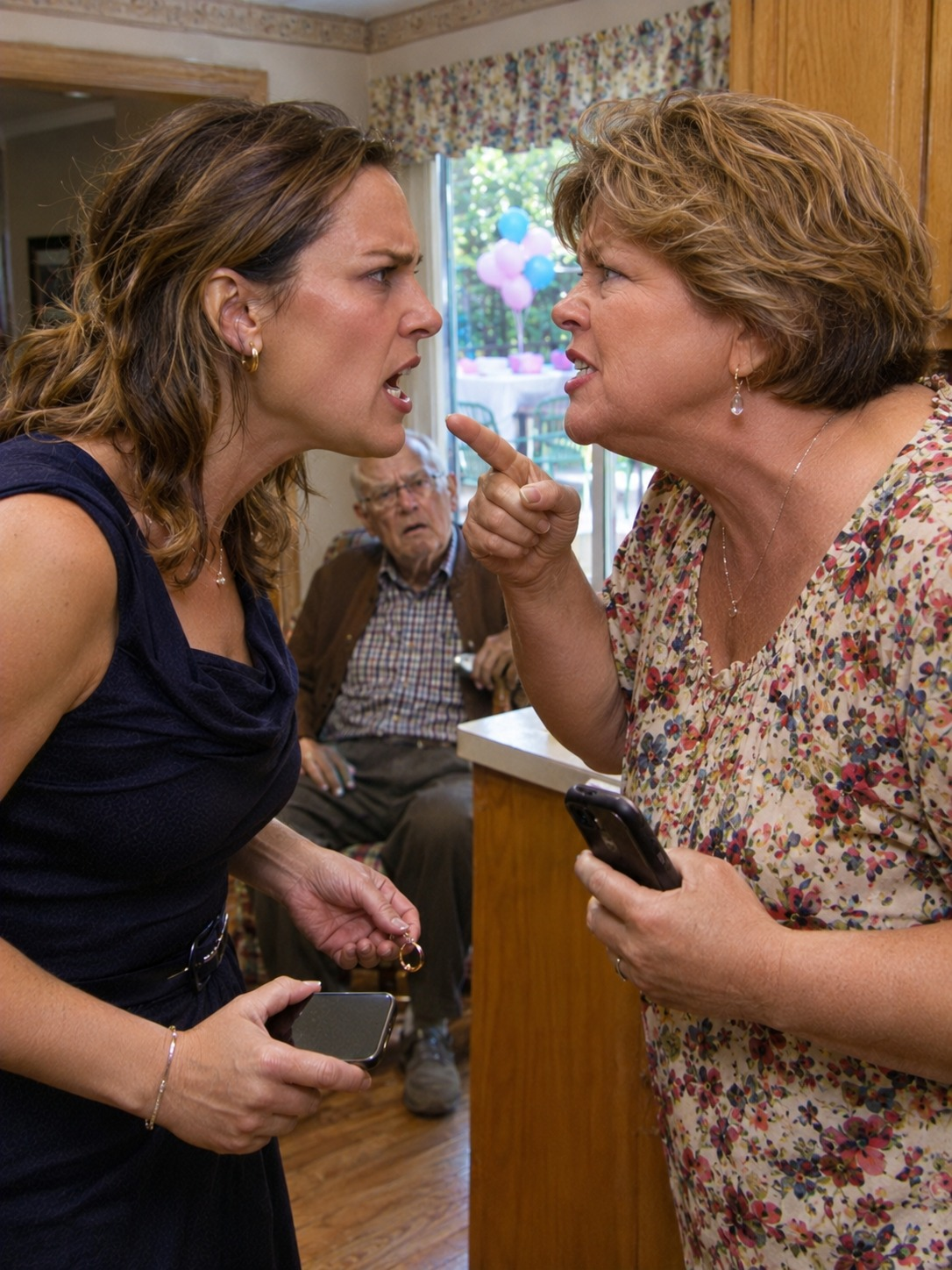
The message arrived while I was standing beside my grandfather's chair.
Your mother listed herself as his authorized family representative.
I read it twice.
Then I looked at Pop.
"Did you ever give Mom permission to make medical decisions for you?"
He shook his head.
"Never."
"Did you sign anything giving her access to your medical records?"
"No."
I looked back at my phone.
The message contained one more sentence.
There is also a scheduled assessment appointment for Monday morning, and the person listed as the primary decision-maker is Sharon Ford.
I felt my stomach tighten.
My mother hadn't simply asked Pop to sign a document.
She had already represented herself as someone authorized to make decisions on his behalf.
"Pop, I think we need to call Eleanor."
He nodded.
"Tomorrow morning."
"Why tomorrow?"
"Because I'm not making important decisions when I'm tired, and neither are you."
I almost smiled.
Even now, he was reminding me of something he had taught me years earlier.
Never sign anything you hadn't read.
Never agree to something you didn't understand.
And never let somebody else's urgency become your emergency.
I pulled a chair beside him.
"Can I ask you something?"
"Anything, Sergeant."
"How long has Mom been doing this?"
He looked toward the window.
"Longer than you think."
I waited.
He rubbed his thumb against the wooden handle of his cane.
"Your mother started asking questions about my house shortly after the Faulkners told me they were buying another place."
"When was that?"
"About six weeks ago."
I leaned forward.
"What kind of questions?"
"Whether the property had a mortgage. Whether I still had insurance. Whether the rent went directly into my account."
Those were reasonable questions in isolation.
But Pop had always handled his own finances.
He knew exactly what came into his account every month and what went out.
He had worked too hard for too many years to let someone else casually take control.
"Did you tell her?"
"I answered some questions. I didn't think much of it."
He paused.
"Then she asked whether I had updated my will."
I looked at him.
"Why?"
"She said things would be easier if everything was organized before I got older."
I couldn't help noticing the wording.
Before I got older.
As if eighty-six were an unexpected development.
"Did she ask you to change anything?"
"She wanted to know whether the house would eventually go to her."
I sat back.
"What did you say?"
"I told her I hadn't decided what I wanted to do with my estate."
That sounded like Pop.
He had never discussed inheritance as though it were a family competition.
Grandma Dorothy used to say that money made people reveal things they had been hiding for years.
Pop had always answered that money didn't change people. It simply gave them permission to stop pretending.
I was beginning to understand what she meant.
My phone vibrated again.
Helen had sent another message.
Becky, we haven't started dinner yet. Please come if you can.
I typed a quick apology and explained that I had an unexpected family matter.
She responded almost immediately.
Take care of what needs taking care of. Your place at the table will be here.
I put the phone away.
Pop noticed.
"You should go."
"I know."
"Then why are you still standing here?"
"Because I don't like what Mom is doing."
He gave me a knowing look.
"Neither do I."
Deb approached with his evening medication.
"Mr. Ford, it's time."
Pop took the water glass and swallowed the tablets one at a time.
I watched him carefully.
His left hand was weaker than it had been before the stroke, and sometimes his fingers struggled with small objects.
But he managed his medication organizer without assistance.
He knew which tablets he needed, when he needed them, and why.
When Deb offered to help, he politely declined.
"See?" he said after finishing. "Still capable of swallowing my own pills."
Deb laughed.
I did too.
It was a small moment, but it reminded me why I had worked so hard to make this arrangement possible.
Pop didn't need a stranger to decide his life.
He needed support that respected the life he still had.
At seven twenty, I finally left for the hospital dinner.
I had missed the first part of the evening, but Helen insisted on making room for me.
When I entered the private dining room, several colleagues applauded.
I immediately felt embarrassed.
"Stop," I said, laughing. "You're making me regret coming."
Helen stood beside the table.
"There she is. Our new director."
She hugged me.
Then she handed me a glass of sparkling water.
"Before we eat, I want to say something."
I looked around the table.
There were eight people from different hospital departments.
Some had worked with me for years.
Others had only recently joined the leadership team.
Helen raised her glass.
"Becky has spent sixteen years proving that leadership isn't about having the loudest voice in the room. It's about knowing when somebody needs help, when somebody needs to be heard, and when somebody needs you to stand up for them."
I looked down.
My eyes had started to sting.
"She understands that every patient is a person, not a room number. And I know she'll bring that same commitment to this position."
Everyone raised their glasses.
I tried to say thank you.
My voice failed.
Helen squeezed my shoulder.
"Enjoy tonight. You've earned it."
For the next hour, I did my best to be present.
We discussed staffing plans, hospital improvements, and the upcoming transition.
I answered questions about the nine units I would oversee.
I even laughed when one of the physicians joked that the first thing I should do as director was replace the coffee machine in the nurses' lounge.
But every few minutes, my mind returned to the message on my phone.
Sharon Ford.
Primary decision-maker.
Monday morning.
I couldn't understand how my mother had arranged an assessment without Pop's knowledge.
At eight thirty, I excused myself and stepped into the quiet hallway.
I called the care coordination office.
A woman answered after two rings.
"Good evening. CarePath Senior Services. This is Margaret."
"Hello. My name is Becky Ford. I received a message regarding my grandfather, Frank Ford."
"Yes, Mrs. Ford. I have the file in front of me."
"I'm calling because there's a problem with the information you have."
"Of course. Can you explain?"
"My grandfather never authorized my mother, Sharon Ford, to make decisions for him."
Margaret paused.
"According to our intake information, she indicated that she was his primary family representative."
"That doesn't mean she has legal authority."
"I understand."
"Did she provide documentation?"
There was a brief silence.
"She uploaded a copy of a family information form."
"What kind of form?"
"A general contact and care coordination document."
"Was it signed by my grandfather?"
Another pause.
"Not the copy I have."
I closed my eyes.
"Then how was she listed as his representative?"
"She stated that she was his daughter and that the family had agreed she would coordinate his care."
I took a breath.
"Nobody agreed to that. My grandfather is mentally capable of making his own decisions. He has not authorized her to act for him."
Margaret's tone became more careful.
"Thank you for clarifying that. I can add your statement to the file."
"Can you cancel Monday's appointment?"
"I can place it on hold pending verification. However, I would like to speak directly with Mr. Ford before making any further arrangements."
"That's fine. He's available tomorrow."
"Does he have an existing healthcare representative?"
"Yes. He has an established arrangement, and we're reviewing the paperwork with his attorney."
Margaret asked for the attorney's name.
I gave her Eleanor Price's details.
Then she said something that made me stop walking.
"Mrs. Ford, there is another note attached to this request."
"What note?"
"It says the family is concerned that Mr. Ford may be unable to manage his finances independently."
My grip tightened around the phone.
"Who submitted that statement?"
"Sharon Ford."
"Did she provide evidence?"
"Not in the documents currently available."
I thanked Margaret and ended the call.
For several seconds, I stood staring at the hallway wall.
My mother had been telling people that Pop needed an assessment.
She had presented herself as his representative.
And she had suggested he might no longer be able to manage his finances.
I returned to the dining room.
Helen noticed my expression.
"Bad news?"
"Family paperwork."
She nodded.
"Anything I can help with?"
I almost said no.
Then I reconsidered.
"Actually, can I ask you something about elder care procedures?"
Helen had spent years managing hospital operations before becoming my supervisor.
She knew the difference between family involvement and legal authority.
I explained the situation without giving unnecessary details.
She listened carefully.
When I finished, she leaned back.
"Becky, a relative being someone's adult child doesn't automatically make that person the decision-maker."
"I know."
"And an assessment request isn't the same thing as a finding that someone lacks capacity."
"I know that too."
She paused.
"Then you need to make sure the records reflect what your grandfather actually wants. Don't let anyone confuse convenience with consent."
Those words stayed with me.
When I returned home shortly after eleven, the kitchen lights were still on.
Deb was sitting at the table with a cup of tea.
Pop was awake, watching an old western on television.
"How was dinner?" he asked.
"Good."
"Did they clap?"
I laughed.
"Unfortunately."
"Good. They should."
Deb stood and collected her handbag.
"Everything went smoothly. He took his medication, ate his dinner, and finished two crossword puzzles."
"Three," Pop corrected.
"Two and a half."
"Three. I completed the last one in my head."
Deb shook her head.
"Good night, Mr. Ford."
After she left, I sat beside Pop.
I told him about my call with Margaret.
He listened without interrupting.
When I mentioned the statement about his finances, his expression became serious.
"So Sharon told them I couldn't manage my money."
"She said the family was concerned."
He looked down.
"That's a remarkable thing to say about someone who has balanced a checkbook since Eisenhower was president."
I smiled faintly.
Then I showed him the message again.
He read it slowly.
"Primary decision-maker," he repeated.
"That's what they called her."
He removed his glasses.
"Your mother has confused being my daughter with being my guardian."
"That's what it looks like."
He was silent for a moment.
Then he asked me to bring the small wooden box from his bedside table.
I went into his room and found it beneath a stack of crossword books.
The box was old, with a brass latch and a small scratch near the corner.
I carried it back.
Pop opened it carefully.
Inside were several envelopes, a few photographs, and a thick stack of financial documents held together with a rubber band.
He removed a folded statement.
"These are the records from the Carrick house."
I looked at the papers.
Mortgage statements.
Insurance renewals.
Property tax receipts.
Rental deposits.
Everything appeared organized by year.
"Why are you showing me this?"
"Because I want you to understand something."
He placed the documents in front of me.
"I haven't forgotten what I own."
I looked at him.
"Pop, nobody should be questioning you like this."
"I know. But I want you to see that I've kept records of everything."
He tapped the top page.
"The rent from the Faulkners goes into my account. The taxes come out of my account. I pay the insurance. I pay for the repairs."
He paused.
"Your mother hasn't paid a dollar toward that property."
I studied the statement.
Then I noticed something unusual.
There was a second account number written in blue ink on the back of one page.
"What is this?"
Pop leaned closer.
"That's an old note."
"Whose account?"
He adjusted his glasses.
I turned the page toward the light.
The handwriting was my mother's.
Beside the account number were four words.
Transfer after assessment approval.
I looked at Pop.
He didn't seem surprised.
"Where did this come from?"
"From the folder she left here Tuesday."
My throat went dry.
"Why didn't you show me?"
"Because I wasn't sure what it meant until Eleanor looked at the paperwork."
I stared at the note.
Then Pop reached into the wooden box and removed another envelope.
It was addressed to him in Eleanor's handwriting.
He placed it beside the bank statement.
"Your attorney knows about this?"
"She does."
"What did she say?"
He looked at me.
"She told me not to confront your mother until we had the complete records."
I sat back.
For the first time, I understood that Pop hadn't simply been refusing to sign paperwork.
He had been investigating something.
And he had been doing it quietly.
I reached for my phone.
"Tomorrow morning, we're calling Eleanor."
Pop nodded.
"Yes."
I thought that would be the end of the conversation.
Then he pointed toward the envelope.
"Open it."
I carefully broke the seal.
Inside was a printed bank document.
The first page showed Pop's name.
The second showed a transaction request.
And the third contained a signature that looked almost exactly like his.
I looked at the date.
It was from the previous week.
Then I saw the name written beneath the authorization line.
Sharon Ford.
My phone began ringing.
Eleanor Price's name appeared on the screen.
I answered immediately.
Her voice was unusually serious.
"Becky, I'm glad you picked up. Your grandfather just gave me permission to tell you something."
I looked at Pop.
Eleanor continued.
"The document your mother brought him is only part of the problem. I've just received a copy of another request, and I need you both to listen very carefully."
She paused.
Then she said, "Someone has already attempted to move money out of Frank's account..."



Comments 0