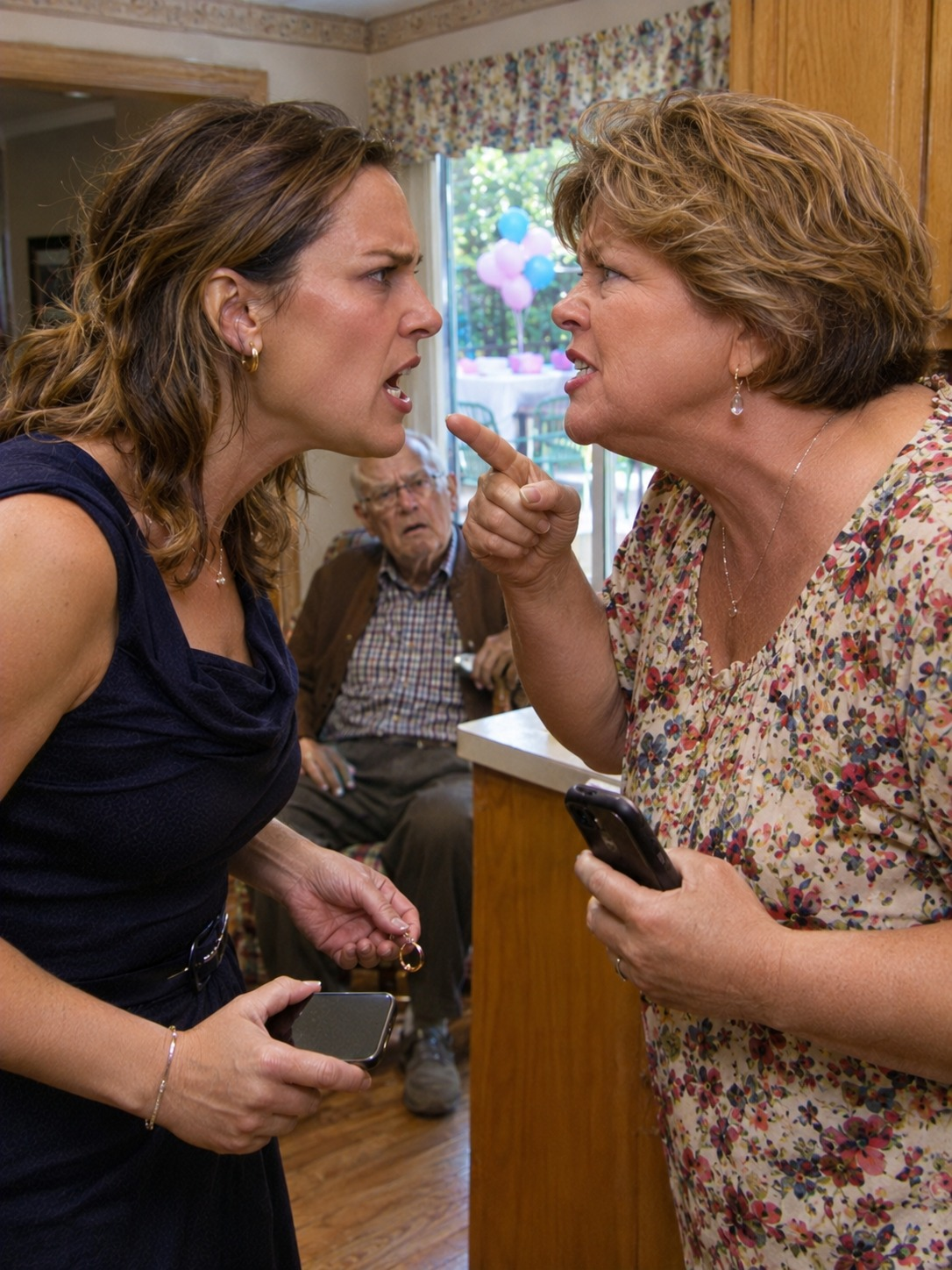
My mother reached across the kitchen counter for the envelope.
Pop covered it with his hand.
"Sharon, sit down."
Nobody moved.
My mother stared at him as if she had never heard those words spoken in that tone before.
"Excuse me?"
"You heard me."
Britney glanced at Kyle. My father wasn't there, and suddenly I wished he were. Whatever was happening had become bigger than a disagreement about a party.
I set my purse on the counter.
"Mom, what's in that envelope?"
"Nothing you need to concern yourself with."
Pop shook his head.
"That's exactly what she said about the other paperwork."
My mother's cheeks flushed.
"Dad, please don't do this in front of everybody."
"Everybody?" Pop looked around the kitchen. "I see my granddaughter, her sister, and a young man who came here carrying balloons. I don't see everybody."
Kyle quietly placed the cardboard box on the floor.
Britney crossed her arms.
"Can we please stop making this weird? We came to celebrate the baby."
Pop looked at her.
"Then celebrate the baby. Nobody told you that you couldn't."
"Becky did."
"No," I interrupted. "I told you that you couldn't use my house without permission."
Britney rolled her eyes.
"Same thing."
"It really isn't."
Mom opened her mouth, but Pop raised one finger.
"I've listened to enough people speak for me this week."
His voice wasn't loud.
That made it more powerful.
He carefully unfolded the envelope and removed several pages. The paper was slightly creased, as though he had carried it around for days.
I noticed a familiar letterhead at the top.
Eleanor Price, Attorney at Law.
I knew Eleanor. She had handled Grandma Dorothy's estate and helped Pop organize his financial affairs after his stroke.
Pop placed the pages in front of me.
"Read the first one."
I pulled out a chair.
The document appeared to be a letter confirming a recent consultation. It described Pop's concerns about several forms his daughter had brought to him and his request for independent legal advice before signing anything.
I looked at the date.
Wednesday.
Two days after Mom's visit.
"Did you see Eleanor?"
"She came to the house Thursday morning."
"Without telling me?"
"You were working."
I glanced at the next page.
It was a copy of a document with a title that made my stomach tighten.
Authorization and Consent for Long-Term Care Assessment.
Below the heading were several sections concerning medical information, financial resources, and the possibility of evaluating residential care arrangements.
I read the first paragraph twice.
"Mom, what is this?"
She immediately reached for the papers.
"That's an assessment form. It's completely routine."
Pop moved the pages closer to me.
"Keep reading, Sergeant."
I did.
The form requested permission to release certain medical records and financial information to a care coordination service.
It also contained language allowing the designated representative to participate in discussions about possible residential placement.
There was nothing inherently wrong with evaluating care options.
But the document had been presented to Pop as ordinary Medicare paperwork.
And he hadn't been given a proper explanation.
"Why didn't you tell him what this was?" I asked.
Mom's expression hardened.
"I was trying to help him."
"Then why did you tell him he didn't need his glasses?"
"I didn't say that."
Pop looked directly at her.
"You did."
She turned toward him.
"Dad, you were confused."
"No, Sharon. I was reading."
Britney let out an impatient breath.
"Grandpa, nobody is trying to hurt you."
Pop nodded slowly.
"I hope that's true."
That answer seemed to bother her more than an accusation would have.
I continued reading.
The next page contained a section identifying the person who would receive information about the proposed assessment.
My mother's name was typed into the representative field.
But what caught my attention was the signature section.
There were two lines.
One for Pop.
One for the proposed representative.
Neither had been completed.
"Mom, did you intend to submit this?"
She looked at the pages.
"Only after Dad agreed."
"Did he agree?"
"He said he'd think about it."
Pop shook his head.
"I said I would read it."
The distinction was small.
But it mattered.
I had spent sixteen years in healthcare. I understood how easily people could confuse consent with cooperation, especially when an elderly patient depended on family members for transportation, medication reminders, and everyday assistance.
A signature was not a formality.
It was permission.
And permission had to be informed and voluntary.
"Why did you bring this to him on Tuesday?" I asked.
Mom folded her arms.
"Because somebody has to plan ahead."
"Plan for what?"
"For the fact that he can't live alone forever."
"He isn't living alone."
"He's living with you because you can't bear to admit he needs more help."
I felt my jaw tighten.
"Pop has an aide. He has medical appointments. He has a safe bedroom. We have a care plan."
"That's not permanent."
"Neither is anything."
Mom looked at me as though I had deliberately misunderstood her.
"You're a hospital director now. You should understand that people deteriorate."
I took a breath.
"Being a hospital director doesn't give me the right to make decisions for him."
For the first time, she didn't have an immediate response.
Pop reached for the envelope again.
"There is another page."
He pulled out a letter from Eleanor.
It was addressed to him, not to my mother.
The first paragraph confirmed that Eleanor had reviewed the unsigned paperwork and advised him not to sign anything until he fully understood its purpose and consequences.
The second paragraph was more personal.
It stated that Pop had specifically requested an independent review of his current living arrangements, financial records, and existing healthcare documents.
I looked up.
"You asked her to do all this?"
"I did."
"When?"
"After your mother left Tuesday."
He paused.
"Something she said bothered me."
"What?"
Pop looked at my mother.
"She asked whether I remembered where my house keys were."
Mom's face changed.
"That's ridiculous."
"Is it?"
"Dad, I was asking because you lose things."
"I misplaced one key last winter. You have apparently decided that means I cannot manage my own life."
I looked at the letter again.
It explained that Pop had requested a review of his existing estate arrangements, including the rental income from his old house in Carrick.
That property had been rented to the Faulkner family for several years.
The Faulkners were buying a home in Dormont and expected to move out at the end of August.
The rent went directly into Pop's personal account.
It helped pay for his care.
Nothing about that arrangement had required my mother to become involved.
Yet she had apparently begun discussing the property's future.
"Mom, what does this have to do with Britney needing a bigger house?"
Britney immediately looked up.
"Nothing."
Pop gave her a quiet look.
"Are you sure?"
She glanced at Mom.
My mother stepped forward.
"That's enough. This is a private family matter."
I looked around my own kitchen.
"Then why did you bring it into my house?"
She ignored the question.
"Your grandfather needs proper care. You work long hours. You have a demanding position. What happens if something goes wrong while you're at the hospital?"
"Deb is here several evenings a week. I have additional coverage arranged."
"And the other nights?"
"I manage them."
"Exactly. You can't keep doing everything."
I studied her face.
For a moment, I wondered whether there was genuine concern beneath her words.
Then she said something that erased the possibility.
"Besides, Britney will need help once the baby arrives. We should be thinking about how to arrange the family homes."
I stared at her.
"What does that mean?"
She glanced toward the hallway.
"Nothing has been decided."
"Then explain it."
Britney shifted uncomfortably.
Mom sighed.
"Your grandfather's house in Carrick is sitting there. Once the Faulkners leave, we could make arrangements. It has three bedrooms."
Pop's fingers tightened around his cane.
I slowly turned toward him.
"Did you know they were discussing this?"
He nodded.
"Your mother mentioned it."
Britney finally spoke.
"Mom thought the house might be perfect for Kyle and me."
The kitchen went silent.
I looked at my sister.
"You're talking about Pop's house?"
"It's not like he's using it."
The words came out casually.
As if she were discussing an empty storage unit.
"Britney, he owns that house."
"Well, yes, but he's not living there anymore."
"That doesn't mean it belongs to you."
She looked irritated.
"I didn't say it belonged to me."
"You just said he wasn't using it."
Kyle finally stepped forward.
"Maybe we should leave this conversation for another time."
For once, I agreed with him.
But Pop wasn't finished.
He carefully placed Eleanor's letter back into the envelope.
"I have something to say."
Mom looked exhausted.
"Dad, please."
"No. Listen."
He leaned forward slightly.
"I worked for forty-two years. I paid for that house. Your mother helped me keep it after Dorothy died. I rented it because I wanted the income to support my care."
He paused to catch his breath.
"That money belongs to me. The house belongs to me. And where I live belongs to me to decide."
Nobody spoke.
Then he looked at Britney.
"I love you, sweetheart. I want you to have a good home for your baby. But I am not giving up my property because you need another bedroom."
Britney's eyes filled with tears.
"Nobody said you had to give it away."
"Then why is your mother asking me to sign papers about long-term care and financial arrangements?"
Britney turned toward Mom.
I noticed the movement.
It was small, but revealing.
My sister hadn't expected Pop to connect those things.
Mom picked up her handbag.
"This conversation is over."
"Not yet," I said.
She turned.
"I have spent years trying to make things easier for this family. I am not going to stand here and be accused of taking advantage of my own father."
"I didn't accuse you of anything. I'm asking you to explain why you're arranging his future without his consent."
Mom looked at me.
"Because someone has to be responsible!"
Pop answered before I could.
"I am responsible for myself."
He placed his hand on the envelope.
"And Eleanor agrees."
I looked at the attorney's letter again.
There was a telephone number at the bottom.
A note in Pop's handwriting appeared beneath it.
Call Friday. Bring Becky.
I pointed to it.
"You wanted me to meet Eleanor?"
"Yes."
"Why didn't you tell me?"
"Because I wanted to understand everything first."
He looked toward my mother.
"And because I didn't want anybody accusing you of putting ideas in my head."
That hurt more than I expected.
He had known what they might say.
He had protected me from accusations before they were even made.
My mother walked toward the kitchen entrance.
"We're leaving."
Britney grabbed her handbag.
Kyle picked up the decoration box.
Before Mom reached the door, Pop spoke again.
"Sharon."
She stopped.
"Those papers are still unsigned."
"I know."
"And I won't be signing them."
She turned slowly.
For a moment, her expression looked almost unfamiliar.
Then she said, "We'll see what the doctor thinks."
Pop's eyes narrowed.
"What doctor?"
Mom didn't answer.
She opened the door and walked outside.
Britney followed her.
Kyle hesitated long enough to give me an uncomfortable look.
"Sorry, Becky."
Then he left too.
I watched their car pull away.
Deb came into the kitchen and quietly began clearing the glasses.
Pop remained seated.
I walked over and knelt beside him.
"Are you okay?"
He nodded.
"Just disappointed."
I took his hand.
"Do you want me to call Eleanor tonight?"
"Tomorrow."
"Are you sure?"
He gave me a small smile.
"You're supposed to be celebrating tonight, Sergeant."
I looked at the clock.
Six forty-seven.
My dinner had already started without me.
I picked up my purse and checked my phone.
There were three missed calls from Helen and one message.
Everything okay? We're saving your seat.
I replied that I was on my way.
Then I noticed another notification.
An unfamiliar number had sent me a text.
Becky Ford? This is Margaret from the care coordination office. Your mother contacted us regarding your grandfather's residential assessment. We need to confirm something before Monday.
I stared at the screen.
Pop noticed my expression.
"What is it?"
I read the message again.
Then another text arrived.
Our records indicate that a family representative has already requested a preliminary placement review.
My stomach dropped.
I looked at Pop.
"Did you authorize anybody to arrange a residential assessment?"
He shook his head.
"No."
I typed a response asking who had submitted the request.
The reply came almost immediately.
Your mother provided the contact information and listed herself as his authorized family representative.
Then a final message appeared.
There is also a scheduled assessment appointment for Monday morning, and the person listed as the primary decision-maker is...



Comments 0