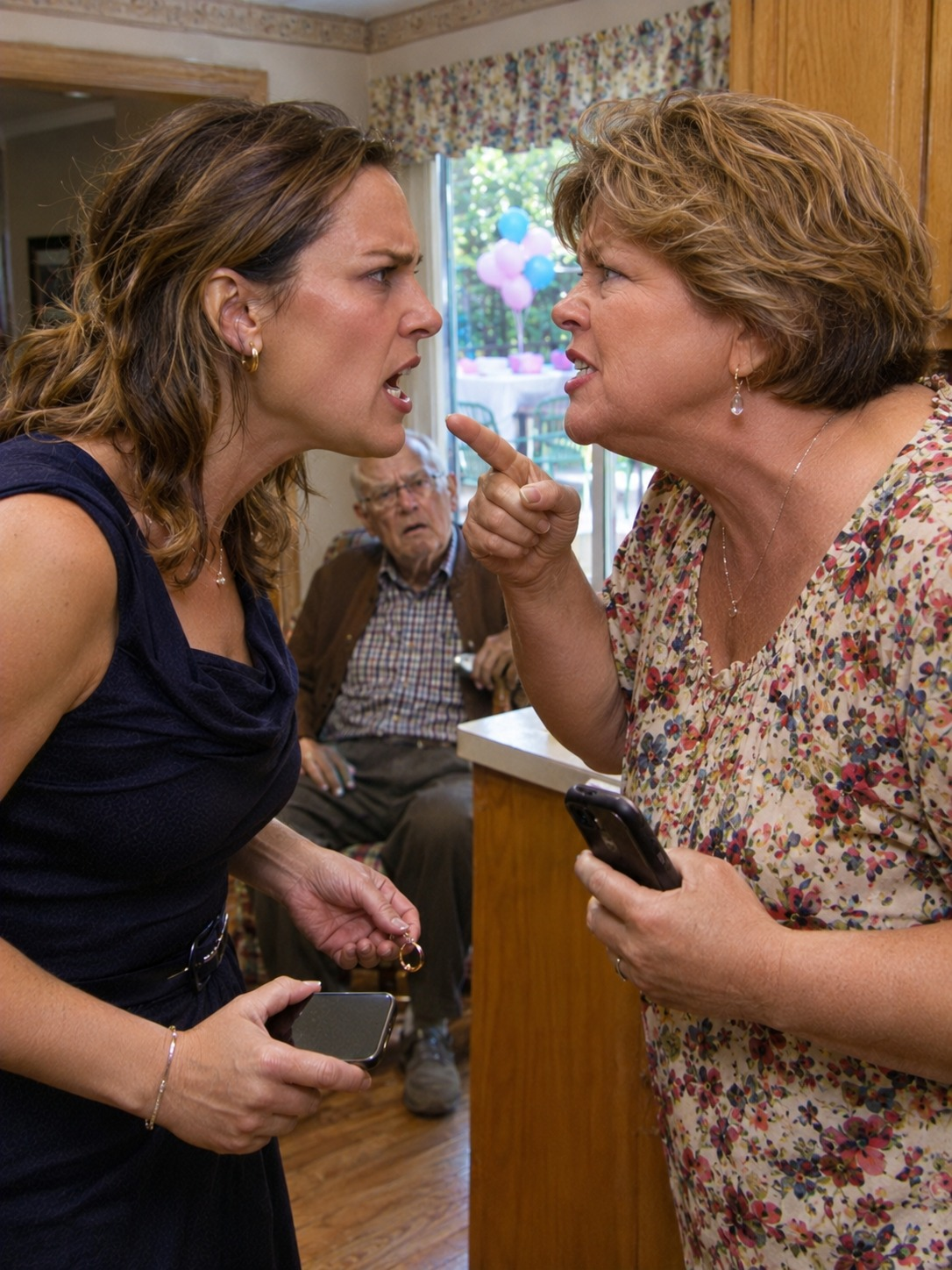
"Your grandmother named the person who was supposed to inherit the house."
Aunt Linda's words continued echoing in my head long after the call disconnected.
I stood in the kitchen with my phone pressed against my ear, waiting for her to call back.
Nothing.
Pop was sitting across from me, his hands resting on the wooden table.
"Call her again, Sergeant."
I did.
This time, Linda answered after the second ring.
"Are you alone?" she asked.
"Pop is here with me."
"Good. I want him to hear this too."
Pop leaned toward the telephone.
"Linda, what did Dorothy leave with you?"
His sister-in-law took a breath.
"An envelope. She gave it to me about six months before she died."
Pop looked stunned.
"Why didn't you tell me?"
"Because she asked me not to."
"She was my wife, Linda."
"I know, Frank. But she made me promise."
I watched Pop's expression change.
Linda continued.
"She said that if anybody ever tried to pressure you into giving away the Carrick property, I was supposed to bring the envelope to you."
Pop rubbed his forehead.
"What was in it?"
"Several documents. A letter, a copy of the original property deed, and something from an attorney."
I felt my heartbeat quicken.
"An attorney?"
"Yes. Dorothy had spoken to someone about protecting the house."
Pop looked at me.
"Why would she do that?"
Linda answered before I could.
"Because she was worried about Sharon."
The kitchen became completely silent.
Pop slowly removed his glasses.
"What do you mean?"
"Your wife believed Sharon was becoming too interested in the property."
"That's my daughter."
"I know."
"Why would Dorothy think that?"
Linda hesitated.
"Because Sharon had asked her about changing the ownership arrangements several times."
I stared at the phone.
My mother had apparently been discussing the property with Grandma long before Grandma died.
"What exactly did Mom want?" I asked.
Linda sighed.
"She wanted Dorothy to add her name to the deed."
Pop shook his head.
"That never happened."
"No. Dorothy refused."
"Why?"
"She said the house belonged to you and that nobody should be added without your agreement."
Pop leaned back.
I could see memories moving across his face.
He and Grandma had been married for nearly sixty years.
He knew her habits, her expressions, and the particular way she became quiet when something troubled her.
He had never mentioned that she was worried about their daughter.
"Linda," he said, "I want that envelope."
"I'll bring it tomorrow."
"Tomorrow?"
"I don't want to discuss this over the telephone."
Pop looked frustrated.
"Why not?"
"Because I think you need to see everything together."
I interrupted.
"Linda, is there anything in those documents that could affect the current property transfer?"
A pause.
"Yes."
"What?"
"I believe Dorothy created a legal arrangement that would prevent the house from being transferred without Frank's independent approval."
Pop stared at the table.
Then Linda added something else.
"There's also a letter explaining why she made that decision."
Linda arrived the following afternoon at eleven fifteen.
I recognized her silver SUV before she reached the front steps.
She carried a brown leather handbag and a large manila envelope.
When I opened the door, she looked exhausted.
"Hello, Becky."
"Hi, Aunt Linda."
She hugged me.
Then she looked past my shoulder.
"Frank?"
"I'm here."
Pop was waiting in the living room.
Linda approached him and kissed his cheek.
For a moment, neither spoke.
Then she placed the envelope on the coffee table.
"I should have brought this to you years ago."
Pop looked at her.
"Why didn't you?"
"Because Dorothy asked me to wait until there was a reason."
He looked down.
"And now there is."
Linda nodded.
She opened her handbag and removed a smaller envelope.
The handwriting on the front was unmistakable.
For Frank. Only if someone tries to take our home.
Pop stared at it.
His fingers began trembling.
I had seen those hands repair broken engines, replace kitchen cabinets, and build a wooden swing for me when I was seven.
Now they struggled to open a simple envelope.
"Would you like me to help?" I asked.
He shook his head.
"No. I can do this."
He carefully opened the flap.
Inside was a handwritten letter.
He unfolded it.
Then he began reading aloud.
"My darling Frank..."
His voice broke.
He stopped.
Linda looked away.
I sat beside him.
"Take your time, Pop."
He swallowed and continued.
If you are reading this, something has happened that I hoped we would never have to face.
I know how much you love this family. I know you would give away your last dollar to help our children.
But I also know that sometimes love makes people forget where kindness ends and responsibility begins.
Pop paused.
I felt tears gathering in my eyes.
He continued.
The house in Carrick is not a prize for anyone to claim. It is the home we built together. You should never feel pressured to give it away simply because somebody else wants it.
If you decide to sell it, give it away, or keep it until the end of your life, that decision belongs to you.
Please don't let anyone make you feel guilty for choosing.
Pop lowered the letter.
For several seconds, he couldn't speak.
Linda reached for a tissue.
He accepted it.
Then he continued reading.
I have spoken with an attorney about making sure our wishes are documented properly. I asked him to prepare a separate set of instructions so that nobody can use your illness, age, or dependence on assistance as an excuse to take away your independence.
I trust you, Frank.
I always have.
Your Dorothy.
Pop folded the letter.
He pressed it against his chest.
I had never seen him cry like that.
Not even at Grandma's funeral.
I put my arm around his shoulders.
Linda sat quietly across from us.
After several minutes, Pop finally spoke.
"She knew."
Linda nodded.
"She was worried."
"Why didn't she tell me?"
"She didn't want you fighting with Sharon."
Pop closed his eyes.
"She should have told me."
"I know."
He looked toward the photograph on the shelf.
"She always thought she could solve everything before anybody noticed there was a problem."
Linda gave a sad smile.
"That sounds like Dorothy."
The next document was a copy of the original property deed.
It confirmed that the Carrick house had been purchased by Frank and Dorothy Ford.
There was also a separate attorney's letter dated several years before Dorothy's death.
The letter explained that Dorothy had requested a review of the family's property arrangements and wanted Frank's independent decision-making authority protected.
I read it twice.
Then I noticed another page.
It was a certificate of trust.
I looked at Linda.
"What is this?"
She leaned forward.
"That's the document Dorothy wanted Frank to have."
Pop adjusted his glasses.
The certificate identified a family property trust established several years earlier.
The Carrick property had been transferred into the trust through a properly executed deed.
Pop was named the surviving trustee.
The document also identified the conditions under which the property could be sold or transferred.
One provision was especially important.
Any transfer required Frank's informed written consent while he remained capable of making his own decisions.
No family member could substitute their preference simply because they believed the arrangement would benefit the family.
I looked at Eleanor's earlier correspondence.
This was exactly the kind of document she needed.
"Pop, did you know the house was in this trust?"
He shook his head slowly.
"I remember Dorothy mentioning something about protecting the property. I thought she was talking about the insurance."
Linda explained that Dorothy had worked with an attorney to organize the arrangement after noticing that family members were asking increasingly frequent questions about the property's value.
"She didn't want anybody fighting over it," Linda said.
Pop looked at the document.
"Who is the successor trustee?"
Linda turned the page.
"That's the part I wasn't sure you were ready to see."
I leaned closer.
The document named a successor trustee if Pop became unable or unwilling to continue serving.
It was not my mother.
It was not my father.
And it wasn't Britney.
The name was mine.
Becky Ford.
I stared at the page.
"What?"
Linda nodded.
"Dorothy chose you."
Pop looked at me.
For a moment, neither of us spoke.
"Why me?" I whispered.
Linda smiled sadly.
"Because she trusted you to put his wishes before your own."
I felt tears sting my eyes.
I remembered Grandma sitting at my kitchen table years earlier, watching me study for my nursing exams.
She had always said that I had a habit of looking after people even when nobody asked.
I had never understood how much she had noticed.
Pop reached for my hand.
"Your grandmother knew you."
I squeezed his fingers.
"I don't want the house, Pop."
"I know."
"I don't want anybody thinking I'm doing this for myself."
He nodded.
"That's why she chose you."
Linda handed me another document.
It was a letter from Dorothy to the attorney.
The instructions were clear.
The trust existed to protect Frank's housing security and property rights.
The successor trustee was not entitled to treat the property as personal inheritance.
The house was not intended to become a family bargaining chip.
And Frank's wishes remained central.
I read the final paragraph.
If my husband wishes to remain in his home, the family should help make that possible. If he wishes to sell, he should be supported in making that decision freely. Nobody should use his age to take away his choices.
I placed the paper on the table.
For the first time since this ordeal began, I felt that we had something stronger than suspicion.
We had evidence of Grandma's intentions.
I called Eleanor.
She arrived within forty-five minutes.
Linda explained everything while Eleanor reviewed the documents.
When she reached the trust certificate, she asked to see the original.
Linda carefully removed it from the envelope.
Eleanor examined the signatures, dates, and attached certification.
"This is important," she said.
"Does it stop the deed transfer?" I asked.
"It gives us a much clearer basis to challenge the proposed transaction. We still need to verify the trust's current status and obtain the recorded property documents, but this changes the situation considerably."
Pop leaned forward.
"Can Sharon transfer the house?"
"Not simply because she wants to. We need to review the governing documents and confirm the current record, but she has no authority merely by being your daughter."
Eleanor examined the successor trustee provision.
Then she looked at me.
"Becky, do you understand what this appointment means?"
I nodded.
"It means I would act only if the conditions for succession were met."
"Correct. And your responsibility would be to follow the trust's terms, not to make decisions based on personal preferences."
"I understand."
Pop looked at Eleanor.
"Can we make sure nobody changes anything without my knowledge?"
"Yes. We'll notify the appropriate institutions, request the necessary property-record safeguards, and make sure all communications go through you and your attorney."
He nodded.
"Good."
Then he looked at Linda.
"Thank you for keeping Dorothy's letter."
Linda began crying.
"I should have told you sooner."
Pop reached for her hand.
"Maybe. But you brought it when it mattered."
She wiped her cheeks.
I watched them.
For years, Linda had been the relative who stayed out of family arguments.
Now she had brought the one document that might protect Pop from the very people who were supposed to care about him.
But the discovery also raised another question.
If Grandma had established this trust years earlier, why had my mother continued preparing documents to transfer the house?
Eleanor seemed to be thinking the same thing.
She turned to Linda.
"Do you know whether Sharon was ever given a copy of these documents?"
Linda hesitated.
Then she nodded.
"Yes."
Pop looked up sharply.
"When?"
"After Dorothy died."
I felt my stomach tighten.
Linda opened her handbag again.
"There was another meeting. Sharon came to my house because she wanted copies of Dorothy's estate papers."
"Did you give them to her?" I asked.
"Yes. I gave her copies of the documents Dorothy had authorized me to share."
"All of them?"
Linda looked at the trust certificate.
"Almost."
"What does that mean?"
She reached into the bottom of her handbag and removed a small, sealed envelope.
The handwriting on it was Dorothy's.
"This one wasn't included in the copies I gave Sharon."
Eleanor looked at the envelope.
"What's inside?"
Linda shook her head.
"I never opened it. Dorothy told me it was meant for Frank, but only if Sharon ever attempted to transfer the house."
Pop stared at the envelope.
"Then open it."
Linda turned it over.
There was a second handwritten line beneath the address.
If Sharon asks about the Carrick property again, give Frank this letter before anyone signs anything.
Eleanor carefully examined the seal.
Then she looked at Pop.
"Frank, I think we need to read this together."
Pop reached for the envelope.
But before his fingers touched it, Linda quietly said something that made all of us stop.
"Frank, there's a reason Dorothy wanted this particular letter kept separate."
She pointed to the final line.
And beneath it was a name that nobody in the room had expected to see.
Curtis Ford.
Comments 0