"My mother is dead."
The words came out so quietly that I barely recognized my own voice.
Samuel Whitaker stood in the doorway of the bunkhouse, holding the telegram as though it might burn his fingers.
Caleb remained beside me.
His mother's silver ring rested against my skin, still warm from the moment he had slipped it onto my finger.
For fifteen years, I had believed Margaret Parker lay beneath a white marble headstone in Chicago.
I remembered standing beside that grave.
I remembered Father's hand on my shoulder.
I remembered the rain.
And now a bank clerk was claiming she had walked into a Chicago office and taken the original deed to Hayes Ranch.
"Read it again," I said.
Whitaker unfolded the telegram.
"Trust packet opened by authorized bearer. Identification recorded as Margaret Parker. Original Hayes deed removed under authorization signed by Henry Parker."
I stared at him.
"That doesn't mean she's alive."
"No," Whitaker admitted. "It doesn't."
Caleb looked at the attorney.
"Could someone have used her name?"
"Yes."
"Then that's where we begin."
I turned toward Caleb.
He took my hand.
"We'll find out what happened, Evelyn."
I looked at the ring on my finger.
Only minutes earlier, he had asked me to marry him.
Now the past had returned with one final cruelty.
But this time, I wasn't standing alone.
"Send another telegram," I told Whitaker. "Ask the bank for a description of the woman. Her signature. The authorization. Everything."
Whitaker nodded.
"And the deed?"
"We'll recover it."
My voice steadied.
"Whatever my father intended, whatever my mother knew, I'm finished letting dead people's secrets decide how the living must suffer."
The reply arrived the following afternoon.
I was in the kitchen with Sarah when Caleb rode back from town.
He dismounted before his horse had fully stopped.
I hurried outside.
"Well?"
He handed me the telegram.
I read it beneath the cold autumn sky.
The woman who had collected the deed was approximately sixty years old, with silver hair, brown eyes, and a slight limp.
She had presented a letter bearing Father's signature and a notarized authorization dated fifteen years earlier.
The bank clerk had not recognized her personally.
He had simply accepted the identification she provided.
But one detail caught my attention.
The woman had signed the receipt with the initials M. E. Parker.
My mother's full name had been Margaret Elizabeth Parker.
I stared at the letters.
Then I looked at Whitaker, who had ridden back with Caleb.
"Did Mother ever have a sister?"
He hesitated.
"Yes."
My heart began to pound.
"What?"
"Your aunt Miriam."
I stared at him.
"I don't have an aunt Miriam."
Whitaker lowered his eyes.
"Your mother had a younger sister. Miriam Elizabeth Parker."
"Why have I never heard of her?"
"Because your father forbade the family from speaking about her after your mother's death."
I felt something cold move through my chest.
"Why?"
Whitaker took a breath.
"Because Miriam accused him of causing your mother's death."
For a moment, the world seemed to tilt.
Caleb caught my elbow.
I looked at the attorney.
"Tell me everything."
We sat around the kitchen table while Whitaker told me the story my father had buried.
Fifteen years earlier, my mother had discovered the proposed marriage agreement between the Parker and Hayes families.
She had been furious.
Not because Caleb was a rancher.
Not because Wyoming was far from Chicago.
But because Father had considered using my future as part of a business settlement without asking me.
Mother had demanded that he cancel the arrangement.
Father agreed.
But Arthur Bell refused to release the original documents.
He threatened to expose the financial losses connected to Parker Western Holdings unless Father continued cooperating.
Mother decided to travel west herself.
"She wanted to speak with the Hayes family," Whitaker said. "She believed the matter could be settled without involving you."
I stared at him.
"She came to Wyoming?"
"Yes."
"Did she reach the ranch?"
Whitaker shook his head.
"Not that I know of."
He explained that Mother had fallen ill during the journey.
She returned to Chicago suffering from a severe infection.
She died several weeks later.
I closed my eyes.
The long illness Father had described hadn't been entirely false.
But he had concealed where it began.
"And Miriam?" I whispered.
"She blamed your father for allowing Margaret to travel while already unwell."
I looked down at my hands.
Mother had always been strong-willed.
She had taught me to speak clearly, work carefully, and never mistake obedience for goodness.
Now I understood why Father had spent the rest of his life insisting that I should choose my own husband.
He had learned that lesson too late to tell her.
"Did Father know Miriam was alive?" I asked.
"Yes."
"Did he know where she was?"
Whitaker nodded.
"She moved to Illinois. They exchanged letters occasionally, but they never reconciled."
I swallowed.
"And you never told me?"
He looked ashamed.
"Your father asked me not to."
I thought of Daniel.
Of Caleb's father.
Of Mercer.
Of all the people who had kept secrets because they believed silence would protect someone.
"Samuel," I said, "I wish you'd trusted me enough to tell me the truth."
He lowered his head.
"So do I."
Two days later, Miriam Parker arrived at Hayes Ranch.
She stepped down from the stagecoach wearing a dark traveling dress and carrying a worn leather satchel.
Her hair was silver.
Her eyes were brown.
And when she looked at me, I saw my mother's face.
Not exactly.
But enough that I forgot how to speak.
"Evelyn," she said.
Her voice trembled.
I stared at her.
"You're Miriam?"
She nodded.
"Your mother's sister."
For a moment, neither of us moved.
Then she opened her arms.
I stepped into them.
She held me tightly.
And I cried.
I cried for the mother I'd lost.
For the years I hadn't known I had another family member.
For the girl who had stood beside a grave and believed the world had become smaller.
Miriam stroked my hair.
"Margaret would have been so proud of you."
I closed my eyes.
I hadn't known how much I needed to hear those words.
That evening, Miriam explained the deed.
Father had placed the original Hayes document in a sealed trust packet because he feared Bell would destroy it.
He had given Miriam a separate authorization permitting her to retrieve the papers if the dispute resurfaced.
The authorization was old, but it remained valid under the bank's instructions.
"When Samuel began sending inquiries," she said, "I knew Bell's fraud had finally come to light."
"Why didn't you contact me first?"
"I tried."
She opened her satchel.
Inside were three letters addressed to me.
All had been returned.
The addresses were old.
One had been sent to the Chicago house I no longer occupied.
Another to a warehouse office my brothers had closed.
The third had reached Dry Creek after I had left town for the ranch.
"I was afraid the deed might disappear before I found you," Miriam said. "So I collected it myself."
She reached into the satchel.
Then she placed a thick envelope on the table.
My heart began to pound.
Caleb stood beside me.
Miriam broke the seal.
Inside was the original Hayes deed.
The parchment was yellowed with age.
The signatures were clear.
And the water rights provision was unmistakable.
The Hayes family retained permanent ownership of the creek crossing and the northern water access.
Parker Western Holdings had received only a temporary right to transport freight across the land.
That right had expired years earlier.
I looked at Caleb.
His face had gone pale.
"Is it real?" he whispered.
Whitaker examined the seals.
Then he nodded.
"Yes."
Caleb sat down slowly.
For a moment, he couldn't speak.
I placed my hand over his.
"The ranch is yours."
He looked at me.
His eyes filled.
"Our ranch," he whispered.
I smiled through my tears.
"Yes."
The hearing took place three weeks later.
By then, winter had settled over Dry Creek.
Snow covered the mountains.
The creek ran dark beneath a thin crust of ice.
And the courthouse was crowded with ranchers, merchants, and townspeople who had followed the dispute for months.
Deputy Porter presented William Crane's sworn testimony.
Crane described how Arthur Bell had ordered him to prepare the Hayes barn for burning.
He admitted placing oil-soaked material beneath the hay.
He explained that lightning had started the prairie fire before he returned to ignite the barn himself.
He also testified that Bell had intended Caleb to die.
When the prosecutor asked why Crane had finally confessed, the man looked toward Caleb.
"Because Daniel Hayes died trying to save people from a fire I helped make more dangerous."
His voice broke.
"I've spent every night since wishing I'd stopped Bell before it happened."
Caleb listened without moving.
He didn't forgive Crane.
But he didn't turn away.
Judge Mercer testified next.
His wound had healed enough for him to stand with assistance.
He admitted accepting money from Whitcomb.
He admitted providing Bell with the ranch plans.
He admitted concealing evidence.
Then he handed over the notebook containing his records.
Every payment.
Every meeting.
Every false filing.
He did not ask the court for mercy.
He simply told the truth.
Charles testified after him.
I watched my brother take the stand.
He looked thinner.
Older.
But when he raised his hand to swear the oath, he did not look away.
He admitted authorizing threats against the Hayes family.
He admitted transferring company funds into his private accounts.
He admitted signing documents without my permission.
And he admitted telling Bell that Daniel possessed evidence of the fraud.
When the prosecutor asked whether he had known Bell intended murder, Charles answered clearly.
"No."
Then he added, "But I knew enough to stop helping him. I chose not to."
I closed my eyes.
It was the first time I had heard him accept responsibility without offering an excuse.
The court ruled that the forged transfers were invalid.
The original Hayes deed was recognized as controlling evidence of the family's ownership and water rights.
Whitcomb's claim against the cattle and equipment was dismissed.
The false debt was canceled.
The court ordered the remaining assets connected to the fraudulent transactions preserved for restitution.
Arthur Bell was convicted of conspiracy, attempted murder, fraud, and related offenses.
Whitcomb was convicted for his part in the financial scheme and the threats against the Hayes family.
Mercer and Crane received sentences reflecting their participation and cooperation.
Charles pleaded guilty to fraud and conspiracy-related charges.
He was ordered to surrender the funds and assets he had improperly taken and to serve a custodial sentence.
There was no miraculous escape from the consequences.
No sudden declaration that everyone had been innocent.
The men who had harmed the Hayes family were held responsible.
And the ranch was finally free.
After the hearing, Caleb and I walked to Daniel's grave.
The cemetery stood on a low hill overlooking Dry Creek.
Snow lay between the headstones.
Caleb carried a small bundle of pine branches.
He placed them beside his brother's marker.
For a long time, he said nothing.
Then he knelt.
"Daniel," he whispered, "we found the papers."
I stood a few steps away.
He touched the stone.
"Father didn't sell the ranch. You were right."
His voice trembled.
"I'm sorry I didn't listen."
The wind moved gently through the trees.
Caleb bowed his head.
"I wish I'd told you how proud I was of you."
Tears slipped down my cheeks.
He stayed there for several minutes.
Then he stood.
When he turned toward me, his eyes were red.
But something in his face had changed.
The grief remained.
It always would.
Yet the terrible certainty that he had failed his brother had finally begun to loosen.
I took his hand.
"Ready to go home?"
He looked toward the mountains.
Then he smiled.
"Yes."
The rebuilding began in earnest that spring.
Parker Freight entered into a properly negotiated shipping agreement with Hayes Ranch.
This time, Caleb and I reviewed every provision together.
The company provided transport at fair commercial rates.
The ranch retained full ownership of its land, cattle, and water.
A separate restitution fund, recovered from the fraudulent accounts, paid for the losses caused by Bell's scheme.
Caleb insisted on keeping careful records.
I insisted on teaching him how to read a balance sheet.
He complained that numbers were more stubborn than cattle.
I told him cattle rarely tried to hide their expenses in the wrong column.
He laughed.
And sometimes, when we were working late, he would lean across the table and kiss me until I forgot which figures I had been adding.
We rebuilt the barn first.
Then the fences.
Then the main house.
Sarah chose the color for the kitchen walls.
Ben insisted the new stable needed a proper place for his wooden horse.
Miriam stayed long enough to help plant a garden beside the porch.
She told me stories about Mother.
Not only the sad ones.
She told me how Margaret had once climbed onto a table at a family dinner to prove a point about women's education.
How she had refused to marry Father until he promised never to interfere with her books.
How she had laughed so loudly at a terrible joke that everyone else began laughing too.
For the first time in years, my memories of Mother became more than the memory of losing her.
She became a woman again.
A woman who had lived.
Loved.
Argued.
Made mistakes.
And taught her daughter to be brave.
Charles wrote to me from prison that summer.
His letter was short.
He didn't ask for money.
He didn't ask me to intervene.
He told me he was working in the prison bookkeeping office and had begun repaying what he could.
He wrote that he understood if I never forgave him.
I read the letter twice.
Then I sat down and answered.
I told him that forgiveness would take time.
I told him that I hoped he would continue making honest choices.
And I told him that being my brother did not erase what he had done.
But it did mean I was willing to believe he could become better than the man who had stood beside Arthur Bell.
When I finished, I sealed the letter.
Then I returned to the porch, where Caleb was repairing a broken chair.
"Everything all right?" he asked.
I nodded.
"I think so."
He smiled.
"Good."
I sat beside him.
For a while, we listened to the evening birds.
Then he reached for my hand.
"Are you ready for Saturday?"
My heart lifted.
Saturday.
Our wedding day.
We married beneath the cottonwood trees beside the creek.
The same creek Bell had tried to steal.
The same land Caleb had nearly lost.
The same place where Daniel had grown up, where Sarah had raised Ben, and where I had arrived believing I might be turned away before supper.
The morning was warm.
Wildflowers covered the meadow.
Sarah wore a pale blue dress.
Miriam stood beside me, holding Mother's faded blue scarf.
I had brought that scarf from Chicago.
It had hung in the bunkhouse during my first weeks at the ranch.
Now Miriam folded it carefully around my shoulders.
"Your mother would have loved this," she whispered.
I looked toward Caleb.
He stood beneath the trees wearing a dark suit.
His scar was visible.
His injured hand rested at his side.
He had refused to wear gloves.
"I want to marry you as I am," he had told me.
I had kissed his scar and answered, "That's the only man I've ever wanted."
Ben walked me down the aisle.
He wore a small vest and looked so serious that I nearly laughed.
When we reached Caleb, the boy placed my hand in his uncle's.
"Take care of her," Ben whispered.
Caleb smiled.
"I will."
Ben looked at me.
"And you take care of him."
"I promise."
The minister began.
I barely heard the first words.
I was looking at Caleb.
At the man who had stood in the doorway of a burned ranch house and told me I should leave.
At the man who had believed his scars made him unworthy of love.
At the man who had learned to let someone stand beside him instead of carrying every burden alone.
When it was time for our vows, Caleb took both my hands.
"Evelyn," he said, his voice rough with emotion, "when you arrived, I thought my life had already ended."
My eyes filled.
"I thought the fire had taken everything worth keeping."
He smiled faintly.
"Then you walked into my kitchen and told me my roof was terrible."
The guests laughed.
I laughed too, through my tears.
"And somehow," he continued, "you made me believe I could build something again."
He squeezed my hands.
"I promise to love you when the days are easy and when they're hard. I promise to tell you the truth, even when I'm afraid. I promise to listen when you speak, and to remember that this life belongs to both of us."
I swallowed.
Then I spoke.
"Caleb, I came here because I wanted someone to love me for who I was."
My voice trembled.
"I didn't know I would find a man who needed the same thing."
His eyes filled.
"I promise never to measure your worth by what you've lost. I promise to stand beside you, not in front of you. I promise to share my fears instead of hiding them, and to trust you with the parts of myself I once believed I had to protect."
I smiled.
"And I promise to keep telling you when your roof is terrible."
Everyone laughed again.
Caleb grinned.
"Fair enough."
The minister pronounced us husband and wife.
Caleb kissed me.
And the whole meadow erupted in applause.
That evening, after the guests had gone and the lanterns were burning low, Caleb and I stood on the porch of our new house.
The barn stood strong against the darkening sky.
The fences stretched across the pasture.
Thirty-seven cattle had become fifty-two.
The creek flowed steadily through the northern meadow.
Inside, Sarah was helping Ben finish the last of the wedding cake.
Miriam sat near the stove, telling him another story about my mother.
Caleb slipped his arm around my waist.
"Mrs. Hayes."
I smiled.
"Mr. Hayes."
He looked down at me.
"Any regrets?"
I pretended to consider.
"Well, the roof could still use some work."
He laughed.
Then he kissed my forehead.
"I suppose I'll spend the rest of my life trying to satisfy you."
"That sounds like an excellent plan."
We stood together, watching the stars appear.
After a while, Caleb grew quiet.
"What are you thinking?" I asked.
He looked toward the old barn foundation, now covered by a patch of wildflowers.
"About Daniel."
I squeezed his hand.
"He would have been happy today."
Caleb nodded.
"I think so."
Then he looked at me.
"And about the day you arrived."
I smiled.
"You told me to go back to Chicago."
"I was a fool."
"A very stubborn fool."
He laughed softly.
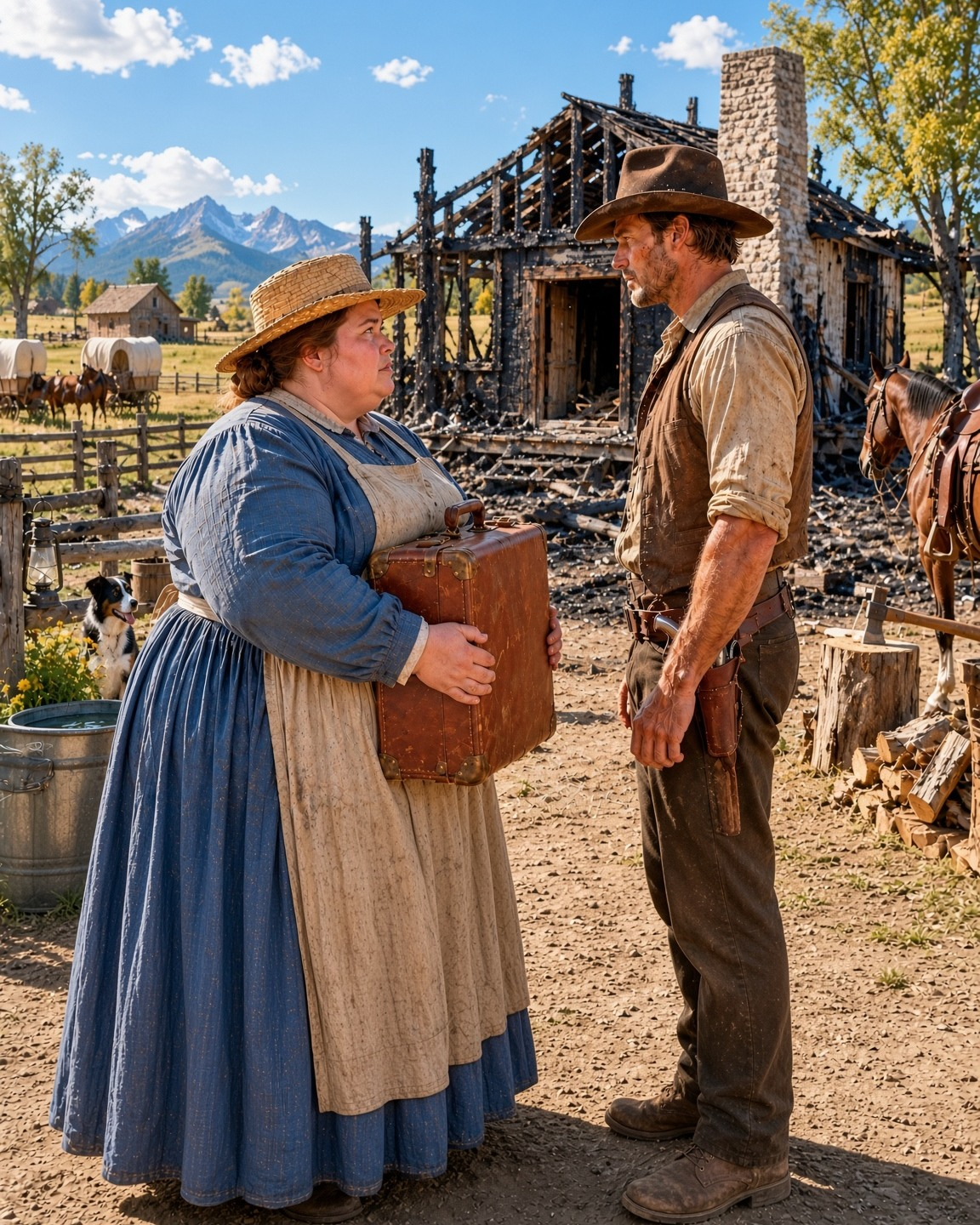
"I remember you standing in the yard with your suitcase. You looked at the burned house, the broken fence, and all those cattle."
"And?"
"And you said you weren't leaving."
I rested my head against his shoulder.
"I meant it."
"I know."
He turned toward me.
"But Evelyn, there's something I've wanted to tell you."
I looked up.
"What?"
He took my hand and placed it against his heart.
"You didn't save this ranch because you had money."
I smiled faintly.
"I know."
"You saved it because you believed it was worth saving."
He paused.
"And you made me believe I was worth saving too."
Tears filled my eyes.
I touched his cheek.
"You were always worth loving, Caleb."
He kissed me gently.
Then he drew me close.
For the first time since I had arrived in Wyoming, there was nothing left to prove.
The ranch was secure.
The truth had been told.
The people who had harmed us had faced justice.
Sarah and Ben had a home.
Miriam had found her family again.
And Caleb and I had chosen each other freely, without contracts, conditions, or promises made by anyone else.
Later, when the house grew quiet, we went inside.
Caleb carried me across the threshold despite my protests that I was perfectly capable of walking.
He nearly stumbled over the rug.
I laughed so hard that he had to stop and laugh with me.
Then he set me down, took my face in his hands, and kissed me beneath the warm light of our kitchen.
Outside, the Wyoming wind moved through the cottonwoods.
Inside, the fire burned gently in the hearth.
I looked around at the home we had built together.
Not the home my father had planned.
Not the future Arthur Bell had tried to steal.
Not the lonely life Caleb had believed he deserved.
Ours.
I had come to Hayes Ranch with one suitcase, my mother's blue scarf, and a stubborn refusal to leave.
I stayed because I found a man who learned to open his heart.
And because, somewhere between the ashes and the first green shoots of spring, we had discovered that love wasn't something either of us needed to earn.
It was something we could choose.
Every morning.
Every difficult day.
Every beautiful year still waiting for us.
Caleb reached for my hand.
"Welcome home, Evelyn."
I smiled.
"I'm already home."






Comments 0