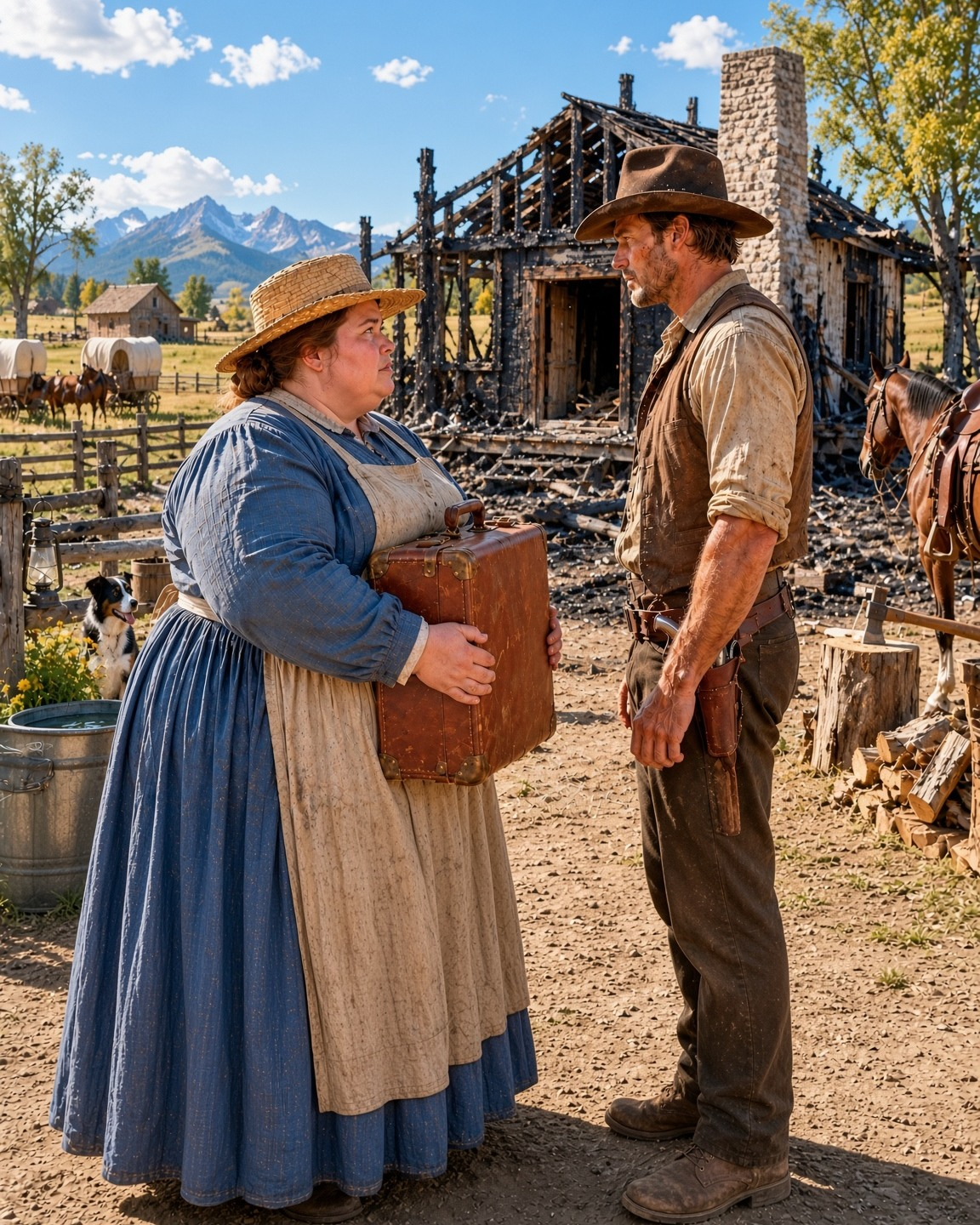
"Open the door, Hayes. I've come to tell you who really started that fire."
Caleb reached for his revolver.
Sarah grabbed Ben and pulled him behind her.
I stood beside the kitchen table, holding Daniel's final letter, while the stranger outside knocked again.
Three slow knocks.
Then silence.
"Who are you?" Caleb demanded.
A familiar voice answered.
"Someone your brother trusted more than he trusted you."
Caleb's face changed.
I recognized the voice from the night we discovered Daniel's metal box.
The stranger who had warned us about the old mill.
Caleb opened the door just wide enough to see him.
The man stood beneath the porch lantern, holding his black hat against his chest. His coat was torn near the shoulder, and a dark bruise marked the side of his face.
He looked as though someone had recently beaten him.
"My name is Thomas Reed," he said. "I worked with Daniel before the fire."
Caleb didn't lower his revolver.
"Then start talking."
Thomas glanced toward Sarah.
"I'm sorry, Mrs. Hayes."
She went pale.
"Why?"
"Because I should have come sooner."
He reached into his coat and removed a folded piece of paper.
"Daniel asked me to deliver this if anything happened to him."
Caleb stared at the paper.
"Then why did you wait six weeks?"
Thomas looked down.
"Because I was afraid."
I stepped closer.
"Of Arthur Bell?"
He nodded.
"Bell found out Daniel had been asking questions about the water rights. He knew about the second book. He knew about the original survey."
Caleb's jaw tightened.
"And the fire?"
Thomas looked toward the burned barn.
"Daniel believed someone intended to burn the old mill. He thought Bell wanted to destroy the records hidden there."
"Then why did the ranch burn?" I asked.
Thomas swallowed.
"Because the storm changed everything."
He explained that lightning had struck the southern ridge during the dry storm. The prairie fire had begun naturally, just as Caleb remembered. But Thomas had seen two riders near the old mill earlier that afternoon, carrying cans of lamp oil.
He had recognized one horse as belonging to Arthur Bell.
"Daniel went looking for them," Thomas said. "He thought they were going to destroy the evidence."
Caleb stared at him.
"Did you see anyone set a fire?"
"No."
"Then you don't know who started it."
Thomas lowered his eyes.
"No. I only know Bell was prepared to burn the mill before the storm arrived."
Sarah pressed a hand against her mouth.
Ben looked from one adult to another.
"Did Dad go to the mill that day?"
Thomas nodded.
"He came back before the lightning struck. He told me to keep the second book hidden."
Caleb looked toward the window.
For weeks, he had blamed himself for Daniel's death.
Now he was discovering that his brother had spent his final days trying to protect the family from something none of them understood.
"Why did Daniel warn me away from the barn?" Caleb asked.
Thomas hesitated.
"Because he thought Bell might come back for the papers."
Caleb's expression hardened.
"Daniel died opening the pasture gates."
"I know."
"Then stop talking as though someone murdered him."
Thomas looked at him with exhausted eyes.
"I'm not saying Bell killed Daniel. I'm saying Bell was willing to risk lives to protect what he'd stolen."
The distinction mattered.
I could see Caleb struggling with it.
A person could be responsible for terrible choices without being responsible for every tragedy that followed.
But Caleb had spent so long searching for someone to blame that uncertainty felt almost unbearable.
Thomas placed the folded paper on the table.
"Daniel wanted you to have this."
Caleb opened it.
There were only two sentences.
Caleb, if you find the second book, don't let Bell convince you that Father intended to sell the ranch.
And whatever happens, take care of Sarah and Ben.
Caleb read the message twice.
Then he turned away.
I saw his shoulders begin to shake.
He walked outside before anyone could speak.
Sarah followed him with her eyes.
But she didn't go after him.
Neither did I.
Some grief needed a little privacy before it could bear kindness.
Thomas stayed long enough to answer our remaining questions.
He had worked as a survey assistant for several ranchers around Dry Creek. Daniel had hired him to compare the original Hayes boundary with the altered county records.
The discrepancy was unmistakable.
The original agreement gave Parker Western Holdings temporary access to the creek for a proposed railroad development.
Arthur Bell's revised documents claimed permanent rights to the crossing.
"Why didn't Daniel take this to the sheriff?" I asked.
Thomas gave a tired laugh.
"Because Whitcomb had been lending the sheriff money for years."
"And Judge Mercer?"
"Daniel trusted him. But Mercer had already retired from most county business."
I thought about the judge's warning.
He had said the documents could cost someone their freedom.
Perhaps he had been trying to gather enough evidence to make the accusation impossible to ignore.
Thomas stood.
"I need to leave before morning."
"Where will you go?" Sarah asked.
"South. I've got family near Laramie."
Caleb returned just as Thomas reached the doorway.
"One more question."
Thomas stopped.
"Did Daniel know about the payment he received fifteen years ago?"
"Yes."
"Did he know Father had used him?"
Thomas looked at Caleb for a long moment.
"Your brother told me he spent half his life believing he'd helped save the ranch."
Caleb's face tightened.
"And the other half?"
"Trying to make sure you never lost it."
Thomas put on his hat.
Then he disappeared into the darkness.
The next morning, I found a pair of work gloves outside the bunkhouse.
They were smaller than Caleb's, made of soft brown leather, and had been carefully repaired along one seam.
There was no note.
I knew who had left them.
I put them on and walked toward the stable.
Caleb was repairing a broken gate.
He glanced at my hands.
"They fit?"
"Perfectly."
He nodded.
I waited.
After a moment, he said, "I should have listened to Daniel."
"You didn't know what he was trying to tell you."
"I knew he was worried."
"That's different."
Caleb set down his hammer.
"He came to me three days before the fire. Said he needed to show me something important."
"What happened?"
"I told him I was busy."
He looked toward the ruined barn.
"He said it couldn't wait. I told him everything could wait until the cattle were fed."
His voice became rough.
"That was the last ordinary conversation we had."
I stepped closer.
"Caleb, you couldn't have known."
He looked at me.
"Everyone keeps saying that."
"Because it's true."
"It doesn't change anything."
"No. It doesn't."
I took a breath.
"But punishing yourself won't bring Daniel back either."
He looked away.
For a long moment, the only sound was the wind moving through the fence wire.
Then he said something I hadn't expected.
"I don't know how to stop."
I felt my heart tighten.
There was no easy answer.
I wanted to tell him that time would heal everything.
But I had lived long enough to know that time alone did very little.
People healed when they were finally willing to live with what they couldn't change.
So I didn't offer a promise.
I simply picked up the hammer.
"Then let's start with this gate."
He looked at me.
And for the first time that morning, he smiled.
By the end of the week, the ranch had begun to change.
The northern fence stood straight again.
The surviving cattle had been moved to better grazing land.
The stable roof no longer leaked.
Caleb had repaired the water trough, and I had reorganized the supply shed so we could find tools without searching through piles of damaged equipment.
There was still too much to do.
But the work no longer felt impossible.
I had also begun making plans.
The ranch needed feed for winter, lumber for repairs, and enough cash to survive until the next cattle sale.
I calculated the expenses carefully.
Then I looked at the available funds.
The numbers were not encouraging.
Caleb had less money than he admitted.
Several suppliers had stopped extending credit after the fire.
Whitcomb's claim had made others nervous.
And the approaching winter meant that every delay would become more expensive.
I knew how to solve part of the problem.
That was what frightened me.
For years, I had managed Parker Freight's contracts.
I knew which shipping companies charged too much, which suppliers could be negotiated down, and which debts could be restructured without harming the people involved.
I also knew that my father's company had enough money to rebuild Hayes Ranch several times over.
But Caleb didn't know that.
He believed I was a woman who had left Chicago with a modest inheritance and a suitcase of belongings.
I had allowed him to believe it.
At first, I told myself the omission was harmless.
He had written to me before my father's death, when I was simply Evelyn Parker, the unmarried daughter who managed accounts nobody considered important.
After Father died, everything changed.
The company became mine.
The warehouses.
The freight contracts.
The cash reserves.
The investments.
And suddenly, men who had barely noticed me began sending flowers.
Relatives who had forgotten my birthday wrote affectionate letters.
Suitors praised my intelligence after years of telling me I was too outspoken.
I had come to Wyoming because Caleb's letters were different.
He had never asked about money.
He had asked whether I liked horses.
Whether I could tolerate cold winters.
Whether I believed a home was something people built together.
I wanted to remain the woman he had written to.
Not the fortune she happened to possess.
But now the ranch was struggling.
And I had the means to help.
Two days later, I rode into Dry Creek alone.
I visited the lumber supplier first.
Mr. Wallace was a broad-shouldered man with gray whiskers and a habit of chewing the end of his pencil.
When I asked about the ranch's outstanding account, he looked uncomfortable.
"Miss Parker, I can't extend more credit to Hayes."
"I'm not asking you to."
He frowned.
"Then what do you want?"
"To review your freight charges."
He laughed.
"My freight charges?"
"You're paying nearly twice the standard rate to bring lumber from Cheyenne."
His smile disappeared.
"How would you know that?"
"Because I spent twelve years negotiating shipping contracts."
I opened my ledger.
Within twenty minutes, I had shown him three ways to reduce his transportation costs.
He listened carefully.
Then he asked, "What do you want in return?"
"A revised invoice for Hayes Ranch."
He studied me.
"How much revised?"
"Enough that the charges reflect the actual cost of delivery."
He leaned back.
"You're a dangerous woman, Miss Parker."
I smiled.
"Only to inaccurate bookkeeping."
By the time I left, he had agreed to reduce the ranch's outstanding balance and delay the next payment.
My next stop was the feed supplier.
That conversation took longer.
The owner insisted his prices were fair.
I showed him the regional rates.
He insisted transportation was expensive.
I showed him the freight schedules.
Finally, he sighed.
"Who taught you to negotiate like this?"
"My father."
He shook his head.
"Remind me never to play cards with you."
I left with a written agreement for winter feed at a lower price.
The final stop was more complicated.
The ranch had a small outstanding equipment account with a merchant in Cheyenne.
It wasn't part of Whitcomb's disputed claim, but the payment deadline was approaching.
I wrote to the merchant and offered a revised schedule.
Then I added a note.
Future shipments may be arranged through Parker Freight at preferred commercial rates.
I hesitated before sealing the letter.
There it was.
The first time I had used my company's influence without telling Caleb.
I told myself I was only negotiating.
No money had changed hands.
I wasn't buying his ranch.
I wasn't taking control.
I was simply using knowledge and connections that could save him hundreds of dollars.
But as I handed the letter to the postmaster, I felt an uncomfortable thought settle in my mind.
Caleb had never asked me to do any of this.
When I returned, Ben was sitting on the fence beside Caleb.
The boy held a hammer while his uncle replaced a damaged post.
I stopped a short distance away.
"Uncle Caleb?"
"Yeah?"
"Did Dad know he wasn't coming back?"
Caleb's hammer stopped.
I felt my chest tighten.
He stared at the nail.
"I don't know, Ben."
The boy nodded.
For a while, neither spoke.
Then Ben asked, "Was he scared?"
Caleb swallowed.
"Probably."
"Then why did he go?"
Caleb looked toward the pasture gates.
"Because he loved you."
Ben considered that.
"Can you be scared and still do something brave?"
"Yes."
"Was Dad brave?"
Caleb's eyes filled.
"The bravest man I ever knew."
Ben looked down at the hammer.
Then he reached for his uncle's injured hand.
Caleb flinched slightly, but he didn't pull away.
The boy held it carefully.
"I think you're brave too."
Caleb closed his eyes.
I turned away before either of them noticed me watching.
Some moments belonged to the people living them.
That evening, Caleb found me working over the ledger.
He placed a cup of coffee beside my hand.
"You're going to wear a hole through that paper."
"Not before I finish."
He looked at the figures.
"What's all this?"
"Winter expenses."
He sat across from me.
"How bad?"
"Manageable."
He raised an eyebrow.
"That's not a number."
I smiled.
"You're learning."
He looked at the pages.
Then he noticed the revised lumber invoice.
"What's this?"
I hesitated.
"Mr. Wallace adjusted the charges."
"Why?"
"Because his freight costs were too high."
Caleb frowned.
"How did you know?"
"I checked."
He picked up the invoice.
"He's taken nearly a hundred dollars off."
"Yes."
Caleb looked at me.
"You did that?"
"I negotiated."
He was silent for a moment.
Then he set down the paper.
"Thank you."
I felt relief wash through me.
Perhaps I had worried unnecessarily.
Perhaps he would understand.
Then he noticed another document.
The revised equipment payment schedule.
He read it slowly.
His expression changed.
"What's Parker Freight doing on this?"
I stopped breathing.
He looked up.
"Evelyn?"
I reached for the document.
"It's a shipping arrangement."
"With your father's company?"
"Yes."
He stared at me.
"You told me your brothers ran that business."
"They handled some of the operations."
"Handled?"
I looked down.
He placed the paper on the table.
"Who owns it?"
The room became painfully quiet.
I could have lied.
I could have told him the company belonged to my family.
I could have delayed the conversation until the documents from Chicago arrived.
But I had already hidden too much.
"I do," I said.
Caleb didn't move.
"What?"
"Parker Freight belongs to me."
"How much of it?"
"All of it."
He stared at me.
I could see him trying to understand.
"The warehouses?"
"Yes."
"The shipping contracts?"
"Yes."
"The investments?"
I nodded.
He leaned back.
For a long moment, he said nothing.
Then he asked, "How long have you known?"
"Since my father died."
"Before you came here?"
"Yes."
His expression hardened.
"And you never thought to mention it?"
I looked at him.
"I wanted you to know me before you knew what I owned."
He shook his head.
"That's not the same as telling me the truth."
"I know."
"Do you?"
His voice rose slightly.
I felt the old instinct to defend myself.
To explain that I had saved him money.
That I had worked beside him.
That I had never asked for anything in return.
But I could see the deeper wound.
He wasn't angry because I was wealthy.
He was angry because I had made decisions involving his ranch without giving him the chance to agree.
"I was helping," I said.
Caleb stood.
"You were deciding."
The words stopped me.
He looked at the ledger.
"Partnership isn't one person deciding what's best for the other."
I had spent years believing that competence made me independent.
I had never considered that competence could become another way of controlling a room.
Caleb picked up his hat.
"Where are you going?"
"Outside."
"Caleb, please."
He stopped at the doorway.
"I don't care how much money you have, Evelyn."
I looked at him.
"I care that you didn't trust me enough to tell me."
Then he walked out.
I remained at the table long after the door closed.
For the first time since arriving in Wyoming, I wondered whether I had damaged the very thing I came here to find.
The next morning, Caleb was gone before sunrise.
His horse was missing from the stable.
I found a short note beside the coffee pot.
Gone to check the north pasture. Back before dark.
I read it twice.
There was nothing cruel about the message.
That somehow made it worse.
I spent the morning reviewing the agreements I had negotiated.
Every one of them had been intended to help.
But intention was not permission.
I had treated Caleb's ranch as a problem I could solve.
I had never stopped to ask whether he wanted my solution.
By noon, I had written three letters.
One to Mr. Wallace, clarifying that any future changes required Caleb's approval.
Another to the equipment merchant, requesting that the revised payment schedule remain unsigned until Caleb reviewed it.
The third went to Mr. Whitaker in Chicago.
I asked for a complete accounting of Parker Western Holdings, including every payment made to Arthur Bell and Elias Whitcomb.
I also asked him to confirm whether my father had ever attempted to cancel the Hayes agreement.
When I finished, I sealed the envelopes and placed them beside my suitcase.
Then I heard a wagon approaching.
A young man from the post office climbed down.
"Miss Parker?"
"Yes."
"Telegram from Chicago."
I took the envelope.
The message was from Mr. Whitaker.
It contained only four lines.
URGENT. DO NOT SIGN ANY DOCUMENTS.
PARKER WESTERN HOLDINGS ACCOUNTS UNDER REVIEW.
YOUR FATHER'S ORIGINAL WILL CONTAINS AN UNDISCLOSED CONDITION.
REPRESENTATIVE ARRIVING DRY CREEK FRIDAY.
I stared at the words.
An undisclosed condition?
My father's will had been settled months earlier.
Mr. Whitaker himself had explained every provision.
Or so I had believed.
I folded the telegram.
Then I noticed a second envelope in the postman's hand.
"There's another letter," he said.
"From whom?"
He glanced at the return address.
"Chicago."
He handed it to me.
The envelope bore the seal of Parker Freight and Stearns.
But the handwriting was not Mr. Whitaker's.
It belonged to my older brother, Charles.
I hadn't heard from him since the day he learned Father had left the company to me.
I opened the envelope.
Inside was a single sheet of paper.
Evelyn, you have made a terrible mistake going to Wyoming.
Father's agreement with Arthur Bell was not the only secret he kept.
If you are staying with Caleb Hayes, you need to know why Father chose that ranch for his final investment.
My heart began to pound.
I continued reading.
There is a reason your name appears in the original Hayes documents.
I stopped.
My name?
I had never visited Wyoming before.
I had never met Caleb's father.
I had never known Daniel.
How could my name appear in documents signed fifteen years earlier?
I turned the page.
There was another sentence.
And there is something about your mother's death that you were never told.
I felt the room tilt around me.
My mother had died after a long illness.
That was what Father had told us.
That was what I had believed for years.
I lowered the letter.
Outside, I heard hoofbeats.
Caleb was returning.
I hurried toward the door, still holding the paper.
He dismounted beside the water trough.
When he saw my face, his expression changed.
"Evelyn? What's wrong?"
I tried to speak.
But before I could answer, another rider appeared behind him.
A man in a dark traveling coat.
He stopped near the gate and removed his hat.
I recognized him immediately.
Samuel Whitaker.
My father's attorney.
He looked from Caleb to me.
Then he reached into his leather satchel and removed a sealed document.
"Evelyn," he said, "I'm afraid your father didn't leave you the whole truth."
Caleb stepped beside me.
Whitaker broke the seal.
He unfolded the first page.
And when he read the name written beneath the heading, I realized the document was not an amendment to my father's will.
It was a marriage agreement.
Dated fifteen years earlier.
And the two names printed at the top were...






Comments 0