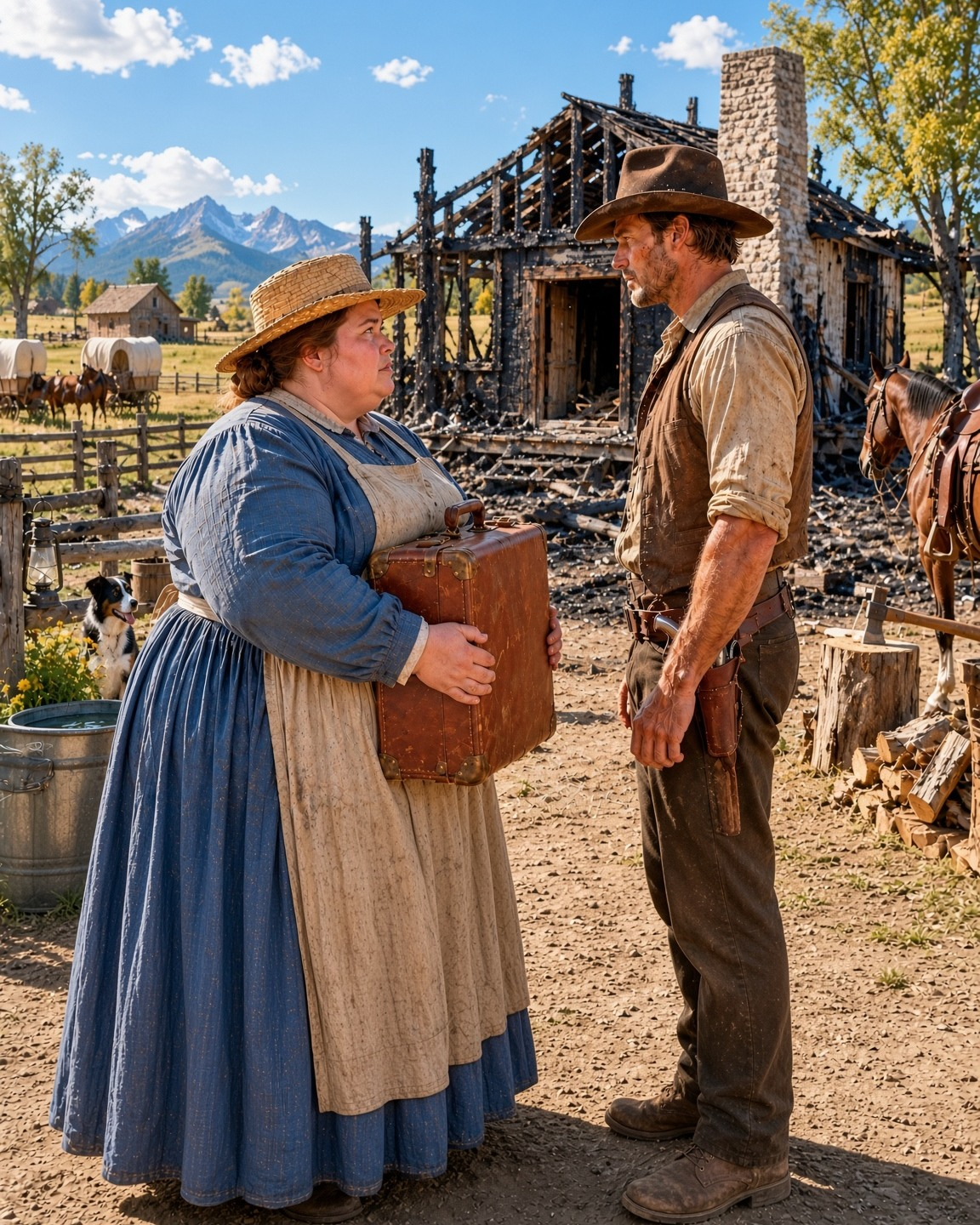
The county clerk dropped the document onto Caleb's kitchen table.
"Your brother promised this ranch to someone else."
Caleb grabbed the paper so quickly that the man's hat nearly fell from his hands.
I stood beside the stove, watching the color drain from Caleb's face.
The name at the top of the document was Elias Whitcomb.
I recognized it.
Not because I had ever met the man, but because I had seen his name in one of my father's old business ledgers.
And I suddenly understood that the trouble waiting for Caleb Hayes might be much bigger than a disputed ranch debt.
"Who is he?" I asked.
Caleb didn't answer.
The county clerk cleared his throat.
"Elias Whitcomb owns the general store in Dry Creek. He claims Daniel borrowed money against the surviving cattle and equipment. Says the agreement was signed three weeks before the fire."
"That's impossible," Caleb replied.
The clerk looked uncomfortable.
"I'm only delivering the notice."
"My brother would never have signed away the cattle."
"Then you'll need to prove it."
Caleb unfolded the document again.
His injured fingers struggled with the paper, and I noticed his jaw tightening as he tried to keep his frustration under control.
"How much?" he asked.
The clerk named a figure.
Caleb stared at him.
"That's more than the cattle are worth."
"Interest has accumulated."
"On what?"
"The original loan."
Caleb pushed the document across the table.
"Show me the original agreement."
The clerk shook his head.
"Whitcomb has it. He's filed a certified copy with the county."
"Then I want to see it."
"You can speak with him tomorrow."
The clerk put on his hat and walked toward the door.
Before leaving, he glanced at me.
"Miss, if you're planning to stay here, I'd reconsider."
I met his eyes.
"Why?"
He hesitated.
"Because this place might not belong to the man standing beside you much longer."
The door closed.
For several seconds, neither Caleb nor I spoke.
Outside, the wind moved through the damaged fence posts.
Caleb folded the notice and placed it on the table.
Then he walked to the window.
"That's it," he said.
"What is?"
"There's no point pretending anymore."
I waited.
He turned around.
"Monday's coach. You're taking it."
I looked at the document.
"Because of a debt?"
"Because this ranch is finished."
"According to a man who hasn't even shown us the original agreement?"
Caleb gave a bitter laugh.
"You don't understand how things work out here."
"Then explain them to me."
He leaned against the counter.
"Whitcomb owns half the town. His store supplies nearly every ranch in the valley. He lends money when people need it and collects when they can't pay. If he says Daniel signed something, people will believe him."
"And the county?"
"The county believes whatever paper has the right seal."
I studied the document.
The clerk had left a small notice attached to it.
A deadline.
Thirty days.
If Caleb failed to challenge the claim, Whitcomb could seek an order to seize the remaining cattle and equipment.
I read it twice.
"Thirty days," I said.
Caleb shook his head.
"Thirty days isn't enough."
"It might be."
"You're not listening."
"I am. You're telling me a man wants to take what remains of your brother's work."
Caleb's expression hardened.
"And I'm telling you I can't stop him."
I pulled out a chair.
"Then we start by finding out exactly what he thinks he owns."
He stared at me.
"You make everything sound simple."
"No. I make it sound possible."
That evening, Caleb barely touched his supper.
I had found potatoes, dried beans, and a small piece of salted beef in the kitchen cupboard.
The meal wasn't elegant, but it was warm.
He ate a few bites and pushed his plate away.
I noticed his left hand trembling slightly.
"Does it hurt?"
"No."
"Caleb."
He looked at me.
"Yes."
"Have you had it examined?"
"There's nothing to examine."
I placed the kettle on the stove.
"That sounds like something a doctor should decide."
He didn't respond.
I poured him another cup of coffee.
After a while, he finally spoke.
"Daniel trusted Whitcomb."
I sat across from him.
"How well?"
"Well enough to buy supplies from him for years. Whitcomb used to come out here himself. He knew our father. He knew Sarah."
His voice became quieter.
"Daniel thought he was an honest man."
"Did they argue about money?"
"Not that I knew of."
"Did Daniel borrow anything recently?"
Caleb rubbed his forehead.
"There was talk about replacing the barn roof before winter. He wanted to expand the cattle operation, too. But we never agreed on the numbers."
"Could the document be related to that?"
"Maybe."
He looked toward the window.
"But Daniel would have told me."
I thought about the burned notebook beneath my bed.
The words Daniel had written about making sure Sarah received the papers returned to my mind.
I wanted to tell Caleb.
But he had asked me to forget what I had seen.
And I was beginning to understand that the mention of his brother's name could turn an ordinary conversation into something unbearable.
The next morning, I woke before sunrise.
Caleb was already outside.
He stood beside the surviving fence, trying to pull a loose section of wire tight with his good hand.
The wind was cold.
His injured hand remained curled against his side.
I put on my work shoes and walked toward him.
"Good morning."
He glanced at me.
"You don't have to do that."
"Do what?"
"Work."
I picked up the spare fencing tool.
"That's unfortunate. I was looking forward to it."
He almost smiled.
He showed me how to hold the wire without cutting my palms.
I failed twice.
On the third attempt, I pulled too hard and scraped the skin beneath my thumb.
Caleb stopped immediately.
"Let me see."
"It's nothing."
He took my hand carefully.
His touch was surprisingly gentle.
He examined the scrape, then reached into his pocket for a clean piece of cloth.
"You're going to need better gloves."
"I have gloves."
"Those aren't work gloves."
I looked at the cloth he was wrapping around my thumb.
"Are you always this particular?"
"Only when someone is making my work harder."
I laughed.
For the first time, he looked almost embarrassed.
We spent the morning inspecting the property.
There were thirty-seven cattle left, though some were thin from the disrupted feeding schedule.
The north pasture had escaped the fire almost completely.
The well was still working.
Several sections of fencing needed repairs, and the surviving stable could accommodate the horses with a little cleaning.
The ranch was not healthy.
But it was not dead.
By noon, I had counted the cattle, inspected the storage shed, and written down the equipment that could still be used.
Caleb watched me fill the pages.
"What are you doing?"
"Making a list."
"Of what?"
"What survived."
He glanced toward the burned barn.
"That won't be a very long list."
"Long enough to begin."
I showed him the figures.
If we concentrated on the surviving cattle, repaired the north pasture, and delayed rebuilding the barn, we could reduce unnecessary expenses.
The stable could be expanded gradually.
We didn't need to replace every structure immediately.
Caleb studied the numbers.
"You're forgetting labor."
"No. I'm including it."
"Materials?"
"Included."
"Feed?"
"Included."
He looked up.
"Where did you learn to do this?"
"My father owned a freight company outside Chicago."
He nodded slowly.
"You never mentioned that."
"You never asked."
He looked as though he wanted to say something, but decided against it.
I closed the ledger.
"There is one more thing."
"What?"
"We need to visit Whitcomb."
His expression immediately darkened.
"No."
"Caleb, we need to see the original agreement."
"I'll handle it."
"How?"
"I'll go into town."
"And say what?"
"That I don't owe him anything."
I raised an eyebrow.
"That sounds like a very expensive conversation."
He turned away.
I could see his pride fighting with his desperation.
He was a man who had spent his entire life believing he needed to carry every burden himself.
Perhaps that was why he had survived the fire and still found a way to make surviving feel like punishment.
I didn't push him further.
Instead, I asked him to show me where Daniel had kept the ranch records.
The old office had been part of the farmhouse.
Most of it was destroyed.
A wooden cabinet remained near the back wall, though the drawers had warped from the heat.
Caleb stood outside while I examined it.
"Careful," he warned.
I pulled open the first drawer.
Nothing.
The second contained several damaged receipts.
The third was stuck.
I tried again.
A small wooden piece broke away, and the drawer opened suddenly.
Inside lay a collection of papers wrapped in oilcloth.
Some were unreadable.
Others had survived.
I found cattle records, old tax receipts, and a list of purchases from Whitcomb's store.
The dates were interesting.
Several transactions appeared twice.
The same quantities.
The same prices.
But the handwriting was different.
I held the papers toward the light.
"Caleb?"
He stepped closer.
"What?"
"Look at these."
He examined the receipts.
His eyes narrowed.
"That's not Daniel's handwriting."
"Are you certain?"
"I've seen his writing every day since we were boys."
He took the receipt and studied the signature.
"Someone copied it."
My stomach tightened.
"Could this be related to the agreement?"
"I don't know."
He looked toward the burned house.
"Daniel kept everything important in that office."
I looked at the oilcloth wrapping.
"Then perhaps the original agreement was here."
Caleb searched the remaining cabinet.
Nothing.
We checked the broken shelves and the small desk.
Still nothing.
Then he noticed a narrow compartment beneath the desk.
It had been hidden behind a loose wooden panel.
He pulled it free.
Inside was a small brass key.
And beneath the key lay a folded piece of paper.
Caleb opened it.
His expression changed.
It was a short note written in Daniel's handwriting.
Caleb, if Whitcomb comes asking about the north pasture, don't sign anything. I found something wrong with the accounts. Sarah knows where the other copy is.
Caleb read it again.
Then he looked at me.
"Sarah."
I nodded.
"Daniel wanted her to have the papers."
He folded the note carefully.
For the first time, I saw something other than grief in his eyes.
Suspicion.
We returned to the bunkhouse just before sunset.
I prepared supper while Caleb sat at the table examining the note.
He barely spoke.
Finally, I placed a bowl in front of him.
"You need to eat."
He looked up.
"Sarah won't talk to me."
"Have you asked?"
"She doesn't want me near her."
"Did she say that?"
He looked away.
"No."
"Then perhaps you're answering for her."
He pushed the bowl aside.
"You don't know what happened after the fire."
"No. I don't."
"Sarah lost her husband. Ben lost his father. And I brought them out alive while Daniel never came back."
His voice cracked.
"I should have gone back for him."
I sat down.
"Caleb, you carried two people out of a burning house."
"I left my brother."
"You made a choice in a moment when every second mattered."
He stared at the table.
I didn't tell him everything would be fine.
I didn't tell him Sarah would forgive him.
I simply sat there until he picked up his spoon again.
The following morning, I decided to visit Dry Creek.
Caleb refused to accompany me.
He said he had fencing to repair.
I suspected he didn't want people seeing him walk beside a woman who had just arrived at his ranch.
I wore my blue dress, beige apron, and straw hat.
I carried the ledger and the surviving receipts in my suitcase.
Dry Creek was smaller than I expected.
There was a general store, a blacksmith, a church, a boardinghouse, and a few wooden buildings clustered along the main road.
Several people watched me walk past.
I heard whispers.
Someone called me the Chicago woman.
Another person wondered aloud how long I would last.
I ignored them.
Whitcomb's store stood near the center of town.
Its front windows were polished, and a painted sign above the entrance displayed his name.
Elias Whitcomb was standing behind the counter.
He was in his late fifties, with silver hair, a carefully trimmed mustache, and a well-tailored dark suit.
He looked like a man who had never carried a sack of grain farther than his front door.
"Miss Parker," he said when I entered.
I stopped.
"Have we met?"
He smiled.
"Not personally."
"Then how do you know my name?"
He closed the ledger in front of him.
"Small town."
His eyes moved toward my suitcase.
"You're staying with Hayes?"
"Yes."
"Unfortunate."
I looked around the store.
"Why?"
"Caleb has always been a difficult man."
"Perhaps you should tell me about the agreement with his brother."
His smile disappeared.
"That's a private business matter."
"Then you won't mind showing me the original document."
Whitcomb studied me.
"You don't appear to understand your position."
"I understand that a claim has been filed against a ranch based on a document I haven't seen."
"Daniel borrowed money."
"How much?"
He named the amount.
I opened my ledger.
"That figure doesn't match the receipts."
His eyes moved toward the pages.
For the first time, his confidence faltered.
I placed one receipt on the counter.
"According to this, the original purchase was paid in full."
Whitcomb didn't touch it.
"Those are old accounts."
"Then you should have no difficulty explaining them."
He leaned closer.
"Miss Parker, you're new here. You would be wise not to involve yourself in matters you don't understand."
I closed the ledger.
"That's an interesting way to conduct business."
His smile returned, but there was no warmth in it.
"Tell Caleb he has until the end of the month."
I turned toward the door.
"And if he doesn't?"
Whitcomb's voice followed me.
"Then he'll learn what happens when a man cannot pay his debts."
I stepped outside.
A woman stood across the street holding a small boy's hand.
She wore a dark dress and a plain shawl.
I recognized her immediately from Caleb's letters.
Sarah Hayes.
Daniel's widow.
Ben stood beside her, holding a wooden toy horse.
When she saw me, her expression changed.
She looked frightened.
Not surprised.
Frightened.
I approached slowly.
"Mrs. Hayes?"
She nodded.
"I'm Evelyn Parker."
"I know."
Her eyes moved toward Whitcomb's store.
"Did he speak to you?"
"Yes."
She tightened her grip on Ben's hand.
"Then you need to leave that ranch."
I stopped.
"Why?"
She glanced at the boy.
Then she lowered her voice.
"Because Daniel didn't borrow that money."
My heart began to beat faster.
"Then who did?"
Sarah looked toward the general store again.
Her face had gone pale.
"Someone used his name."
I waited.
She leaned closer.
"And I know exactly who did it."
Before I could ask another question, a man stepped out of the store behind us.
Sarah grabbed Ben's hand.
"Don't let Caleb come looking for me," she whispered.
Then she pointed toward the road.
"Not until you find out what Daniel hid in the old barn."
She hurried away.
I remained standing in the street.
The old barn had burned almost completely.
But Daniel had apparently hidden something there.
Something Sarah was afraid to name.
I returned to the ranch just before sunset.
Caleb was repairing the north fence.
I told him everything.
His hammer stopped when I mentioned Sarah.
"She spoke to you?"
"Yes."
"What did she say?"
I repeated her warning.
Caleb slowly lowered the hammer.
"What did she say was hidden in the barn?"
"She didn't explain."
He looked toward the burned structure.
For several moments, he stood perfectly still.
Then he walked toward the ruins.
I followed him.
The remains of the barn were unstable, with blackened beams scattered across the ground.
Caleb stepped carefully over the debris.
"Daniel used to keep his tools near the back wall," he said.
We searched through the surviving timber.
I found a broken saddle.
Caleb discovered an old metal bucket.
Nothing else.
Then I noticed a section of floorboards near the collapsed eastern wall.
One board was different.
It was darker than the others, and its edge had been lifted slightly.
"Caleb."
He turned.
I pointed toward it.
He crouched and pulled at the board with his good hand.
It moved.
Beneath it was a narrow opening.
Inside lay a small metal box.
Caleb reached down and lifted it out.
The lock was intact.
A brass keyhole sat in the center.
He looked at the key we had found beneath Daniel's desk.
His breathing changed.
He took the key from his pocket.
It fit.
Caleb turned it slowly.
The lock clicked.
He lifted the lid.
Inside were several folded documents, a small leather-bound notebook, and a photograph of Daniel standing beside a man I recognized immediately.
Elias Whitcomb.
But it was the writing on the back of the photograph that made Caleb's face turn white.
Daniel had written just one sentence:
If anything happens to me, the man in this photograph knows why.
Caleb turned the photograph over again.
His injured hand began to tremble.
Then, from somewhere behind the burned barn, a voice called out.
"Caleb Hayes!"
We both turned.
A stranger was standing beside the broken pasture gate.
He held a long envelope in one hand.
And before Caleb could answer, the stranger raised the envelope and shouted:
"Your brother wasn't the only one who signed those papers!"






Comments 0