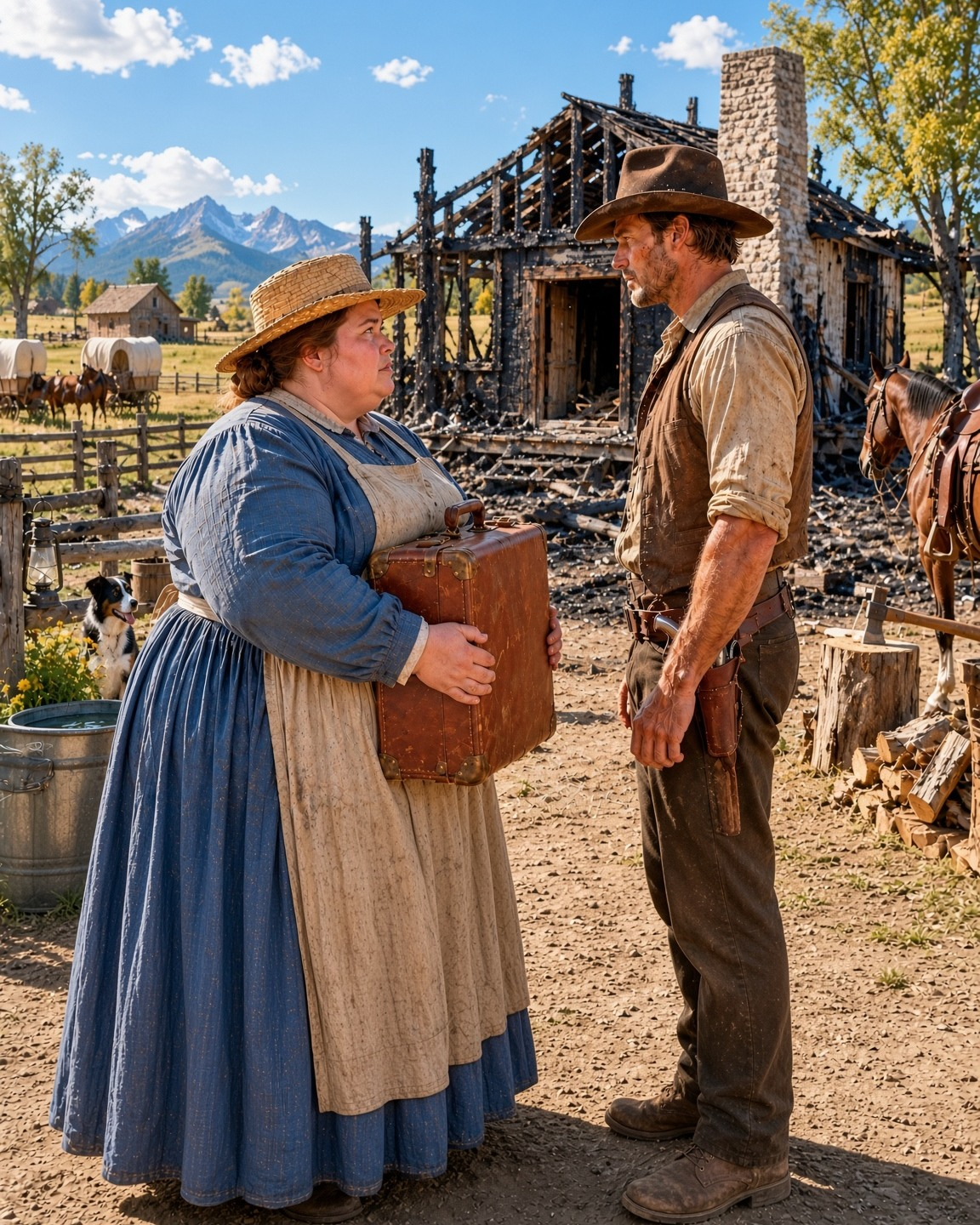
"Daniel took money from them?"
Caleb's voice was so quiet that I almost wished he had shouted.
He stood beside the kitchen table, holding the agreement from Chicago. His eyes remained fixed on the final line, where his younger brother's signature appeared beneath a payment acknowledgment.
I reached for the paper.
"Caleb, we don't know what that payment was for."
He pulled it away.
"It says right here. Five hundred dollars."
"That doesn't tell us why he received it."
"Five hundred dollars, Evelyn. That's more than Daniel earned in months."
I watched his burned hand tighten around the document.
For six weeks, Caleb had been trying to convince himself that Daniel died protecting the ranch. Now he was looking at evidence suggesting his brother had once accepted money from the very men who threatened to take it.
"Daniel was barely twenty when this agreement was signed," I said.
Caleb looked up.
"What?"
"Look at the date."
He examined the page again.
The agreement was nearly fifteen years old. Daniel had been a young man then, still learning the business from his father.
"That matters," I continued. "A twenty-year-old might sign something without understanding what it means."
"Daniel wasn't stupid."
"I never said he was."
"Then stop making excuses for him."
The words struck harder than he intended.
I stepped back.
Caleb saw my expression and immediately looked ashamed.
"Evelyn—"
"No. You have every right to be angry. But don't ask me to condemn a dead man because someone wrote a number beside his name."
He looked down at the document.
For several seconds, neither of us spoke.
Then he placed the paper on the table.
"My brother spent his whole life trying to prove he was useful."
I waited.
"Father never thought Daniel was serious enough. He was always laughing, always talking, always making promises about things he couldn't possibly accomplish."
Caleb pulled out a chair.
"I was the one Father trusted with the cattle and the land. Daniel handled the books because Father thought he couldn't do much damage sitting behind a desk."
I sat across from him.
"Perhaps Daniel understood more than either of you realized."
Caleb gave a bitter laugh.
"Maybe he understood exactly how much money he could make."
I didn't answer.
There were moments when arguing only made a person's fear sound more convincing.
Instead, I opened the letter from Mr. Whitaker.
My father's attorney had included a brief explanation of Parker Western Holdings, but several pages appeared to be missing.
The company had been established to invest in transportation routes and agricultural property throughout Wyoming.
That much was ordinary.
The unusual part was the agreement involving the creek.
Parker Western Holdings had paid a substantial sum for an option to acquire the northern water crossing if certain conditions were met.
The conditions were listed in an attachment that had not been included.
I pointed to the reference.
"Schedule C."
Caleb leaned forward.
"What about it?"
"The agreement says the property transfer depends on conditions described in Schedule C. But that schedule isn't here."
"Then we ask Whitaker for it."
"I already intend to."
Caleb stared at the papers.
"How much did your father invest?"
I found the figure.
"Eight thousand dollars."
He looked at me sharply.
"Eight thousand?"
I nodded.
"That's more than the ranch was worth back then."
"Why would anyone pay that much for a creek crossing?"
I thought about the old mill, the original survey, and the altered boundaries.
"Because someone expected that water to become valuable."
Caleb looked toward the window.
Beyond the glass, the north pasture stretched toward the creek.
His father had always insisted that the land was worth keeping, even during years when cattle prices fell.
Perhaps he had known something about its future.
Or perhaps he had made a promise he later regretted.
I turned another page.
There was a handwritten notation beside the investment amount.
Advance secured against future development.
I frowned.
"Caleb, did anyone ever talk about building a railroad through Dry Creek?"
He looked surprised.
"Years ago. There were rumors."
"What happened?"
"Nothing. The surveyors came through, looked at the valley, and went west instead."
"Did they examine the creek?"
He nodded slowly.
"Father said they did."
I looked down at the agreement.
A railroad route would require reliable water for construction crews, livestock, and steam engines. A creek crossing could become far more valuable if it controlled access through the valley.
But the railroad had never arrived.
Someone might have spent years waiting for an investment that failed to pay off.
And someone else might now be desperate to recover the money.
Caleb seemed to follow my thoughts.
"Bell and Whitcomb."
"Possibly."
He looked at Daniel's signature.
"Then why did they pay my brother?"
I had no answer.
Not yet.
Sarah arrived shortly before noon.
She brought a basket of bread, a jar of preserved peaches, and Ben, who immediately ran toward the stable.
Caleb was outside repairing a fence post when she approached.
I watched from the doorway.
Their conversations had become less hostile, but they still carried the careful politeness of people afraid of reopening an old wound.
Sarah stopped beside him.
"Ben wanted to see the new colt."
Caleb nodded.
"He's welcome."
She hesitated.
"There's something I need to tell you."
Caleb lowered his hammer.
"What now?"
Sarah glanced toward the bunkhouse.
"About Daniel."
He became still.
I stepped outside.
Sarah looked at me, then back at Caleb.
"I heard you found a document with his signature."
Caleb's expression hardened.
"How?"
"Ben heard you talking last night."
Caleb looked toward the stable.
The boy was kneeling beside a water bucket, watching the horses.
Sarah continued.
"Daniel told me about the money."
Caleb turned toward her.
"You knew?"
"Not everything."
"Then tell me what you knew."
Sarah clasped her hands together.
"When Daniel was young, your father asked him to witness a business agreement. Arthur Bell brought the papers. Daniel signed them."
"And took five hundred dollars."
Sarah nodded.
Caleb's face tightened.
"He never told me."
"He was ashamed."
"Of what?"
Sarah looked down.
"Of being paid to keep quiet."
The silence that followed seemed to swallow every sound in the yard.
Caleb stared at her.
"Keep quiet about what?"
"Your father told him the agreement was temporary. He said the money would help Daniel start his own household when he married."
"Daniel wasn't married then."
"No. But he was saving."
Caleb shook his head.
"So Father bribed him."
Sarah's eyes filled.
"Daniel believed he was helping the family."
"By selling our land?"
"He didn't know the agreement could be used that way."
Caleb turned away.
Sarah stepped closer.
"Listen to me. When Daniel discovered the altered survey, he realized the agreement had never been canceled. He spent months trying to find the original papers."
"Why didn't he come to me?"
"Because he knew what you would say."
Caleb looked back.
Sarah's voice trembled.
"You would tell him he'd betrayed the family."
He opened his mouth, then closed it.
I watched the truth settle across his face.
He had already said those words without knowing whether they were deserved.
Sarah wiped her cheek.
"Daniel wanted to fix it before you found out."
Caleb looked toward the burned barn.
For a long time, he said nothing.
Then he asked, "Did he ever tell you why Father signed the agreement?"
Sarah shook her head.
"Only that Father needed money badly."
"Father never told me we were in debt."
"He didn't tell Daniel either. Not until after the papers were signed."
I looked at Caleb.
"Your father may have been protecting the ranch."
Caleb gave a humorless laugh.
"By risking the land?"
"Perhaps he believed he had no choice."
Sarah nodded.
"Daniel said the same thing."
Caleb leaned against the fence.
His face looked older than it had that morning.
"I spent years thinking Father trusted me with everything."
I approached him.
"Maybe he trusted you with the things he was proud of."
He looked at me.
"And gave Daniel the things he wanted hidden."
Neither of us could argue with that.
That afternoon, I returned to the leather book.
Daniel had recorded the payments involving Parker Western Holdings, but his notes became more detailed during the months before the fire.
He had drawn several rough maps.
One showed the creek crossing.
Another showed a narrow strip of land connecting the old mill to the northern pasture.
Beside the second map, he had written:
The water rights are separate from the land.
I read the sentence twice.
That changed everything.
If the water rights had been transferred independently, proving ownership of the land might not be enough to protect the ranch.
I searched the remaining documents.
There were references to a county water filing, a survey number, and an old registration date.
But the actual filing was missing.
I carried the notebook outside.
Caleb was working near the stable.
"Do you know anything about separate water rights?"
He looked up.
"What do you mean?"
"Your father may have sold rights to use the creek without selling the land itself."
Caleb frowned.
"Can someone do that?"
"Under certain arrangements, yes. But we need to know exactly what was recorded."
He took the notebook.
I showed him Daniel's notes.
He studied the page.
"Father always said the creek belonged to the ranch."
"That may have been true when he said it."
Caleb looked toward the northern hills.
"Then we need the county records."
I nodded.
"Tomorrow."
He closed the book.
"Together."
It was a small word.
But after days of suspicion, I was grateful to hear it.
The next morning, we rode into Dry Creek.
The town was busy with wagons bringing supplies for winter.
A blacksmith worked outside his shop. Two women stood near the general store, talking beneath the awning.
When Caleb and I passed, their conversation stopped.
I was beginning to understand that people in small towns often knew a person's troubles before they knew the person.
The county records office occupied two rooms beside the courthouse.
A clerk named Mr. Harlan sat behind a tall desk.
He was a thin man with spectacles and an expression suggesting he disliked interruptions.
Caleb placed the survey number on the counter.
"We need the original filing for the Hayes water rights."
Harlan adjusted his glasses.
"Those records are old."
"We know."
"They may take time to locate."
"We can wait," I said.
He looked at me.
"And you are?"
"Evelyn Parker."
His expression changed.
"Parker?"
"Yes."
He glanced toward a closed door behind his desk.
Then he looked back at the survey number.
"I'm afraid those records aren't available."
Caleb frowned.
"Why not?"
"They've been transferred."
"Where?"
"To the county attorney."
I stepped forward.
"On whose authority?"
Harlan hesitated.
"I don't believe I'm permitted to discuss that."
Caleb leaned against the counter.
"That's my family's land."
The clerk looked uncomfortable.
"Mr. Hayes, I suggest you speak with your attorney."
"We don't have one," Caleb replied.
"Then perhaps you should obtain one."
I noticed a ledger lying open beside Harlan's elbow.
A recent entry contained the Hayes survey number.
Beside it was a name.
Arthur Bell.
I pointed toward the page.
"Mr. Bell requested those records yesterday?"
Harlan quickly closed the ledger.
"That information is confidential."
Caleb's expression darkened.
I touched his arm.
"Thank you for your time, Mr. Harlan."
He looked surprised.
We left before Caleb could argue.
Outside, he turned toward me.
"Why did you stop me?"
"Because he was frightened."
"Of Bell?"
"Possibly. And frightened people often reveal more when they think you aren't threatening them."
Caleb glanced back at the office.
"Then what do we do?"
"We find someone who isn't afraid of Arthur Bell."
A voice spoke behind us.
"That may be harder than you think."
We turned.
An elderly man stood beside the courthouse steps.
He wore a worn brown coat and carried a leather satchel.
His white beard was neatly trimmed, and his eyes were sharp.
"Mr. Hayes," he said.
Caleb recognized him.
"Judge Mercer."
The old man nodded.
"I heard you were asking about the creek."
I stepped forward.
"Do you know something about the original filing?"
Mercer looked toward the records office.
"Perhaps."
Caleb crossed his arms.
"Then tell us."
The judge studied him.
"Your father and I were friends once."
Caleb's expression changed.
"Once?"
Mercer nodded.
"Until he made a decision I couldn't support."
I felt my pulse quicken.
"What decision?"
The judge looked at me.
"Miss Parker, I believe your father was involved."
Caleb stepped closer.
"We already know that."
Mercer shook his head.
"No. I don't think you know what he was trying to prevent."
He opened his satchel.
Inside was a narrow envelope tied with red string.
He handed it to Caleb.
"Your father gave me this shortly before he died."
Caleb stared at it.
"Why didn't you bring it to me?"
"Because he asked me not to."
"Why?"
Mercer looked toward the courthouse.
"He said Arthur Bell would destroy anyone who tried to interfere."
Caleb's jaw tightened.
"Then why give it to us now?"
The judge's expression became grave.
"Because Daniel Hayes is dead, and I no longer believe his death was simply an accident."
I felt the air leave my lungs.
Caleb went completely still.
"What are you saying?"
Mercer lowered his voice.
"I'm saying your brother was asking questions about the same documents shortly before the fire."
He looked at the envelope.
"And someone knew he was getting close."
Before Caleb could respond, the courthouse door opened.
Mr. Harlan stepped outside.
His face was pale.
"Judge Mercer," he called. "The county attorney wants to see you."
Mercer turned.
"Tell him I'm occupied."
Harlan hesitated.
"He said it concerns the Hayes property."
The judge looked at Caleb.
Then he placed a hand on his shoulder.
"Don't open that envelope here."
"Why?"
"Because the contents could cost someone their freedom."
He walked toward the courthouse.
Caleb watched him disappear inside.
I looked at the envelope in his hand.
The red string had been tied in a careful knot.
On the back was a familiar mark.
A small black circle.
The same symbol engraved into Arthur Bell's silver ring.
We returned to the ranch before sunset.
Caleb placed the envelope on the kitchen table.
Neither of us opened it immediately.
Sarah had brought Ben for supper.
The boy sat beside the stove, carving a small piece of wood with a blunt knife Caleb had given him.
I prepared coffee while Caleb examined the envelope.
"Do you think Mercer knew about the agreement all along?" I asked.
"Maybe."
"Then why wait until now?"
Caleb looked toward the window.
"Because people are afraid."
I sat across from him.
"Fear can keep a secret alive longer than any lie."
He nodded slowly.
Then he untied the red string.
Inside were three documents.
The first was a copy of the original water rights filing.
The second was a sworn statement signed by Caleb's father.
The third was a letter addressed to both of his sons.
Caleb unfolded the letter.
His eyes moved across the page.
I watched his expression change.
First confusion.
Then disbelief.
Then something that looked almost like grief.
"What does it say?" I whispered.
He handed it to me.
The letter explained that his father had accepted money from Parker Western Holdings during a severe financial crisis.
He had believed the arrangement would preserve the ranch.
But Arthur Bell had altered the agreement after it was signed.
The original contract granted limited access to the creek for a proposed railroad project.
The altered version transferred permanent control of the water rights.
Caleb's father had discovered the deception too late.
He had tried to challenge the filing, but Bell threatened to expose the original payment and accuse Daniel of participating in the fraud.
I looked at Caleb.
"Your father was trying to protect Daniel."
He nodded.
But his expression remained troubled.
I continued reading.
The final paragraph contained something unexpected.
I made the agreement because I believed the railroad would save us. But when I learned what Bell intended, I refused to cooperate. Daniel was innocent of the alteration. He signed only as a witness, and the money was meant for his future. If either of my sons finds this letter, they must know that I failed them both.
Caleb covered his face.
For a long moment, he didn't move.
Then he whispered, "He knew."
I reached across the table.
"Caleb."
"He knew Daniel was innocent."
"Yes."
"And he let him carry the shame."
I didn't answer.
Some truths were too painful to soften.
Sarah approached quietly.
She placed a hand on Caleb's shoulder.
"Daniel knew your father regretted it."
Caleb looked up.
"How?"
Sarah's eyes filled.
"Because he told me."
She reached into her apron pocket.
"I kept something from you."
Caleb stared at her.
"What?"
Sarah removed a folded sheet of paper.
It was worn along the edges.
"Daniel wrote this the morning of the fire."
Caleb reached for it.
Sarah hesitated.
"I couldn't give it to you before."
"Why not?"
"Because I was afraid you would blame yourself."
Caleb's face tightened.
He unfolded the paper.
There were only a few lines.
He read them silently.
Then he looked at Sarah.
"What does this mean?"
Her hands began to tremble.
I stepped closer.
Caleb turned the letter toward me.
The final sentence had been underlined twice.
If the fire starts where Bell said it would, Caleb must not go to the barn.
I stared at the words.
The room seemed suddenly too quiet.
Caleb looked toward the burned buildings outside.
"Daniel knew there would be a fire?"
Sarah began to cry.
"I didn't understand it then."
Caleb stood.
"Sarah, what aren't you telling me?"
She backed toward the door.
"Caleb, please."
He followed her.
"Tell me."
Sarah reached for the handle.
Then she stopped.
Her face drained of color.
Outside, a horse had just arrived.
Someone knocked three times.
And a man's voice called through the door.
"Open up, Hayes. I've come to tell you who really started that fire."






Comments 0