My mother's email sat unopened on my phone.
YOUR FATHER'S FINAL INSTRUCTIONS
Five words beneath the attachment made my hands go cold.
He never wanted you to know.
For six years, I had believed my father left nothing unfinished.
Now my mother was claiming he had hidden something from me.
And the worst part was that she knew exactly which wound to reopen.
I stared at the screen until the letters blurred.
My father had been dead for six years.
Six years of birthdays without his phone calls.
Six Christmas mornings without his terrible jokes.
Six years of walking past his photograph in the hallway and pretending I didn't still expect to hear his footsteps.
He had been the one person who never made me feel like love was something I had to earn.
And now my mother was using his name to frighten me.
My phone vibrated.
Margaret was calling.
I answered immediately.
"Don't open the attachment," she said before I could speak.
"How did you know she sent it?"
"Because Daniel Mercer contacted me after he realized the document your mother submitted might contain a fraudulent signature. He also forwarded an email from the person coordinating the transaction."
"Who?"
"We're working on confirming everyone's role."
"Margaret, my mother just sent me something supposedly written by Dad."
"I know."
My stomach tightened.
"You've seen it?"
"I've seen a copy of what she claims is a supplemental instruction letter."
"Is it real?"
Margaret paused.
"Nora, listen carefully. Your father's estate was properly administered. His will was admitted to probate. The house was distributed to you. The deed was recorded. None of that changes because someone produces an unsigned or questionable letter six years later."
"But what if he really wrote it?"
"Then we'll examine it. We won't assume it's genuine simply because your mother says it is."
I looked at the subject line again.
"She said he never wanted me to know."
Margaret's voice softened.
"Your father wanted you to know exactly what he left you. I was there when he gave those instructions."
I closed my eyes.
For a moment, I was twenty-two again.
Sitting in Margaret's office after the funeral.
Holding a tissue I had already shredded into pieces.
Listening to words like estate, beneficiary, and distribution while wishing someone would tell me the doctors had made a mistake.
Margaret had placed a folder in front of me.
"Your father made his wishes very clear."
I remembered nodding.
I remembered seeing my name.
But there were things about that meeting I had forgotten.
Or perhaps things I had been too devastated to understand.
"Margaret," I whispered, "did Dad know Mom would try something like this?"
Silence.
Then she said, "I think it's time we talked about why he structured his estate the way he did."
I didn't sleep.
At 6:30 the next morning, I was sitting at the hotel desk with a cup of coffee I couldn't drink.
My face hurt.
The dressings felt tight.
Every time I moved my jaw, the skin along my cheek reminded me of what had happened.
I had followed the doctor's instructions, but the pain was only part of what kept me awake.
My mother had attempted to use my signature on a property transfer agreement.
Someone had prepared documents involving my house.
And Violet had apparently known about it.
I looked at my phone.
Twenty-three missed calls.
Eleven new messages.
My mother had sent most of them between midnight and three in the morning.
Mom: You need to stop involving strangers in family matters.
Mom: Your father would be ashamed of how you're behaving.
Mom: I have sacrificed everything for you.
Mom: Answer me.
Mom: We need to discuss the paperwork before you make a terrible mistake.
Then, at 2:47 a.m.:
Mom: You are forcing me to protect myself.
I read that message three times.
Protect herself.
From what?
The daughter whose face she had burned?
The daughter who had paid the property taxes for six years?
The daughter who had allowed her to live in a house she didn't own?
I took screenshots and forwarded them to Margaret.
Then I opened the security application.
The kitchen camera showed my mother standing beside the marble island.
Violet sat on one of the stools, scrolling through her phone.
They were drinking coffee.
My coffee.
From the expensive machine I had bought after my last promotion.
My mother looked perfectly comfortable.
No concern.
No guilt.
No visible awareness that she had sent her daughter to urgent care the previous afternoon.
Violet said something.
I turned up the volume.
"Do you think she'll actually do anything?"
My mother took a sip of coffee.
"Nora doesn't have the stomach for a fight."
"She called a lawyer."
"She always calls Margaret when she gets nervous."
Violet frowned.
"Isn't Margaret the one who handled Robert's estate?"
"Yes."
"Then won't she know?"
My mother set down her cup.
"She knows what Robert wanted her to know."
I leaned closer to the screen.
Violet lowered her voice.
"What about the letter?"
My mother glanced toward the camera.
For one terrifying second, I thought she had remembered it was there.
Then she looked away.
"Don't worry about the letter."
"But what if Nora compares the signatures?"
My mother smiled.
"Your sister sees what she wants to see."
My stomach turned.
Violet laughed.
"That's true."
I stopped the recording.
Saved it.
Downloaded another copy.
Then I sat perfectly still.
My mother wasn't panicking because she had lost control of her temper.
She was panicking because something she had planned was beginning to unravel.
And I was no longer willing to pretend otherwise.
Margaret's office was on the fourth floor of a brick building downtown.
I arrived at nine.
The receptionist looked up from her computer.
Her expression changed when she saw my face.
"Oh, Nora."
I gave her a small smile.
"Hi, Susan."
She came around the desk.
"Margaret is expecting you."
I followed her down the hallway.
Margaret stood when I entered.
She wore a navy suit and thin silver glasses.
Her hair was pulled back neatly.
A stack of folders sat on her desk.
She looked at my dressings.
Then at my eyes.
"How are you feeling?"
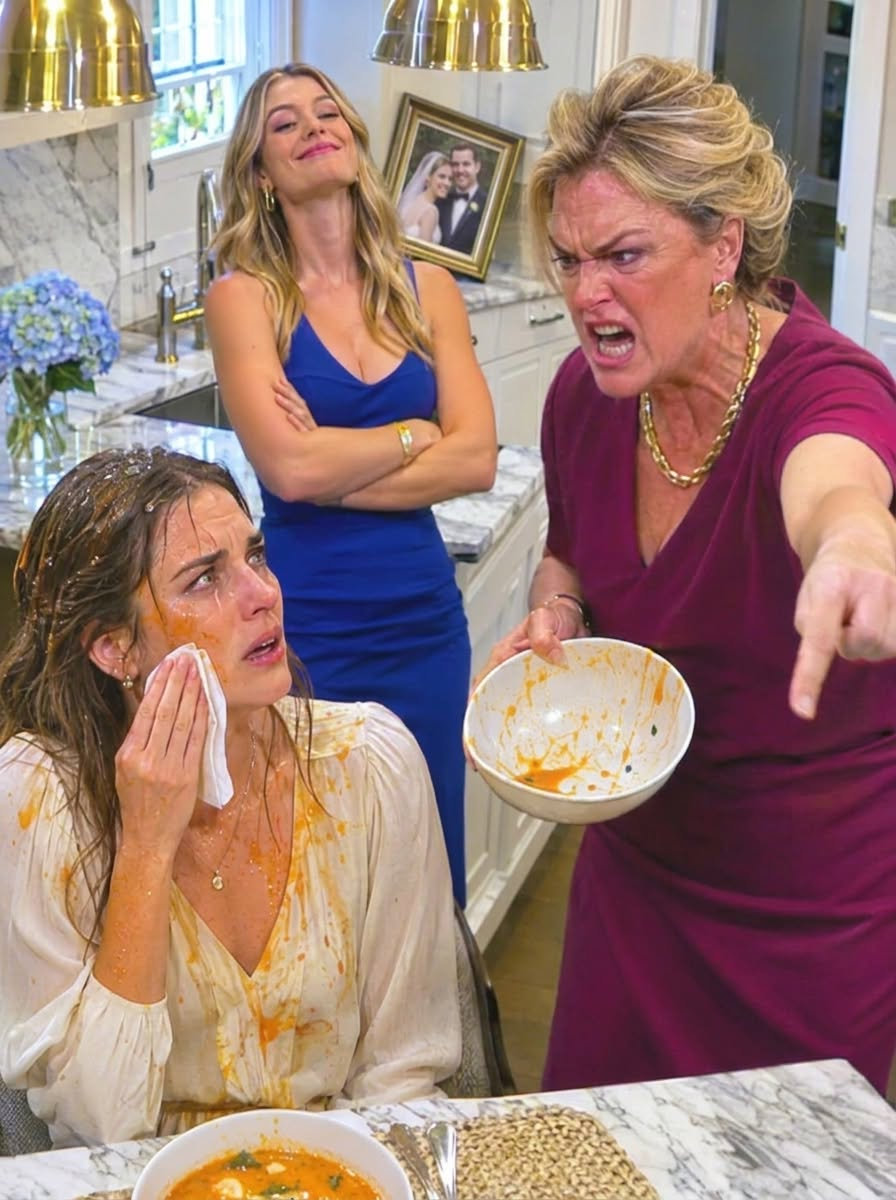
"Like someone threw soup in my face."
Margaret didn't laugh.
"Sit down."
I did.
She placed a glass of water in front of me.
Then she opened the first folder.
"Before we discuss the suspicious documents, I want to establish what we know."
I nodded.
"Your father purchased the property before he married your mother. During their divorce, the house remained his separate property under the final settlement."
I remembered that much.
My parents divorced when I was seventeen.
It had been painful, but not explosive.
Dad moved into a smaller apartment for several months while the legal arrangements were finalized.
Mom stayed in the house with me.
Eventually, Dad returned after Mom moved out.
Years later, after her second marriage ended, she asked to stay temporarily.
By then, I was living there again to help Dad during his illness.
Temporary became permanent.
Margaret continued.
"When your father became seriously ill, he updated his estate plan."
She slid a copy of his will across the desk.
"His primary concern was making sure you had a stable home."
I touched the paper.
Dad's name appeared at the top.
Robert James Whitmore.
My throat tightened.
"He told me he didn't want you dependent on anyone else's goodwill," Margaret said.
I looked up.
"Those were his words?"
"Very close to them."
She turned another page.
"He was particularly concerned about family pressure."
I frowned.
"What kind of pressure?"
Margaret folded her hands.
"Nora, your father knew you were generous. He also knew you had difficulty refusing your mother."
I looked away.
"He worried that if he left the property jointly to you and Diane, you might eventually surrender your interest simply to keep the peace."
My eyes filled.
"He actually said that?"
"Yes."
I stared at the will.
For years, I had thought Dad left me the house because I was his only child.
I never realized he had been protecting me from something he could already see.
Margaret continued.
"He considered creating a trust with restrictions, but ultimately decided to transfer the property directly to you through his estate. He believed you deserved full ownership and the freedom to make your own decisions."
"Did Mom know?"
"She knew the house wasn't hers."
I swallowed.
"Did she object?"
Margaret hesitated.
"She contacted my office several times after your father's death."
My stomach tightened.
"About what?"
"She wanted to know whether she could challenge the will."
I stared at her.
"She what?"
"She asked whether your father had been mentally competent when he signed it."
I felt the blood drain from my face.
"Dad was sick. He wasn't confused."
"I know. We had appropriate documentation of his capacity."
"She knew that."
"Yes."
I looked down at my hands.
My mother had stood beside me at Dad's funeral.
She had held my shoulders while people offered condolences.
She had told relatives how much she admired his strength.
Then she had apparently called his lawyer to ask whether his final wishes could be overturned.
"Why didn't you tell me?"
Margaret's expression softened.
"You were grieving. The inquiries didn't develop into a formal challenge. Your father had made his wishes clear, and the estate was completed properly."
I nodded slowly.
I understood.
But understanding didn't make it hurt less.
Margaret opened another folder.
"Now we need to discuss the document Daniel Mercer brought to your house."
I straightened.
"Did you get a copy?"
"Yes."
She placed three pages on the desk.
The first was titled:
PROPERTY TRANSFER AGREEMENT
The second contained a legal description of the property.
The third displayed a signature.
My signature.
Except I had never written it.
I stared at the page.
"That's the one."
Margaret nodded.
"Daniel's office was asked to review the documentation before a proposed transaction proceeded. He became concerned when he couldn't verify your authorization."
"Who hired him?"
"A private transaction coordinator acting for the proposed recipient."
I looked at her.
"Who was supposed to receive my house?"
Margaret turned the first page toward me.
A name appeared in the section identifying the proposed transferee.
Violet Anne Whitmore.
For a moment, I couldn't breathe.
Violet.
My stepsister.
The woman who wanted my car.
My laptop.
My father's necklace.
She wasn't satisfied with those things.
She wanted my house too.
I looked up.
"Mom was trying to give Violet the house?"
"That's what the document proposes."
"Without telling me?"
"Without your verified authorization."
I shook my head.
"No."
The word escaped before I could stop it.
"No, she wouldn't—"
I stopped.
Because I remembered the soup.
The threats.
The stolen jewelry box.
The whispered conversation.
The forged signature.
Of course she would.
She already had.
I pressed my fingers against my forehead.
"Why?"
Margaret waited.
"Why would she do this?"
"I can't tell you her motives with certainty."
"Violet has an apartment."
"Yes."
"She has a car."
"Yes."
"She has a job interview tomorrow."
Margaret watched me carefully.
"Nora, this may not be about what Violet needs."
I looked up.
"What do you mean?"
"It may be about what your mother believes Violet deserves."
The words settled heavily between us.
I thought about every birthday.
Every Christmas.
Every family gathering.
Violet received expensive gifts.
I received lectures about being grateful.
Violet made mistakes.
I was expected to fix them.
Violet cried.
Everyone rushed to comfort her.
I cried.
My mother told me to stop being dramatic.
I had spent years trying to understand the difference.
Now it was sitting in front of me on a legal document.
My mother had tried to give Violet something she didn't own.
And she had used my name to do it.
Margaret handed me another page.
"This is a copy of the letter your mother sent you."
I looked at it.
The heading read:
Personal Instructions Regarding the Family Residence
Beneath it was a paragraph claiming my father had always intended the house to serve as a shared family asset.
The letter suggested that I should transfer ownership to my mother or another family member if doing so would preserve harmony.
At the bottom was a signature.
Robert J. Whitmore.
My eyes filled immediately.
I knew my father's handwriting.
I had birthday cards from him.
Notes tucked into books.
Recipes written on scraps of paper.
A letter he gave me before I left for college.
His handwriting was distinctive.
The capital R leaned slightly forward.
His lowercase t had a long crossbar.
He always wrote his middle initial with a period.
This signature looked close.
Very close.
But something bothered me.
I leaned forward.
"Can I see that again?"
Margaret slid it closer.
I studied the signature.
Then I noticed it.
The final stroke of the W.
My father always finished his surname with a slight upward curve.
This signature ended flat.
I looked at Margaret.
"That's not how Dad signed his name."
She nodded.
"I noticed differences too. A qualified document examiner would need to assess it."
I touched the edge of the page.
"Where did Mom get this?"
"She claims she found it among his personal effects."
"Six years later?"
"That's her claim."
I shook my head.
"She went through his things after he died. Everything. Every drawer. Every cabinet."
Margaret watched me.
"Do you remember whether she kept any documents?"
I thought about it.
Then a memory surfaced.
Dad's study.
Three days after the funeral.
My mother standing beside his desk.
A cardboard box at her feet.
I had walked into the room and found her sorting through folders.
She told me she was organizing paperwork.
I remembered asking whether she wanted help.
She said no.
Then she closed the desk drawer.
Quickly.
Too quickly.
I looked at Margaret.
"She had access to his old files."
"That may be important."
"Could she have copied his signature?"
"Possibly. We need evidence before drawing conclusions."
I nodded.
But my mind was already racing.
The signature on the insurance form.
The signature on the transfer agreement.
The signature on the supposed letter.
Three documents.
Three attempts to turn handwriting into authority.
My father had warned me that paper remembered the truth.
My mother had apparently decided paper could be taught to lie.
At noon, Margaret's assistant brought us sandwiches.
I couldn't eat much.
My cheek hurt whenever I moved my mouth.
Margaret noticed.
"Take your time."
I set the sandwich down.
"Can she actually take the house?"
"Not merely because she produced these documents. Your recorded ownership remains strong evidence of your rights. But we need to act promptly to prevent misuse of the paperwork."
"What happens to Violet?"
"That depends on what she knew and what she did."
I thought about Violet's smile.
Her arms crossed.
Her voice telling me I had finally learned my place.
"She knew."
Margaret looked at me.
"Tell me why you believe that."
I played the security recording.
Violet's voice filled the office.
What if Nora compares the signatures?
Margaret listened without moving.
Then my mother's voice followed.
Your sister sees what she wants to see.
When the recording ended, Margaret leaned back.
"Preserve that file exactly as it is."
"I already saved copies."
"Good."
She made a note.
"We may need to provide this to investigators."
I nodded.
Then I asked the question I had been avoiding.
"Should I report Mom?"
Margaret looked at my face.
"The assault?"
"And the paperwork."
"The medical records and video may support a criminal complaint regarding the assault. The suspected document fraud should also be brought to the appropriate authorities. We can discuss the safest and most effective way to proceed."
I looked down.
"She'll tell everyone I'm destroying the family."
"She may."
"She'll say I'm cruel."
"She may."
"She'll say Dad would hate me."
Margaret's expression changed.
"Nora, your father came into this office while undergoing treatment because he wanted to make sure you would be protected."
My throat tightened.
"He was exhausted. He was frightened. But he was absolutely certain about one thing."
I looked at her.
"What?"
"He wanted you to have a life that belonged to you."
I covered my mouth.
For several seconds, I couldn't speak.
Then I whispered, "I miss him."
Margaret's eyes softened.
"I know."
At 2:15 p.m., I returned to the hotel.
My phone was vibrating before I reached the elevator.
Violet.
I let it ring.
She called again.
Then again.
Finally, a message appeared.
Violet: Mom says you're trying to steal the house from us.
I stared at the screen.
Steal.
The house.
From them.
I almost admired the audacity.
Then another message arrived.
Violet: You know we've lived there for years. You can't just decide it's yours.
I typed:
The recorded deed has been in my name since Dad's estate was settled.
Her reply came immediately.
Violet: That's not fair.
I looked at those words for a long time.
Not fair.
To Violet, fairness meant receiving what she wanted.
Anything else was an injustice.
I typed one final message.
Do not enter my bedroom, use my car, or remove any of my belongings.
Then I stopped responding.
Five minutes later, she posted another photograph.
This one showed her sitting on my bed.
Wearing my favorite coat.
Holding my father's necklace.
The caption read:
Some people finally learn that family comes first.
I felt sick.
Then angry.
Not the wild anger my mother used.
Something quieter.
Something steadier.
I saved the photograph.
Forwarded it to Margaret.
And added it to the growing folder of evidence.
At 4:40 p.m., my mother called from an unfamiliar number.
I answered before realizing who it was.
"Nora."
I closed my eyes.
"Mom."
"Where are you staying?"
"I'm not telling you."
"Don't be ridiculous."
"What do you want?"
Her voice softened.
"I want my daughter back."
For one dangerous second, I wanted to believe her.
I wanted her to say she was sorry.
I wanted her to ask whether my burns were healing.
I wanted her to sound like the mother I remembered from childhood.
The woman who used to sit beside my bed when I was sick.
The woman who once drove across town in the middle of the night because I had forgotten my school project.
The woman I had spent years trying to find again.
But then she spoke.
"Violet is devastated."
I opened my eyes.
"Violet?"
"She's crying, Nora."
"Why?"
"Because you're threatening her future."
I stared at the wall.
"My face is burned."
My mother sighed.
"You're still talking about that?"
I felt something inside me close.
"Yes."
"It was one moment of anger."
"It was assault."
"Don't use that word."
"It's what happened."
Her voice sharpened.
"You are making a terrible mistake."
I said nothing.
"You think because your father left you some paperwork, you can control everyone?"
I looked toward the folder on the desk.
"Mom, Dad left me the house."
"He left you responsibility."
"He left me ownership."
"You're twisting his wishes."
"No. I'm finally respecting them."
She inhaled sharply.
Then her tone changed.
Cold.
Precise.
"You have no idea what your father did before he died."
My stomach tightened.
"What does that mean?"
"There are things he never told you."
"Then tell me."
"Come home."
"No."
"Come home, Nora, and we'll discuss everything like adults."
I looked at the dressings on my cheek.
"Adults don't throw soup at each other."
Silence.
Then my mother whispered something that made my blood run cold.
"You think Robert was such a good man. You have no idea what he was hiding."
I gripped the phone.
"What was he hiding?"
She didn't answer.
"Mom?"
Her voice became almost gentle.
"Ask Margaret about the second envelope."
Then she hung up.
I stared at the phone.
The second envelope.
I called Margaret immediately.
She answered after four rings.
"Nora?"
"What is the second envelope?"
Silence.
I stood.
"Margaret?"
"Where did you hear that?"
"My mother."
Another pause.
Longer this time.
"Nora, I need you to come back to my office."
My heart began pounding.
"Why?"
"Because there is something your father asked me to keep until a specific circumstance arose."
I felt dizzy.
"What circumstance?"
Margaret didn't answer immediately.
Then she said, "Until someone attempted to interfere with your ownership of the house."
I gripped the edge of the desk.
My father had anticipated this.
Six years ago.
Before he died.
He had known there might come a day when someone tried to take his home from me.
And he had prepared for it.
"What's in the envelope?" I whispered.
"I'd rather show you in person."
"Margaret, please."
Her voice softened.
"Nora, your father trusted me with something important. I need to handle it exactly as he instructed."
I looked at his photograph.
The red baseball cap.
The familiar smile.
The man who had spent his final months making sure I would be safe.
"I'll be there in twenty minutes."
Margaret's office was nearly empty when I arrived.
The receptionist had gone home.
Only a few lights remained on in the hallway.
Margaret opened the door herself.
She looked more serious than I had ever seen her.
"Come in."
I followed her into the conference room.
On the table sat a small cream-colored envelope.
My name was written across the front.
Not typed.
Handwritten.
In my father's unmistakable handwriting.
For Nora.
My knees nearly gave out.
I sat down.
Margaret took the chair opposite me.
"Your father gave me this shortly before he died."
I stared at the envelope.
"Why didn't you give it to me?"
"Because he asked me not to unless someone challenged your right to the property or attempted to pressure you into surrendering it."
My eyes filled.
"He knew."
Margaret nodded slowly.
"He was concerned."
"About Mom?"
"About several things."
I reached toward the envelope.
Then stopped.
My father's handwriting was right there.
Six years old.
Untouched.
Waiting.
I looked at Margaret.
"Did you read it?"
"No. He sealed it himself."
My throat tightened.
"Then how did Mom know about it?"
Margaret's expression changed.
"That's something I was hoping you could help me understand."
I looked down at the envelope.
There was a small notation in the lower corner.
A date.
The day before my father's final hospitalization.
I remembered that day.
He had asked me to bring him his old leather briefcase.
I thought he wanted photographs.
Instead, he had spent nearly an hour alone in his study.
When I knocked, he told me he was finishing something important.
I never asked what.
Now I knew.
Or at least I was about to.
Margaret pushed the envelope gently toward me.
"It's yours."
I picked it up.
The paper felt fragile.
I could almost imagine my father's hands folding it.
Sealing it.
Writing my name.
My eyes blurred.
I wiped them carefully, avoiding the injured skin.
Then I opened the envelope.
Inside were two folded sheets.
And a small photograph.
I unfolded the first page.
The letter began:
My beautiful Nora,
If you're reading this, it means someone has tried to make you doubt what I left you.
I covered my mouth.
Margaret waited silently.
I continued.
I know you will want to believe the best of everyone. That's one of the things I love most about you.
But kindness should never require you to surrender your safety.
Tears slipped down my cheeks.
I read on.
There is something I should have told you years ago. I kept quiet because I hoped the truth would never become necessary.
My breathing quickened.
If Diane ever claims I intended the house for someone else, I want you to remember that I made my decision with a clear mind and a full understanding of what I was doing.
The house is yours, Nora. It was always meant to be yours.
I pressed the letter against my chest.
For a moment, the room disappeared.
I could hear Dad's voice.
Steady.
Warm.
Certain.
Then I lowered the page and read the final paragraph.
There is one more thing you need to know.
The photograph enclosed with this letter was taken three months before my diagnosis.
I kept it because I knew one day someone might deny what happened.
My hands began trembling.
I looked at the photograph.
It showed my father standing outside the house.
Beside him was my mother.
And between them stood a man I didn't recognize.
He wore a dark suit.
His hand rested on a leather briefcase.
On the back of the photograph, my father had written a name.
Charles Bennett.
Beneath it were four words.
He knows about Diane.
I looked at Margaret.
"Who is Charles Bennett?"
She stared at the photograph.
The color slowly drained from her face.
"Nora," she whispered, "where did you get that name?"
"From Dad."
Margaret reached for the photograph.
Then stopped herself.
Her eyes moved toward the second folded sheet still lying on the table.
"Your father never told me he had a photograph."
My heart began pounding.
"What does that mean?"
Margaret didn't answer.
Instead, she stood and walked toward her office door.
She checked the hallway.
Then returned and closed the door.
"Nora, I need you to listen very carefully."
I sat completely still.
"Charles Bennett was involved in a dispute concerning your father's property years before his death."
"What kind of dispute?"
Margaret looked at the photograph again.
"One that was supposed to have been resolved."
I swallowed.
"Was he a lawyer?"
"No."
"Then who was he?"
Margaret's voice dropped.
"He was the man your mother claimed she had never met."
I stared at her.
Before I could ask another question, my phone vibrated.
A notification from the security company appeared.
ALERT: UNAUTHORIZED ACCESS ATTEMPT — MASTER ACCOUNT
I opened it.
Someone had tried to disable the kitchen camera.
Then another alert appeared.
FRONT DOOR CAMERA: MOTION DETECTED
I tapped the live feed.
The image loaded.
My mother stood outside the house.
Violet was beside her.
And between them stood a tall man carrying a black leather briefcase.
He turned toward the camera.
For one second, I saw his face clearly.
I looked down at the photograph in my hand.
Then back at the screen.
The same eyes.
The same jaw.
The same man.
Charles Bennett.
He reached into his jacket and removed a folded document.
My mother unlocked the front door.
Then Charles looked directly into the security camera and spoke.
"Nora, if you're watching this, you need to know what your father did the night before he died."
He unfolded the paper.
At the top was my father's name.
Beneath it was a date.
And the first line read:
CONFIDENTIAL AGREEMENT REGARDING THE TRUE BENEFICIARY OF THE WHITMORE ESTATE.
Then Charles raised the document closer to the camera.
And I saw the name written beneath my father's.
It wasn't mine.
It wasn't my mother's.
It was someone I had believed was dead.






Comments 0