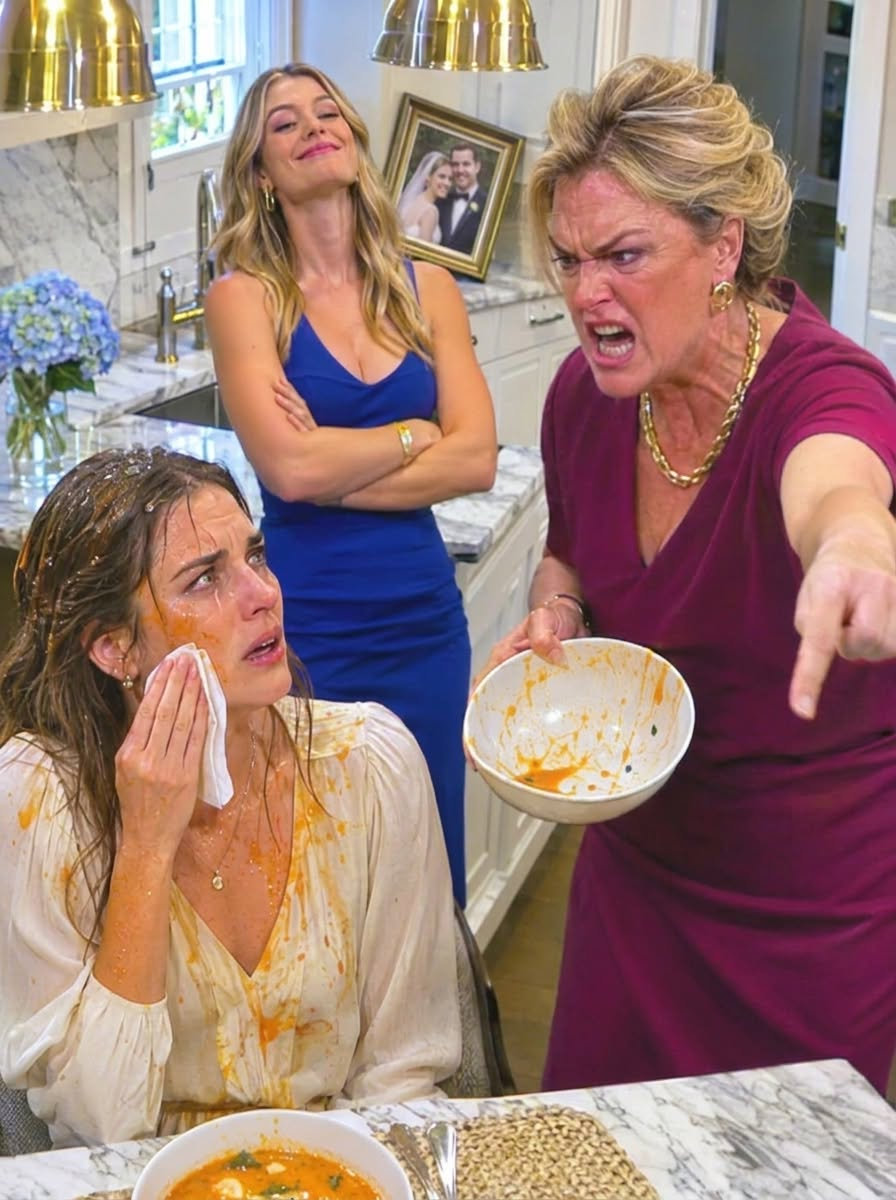
My mother threw a bowl of scalding soup into my face and screamed, "Give Violet everything—or get out!"
Behind her, my stepsister held my father's necklace box.
A small brass plate beneath the box carried three engraved words:
For Nora. Always.
My mother had just demanded that I surrender the only home my father had left me.
She didn't know it yet.
Neither did Violet.
And neither of them understood why, after twenty-eight years of apologizing for things I hadn't done, I was finally ready to stop.
The soup struck my face before I could turn away.
For one terrible second, I felt nothing.
Then the heat came.
It burned across my forehead, my cheeks, and the delicate skin beneath my chin. Orange broth soaked through my ivory blouse and ran down my neck. A piece of carrot caught in my hair.
I gasped and pushed back from the kitchen counter.
My chair scraped across the floor.
"Mom!"
My voice came out smaller than I expected.
My mother, Diane Whitmore, stood over me holding the empty ceramic bowl.
She was sixty-one, with neatly styled chestnut hair, expensive silver earrings, and a forest-green dress she had bought with money from an account I helped her manage.
Her face was twisted with anger.
Not regret.
Not shock at what she had done.
Anger.
"Don't you dare raise your voice at me!" she shouted.
I stared at her.
My skin was burning.
"You threw hot soup at me."
"And I'd do it again if that's what it takes to teach you some respect!"
Behind her, Violet laughed.
It wasn't a nervous laugh.
It was the sound of someone enjoying a victory she had spent months arranging.
Violet was twenty-five, with a sleek black bob, flawless makeup, and the kind of confidence that comes from never being told no.
She stood beside the marble island with her arms folded.
"Honestly, Nora," she said, "you brought this on yourself."
I reached for a napkin.
My fingers were trembling so badly that I almost dropped it.
I pressed the cloth against my cheek.
The pain made my eyes water.
"What did I do?" I whispered.
Violet rolled her eyes.
"You're really going to play innocent?"
My mother slammed the bowl into the sink.
"Your sister has an important interview tomorrow. She needs reliable transportation, a professional computer, and something appropriate to wear. You have all those things. She doesn't."
"She has a car."
"Her car is embarrassing," Violet interrupted.
I looked at her.
"You drive a three-year-old BMW."
"With a cracked windshield."
"Then repair the windshield."
Violet's expression hardened.
"See, Mom? This is exactly what I'm talking about."
My mother turned back toward me.
"You have a perfectly good SUV sitting in the driveway. You work from home. Why should you keep it when your sister needs it?"
"Because I bought it."
"Don't be selfish."
"I paid for it myself."
"And the laptop?" Violet demanded.
I blinked.
"What about it?"
"You have the newest MacBook. Mine is getting slow."
"Then buy another one."
Her mouth fell open.
My mother stepped closer.
"That is enough."
But Violet wasn't finished.
"And the necklace."
My stomach tightened.
She lifted a small velvet jewelry box from the counter.
I recognized it immediately.
It was the box my father had given me on my twenty-first birthday.
Inside was a delicate silver necklace with a small oval pendant.
Nothing flashy.
Nothing extravagant.
But on the back of the pendant, in letters so tiny they were almost invisible, my father had engraved a message.
You are enough.
He had given it to me during the last healthy summer of his life.
Two months later, doctors found the cancer.
Eleven months after that, he was gone.
I looked at Violet.
"Where did you get that?"
She shrugged.
"Your room."
"You went into my bedroom?"
"Mom said I could."
I turned toward my mother.
"You gave her permission to go through my things?"
My mother crossed her arms.
"Everything in this house belongs to this family."
"That necklace was from Dad."
"And your father would have wanted you to share."
Something inside me went very still.
My father, Robert Whitmore, had been a quiet man.
He wasn't the kind of father who gave speeches or demanded obedience.
He taught me to change a tire, balance a checkbook, and read every page before signing a contract.
When I was twelve, he sat beside me at the dining table with a stack of paperwork and said something I never forgot.
"People can tell you almost anything, sweetheart. But paper has a way of remembering the truth."
I didn't understand what he meant then.
I understood it now.
I looked at the jewelry box.
"Put it down, Violet."
She smiled.
"Or what?"
"Please."
"That's better. You should have started with please."
My mother pointed toward the hallway.
"Go upstairs. Pack a bag. And leave the keys to your car on the counter."
I stared at her.
"You want me to leave?"
"If you cannot behave like a grateful daughter, you don't deserve to live under my roof."
There it was.
The phrase she had used my entire life.
Under my roof.
When I was sixteen, she used it because I wanted to attend a summer science program instead of helping her host a family reunion.
When I was nineteen, she used it because I refused to give Violet the money I had saved from my first job.
When I was twenty-three, she used it because I wouldn't cosign a loan for Violet's boyfriend.
And when I was twenty-six, after I moved back home to help my mother through a difficult year, she began using it almost every week.
Under my roof.
My rules.
My house.
My generosity.
She had repeated those words so often that everyone in the family believed them.
Including, for a long time, me.
But the truth was sitting inside a fireproof document box in my bedroom closet.
The deed.
My father's final will.
The probate court's order distributing his estate.
My name.
Not hers.
Mine.
I looked at my mother and realized something painful.
She hadn't forgotten the truth.
She had simply grown comfortable pretending it didn't exist.
"Mom," I said quietly, "I need you to listen to me."
"No. You need to listen to me."
"My face is burning."
"Then go wash it."
"I think I need a doctor."
Violet sighed dramatically.
"Oh my God. It was soup, Nora. Not acid."
I turned toward her.
"Would you say that if someone threw it at you?"
She looked away.
My mother made a dismissive gesture.
"Stop being dramatic. You always exaggerate when things don't go your way."
I pressed the napkin harder against my cheek.
A sharp sting made me flinch.
"All I said was no."
"And I told you," my mother snapped, "that no is not an acceptable answer when your family needs something."
I stared at her.
She had said that before.
When Violet wanted my graduation gift money.
When Violet needed help paying her credit card bill.
When Violet borrowed my clothes and returned them damaged.
When Violet ruined the leather seats in my old car and my mother told me accidents happened.
Every time, I had been expected to forgive.
Every time, Violet had been expected to receive.
And every time, my mother called the arrangement family loyalty.
I had mistaken surrender for kindness.
That realization hurt almost as much as my face.
Violet moved closer.
She picked up the jewelry box and opened it.
The necklace glimmered beneath the kitchen lights.
"I think I'll wear this tomorrow," she said.
"No."
She froze.
My mother turned toward me.
"What did you say?"
I swallowed.
"No, Violet. You won't."
Violet's eyes narrowed.
"You're unbelievable."
"That necklace isn't yours."
"Mom said I could borrow it."
"Mom didn't give it to me. Dad did."
For a moment, the kitchen fell silent.
My mother's expression changed.
Not because she felt ashamed.
Because I had mentioned my father.
She hated when I did that.
Especially when his memory contradicted something she wanted.
"Your father is dead," she said coldly.
The words struck harder than I expected.
Violet looked at me with a satisfied little smile.
My mother continued.
"And I am the one who has kept this family together since he died."
I stared at her.
My father had died six years earlier.
For the first year after his death, I had barely functioned.
I went to work, came home, and cried in the shower so my mother wouldn't hear.
I had been twenty-two.
My mother was already married to Violet's father, who had entered our lives after my parents divorced. That marriage had been difficult, and Violet's father eventually moved overseas after their separation.
By the time Dad died, my mother had begun referring to the house as the one thing that would keep our family stable.
I let her.
Dad had wanted me to feel secure.
I thought allowing my mother to stay was the right thing to do.
I didn't charge rent.
I paid the property taxes.
I covered the insurance.
I handled major repairs.
When the air-conditioning system failed, I replaced it.
When the roof developed a leak, I hired contractors.
When my mother wanted new marble countertops, I paid for those too.
She told her friends she'd renovated the kitchen herself.
I never corrected her.
I told myself it didn't matter who received the credit.
Now I was sitting in that same kitchen, covered in soup, while she threatened to throw me out.
"You're right," I said softly.
My mother blinked.
"What?"
"Dad is gone."
Violet rolled her eyes.
"Here we go."
I ignored her.
"And I've spent six years trying to make sure we didn't lose what he left behind."
My mother's face tightened.
"Don't start talking about money."
"I'm not."
"Because everything you have is because of this family."
I looked at the white marble countertop.
The gold fixtures.
The expensive pendant lights.
The framed photograph of my parents' wedding that still sat near the pantry, despite their divorce.
I remembered my father standing in this kitchen before his illness, teaching me how to make pancakes.
He always burned the first one.
He called it the cook's tax.
For one second, I wanted him back so badly that my chest hurt.
Not because I needed him to rescue me.
Because I wanted him to see what had become of the home he loved.
Then I looked at my mother again.
"Okay," I said.
She frowned.
"Okay what?"
"I'll leave."
Violet laughed.
"Finally."
My mother seemed surprised.
She had expected an argument.
Maybe tears.
Maybe another apology.
Instead, I pushed my chair back and stood.
My blouse clung to my skin.
Soup dripped onto the floor.
I took one careful breath.
"Can I get my medical documents?"
My mother waved toward the stairs.
"Take whatever personal papers you need. But leave the car keys."
I nodded.
"And my laptop?"
"Violet needs it."
"My necklace?"
Violet snapped the jewelry box shut.
"Mine for now."
I looked at her.
Then at my mother.
"All right."
Violet smiled broadly.
"See? That wasn't so hard."
No.
It wasn't.
Not anymore.
I walked toward the stairs.
My mother called after me.
"And don't expect to come crawling back tomorrow."
I stopped.
For a moment, I considered turning around.
I considered telling her about the deed.
About the attorney who had handled my father's estate.
About the trust instructions and the property records.
I considered explaining that the person she was ordering out of the house was the only person in the room with the legal authority to decide who stayed.
But then I remembered something my father had once told me.
"Never explain your position to someone who benefits from misunderstanding it."
I kept walking.
Behind me, Violet said, "She'll be back before breakfast."
My mother answered, "Then maybe she'll finally learn gratitude."
I climbed the stairs without another word.
Inside my bedroom, I closed the door.
Then I locked it.
My hands began shaking again.
Not from fear.
From pain.
I went straight to the bathroom mirror.
My face was red.
My left cheek looked worse than the right.
A few small areas were already beginning to swell.
I turned on cool running water and carefully rinsed my skin.
It hurt.
I stood there for several minutes, trying to breathe evenly.
Then I called an urgent care clinic.
The receptionist asked what had happened.
I hesitated.
It was strange how difficult it felt to say the truth aloud.
"My mother threw hot soup in my face."
There was a pause.
Then the woman's voice softened.
"Are you somewhere safe right now?"
I looked toward my locked bedroom door.
"Not really."
She told me to seek immediate medical evaluation and asked whether I needed emergency assistance.
I told her I could leave safely for the moment, but that I wanted the injury documented.
After ending the call, I sat on the edge of my bed.
I looked around the room.
The pale curtains.
The bookshelves.
The framed photograph of Dad and me at a baseball game.
I had been fourteen.
He was wearing a ridiculous red cap.
We were both laughing.
I picked up the photograph.
"Okay, Dad," I whispered.
"I think I finally understand."
Then I opened my closet.
Behind a row of winter coats sat a small black fireproof box.
I pulled it out.
Inside were the documents my father had insisted I keep.
His will.
The probate order.
The recorded deed.
Insurance records.
A handwritten letter.
I took out the deed first.
My eyes moved over the familiar words.
Grantee: Nora Elizabeth Whitmore.
I stared at my own name.
For years, I had treated that document as a responsibility.
Something to protect.
Something to preserve for everyone.
For the first time, I saw it differently.
It was also protection for me.
I photographed the deed.
Then the probate order.
Then the property tax statements showing payments from my account.
I saved everything to an encrypted folder.
Next, I opened the security application on my phone.
Six months earlier, I had installed cameras after a package theft and a series of suspicious late-night visitors in the neighborhood.
My mother had complained about them.
Violet called them paranoid.
But both had eventually forgotten they were there.
One camera faced the driveway.
Another covered the front entrance.
A third was mounted high above the kitchen cabinets.
That camera had a clear view of the marble island.
And its microphone worked perfectly.
I opened the recording.
There I was.
Sitting at the counter.
Violet standing behind me.
My mother holding the bowl.
I watched the argument unfold.
I heard myself say no.
I watched my mother lift her arm.
Then the soup struck.
Even through the phone screen, I flinched.
I paused the video.
My stomach twisted.
For several seconds, I couldn't make myself press play again.
Then I did.
"Give her everything—or get out!"
The recording captured every word.
Every insult.
Every threat.
Including Violet laughing while I held the napkin against my face.
I downloaded the entire clip.
Then I saved a second copy.
And a third.
My father had taught me to keep records.
He had also taught me never to trust a single copy of anything important.
I opened my contacts.
The first number belonged to my doctor.
The second belonged to Margaret Ellis.
Margaret had been my father's estate attorney.
She was fifty-eight, precise, calm, and known for being almost impossible to intimidate.
When I was twenty-two, sitting across from her after Dad's funeral, she had handed me the documents and said, "Your father wanted to make absolutely certain that this house would remain yours."
I hadn't spoken to her in nearly a year.
But when I called, she answered after three rings.
"Nora?"
"Hi, Margaret."
There was a pause.
"What's happened?"
I tried to speak.
My throat tightened.
Then the words came out.
"My mother threw boiling soup in my face."
Silence.
A different kind of silence.
Not disbelief.
Attention.
"Are you safe?"
"I'm in my bedroom."
"Have you seen a doctor?"
"I'm arranging that."
"Good. Do that immediately. Are you in immediate danger?"
"I don't think so, but she's downstairs."
"Then don't confront her again. If you feel threatened, call emergency services."
I nodded even though she couldn't see me.
"Margaret?"
"Yes?"
"She told me to get out."
Another pause.
"Out of the house?"
"Yes."
"The house your father left you?"
"Yes."
Margaret exhaled slowly.
"Does she understand what she's saying?"
"I think she's counting on me not understanding."
For the first time since the soup hit my face, I heard something that sounded almost like approval.
"Then we're going to handle this carefully."
I told her everything.
The car.
The laptop.
The necklace.
The threat.
The cameras.
The changed behavior over the last several months.
Margaret listened without interrupting.
When I finished, she asked one question.
"Do you still have the original deed?"
"Yes."
"Keep it somewhere secure. Send me copies of the documents and the recording. And Nora?"
"Yes?"
"Do not sign anything your mother gives you."
I frowned.
"Why would she give me something to sign?"
Margaret was quiet for a moment.
"Because people who think they own something sometimes become desperate when they discover they don't."
A chill moved through me.
I looked toward the bedroom door.
Downstairs, Violet was laughing again.
I could hear music playing.
They were celebrating.
My mother had just injured me, and they were celebrating.
"Margaret," I whispered, "I want them out."
The words surprised me.
I had never said them before.
Not even in my darkest moments.
But once they were spoken, I knew they were true.
Margaret didn't rush to reassure me.
She didn't promise that everything would be easy.
She simply said, "Then we'll begin the proper legal process."
I closed my eyes.
"Okay."
"One more thing," she said.
"What's that?"
"Before you leave, make sure you take the things that cannot be replaced."
I looked at my father's photograph.
The necklace.
The handwritten letter.
My passport.
The documents.
I understood.
After the call, I packed one small suitcase.
I chose ordinary clothes.
My medication.
My identification.
A few photographs.
The fireproof box.
I left the expensive handbags Violet had been asking to borrow.
I left the designer coats.
I left the electronics.
Not because I was giving them away.
Because I was done fighting over objects while the people around me treated my dignity as negotiable.
I would recover what belonged to me through proper channels.
I wasn't going to give them another confrontation.
I sent Margaret the recordings.
Then I called the security company to confirm that the footage was preserved and that no one else could delete it.
The representative verified my account.
"You're the registered owner and primary administrator," he said.
"Can anyone else remove recordings?"
"Not without your credentials."
"Good."
I changed my password anyway.
Then I enabled additional account security.
By the time I finished, my phone showed twelve missed calls from my mother.
I hadn't even left the house yet.
I opened the newest message.
Mom: Don't make this more difficult than it needs to be.
A second message followed.
Violet: Leave the car key on the counter. I'm serious.
I stared at the screen.
Then I typed one sentence.
I'm leaving. Please don't touch my belongings.
I didn't send anything else.
At the bedroom door, I paused.
I could hear footsteps downstairs.
A cabinet opening.
Violet talking about her interview.
My mother telling her not to worry.
"She'll come around," my mother said.
I gripped the suitcase handle.
Then I opened the door.
The hallway was empty.
I walked toward the staircase.
Halfway down, I heard Violet say something that made me stop.
"Mom, did you find the papers?"
My mother answered in a lower voice.
"Not yet."
"What if she takes them?"
"She won't know what matters."
My hand tightened around the banister.
Papers?
What papers?
I stood completely still.
Violet spoke again.
"But you said the lawyer needed them before Friday."
My heart began beating faster.
The lawyer?
Which lawyer?
My mother lowered her voice even more.
"Keep your voice down. I'll get what I need after she leaves."
I backed up one step.
The wooden stair creaked.
Both women fell silent.
Then my mother called toward the stairs.
"Nora?"
I didn't answer.
"Nora, come down here."
I looked at the suitcase in my hand.
Then at the bedroom door behind me.
Something was wrong.
Very wrong.
My mother wasn't just trying to take my car.
She was looking for documents.
And she had already spoken to a lawyer.
I took out my phone and opened the security application.
The kitchen camera was still recording.
I turned up the volume.
For several seconds, I heard only the refrigerator humming.
Then Violet whispered something.
"Mom, what if Nora finds out about the signature?"
My blood went cold.
My mother's answer came immediately.
"She won't. The papers are already—"
A loud knock interrupted her.
Not from the front door.
From somewhere inside the house.
Then a man's unfamiliar voice called out:
"Diane Whitmore? We need to talk about the document you signed yesterday."






Comments 0