The man knocked again.
“Diane Whitmore, I know you're in there. We need to discuss the document you signed yesterday.”
I stood halfway down the staircase, holding my suitcase with one hand and my phone with the other.
My mother's face had gone pale.
That frightened me more than her anger ever had.
Because my mother was rarely afraid of anything.
She could scream at restaurant managers, threaten customer service representatives, and reduce grown relatives to silence with a single look.
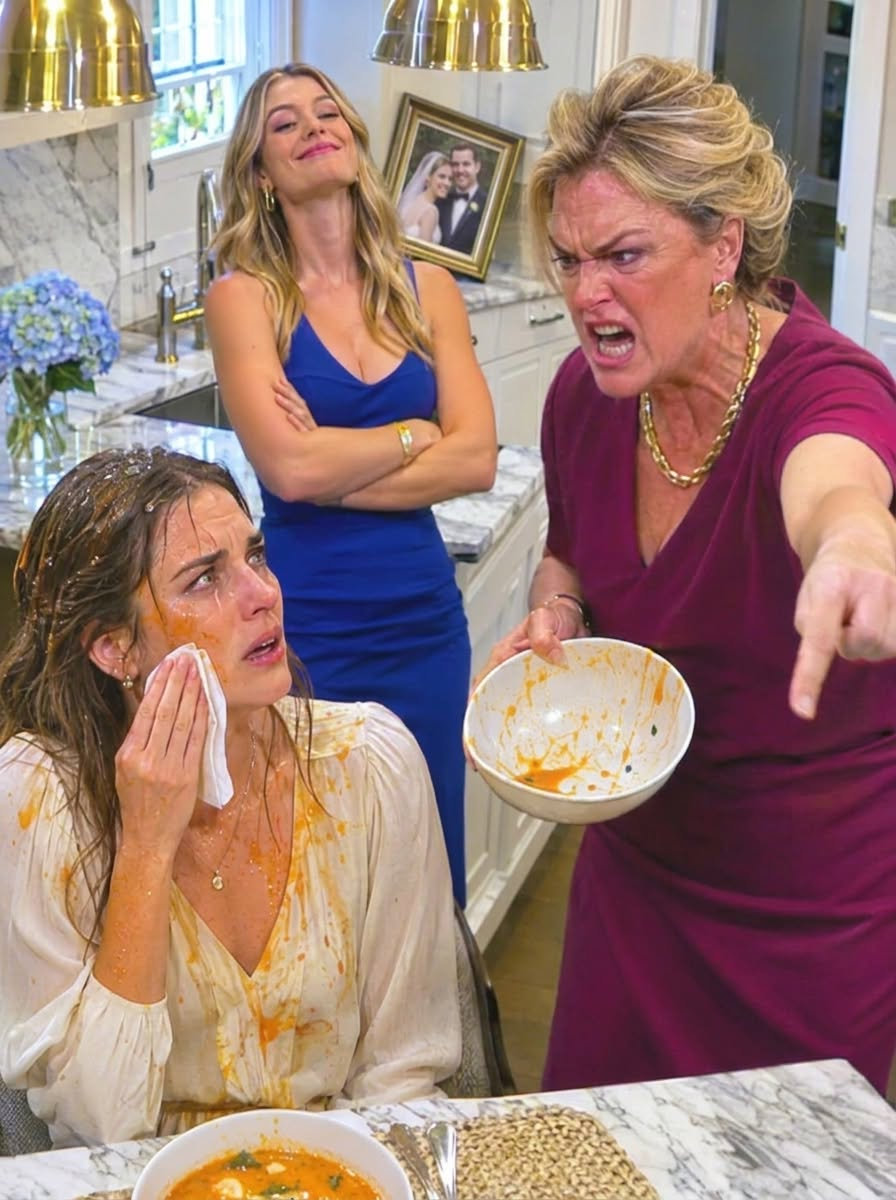
But now, standing in the kitchen with an empty soup bowl beside her, she looked like someone who had just heard a secret spoken aloud.
Violet glanced toward the hallway.
“Mom,” she whispered, “who is that?”
“Be quiet.”
The man's voice came again.
“Mrs. Whitmore, this matter cannot wait until Friday.”
Friday.
The same day Violet had mentioned.
I looked at my phone.
The kitchen camera was still recording.
I pressed the button to save the current footage.
Then I quietly moved down another step.
“Mom?” I called.
Both women turned.
My mother recovered quickly.
“Nora. I told you to pack your things.”
“I did.”
“Then leave.”
I looked toward the hallway.
“Who's here?”
“Nobody you need to concern yourself with.”
The man knocked a third time.
“Mrs. Whitmore?”
Violet took a nervous step toward my mother.
“You said he wasn't coming until tomorrow.”
My mother shot her a warning look.
I noticed it.
So did Violet.
For the first time that afternoon, my stepsister stopped smiling.
“Is that your lawyer?” I asked.
My mother straightened her shoulders.
“That is none of your business.”
“Did you sign something involving this house?”
Her expression hardened.
“Don't start.”
“What document?”
“Nora, I am not going to stand here and be interrogated by my own daughter.”
I glanced at the framed photograph near the pantry.
Dad had been smiling in that picture.
He had no idea that one day the woman he once loved would be standing in his kitchen, hiding paperwork from the daughter he had tried so hard to protect.
I wanted to demand answers.
I wanted to walk into the hallway and confront whoever was waiting.
But Margaret's warning returned to me.
Do not sign anything your mother gives you.
And another thought followed.
If my mother had already signed something she wasn't authorized to sign, arguing with her would only give her time to invent a better story.
So I did something she didn't expect.
I stopped asking questions.
“Okay,” I said.
My mother blinked.
“Okay?”
“I'll go.”
Violet looked relieved.
My mother looked suspicious.
I lifted my suitcase.
“But I need to see a doctor first.”
“Then go.”
I walked toward the front entrance.
My mother moved quickly to intercept me.
“Use the garage.”
I stopped.
“Why?”
“Because I said so.”
The man in the hallway spoke again.
“Mrs. Whitmore, I can hear you. I need to confirm whether Nora Whitmore has authorized this transaction.”
My heart slammed against my ribs.
My mother froze.
Violet whispered, “Oh, God.”
I looked directly at my mother.
“What transaction?”
She grabbed my arm.
Not hard enough to leave a bruise.
Hard enough to remind me that she still believed she had the right.
“Garage,” she hissed.
I looked at her hand.
Then at her face.
“Let go.”
Something in my voice made her release me.
I walked past her without another word.
But instead of going straight to the garage, I turned toward the hallway.
The man stood near the side entrance, just beyond the laundry room.
He was in his forties, wearing a gray suit and carrying a black leather folder.
He looked startled when he saw me.
“Are you Nora Whitmore?”
Before I could answer, my mother appeared behind me.
“She is leaving,” she snapped.
The man looked from my stained blouse to the white napkin pressed against my cheek.
His expression changed.
“Ma'am, are you injured?”
“I'm going to the doctor.”
He hesitated.
Then he looked at my mother.
“Mrs. Whitmore, I was told Ms. Whitmore had already reviewed the paperwork.”
My mother smiled.
It was a terrible smile.
The kind she used at church when she wanted everyone to believe we were a happy family.
“There's been a misunderstanding.”
The man didn't smile back.
“I need to speak with the property owner.”
I looked at him.
“You are.”
My mother made a sharp sound.
“Nora!”
I ignored her.
“My name is Nora Elizabeth Whitmore.”
The man opened his folder.
For a moment, nobody spoke.
Then he said, “I see.”
Two words.
But the way he said them made my mother step backward.
He closed the folder again.
“I think we should postpone this conversation until Ms. Whitmore has received medical attention.”
“What conversation?” I asked.
He glanced at my mother.
“I'm not comfortable discussing it under these circumstances.”
My mother seized the opportunity.
“Exactly. Nora needs to leave.”
I looked at the man's business card clipped to the folder.
Daniel Mercer.
Beneath his name were the words:
Property Documentation Services.
I memorized them.
Then I nodded.
“Fine.”
The man looked at me carefully.
“Ms. Whitmore, would you like my card?”
My mother opened her mouth.
I answered first.
“Yes.”
He handed it to me.
I slipped it into my pocket.
My mother watched the movement as if he had handed me a loaded weapon.
I walked into the garage.
Behind me, I heard the man say quietly, “Mrs. Whitmore, we have a serious problem.”
I didn't wait to hear her answer.
I got into my car.
And for the first time in my life, I drove away from that house without feeling obligated to tell my mother where I was going.
The pain became worse at the first traffic light.
My cheek throbbed.
The skin beneath my jaw felt tight.
I pulled into a parking lot and called the clinic again.
When I described the injury, the nurse told me to come in immediately.
I drove carefully.
Every movement reminded me of the soup.
Every time I blinked, I saw my mother's face.
Not angry.
Not disappointed.
Certain.
She had been certain that she could hurt me and still expect me to obey.
That was the part I couldn't stop thinking about.
At the urgent care center, a nurse named Rebecca led me into an examination room.
She looked at my face.
Then at my blouse.
“What happened?”
I swallowed.
“My mother threw hot soup at me.”
Rebecca stopped writing.
She looked up.
“Your mother?”
“Yes.”
“Was it accidental?”
“No.”
The word felt strange.
Clean.
Final.
No explanation.
No excuse.
Just no.
Rebecca nodded.
“Thank you for telling me.”
She examined the affected areas and called the physician.
Dr. Elena Morris arrived a few minutes later.
She was a calm woman with dark hair pulled into a bun and the kind of voice that made me feel less embarrassed about being there.
She checked my eyes, my cheeks, and my neck.
She asked about pain, vision changes, and difficulty breathing.
Then she explained that I had superficial and partial-thickness burns in several areas.
Some would likely heal without permanent damage.
Others would need careful monitoring.
She gave me treatment instructions, applied appropriate dressings, and arranged a follow-up.
Then she asked whether I wanted the cause of the injury documented.
I stared at her.
“Isn't that already in the chart?”
“It is. But I want to make sure your statement is recorded accurately.”
I looked down at my hands.
For twenty-eight years, I had been trained to soften the truth.
Mom didn't mean it.
Mom was stressed.
Mom had a difficult childhood.
Mom was worried about Violet.
Mom was grieving.
Mom was tired.
Mom was doing her best.
There was always a reason.
Always an explanation.
Always a way to make her behavior sound smaller than it was.
I looked back at Dr. Morris.
“My mother deliberately threw a bowl of hot soup into my face because I refused to give my stepsister my belongings.”
The doctor nodded.
She wrote it down.
Then she asked whether I wanted information about reporting the assault.
I hesitated.
I could already hear my mother's voice.
You're really going to call the police on your own mother?
I imagined Aunt Linda calling.
I imagined relatives telling me I had gone too far.
I imagined Violet posting something cruel online.
Then I remembered the soup sliding down my neck.
“Yes,” I said.
“I want the information.”
By the time I left the clinic, my face was covered with light dressings.
I had a folder of medical paperwork and photographs documenting the injury.
My phone showed nineteen missed calls.
Twelve from my mother.
Seven from Violet.
There were also seventeen text messages.
I opened the first one.
Mom: You embarrassed me in front of that man.
The second:
Mom: You had no right to tell him you own this house.
The third:
Mom: Call me immediately.
Violet's messages were less restrained.
Violet: What the hell did you say to him?
Violet: Mom is furious.
Violet: You ruined everything.
Violet: Bring back the car.
I stared at the screen.
Then another message arrived.
Violet: If you think Dad's stupid paperwork makes you special, you're delusional.
I almost laughed.
Not because anything was funny.
Because for years, Violet had mocked me for being quiet, ordinary, and boring.
Now she was furious because the quiet, ordinary, boring woman she despised had something she couldn't take.
I saved screenshots.
Then I called Margaret.
She answered immediately.
“Nora?”
“I'm out.”
“Good. Are you safe?”
“Yes. I'm leaving urgent care.”
“How bad are the burns?”
I told her.
She was quiet for a moment.
Then she said, “I'm sorry.”
Those two words nearly broke me.
Not because they were extraordinary.
Because they were so simple.
My mother had thrown soup in my face and never apologized.
My lawyer had heard about it and immediately understood that something terrible had happened.
I took a breath.
“Margaret, someone came to the house.”
“Who?”
“Daniel Mercer. Property Documentation Services.”
There was a pause.
“Did he say why?”
“He asked whether I had authorized a transaction.”
Margaret's voice changed.
“Did you sign anything?”
“No.”
“Did you give your mother written permission to act for you?”
“No.”
“Have you ever granted her power of attorney?”
“No.”
“Has she ever asked you to transfer the property?”
“Not directly.”
Margaret exhaled.
“Send me his card.”
I photographed it and sent it.
Then I told her what Violet had said about a signature.
Margaret listened.
When I finished, she said, “Nora, I need you to understand something.”
“What?”
“Your mother may have attempted to create or use a document that falsely represents your authorization.”
My stomach tightened.
“Can she take the house?”
“Not simply by signing something. But fraudulent paperwork can create serious problems if it isn't challenged quickly.”
I looked out through my windshield.
Cars moved through the parking lot.
People carried groceries.
A man helped his little daughter into a car seat.
The world continued as if nothing had happened.
Meanwhile, my mother might have been trying to steal the house my father left me.
“What do we do?”
“First, we verify exactly what was signed. Then we preserve every piece of evidence. I'll contact Mr. Mercer and review the property records.”
“Should I go back?”
“No.”
The answer was immediate.
“Not tonight. You need medical care and a safe place to stay.”
I nodded.
“Okay.”
“And Nora?”
“Yes?”
“Do not tell your mother what we're investigating.”
I looked at the messages filling my phone.
“I wasn't planning to.”
I checked into a hotel near the medical center.
Nothing extravagant.
Just a clean room with a bed, a desk, and a window overlooking a parking lot.
I placed my suitcase beside the dresser.
Then I sat on the edge of the mattress.
The silence was overwhelming.
No mother shouting from downstairs.
No Violet demanding something.
No television playing too loudly.
No footsteps approaching my door.
For the first time in years, nobody expected anything from me.
And I didn't know what to do with that freedom.
I took off my shoes.
Then I cried.
Not loudly.
Not dramatically.
I simply sat there and let the tears come.
I cried because my face hurt.
Because my mother had hurt me.
Because Violet had smiled.
Because my father was dead.
Because I had spent so much of my life trying to earn love from people who treated love like a reward for obedience.
Eventually, I washed my hands, followed the doctor's care instructions, and lay down.
My phone buzzed.
I almost ignored it.
Then I saw the name.
Aunt Linda.
My mother's older sister.
I answered.
“Nora?”
“Hi, Aunt Linda.”
“Oh, sweetheart. What have you done?”
I closed my eyes.
There it was.
Not Are you okay?
Not I heard you were hurt.
What have you done?
“I'm not sure what Mom told you.”
“She said you had a terrible argument and stormed out.”
“Did she mention throwing soup in my face?”
Silence.
Then a small, uncomfortable laugh.
“She said there was an accident.”
“It wasn't an accident.”
“Well, Diane has been under a lot of pressure.”
I stared at the ceiling.
“Did she tell you why she was angry?”
“Something about Violet needing help.”
“She demanded my car, laptop, and Dad's necklace.”
Aunt Linda sighed.
“You know how your mother gets when she thinks someone is being selfish.”
I sat up.
“Are you saying I deserved it?”
“Of course not.”
“Then why are you explaining it?”
Another silence.
“Nora, I just don't want this family torn apart over material things.”
I looked at the medical folder on the desk.
“Neither do I.”
“Then maybe you should go home and talk.”
“I don't feel safe there.”
“Nora—”
“My mother assaulted me.”
The words hung between us.
Aunt Linda lowered her voice.
“Please don't use language like that.”
“Why?”
“Because once you start saying things like that, you can't take them back.”
I looked at my reflection in the dark hotel window.
The dressings.
The swollen cheek.
The tired eyes.
“I don't want to take it back.”
Aunt Linda didn't answer.
I ended the call.
Then I blocked her number for the night.
At 8:17 p.m., Margaret called again.
“I spoke with Daniel Mercer.”
I sat up immediately.
“What did he say?”
“He confirmed that your mother contacted his office about a proposed property transaction.”
“What kind?”
“He wouldn't discuss all the details until he verifies the documents and the parties involved. But he did tell me something important.”
I gripped the phone.
“What?”
“Your mother represented herself as having authority to act on your behalf.”
I felt sick.
“How?”
“That is what we're investigating.”
“Did she forge my signature?”
“We don't know yet.”
I looked toward the suitcase.
The fireproof box sat beside it.
Inside were the original documents.
My father's handwriting.
The deed.
The will.
Everything he had carefully arranged.
I suddenly remembered Violet's words.
What if Nora finds out about the signature?
“Margaret,” I whispered, “I think they planned this.”
“I think we need to consider that possibility.”
I swallowed.
“What happens now?”
“Tomorrow morning, I'll obtain the available records and contact the appropriate parties. We'll also discuss formal steps to protect your property and address the assault.”
I nodded.
Then remembered she couldn't see me.
“Okay.”
“One more question,” Margaret said.
“Yes?”
“Has your mother ever had access to your signature?”
I frowned.
“What do you mean?”
“Old contracts. Bank forms. Tax documents. Anything she could copy.”
I thought about it.
Then my stomach dropped.
“Last year.”
“What happened?”
“She told me she needed help with an insurance renewal.”
“Did you sign anything?”
“Yes.”
“Do you have copies?”
“I might.”
Margaret's voice became very still.
“Find them.”
I opened my laptop bag.
Then I remembered.
My laptop was still at the house.
Violet had demanded it.
I had left it behind.
For a moment, panic rose in my throat.
My laptop contained years of work.
Financial records.
Family documents.
Scanned copies of old paperwork.
But then I remembered that most of my important files were stored in a secure cloud account.
I used the hotel's desk computer only to access a trusted remote session through my phone, then retrieved the relevant records on my own device.
I searched my files.
Insurance.
Renewal.
Diane.
Whitmore.
Finally, I found a folder dated eleven months earlier.
Inside was a scanned document.
A property insurance authorization form.
My signature appeared on the final page.
I stared at it.
Then I noticed something strange.
The signature wasn't on the same page as the rest of the document.
It had been scanned separately.
The image was slightly darker.
The paper texture was different.
I zoomed in.
My name appeared in black ink.
Nora Elizabeth Whitmore.
But the signature looked unusually familiar.
Not because I remembered signing that page.
Because I had seen that exact shape somewhere else.
I opened an older file.
A vehicle registration form from two years earlier.
My signature appeared near the bottom.
I placed the images side by side.
The same curve.
The same unusually long final stroke.
The same tiny break in the letter W.
Identical.
Not similar.
Identical.
I felt cold.
Someone had copied my signature.
I took screenshots.
Then I sent both files to Margaret.
A minute later, she replied.
Received. Do not alter the originals.
I leaned back in the chair.
For years, my mother had insisted she didn't understand paperwork.
She asked me to handle bills.
She pretended legal documents confused her.
She complained that online banking was too complicated.
But now I was looking at evidence suggesting someone had deliberately reused my signature.
And I could think of only one person who had access to those forms.
My mother.
At 9:43 p.m., Violet posted a photograph online.
I saw it because a friend sent me a screenshot.
There she was.
Standing in our driveway.
Leaning against my SUV.
Wearing oversized sunglasses despite the darkness.
The caption read:
New chapter. Finally getting what I deserve.
I stared at the photograph.
Then I noticed something.
My car's headlights were on.
The driver's door was open.
Violet was holding something in her right hand.
A key fob.
My key fob.
I sat upright.
I had my primary car key with me.
But there was a spare.
I kept it in a small drawer near the kitchen.
A drawer my mother knew about.
I opened the vehicle manufacturer's app on my phone.
The car was still linked to my account.
Its location showed the driveway.
I checked the activity history.
The doors had been unlocked twice.
Once at 8:56.
Again at 9:37.
I immediately secured the account and contacted the vehicle service provider about protecting access.
Then I saved the screenshot.
My phone buzzed again.
A message from Violet.
You left, remember? Stop acting like everything is still yours.
I stared at the words.
Then I typed:
Do not use my vehicle. You do not have permission.
She replied almost instantly.
Mom says otherwise.
I saved that too.
Then I called Margaret's office voicemail and left a short message about the car.
Afterward, I sat in the quiet hotel room and looked at my father's photograph.
He was smiling at me from the baseball stadium.
I remembered what he said when I got my first job.
"Never let someone confuse your kindness with permission."
I had laughed then.
I thought he was being overly serious.
Now I wished I had listened.
At 10:26 p.m., my mother called.
I watched the phone ring.
Once.
Twice.
Three times.
Then I answered.
“Nora.”
Her voice was strangely gentle.
I almost didn't recognize it.
“Mom.”
“Where are you?”
“Somewhere safe.”
She sighed.
“Sweetheart, this has gotten completely out of hand.”
I said nothing.
“I was upset earlier.”
I waited.
“You know how much pressure I've been under.”
Still nothing.
“And Violet has been so anxious about her interview.”
I closed my eyes.
There it was again.
Violet.
Always Violet.
My mother continued.
“I think we both said things we didn't mean.”
I looked at the bandage on my cheek.
“I didn't throw anything at you.”
She went silent.
Then her voice sharpened.
“Are you going to hold that over my head forever?”
“It's been less than twelve hours.”
“You know what I mean.”
“No, Mom. I don't.”
She exhaled loudly.
“Fine. I shouldn't have thrown the soup.”
I waited.
“But you pushed me.”
I felt something inside me settle.
There would be no apology.
Not a real one.
Only a new version of the story where I was responsible for what she had done.
“Why are you calling?” I asked.
My mother hesitated.
Then she said, “I need you to come home tomorrow.”
“No.”
“Nora—”
“No.”
Her breathing changed.
“Listen carefully. There are some documents we need to straighten out.”
My pulse quickened.
“What documents?”
“Nothing serious.”
“Then why do I need to come home?”
“Because I need your signature.”
I sat completely still.
My mother continued quickly.
“It's just an administrative issue. Something your father's attorney should have handled years ago.”
“Margaret?”
A pause.
“Yes.”
I knew she was lying.
Margaret had never mentioned any unresolved paperwork requiring my signature.
“What exactly am I signing?”
“Don't be difficult.”
“Send me the documents.”
“I can't.”
“Why not?”
“Because they're here.”
“Then take pictures.”
“Nora!”
Her voice cracked like a whip.
I pulled the phone away from my ear.
For several seconds, neither of us spoke.
Then I said quietly, “I'm not signing anything.”
My mother inhaled sharply.
“You have no idea what you're doing.”
“Maybe not.”
“You could ruin this family.”
I looked at the deed beside my bed.
“No, Mom.”
My voice remained steady.
“I think you already tried.”
I ended the call.
At 11:04 p.m., Margaret sent me a message.
Do not respond to any further requests for signatures. I have requested copies of the disputed paperwork. We will speak in the morning.
I placed my phone on the nightstand.
For the first time all day, I felt a small measure of relief.
I had a doctor.
I had an attorney.
I had the deed.
I had the recordings.
And I had finally stopped asking my mother for permission to protect myself.
I turned off the light.
But sleep wouldn't come.
I kept hearing the soup hit my face.
Kept seeing Violet smile.
Kept remembering the man in the gray suit.
We need to discuss the document you signed yesterday.
I rolled onto my side.
My cheek hurt against the pillow.
I adjusted the bedding and stared into the darkness.
At 11:38 p.m., my phone lit up.
An unfamiliar number.
I almost ignored it.
Then a message appeared.
Ms. Whitmore, this is Daniel Mercer. I apologize for contacting you so late. Your attorney has my information. I believe you need to know something before tomorrow morning.
I sat up.
A second message arrived.
The document your mother submitted was not simply an authorization form.
My heart began pounding.
I typed:
What was it?
Three dots appeared.
Disappeared.
Appeared again.
Then a photograph came through.
It showed the first page of a legal document.
At the top were the words:
PROPERTY TRANSFER AGREEMENT.
Beneath them was my father's address.
My house.
And below that—
Transferor: Nora Elizabeth Whitmore.
I stared at the screen.
Then I scrolled down.
A signature appeared at the bottom.
My signature.
Or something designed to look exactly like it.
But the date was yesterday.
Yesterday, when I had been working from home.
Yesterday, when I hadn't signed a single document.
Yesterday, when my mother had told me she was going shopping with Violet.
My hands began shaking.
I called Daniel immediately.
He answered on the second ring.
“Ms. Whitmore?”
“Who was she transferring the house to?”
There was a pause.
Then he said, “I think you should discuss that with your attorney.”
“Please.”
My voice broke.
“Just tell me.”
He exhaled.
“Your mother claimed you had agreed to transfer ownership as part of a family financial arrangement.”
“To whom?”
Another silence.
Then he said something that made my stomach drop.
“The named recipient wasn't your mother.”
I gripped the phone.
“Then who?”
Before he could answer, another message appeared on my screen.
It was from Margaret.
Nora, do not open the attachment your mother just sent you. Call me immediately.
I stared at the warning.
Then another notification appeared.
An email from my mother.
Subject:
YOUR FATHER'S FINAL INSTRUCTIONS
Attached was a scanned letter bearing my father's signature.
And beneath the attachment, my mother had written five words:
He never wanted you to know.






Comments 0