"That's impossible."
Thomas Reed's words echoed through the conference room.
I stared at the sealed envelope in Sarah Collins's hand.
My father's handwriting covered the front.
OPEN ONLY AFTER VERDICT.
And beneath it was a date.
A date that came three days after the hospital told me my father had died.
I felt the floor shift beneath my feet.
"What are you saying?" I whispered.
Thomas took the envelope from Sarah and examined it carefully.
"I'm saying the date doesn't match the official timeline."
Daniel stepped closer.
"Are you telling us Dad was alive?"
Thomas looked at him.
"We need to establish when this was actually written. A handwritten date alone doesn't prove that someone was alive on that day."
I swallowed.
"But you recognized something."
Thomas nodded.
"Your father's records contain references to a sealed statement prepared before his final hospitalization. We need to compare those records with this envelope."
Margaret Ellis moved beside us.
Her expression was troubled.
"May I see it?"
Thomas showed her the front.
Margaret's eyes widened.
"Oh, Robert."
My heart began pounding.
"What?"
She looked at me.
"Nora, I think I know what this is."
I grabbed the back of a chair.
"Then tell me."
Margaret took a breath.
"Your father prepared several statements in advance because he feared his condition might deteriorate before he could finish exposing the trust fraud."
I stared at her.
"Why is the date wrong?"
"Because the date on the envelope wasn't necessarily the date he wrote the letter."
Thomas turned it over.
A small notation appeared beneath the flap.
RELEASE DATE — THREE DAYS AFTER CERTIFICATION OF DEATH.
My breath caught.
Margaret nodded slowly.
"He instructed the firm to release certain documents only after his death was formally recorded. This may have been one of them."
I closed my eyes.
For one terrible moment, I had imagined my father alive somewhere.
Waiting.
Hidden.
Just as Daniel had been hidden for eleven years.
The hope hurt almost as much as losing him again.
Thomas spoke gently.
"Nora, the evidence still indicates Robert died at the hospital six years ago. What we're investigating is whether his death was deliberately hastened."
I nodded.
My eyes burned.
"Okay."
Margaret looked at the envelope.
"There's another problem."
"What?"
"This isn't the envelope I remember."
I went still.
She continued.
"Robert's original instructions were held in a plain white legal envelope. This one has been recreated to look like his handwriting."
Sarah examined it.
"So Diane may have prepared a substitute?"
Margaret nodded.
"Possibly."
I looked toward the courtroom.
My mother had lied about the house.
About my signature.
About Daniel.
About my father's last night.
And now she was trying to use another letter against me.
I took a slow breath.
"Then let's finish this."
When we returned to the courtroom, my mother was sitting beside her attorney.
She looked almost pleased.
For a moment, I wondered whether she believed she had finally won.
The judge reviewed the additional submission.
Sarah explained that the envelope's authenticity and date were disputed and that its contents had not been properly established.
My mother's attorney argued that the document demonstrated Robert's intentions.
The judge examined the materials.
Then he asked a simple question.
"Mrs. Whitmore, where did you obtain this envelope?"
My mother stood.
"From Robert's study."
"When?"
"Recently."
"Did you create or alter any part of it?"
"No."
Sarah rose.
"Your Honor, we have reason to believe the envelope was assembled from separate documents. We request that it not be treated as an authenticated statement from Robert Whitmore."
The judge agreed that the document's authenticity had not been established.
Then he turned toward my mother.
"Mrs. Whitmore, you have made several assertions under oath that have been contradicted by documentary evidence and your own recorded statements."
My mother stared straight ahead.
He continued.
"The recorded deed identifies Nora Elizabeth Whitmore as the owner. The evidence presented does not establish that you acquired ownership or valid authority to transfer the property."
My heart began pounding.
Daniel reached for my hand.
The judge addressed the remaining property issues, rejecting my mother's request to use the disputed documents as a basis for controlling the house and directing that possession and access be handled under the applicable court orders.
He also noted that questions involving possible forged documents and false testimony could be referred to the appropriate authorities.
My mother didn't move.
Neither did I.
For years, she had spoken as if her wishes were law.
Now a judge had told her that wanting something did not make it hers.
The hearing ended.
Sarah turned toward me.
"Nora, the ownership issue is resolved in your favor."
I stared at her.
"The house?"
She smiled.
"Your house."
I covered my mouth.
Daniel wrapped his arms around me.
I started crying.
Not because I had won something from my mother.
Because I had finally stopped losing what my father had left me.
Outside the courthouse, my mother approached us.
Her face was pale.
Violet followed several steps behind.
"Nora."
I turned.
My mother looked at Daniel, then back at me.
"Are you satisfied?"
I took a breath.
"The court made its decision."
She laughed bitterly.
"You've taken everything from me."
I stared at her.
"No, Mom."
Her eyes narrowed.
"You took my childhood peace. You took eleven years with my brother. You tried to take my home. And when I refused, you hurt me."
Her mouth tightened.
"I raised you."
"I know."
"I fed you. I clothed you."
"Yes."
She stepped closer.
"And this is how you repay me?"
I looked at her for a long moment.
Then I said the words I should have said years earlier.
"Being my mother didn't give you permission to destroy me."
She went still.
For once, she had nothing to say.
I turned toward Daniel.
"Let's go."
My mother called after me.
"Nora, you can't just walk away!"
I stopped.
Then looked back.
"Watch me."
And I walked away.
The criminal investigation continued over the following months.
It was slower than I wanted.
There were interviews.
Financial examinations.
Medical reviews.
Forensic comparisons.
And days when I woke up afraid that the truth would disappear beneath another mountain of paperwork.
But this time, people were preserving the evidence instead of hiding it.
Thomas kept us informed about developments he was permitted to share.
Margaret cooperated fully.
Grace Bennett provided Evelyn's original letters, recordings, and notes.
And Violet, facing questions about her own business and the documents she'd used, finally agreed to tell investigators what she knew.
The evidence established a devastating picture.
My father had discovered that money intended for Daniel had been diverted through accounts and companies associated with Charles, Richard, and Martin.
Diane had signed documents that helped them maintain control over Daniel's whereabouts and finances.
Richard handled transactions.
Charles kept Daniel isolated.
Martin helped move money through consulting arrangements that concealed its destination.
When Dad threatened to expose them, they tried to silence him financially.
Then the situation became far worse.
Medical experts reviewing the recovered hospital records identified evidence consistent with deliberate interference in Dad's treatment.
The archived records, access logs, Evelyn's recording, and later witness statements helped investigators reconstruct the final hours.
Martin had entered Dad's room without a legitimate medical role.
Richard had helped arrange his access.
And my mother had known what they intended.
She had not administered the medication herself.
But she had helped create the opportunity and had agreed to conceal what happened afterward.
When Thomas told me, I sat in silence for a long time.
Then I asked, "Did Dad suffer?"
Thomas looked at me with compassion.
"The medical review indicates he was already seriously ill. We can't reconstruct every moment of his experience."
I nodded.
That answer hurt.
But I appreciated that he didn't invent certainty to make me feel better.
Then I asked the question that mattered most.
"Did he know I loved him?"
Thomas didn't hesitate.
"Nora, everything we've found suggests your father spent his final days trying to protect you and Daniel. He knew how much you mattered to him."
I began crying.
Daniel held me until I could breathe again.
The forged documents became another part of the case.
Investigators found evidence that Richard had used false notarial information and altered financial authorizations.
The supposed power of attorney was invalid.
The property transfer agreement was not mine.
The life insurance beneficiary change was challenged through the insurer's review and the subsequent legal proceedings.
The original designation named Daniel and me.
Not Violet.
Not my mother.
And not the companies that had been trying to take our father's money.
The insurance dispute was eventually resolved in our favor, with the improper payments addressed through recovery proceedings.
Daniel's trust required a more complicated process.
Some money had been spent.
Some had been moved through multiple accounts.
Some was recovered after assets were frozen and claims were pursued.
The court appointed an independent fiduciary to oversee the remaining trust assets and the recovery process.
Daniel finally received an accounting.
He sat beside me as we read it.
For years, Charles had told him that Dad had abandoned him.
Now he could see what Dad had actually done.
Education funds.
Housing provisions.
Medical coverage.
A handwritten instruction about helping Daniel pursue whatever career made him happy.
Daniel stared at that last sentence.
Then he laughed through his tears.
"He remembered."
I looked at him.
"What?"
"When I was little, I told Dad I wanted to study animals."
I smiled.
"You wanted to become a dinosaur scientist."
Daniel laughed.
"Paleontologist."
"You were eleven."
"I was very serious."
I squeezed his hand.
"Dad knew."
Daniel folded the paper carefully.
Then whispered, "He really did."
The charges against Charles, Richard, Martin, and Diane proceeded separately, reflecting their different roles.
Their attorneys challenged evidence and negotiated where appropriate.
I attended the hearings I needed to attend.
I gave statements.
I answered questions.
And when the time came, I testified about what I knew firsthand.
Not what I suspected.
Not what I wished had happened.
Only what I had seen, heard, and documented.
Eventually, the criminal cases reached their conclusions.
Martin was convicted in connection with the deliberate interference in my father's care and received a lengthy prison sentence.
Richard was convicted of financial crimes and offenses connected to the concealment of evidence and the hospital scheme.
Charles was convicted for his role in Daniel's unlawful confinement as a child, financial exploitation, and related offenses.
My mother ultimately admitted to participating in the financial fraud and the cover-up surrounding Dad's death.
Her plea agreement did not erase what she had done.
She received a prison sentence.
I was present when the judge addressed her.
She stood without her pearls.
Without her perfect makeup.
Without the confident smile she had worn at every family gathering.
She looked older.
Smaller.
For the first time, I saw her without the illusion of power she had maintained over me.
The judge spoke about the harm caused to both her children.
Eleven years stolen from Daniel.
Years of deception inflicted on me.
The financial exploitation.
The false accusations.
And the betrayal of a dying man who had been trying to protect his family.
My mother cried.
I didn't know whether she was crying for us.
Or for herself.
And for once, I didn't need to know.
Violet's situation was different.
She had lied about her business.
Used disputed documents.
Misrepresented my involvement.
And accepted money based on promises she couldn't fulfill.
But investigators found no evidence that she had participated in the plan to harm Dad.
She had been sixteen when he died.
She had been at the hospital.
She had seen adults arguing.
And she had been told to stay quiet.
Years later, she had allowed her mother to use that silence against me.
Violet faced civil claims and legal consequences for her own financial misrepresentations.
Her company collapsed.
The luxury car disappeared.
The designer apartment was gone.
The expensive launch event was canceled.
For a while, she blamed everyone.
Me.
The investors.
The vendors.
The lawyers.
Then something changed.
One afternoon, she asked to meet me.
I almost refused.
But Sarah had confirmed there was no legal reason I couldn't speak with her, provided we avoided discussing unresolved matters that needed to go through counsel.
So I agreed.
We met at a small coffee shop.
Violet arrived wearing jeans and a plain sweater.
No jewelry.
No expensive handbag.
No dramatic entrance.
She looked tired.
"Nora."
I nodded.
"Violet."
She sat across from me.
For several minutes, neither of us spoke.
Then she said, "I'm sorry."
I looked at her.
She swallowed.
"For the house. The car. The videos. The things I said about you."
I waited.
She looked down.
"And for helping Mom."
My throat tightened.
"Why did you?"
Violet wiped her eyes.
"Because she always told me I deserved more."
I stared at her.
"More than what?"
"More than I had."
She gave a bitter laugh.
"She made me believe that if you had something and I didn't, it meant someone had cheated me."
I said nothing.
Violet continued.
"I believed her because it was easier than admitting I was jealous."
Her voice broke.
"And because I liked getting what I wanted."
I appreciated that she didn't pretend she'd been completely innocent.
She looked at me.
"I don't expect you to forgive me."
I took a slow breath.
"I don't know what forgiveness looks like yet."
She nodded.
"I understand."
"But I hope you build a life that's actually yours."
Her eyes filled.
"How?"
"By starting with the truth."
She looked down.
Then whispered, "I'm trying."
I believed that she was trying.
But I also knew that trying wasn't the same as changing.
We finished our coffee.
When we left, Violet didn't ask me for money.
She didn't ask for my car.
She didn't ask for the house.
She simply said, "Take care of yourself, Nora."
I nodded.
"You too."
It wasn't a perfect reconciliation.
It was something more honest.
A beginning that didn't require me to pretend the past had never happened.
Six months after the property case ended, I finally moved back into my house.
The locks had been changed through the proper process.
The disputed occupants had left.
The legal restrictions had been resolved.
And the study had been released after the necessary evidence was collected.
I stood in the front doorway with Daniel beside me.
For a long time, neither of us moved.
The house was quiet.
No shouting.
No demands.
No footsteps rushing down the hallway to tell me what I had done wrong.
Just sunlight stretching across the hardwood floor.
Daniel looked at me.
"Ready?"
I smiled.
"I think so."
We stepped inside.
The dining room was empty.
The table my mother had overturned was gone.
I had decided not to keep it.
I didn't want the room to remain a monument to the worst night of my life.
Instead, I ordered a smaller oak table.
Round.
Warm.
Simple.
One that didn't have a head.
One where everyone could sit as an equal.
Daniel helped me carry the chairs inside.
We argued about where to put them.
He insisted the table looked better near the window.
I insisted it belonged beneath the light fixture.
We moved it three times.
Then we both started laughing.
It was the kind of ordinary argument I had missed for eleven years.
The kind that ended with laughter instead of fear.
We renovated Dad's study last.
I couldn't bring myself to change it immediately.
His books were still there.
His old desk.
The framed photograph of him holding Daniel and me when we were little.
The hidden compartment had been repaired.
The brass key rested in a small wooden box.
One afternoon, Daniel found me standing beside the bookshelf.
"You okay?"
I nodded.
"Yeah."
He looked around.
"What are you going to do with this room?"
I smiled.
"I was thinking about turning it into a library."
He grinned.
"Dad would like that."
"I think so."
Daniel walked toward the desk.
Then stopped.
"Can we keep his chair?"
I looked at the old leather armchair.
The one Dad used to sit in while reading.
The one where Daniel had fallen asleep on his lap.
The one where I had cried after my first heartbreak.
I nodded.
"Absolutely."
Daniel sat down.
The chair creaked.
He smiled.
"Still uncomfortable."
I laughed.
"Dad always said it was good for his posture."
Daniel leaned back.
"He was lying."
We laughed until our eyes watered.
Then we sat quietly.
Remembering him.
Not as a victim.
Not as a name in a criminal case.
But as our father.
The man who made terrible pancakes.
Who sang off-key in the car.
Who remembered our birthdays.
Who kept a plastic dinosaur in a blue metal box because his son loved it.
And who had tried, even when he was dying, to make sure his children would be safe.
Daniel moved into the guest suite while he decided what to do next.
He enrolled in college.
He chose biology.
Not because he felt obligated to fulfill a childhood dream.
But because he still loved learning about living things.
He started seeing a counselor who helped him work through the years he'd spent believing his family was dead.
Some days were difficult.
He had nightmares.
He struggled with trusting people.
Sometimes he woke up afraid that I had disappeared.
On those nights, he would knock on my door.
"Nori?"
I would open it.
"Yeah?"
He would stand there looking embarrassed.
"Just checking."
I always smiled.
"I'm here."
And he would nod.
"Okay."
Over time, the nightmares became less frequent.
He made friends.
He joined a hiking group.
He adopted a ridiculous little dog from a shelter.
A terrier mix with enormous ears and absolutely no respect for furniture.
He named him Detective.
I laughed so hard when he told me that I nearly spilled my coffee.
"Detective?"
Daniel grinned.
"He's investigating everything."
The dog immediately stole one of my slippers.
Daniel pointed.
"See?"
For the first time in years, our house was filled with the sounds of a normal family.
Footsteps.
Music.
Laughter.
A barking dog.
And the occasional argument about who had forgotten to buy milk.
Margaret remained part of our lives.
Her involvement in the financial authorization had been thoroughly reviewed, and the evidence supported her account that the payment instruction had been added after she signed the original document.
She had made mistakes.
She admitted them.
She had withheld information she should have shared.
But she had also preserved records that ultimately helped expose the truth.
One afternoon, she visited the house.
I made tea.
We sat at the new dining table.
She looked around.
"Robert would have loved what you've done."
I smiled.
"Really?"
She nodded.
"He always wanted this place to feel like a home."
I looked toward the window.
"For a long time, it didn't."
Margaret's expression softened.
"I know."
I took a breath.
"Thank you for helping us."
Her eyes filled.
"I wish I'd done more sooner."
I shook my head.
"You helped us find the truth."
She looked down.
Then whispered, "Your father would be proud of you."
My throat tightened.
"I hope so."
Margaret reached across the table and squeezed my hand.
"I'm certain of it."
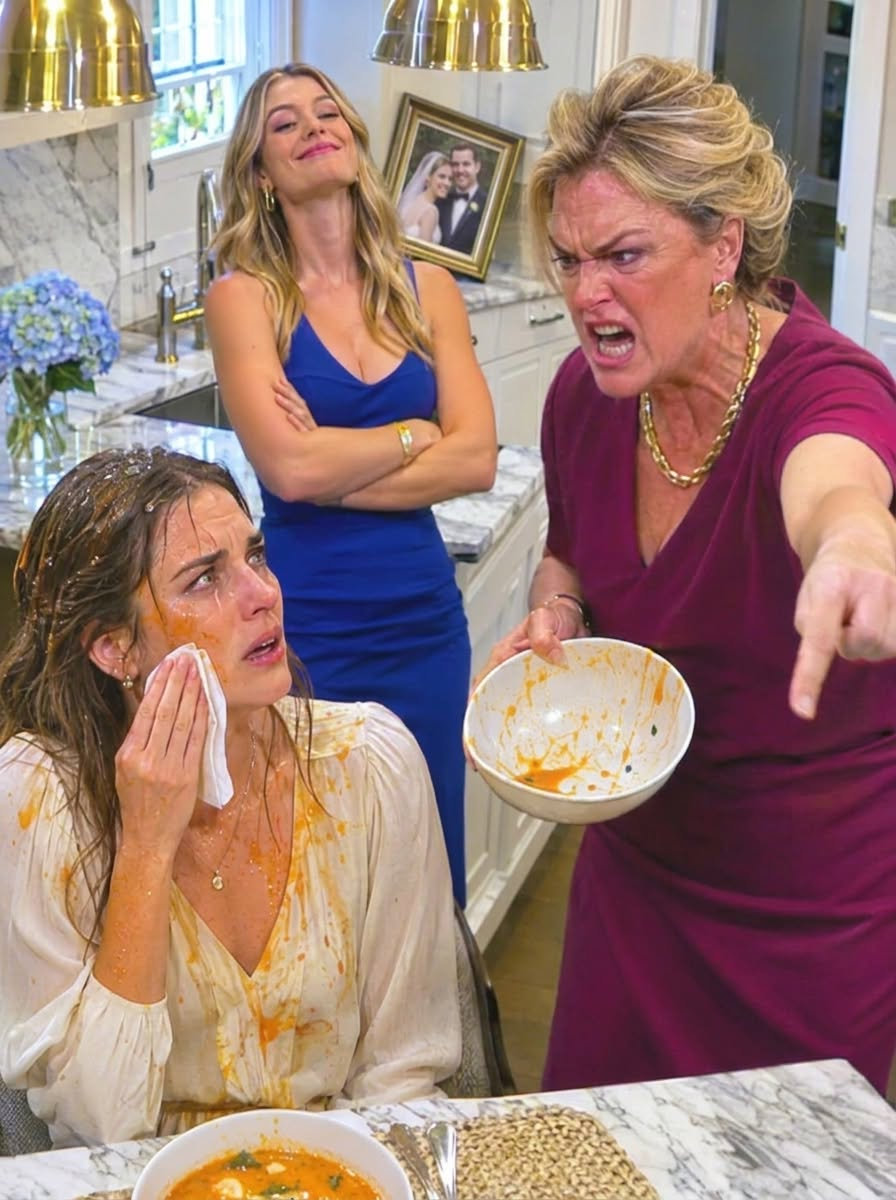
A year after the night my mother threw soup in my face, Daniel and I hosted our first family dinner.
Not a holiday.
Not a birthday.
Just dinner.
We invited Margaret.
Grace Bennett.
Sarah Collins.
Caroline Brooks, who had helped expose Violet's false claims.
And a few friends who had stood by me when everything fell apart.
I cooked chicken.
Daniel made mashed potatoes.
Detective supervised from beneath the table.
The kitchen smelled like rosemary and butter.
Music played softly.
Someone laughed in the living room.
And for the first time, I realized I wasn't waiting for something terrible to happen.
I wasn't listening for my mother's footsteps.
I wasn't afraid of breaking a plate.
I wasn't worried that a simple disagreement would turn into a punishment.
I was just home.
Daniel came into the kitchen carrying a bowl.
"Nori?"
I turned.
"Yeah?"
He smiled.
"Do you remember when Dad used to say we needed one good meal together every week?"
I laughed softly.
"Yeah."
"He said it didn't matter what we ate."
"As long as we were together."
Daniel nodded.
Then his expression softened.
"I think he'd like tonight."
I looked toward the dining room.
The table was full.
People were talking.
Laughing.
Passing plates.
Nobody was demanding anything.
Nobody was keeping score.
Nobody was trying to prove they deserved more love than someone else.
I felt tears rise.
"Yeah," I whispered.
"I think he would."
Later that evening, after everyone had gone home, Daniel and I sat on the back porch.
Detective slept between us.
The night air was cool.
The garden lights glowed softly.
Daniel leaned back in his chair.
"Can I ask you something?"
I smiled.
"Of course."
"Do you ever miss Mom?"
I looked toward the trees.
For a long time, I didn't answer.
Then I said, "Sometimes."
He nodded.
"Me too."
I took a breath.
"I don't miss what she did. I don't miss being afraid of her."
Daniel looked at me.
"What do you miss?"
I thought about it.
Then answered honestly.
"I miss the mother I kept hoping she'd become."
He looked down.
"Yeah."
I reached for his hand.
"We can miss someone and still know we can't have them in our lives."
He nodded slowly.
"I think I'm starting to understand that."
We sat quietly.
Then Daniel smiled.
"You know what I don't miss?"
"What?"
"Charles's cooking."
I laughed.
"Was it that bad?"
"Worse."
He shook his head dramatically.
"Eleven years of dry chicken, Nori. Eleven years."
I burst out laughing.
He laughed too.
And suddenly we were children again.
Not the children we'd actually been.
But the children we should have been allowed to remain.
Safe.
Loved.
Together.
The following morning, I visited Dad's grave.
Daniel came with me.
We brought flowers.
And the little green dinosaur from his blue box.
Daniel placed it carefully beside the headstone.
Then he stepped back.
"Hi, Dad."
His voice broke.
I wrapped an arm around him.
For a long time, neither of us spoke.
Then Daniel took a breath.
"I'm okay."
He wiped his eyes.
"I'm really okay."
I looked at the headstone.
Robert James Whitmore.
Beloved Father.
I had visited that grave for six years carrying questions I couldn't answer.
Now I finally knew the truth.
Dad hadn't abandoned Daniel.
He hadn't given away my house.
He hadn't chosen Violet over us.
He had been trying to protect his children from people he trusted too much.
He had made mistakes.
He had kept secrets.
But he had loved us.
And we had found our way back to each other.
I knelt beside the grave.
"Hi, Dad."
The wind moved gently through the trees.
I smiled through my tears.
"We got the house back."
Daniel knelt beside me.
"And I started college."
I laughed softly.
"He's doing really well."
Daniel smiled.
"Most of the time."
I looked at Dad's name.
"We're going to be okay."
My voice trembled.
"Not because everything turned out the way you wanted."
I took a breath.
"But because you gave us enough love to find our way through what didn't."
Daniel placed his hand over mine.
We stayed there until the morning sun warmed the grass.
Then we stood.
And went home.
That evening, I stood in the dining room alone.
The new oak table glowed beneath the warm light.
Through the window, I could see Daniel playing with Detective in the backyard.
The dog was running in circles.
Daniel was laughing.
I smiled.
Then I noticed something on the bookshelf.
Dad's old framed photograph.
The one of the three of us at the beach.
I picked it up.
I was eight.
Daniel was two.
Dad stood behind us, holding us both.
We were smiling so hard our eyes were almost closed.
I traced the edge of the frame.
For years, I had thought happiness was something you had to earn by being useful.
By giving enough.
By apologizing first.
By keeping everyone else comfortable.
My mother had taught me that love came with conditions.
My father had tried to teach me something different.
I hadn't understood it until I nearly lost everything.
I turned the photograph over.
There, tucked beneath the backing, was a small piece of paper.
I recognized Dad's handwriting.
It wasn't a secret.
It wasn't another warning.
It wasn't evidence.
Just a note.
One he'd written years before any of this happened.
For Nora and Daniel.
Wherever life takes you, remember that you deserve a place where you are safe, where you are loved, and where you never have to apologize for being yourselves.
Love, Dad.
I read it twice.
Then I sat down at the table and cried.
Not the desperate tears I'd cried in the hotel.
Not the frightened tears I'd cried after the soup struck my face.
These tears were different.
They came from finally understanding that the thing I'd been fighting for was never just a building.
It was the right to live without fear.
The right to say no.
The right to be loved without surrendering myself.
The right to have a family that didn't demand my suffering as proof of loyalty.
Daniel came inside.
He saw me sitting at the table.
"Nori?"
I looked up.
He noticed the photograph.
Then the note.
He read it quietly.
His eyes filled.
He sat beside me.
For a moment, we simply held each other.
Then he whispered, "We have that now."
I looked around.
At the warm lights.
The photographs.
The books.
The little dog asleep near the kitchen.
The home that had once felt like a battlefield.
I smiled.
"Yeah."
I squeezed his hand.
"We do."
Outside, the last light of evening settled over the garden.
Inside, Daniel got up to make tea.
Detective followed him.
I placed Dad's photograph on the shelf, where we could both see it every day.
Then I walked into the kitchen to help my brother.
There was dinner to prepare.
A table to set.
A life to live.
And for the first time, the house my father left me was filled with exactly what he had always wanted for us.
Love.
Safety.
And peace.






Comments 0