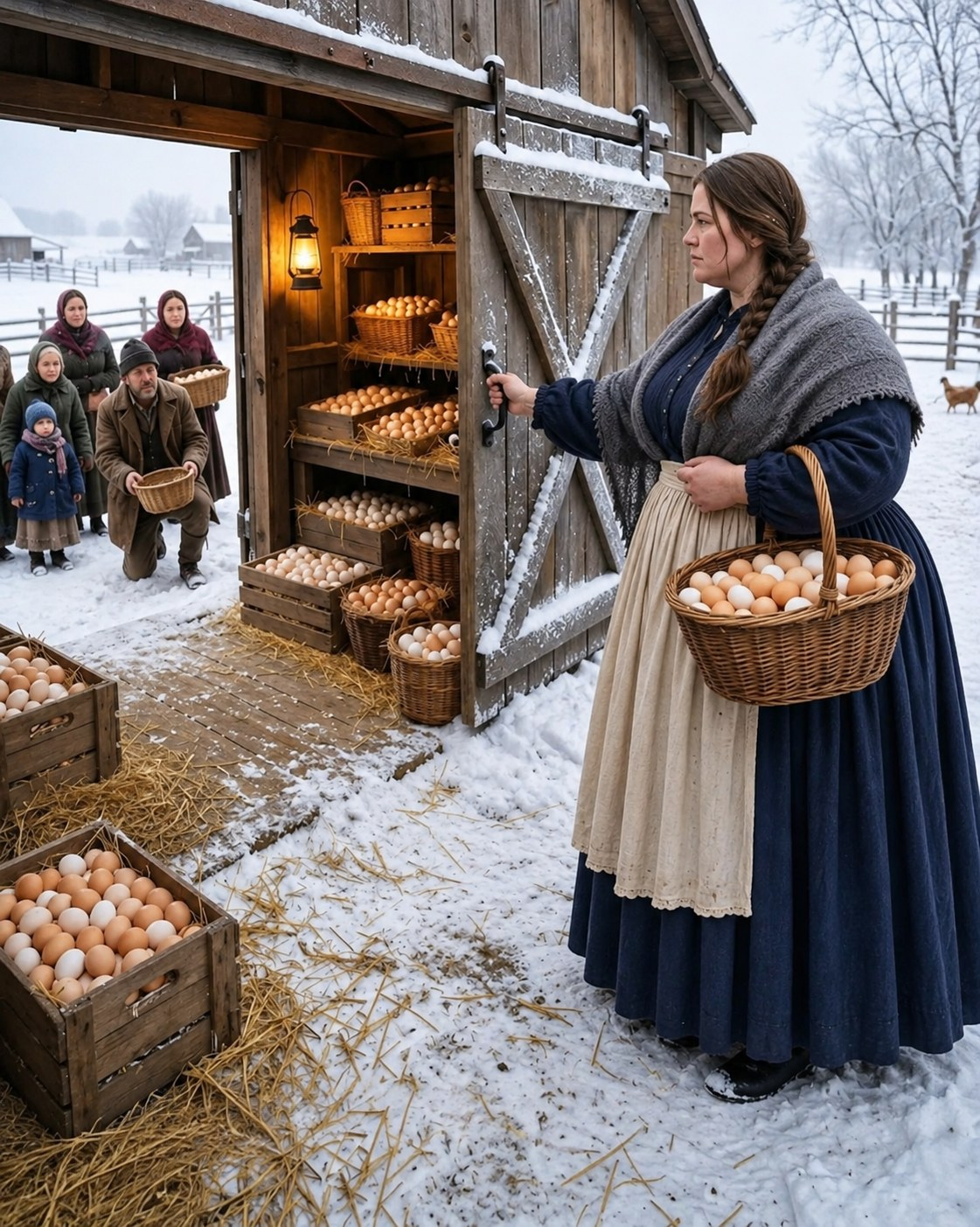
Daniel Carter pounded on my farmhouse door, shouting through the freezing wind:
"Mrs. Bennett! Please, you have to see this!"
When I opened the door, Harold Whitcomb, the richest businessman in Willow Creek, stood behind him with a folded government document.
At the bottom was my dead husband's signature.
Thomas Bennett had been dead for seven years.
And someone had used his name to steal food from an entire town.
I remember the exact moment I saw that signature.
Not because the snow was falling so heavily that I could barely see Daniel's face. Not because Harold Whitcomb, the man who had once laughed at me in front of an entire grocery store, was standing on my porch begging for help.
I remember it because my hands, which had spent years gathering eggs, carrying feed, repairing fences, and doing all the ordinary work of a woman living alone, suddenly began to shake.
For a few seconds, I could not hear anything except the wind.
Then Daniel spoke again.
"Mrs. Bennett?"
I looked at him.
The boy's cheeks were red from the cold. Snow clung to his auburn hair, and his dark green jacket was covered in white flakes. He was holding the folded paper so tightly that the edges had begun to tear.
"Come inside," I said.
My voice sounded strange to my own ears.
Harold stepped forward.
"Martha, we don't have much time."
I looked at him.
"Then you should have started preparing before the snow came."
He lowered his eyes.
There had been a time when that sentence would have made him laugh.
There had been a time when almost anything I said could make Harold Whitcomb laugh.
Six weeks earlier, he had stood behind me at Miller's General Store and announced to everyone within hearing distance that I was preparing to feed the chickens until the end of civilization.
Now he could barely look me in the face.
I stepped aside and let them enter.
The warmth from the old lantern inside the barn reached the doorway. Behind me, wooden shelves held hundreds of carefully arranged eggs. Some were in ordinary cartons, others in baskets, and some had been safely processed into shelf-stable supplies.
There were bags of feed stacked against the far wall.
Preserving jars stood in neat rows.
Insulated storage boxes occupied the lower shelves.
I had spent months preparing that space.
And now, standing in front of it, were two people who had arrived with something more important than a request for food.
They had brought me a secret.
"How many people?" I asked.
Harold swallowed.
"Almost everyone."
I stared at him.
"What does that mean?"
"It means the supermarket is empty. The roads are blocked. The trucks aren't coming. The power is out in most of town, and the shelter is running out of supplies."
"Where is the mayor?"
Harold hesitated.
That hesitation told me more than his words.
"Richard Hale is at the emergency shelter," he finally replied.
"And the emergency food reserve?"
He looked at Daniel.
Daniel looked down.
I felt something cold move through my chest.
"Harold. Answer me."
He rubbed his gloved hands together.
"The reserve was empty before the storm."
For a moment, I thought I had misunderstood.
"Empty?"
"Yes."
"How?"
He opened his mouth, but no answer came.
Daniel stepped forward.
"Mrs. Bennett, the mayor knew."
I turned toward him.
"He knew?"
Daniel nodded.
"That's what the document says."
He unfolded the paper and placed it on the wooden table beside the lantern.
The document had official markings at the top. It was dated two weeks before the first snow.
I leaned closer.
The words were difficult to read because the paper had become damp around the edges.
But the main authorization was clear.
The town's remaining emergency food supplies had been approved for removal.
The order carried the signature of Mayor Richard Hale.
I read it twice.
Then I reached the bottom.
My breath caught.
THOMAS BENNETT.
My husband's name.
I touched the signature with one finger.
"No," I whispered.
Daniel moved closer.
"Mrs. Bennett?"
I did not answer.
Thomas had died seven years earlier.
I had stood beside his hospital bed. I had held his hand when his breathing became shallow. I had watched the doctor lower his eyes before telling me there was nothing more they could do.
I had chosen his burial clothes.
I had signed the funeral papers.
I had placed flowers on his grave every anniversary since.
There was no possibility that he had signed this document.
None.
I knew his handwriting better than I knew my own.
The capital T was wrong.
The final stroke of his surname was too long.
And the date was impossible.
Someone had copied his signature.
Someone had deliberately placed his name on a document authorizing the removal of the town's emergency food supply.
"Where did you get this?" I asked.
Daniel glanced at Harold.
"From a folder at the emergency shelter."
"Who gave it to you?"
"Nobody. I found it."
Harold shifted his weight.
"Martha, I know this looks terrible, but we have to think about the people who need food right now."
I slowly raised my eyes.
"How long have you known?"
He looked uncomfortable.
"About what?"
"That the reserve was empty."
He did not answer.
I waited.
Finally, he said, "I found out yesterday."
"Yesterday?"
"The mayor told me."
"And you came here today."
"Because we need your help."
I looked at the document again.
That was the moment I understood something.
Harold had not come because he suddenly respected me.
He had come because the people he once dismissed were now his only hope.
I walked toward the shelves.
Behind me, Daniel began explaining that his younger sister, Lily, had become sick again.
His mother had been trying to find food and medicine, but the local shops had run out of almost everything.
I stopped.
"How is Lily?"
"She's weak," he answered. "Mom is trying to keep her warm. We haven't had a proper meal since yesterday."
I turned toward him.
"Then take some eggs. I'll prepare something for your family."
Daniel's eyes filled with relief.
"Thank you."
"Don't thank me yet. We need to make sure your sister gets the help she needs."
I placed a basket on the table and began filling it.
Then I looked at Harold.
"How many families are at the shelter?"
"More than eighty."
"Children?"
"Thirty or forty. I haven't counted."
"Elderly people?"
"Several."
I nodded slowly.
"Then we need to organize this properly."
Harold looked surprised.
"What?"
"I said we need to organize the food. We cannot simply hand everything to whoever reaches my door first."
For the first time since arriving, Harold looked directly at me.
"Martha, people are desperate."
"I know."
"They won't wait."
"Then we will have to help them quickly."
I took a notebook from the shelf and opened it.
I had kept records of everything for months.
The number of eggs gathered each morning.
The amount of feed used.
The supplies needed to keep the chickens warm.
The eggs stored for ordinary use.
The safely preserved egg products intended for emergencies.
Every detail had been written down.
I had never imagined that those records would become the foundation of an emergency food plan for an entire town.
But before I could begin, Daniel pointed toward the document.
"Mrs. Bennett, there's something else."
I looked up.
"What?"
He placed his finger beneath the mayor's signature.
"Look at the date."
I had already read it.
December first.
Daniel shook his head.
"Look at the date beside your husband's signature."
I leaned closer.
The handwritten date was slightly different.
December third.
Two days after the mayor's authorization.
My stomach tightened.
"Why would someone write a different date?"
Harold suddenly stepped forward.
"Daniel, that's enough."
The boy froze.
I looked at Harold.
"Why?"
He shook his head.
"It's probably a clerical mistake."
"A mistake involving my dead husband's signature?"
He did not answer.
I picked up the paper again.
There was a faint mark near the bottom corner.
A small indentation, as though another sheet of paper had been placed beneath it when someone wrote the signature.
I turned the document toward the lantern.
Beneath the official authorization was a barely visible handwritten notation.
It was only three words.
PRIVATE STORAGE TRANSFER.
I looked at Harold.
His face had changed.
He knew something.
And whatever it was, he had not intended to tell me.
"Harold," I said quietly. "What was transferred?"
He looked toward the barn door.
Then toward Daniel.
Finally, he whispered:
"That's what the mayor told us never to discuss."
I felt my fingers tighten around the document.
"Who is us?"
Harold took a breath.
Before he could answer, a distant engine growled through the storm.
Daniel turned toward the window.
A pair of headlights appeared beyond the snow-covered fence.
Then another.
And another.
Three vehicles were approaching the farmhouse.
Harold's face went pale.
He stepped backward.
"Oh, no."
I looked at him.
"Who is coming?"
He did not answer.
The first vehicle stopped outside my gate.
Its headlights illuminated the falling snow.
A man stepped out.
Even from a distance, I recognized the dark outline of his long winter coat.
Mayor Richard Hale had come to my farm.
And he was not alone.






Comments 0