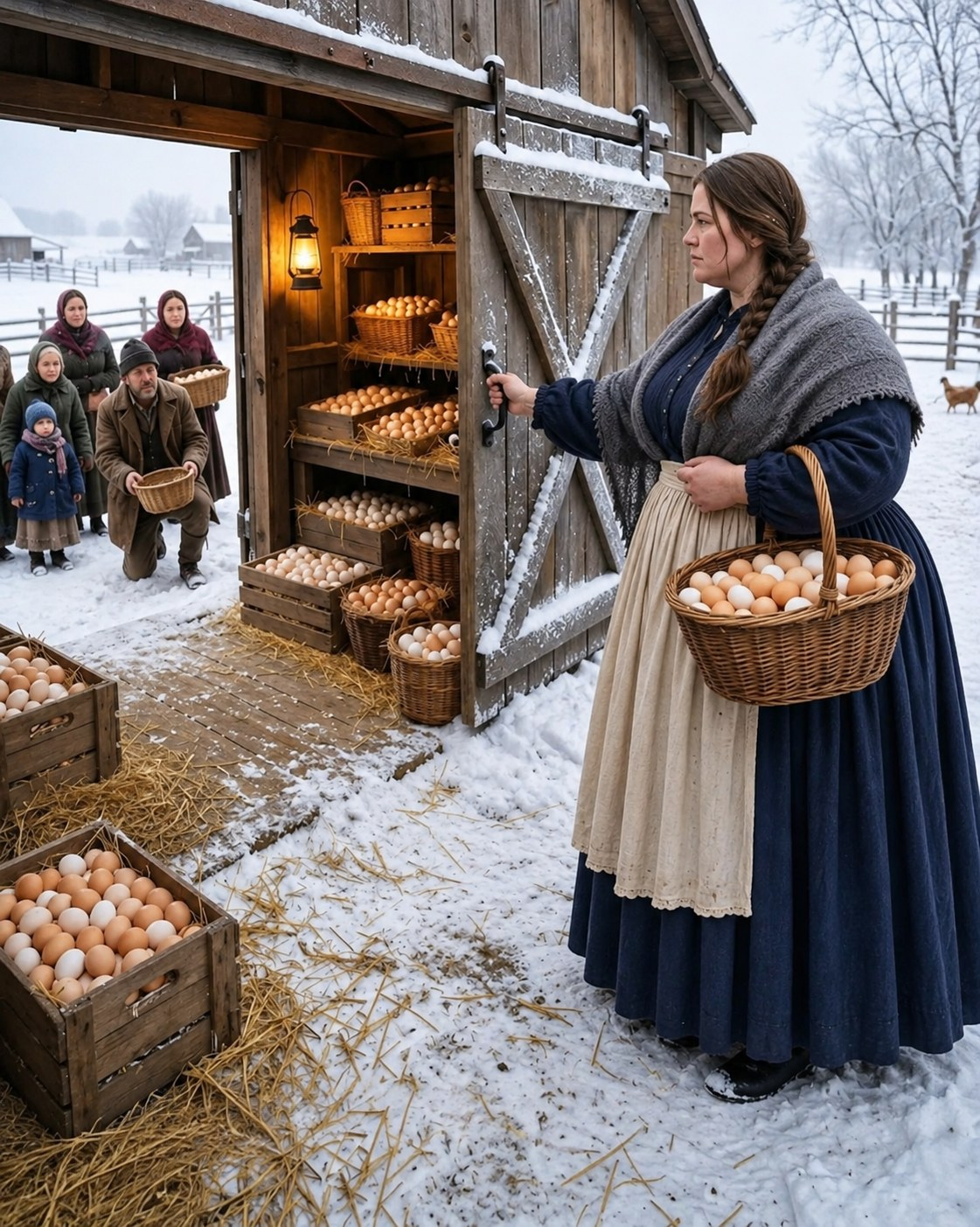
Six weeks before the blizzard, I stood at the counter of Miller's General Store with two large bags of chicken feed.
I had also purchased a sack of grain, several bundles of straw, and a box of empty egg cartons.
Outside, the sky was unusually gray.
The temperature had dropped during the previous week, and the wind had begun carrying a bitter chill through the streets of Willow Creek.
I wanted to finish my shopping before the afternoon rain.
That was when Harold Whitcomb walked into the store.
He was accompanied by two businessmen, both of whom seemed to find everything Harold said amusing.
Harold owned the largest supermarket in town. He also owned several commercial properties, a distribution warehouse, and a fleet of delivery trucks.
People listened when he spoke.
Some admired him.
Others feared disagreeing with him.
And almost everyone knew that Harold enjoyed reminding people how successful he had become.
He stopped behind me and looked at the bags near the counter.
"Good heavens, Martha."
I continued counting my money.
"Good afternoon, Harold."
He leaned toward one of the businessmen.
"Is she opening a poultry factory?"
The men laughed.
I picked up my receipt.
"Just preparing for winter."
Harold raised his eyebrows.
"Winter comes every year, sweetheart. You don't need to build Noah's Ark."
His friends laughed again.
I adjusted my faded wool scarf.
There was nothing particularly clever about his joke.
But Harold had never needed cleverness to make people laugh. He only needed an audience.
Betty Collins, the store owner's wife, came out from the back room carrying a cardboard box.
She glanced at my purchases.
"That's quite a lot of feed, Martha."
"I have thirty-seven chickens."
"Thirty-seven?"
"Thirty-seven."
Betty smiled.
"I suppose they eat more than I imagined."
"They do when the weather turns cold."
She placed the box on the counter and noticed the handwritten paper sticking out of my coat pocket.
"What's this?"
Before I could reach for it, she pulled it free.
"Oh, goodness."
I extended my hand.
"Betty, please."
But she had already read the first few lines.
Egg cartons.
Preserving jars.
Extra feed.
Insulated storage boxes.
Her eyes widened.
"Mercy, Martha! How many eggs are you planning to save?"
"Enough."
"Enough for what?"
I took the paper from her.
"For whoever might need them."
Harold burst out laughing.
"Did you hear that?"
He turned toward his friends.
"She's going to save Willow Creek with chicken eggs!"
The two businessmen laughed loudly.
Betty covered her mouth.
I folded the paper and returned it to my pocket.
"People need food in winter," I said.
Harold shook his head.
"People need sensible investments, Martha. Not a warehouse full of eggs."
I looked at him.
"Food is a sensible investment."
He smiled.
"Not when you can buy everything you need at my supermarket."
I wanted to tell him that a supermarket was only as reliable as the trucks bringing supplies to it.
But I decided against arguing.
I paid for my purchases and asked the store employee to help load them into my old pickup truck.
As I reached the door, Harold called after me.
"Don't forget to leave some eggs for the rest of us!"
His friends laughed again.
I did not turn around.
By evening, the joke had spread through town.
At the diner, someone called me the Egg Queen.
At the beauty salon, two women joked that I would soon need a separate building just to store my chickens' breakfast.
At church, a man asked whether I intended to open a museum of ancient omelets.
Even the children began making clucking noises whenever I walked past.
I heard about it from Betty the following Sunday.
She seemed embarrassed.
"Martha, people don't mean anything by it."
I smiled politely.
"It's all right."
"Harold has always had a big mouth."
"I know."
"Don't let him get to you."
I looked through the kitchen window toward the chicken coop.
The hens were gathering near the wooden shelter.
"Betty, I have been married to a farmer for most of my adult life. I learned a long time ago that people can laugh at work they don't understand."
She nodded.
I changed the subject.
There was no reason to waste an afternoon arguing about people who had already made up their minds.
Besides, I had work to do.
Every morning before sunrise, I went to the coop.
I collected the eggs carefully, checked each one, and separated those intended for immediate use from those that would be preserved.
I cleaned the nesting boxes.
I replaced damp straw.
I checked the water containers and made sure the chickens had enough feed.
The work was repetitive.
Sometimes my fingers hurt.
Sometimes my back ached so badly that I needed to sit down halfway through cleaning the shelter.
But I kept going.
My husband, Thomas, had taught me that preparation was not something you did when trouble arrived.
It was something you did when everything still seemed ordinary.
He had been a practical man.
He never wasted food.
He never ignored a warning.
And he never believed that being financially comfortable meant being prepared.
Seven years earlier, during a terrible ice storm, Thomas had driven through dangerous roads delivering food to stranded families.
He had loaded his old truck with bread, potatoes, canned vegetables, and anything else he could spare.
I had begged him not to go.
The roads were slippery.
The power lines were falling.
The weather service had warned people to remain indoors.
But Thomas had simply put on his coat.
"Someone has to remember the people nobody else remembers," he had told me.
Those were the last words he said before leaving that morning.
He returned safely that evening, but the illness that eventually took his life came several months later.
I still missed him.
Sometimes, when I worked alone in the barn, I caught myself turning to ask him a question.
Then I remembered.
The silence always lasted a little longer after that.
But his lessons remained.
I believed food should never be wasted.
I believed neighbors should help one another.
And I believed a community was only as strong as the people it was willing to protect.
That was why I continued preparing.
Not because I expected the end of the world.
Not because I wanted to prove Harold Whitcomb wrong.
And certainly not because I wanted anyone to call me a hero.
I simply did not want a hungry child to discover that the adults responsible for preparing had forgotten to do so.
A week after my visit to Miller's General Store, something unusual happened.
I was carrying a basket of eggs toward the storage shed when I noticed Daniel Carter standing beside the fence.
He was sixteen years old.
His mother, Sarah, worked two jobs, and his younger sister, Lily, had recently recovered from a serious illness.
Daniel was a quiet boy.
He usually walked home from school with his head down, carrying a backpack that looked older than he was.
Unlike the other children, he had never clucked at me.
He had never called me the Egg Queen.
He simply nodded whenever he passed my property.
That morning, he seemed hesitant.
"Mrs. Bennett?"
I turned.
"Hello, Daniel."
He glanced toward the chicken coop.
"Can I ask you something?"
"Of course."
He looked at the baskets.
"Why are you keeping so many eggs?"
I smiled.
"Because chickens don't understand supermarket schedules."
He laughed softly.
Then his expression became serious again.
"People say you're preparing for something terrible."
I placed the basket on a wooden table.
"People say many things."
"Are you worried about winter?"
I looked toward the hills.
The pine trees were moving in the wind.
"Yes," I answered honestly.
Daniel frowned.
"But winter happens every year."
"That's true."
"Then why are you worried?"
I pulled a small cloth from my pocket and wiped my hands.
"Because sometimes the weather is only part of the problem."
He waited.
I pointed toward the shelves inside the barn.
"People depend on trucks bringing food to stores. Stores depend on electricity. Refrigerators depend on electricity. And families depend on being able to afford whatever happens to be available."
Daniel listened carefully.
"If the roads close, the trucks stop."
"Yes."
"And if the electricity goes out?"
"Some food spoils. Some heating systems stop working. Things become difficult very quickly."
He looked toward the coop again.
"That's why you're saving eggs?"
"That's part of it."
I opened one of the baskets.
"Eggs can become breakfast. They can be used in bread, soup, and other meals. Properly handled and safely processed, they can also be part of an emergency food supply."
Daniel considered that.
Then he asked a question I had not expected.
"Could I help?"
I looked at him.
"Help with what?"
"Whatever you're doing."
There was something sincere in his expression.
I studied him for a moment.
"Do you have time after school?"
"Most days."
"And are you willing to work?"
He nodded immediately.
"Yes, ma'am."
I reached into the kitchen and brought him a warm biscuit.
He accepted it with both hands.
"Thank you."
"Come back tomorrow morning. We'll start with the chicken coop."
His face brightened.
"Really?"
"Really."
For the first time that morning, I felt less alone.
Over the next several days, Daniel became a regular visitor.
He carried bags of feed.
He helped replace the straw.
He reinforced loose boards around the chicken shelter.
He learned how to inspect the eggs and sort them carefully.
He even began keeping a notebook of his own.
His questions were endless.
How much food did thirty-seven chickens consume?
How many eggs could they produce in a week?
How long could eggs remain safe under different storage conditions?
Why did some chickens lay more frequently than others?
I answered as many questions as I could.
He absorbed everything.
One afternoon, while we were repairing a section of fencing, he asked me something that made me put down my hammer.
"Mrs. Bennett, what happens if the whole town runs out of food?"
I looked at him.
"Then we'll have to help each other."
"What if people don't help each other?"
I thought about Harold.
I thought about the laughter at the store.
I thought about the people who believed that money and delivery trucks could solve every problem.
Then I looked at Daniel.
"Then we remind them that being prepared isn't about being better than someone else."
He frowned.
"What is it about?"
I smiled gently.
"It's about making sure nobody gets left behind."
He nodded.
We returned to work.
That evening, I checked the weather forecast.
The meteorologist was discussing unusual changes in the northern air currents.
A powerful cold system was developing.
The forecast showed a possibility of severe winter conditions across several states.
I turned up the television.
The reporter mentioned that residents should monitor official updates and consider checking their emergency supplies.
I wrote the date in my notebook.
Then I looked through the window at the chicken coop.
The hens had already settled inside.
I checked the heating equipment one more time.
Outside, the first thin layer of frost had appeared along the fence.
I had no idea how severe that winter would become.
But I knew one thing.
I was not going to stop preparing simply because people thought it was funny.
The next morning, Daniel arrived earlier than usual.
He was carrying his phone.
"Mrs. Bennett!"
I looked up from the feed containers.
"What's wrong?"
He held out the screen.
A photograph showed Harold Whitcomb standing proudly outside his supermarket.
Behind him were rows of colorful grocery displays.
Across the photograph, Harold had written a cheerful message:
"FULLY STOCKED! NO NEED TO PANIC!"
Daniel looked at me.
"Doesn't he think the storm is going to be bad?"
I studied the photograph.
Then I looked at the weather report displayed beneath it.
The forecast had changed overnight.
The expected storm system was moving faster than predicted.
I handed Daniel his phone.
"Let's finish checking the generator."
"Why?"
I looked toward the northern hills.
"Because I have a feeling we won't have much time."
And that afternoon, the town council announced an emergency meeting that would change everything.






Comments 0