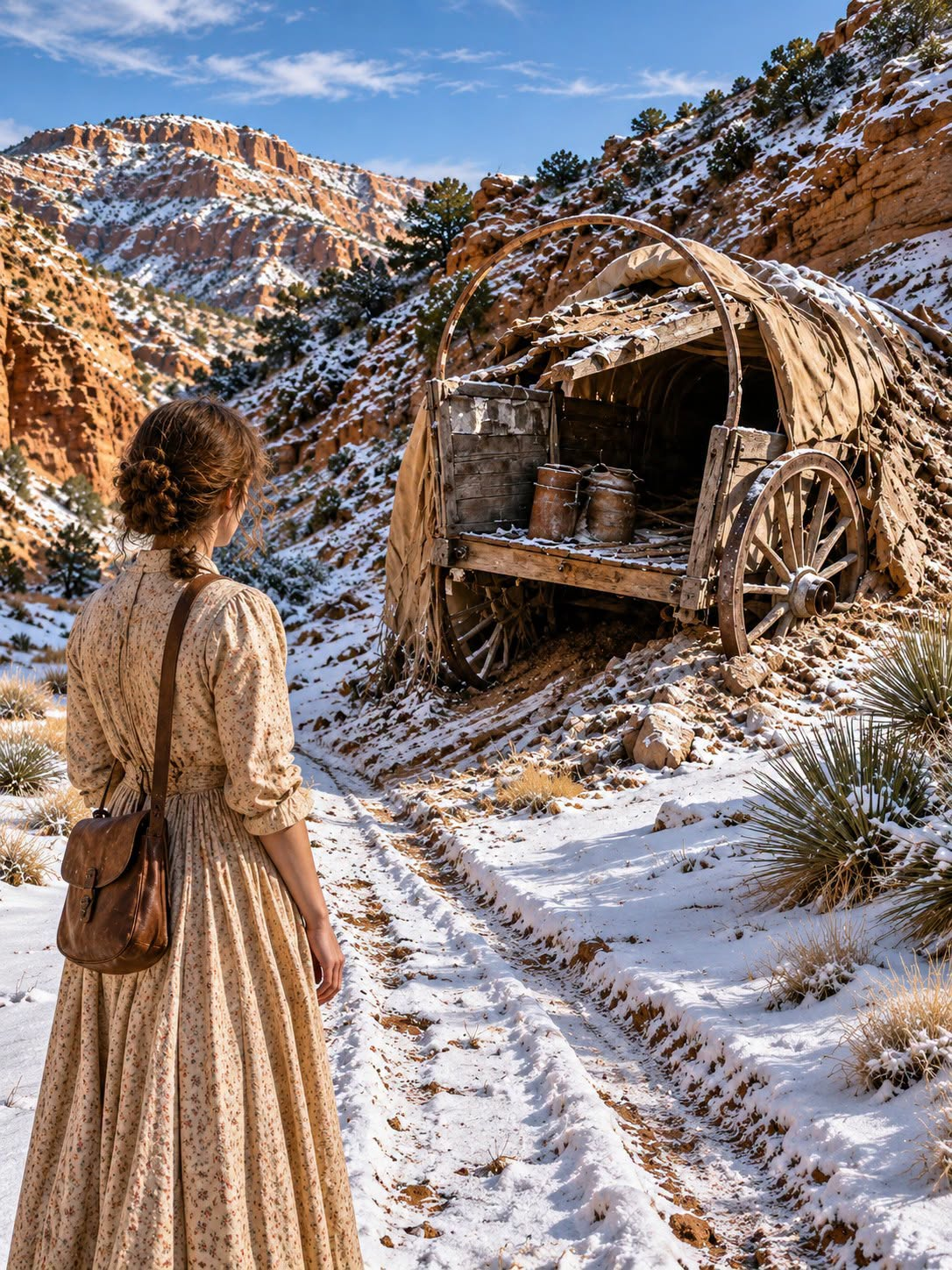
I barely slept that night.
The hearing was scheduled for the following morning, and Judge Whitcomb intended to preside over a case involving his own family's history.
Thomas Bell believed the arrangement was improper.
Silas believed Whitcomb was desperate.
Caleb believed Ames still had another plan.
I believed all three men were right.
We gathered at the county office before sunrise.
The original registry was placed on the desk.
The survey maps were arranged beside it.
My father's letters were stacked carefully.
The medical report from Doctor Granger was placed in a separate folder.
There was also the old photograph of Abigail Mason and her daughter.
I looked at the collection.
It represented nearly ninety years of history.
And every piece had survived because someone had refused to let it disappear.
Thomas Bell examined the documents.
"We need to present the evidence in the right order."
Silas nodded.
"First, the original deed."
"Then the witness declaration."
"Then the registry."
"And finally the medical report."
I looked at the marshal.
"Why the medical report?"
"Because it establishes that your father was pressured and threatened after attempting to restore the property claim."
"Will that affect the land case?"
"It will help establish a pattern of interference."
I thought about Ford.
About Ames.
About Whitcomb.
Three men who had worked together to keep the Mason family silent.
I looked at the old photograph.
Abigail had stood beside the cabin with a child.
She had probably believed that the worst of the struggle was over when she placed the papers beneath the floor.
But the men who wanted the land had never stopped.
They had simply waited for the next generation to forget.
I folded my father's letter and placed it in my coat.
Then I looked at Silas.
"Do you think we can win?"
He smiled.
"We have the truth."
"That's not what I asked."
He considered the question.
"Yes, Mary. I think we can."
We reached the courthouse shortly before nine.
People had gathered outside.
Word had spread through North Fork.
Some had come to watch the property hearing.
Others had heard that a young woman had uncovered a ninety-year-old land dispute.
I entered with Silas and Thomas Bell.
Caleb carried the document box.
Joseph and Margaret were already inside.
Margaret sat near the front.
When she saw me, she nodded.
The room was crowded.
At the far end sat Judge Nathaniel Whitcomb.
He wore a dark suit and a white collar.
His expression was calm.
Rutherford Ames sat beside his attorney.
Ford Kessler was not present.
Ridley Pace sat near the back with a deputy.
Doctor Granger waited near the witness bench.
Whitcomb struck the wooden desk.
"Order."
The room quieted.
He announced the matter.
"Regarding the disputed boundary and ownership claim of the property known as Elk Ridge Holding."
I stood.
"Your Honor, I object to your presiding over this case."
A murmur moved through the room.
Whitcomb looked at me.
"On what grounds?"
"Your family is named in the original registry. You also have business interests connected to Mr. Ames."
His jaw tightened.
"That is irrelevant."
Thomas Bell rose.
"It is not irrelevant. We request that the matter be transferred to an independent judge."
Whitcomb looked toward the court clerk.
"Denied."
Bell placed a document on the desk.
"Then we request that the objection be entered into the official record."
Whitcomb hesitated.
Then he nodded.
The clerk wrote it down.
The judge turned toward Ames's attorney.
"Proceed."
The attorney stood.
He spoke about the long period during which the Ames family had managed the land.
He described the improvements made to the grazing areas.
He argued that the Mason family had abandoned its claim.
He said that the old documents were incomplete.
And he insisted that the original boundary could not be established with certainty.
When he finished, Whitcomb looked toward me.
"Miss Mason, do you have evidence to support your claim?"
I stood.
"Yes, Your Honor."
Caleb placed the document box on the table.
I opened it.
First came the original survey.
Then the deed.
Then the declaration signed by Abigail Mason.
The attorney examined the papers.
His expression changed.
Whitcomb leaned forward.
"Where did these documents come from?"
"The original Mason holding."
"Who preserved them?"
"My family. The Reed family. And the Bram family."
I placed the leather-bound registry on the desk.
"This is the original family record."
The room became silent.
Whitcomb stared at it.
The clerk approached.
He examined the seal.
Then he compared the signatures.
The judge's expression hardened.
"That registry is not admissible."
"Why not?" I asked.
"It has not been authenticated."
Silas stood.
"We have the witness signatures."
Whitcomb looked toward him.
"Those signatures are nearly ninety years old."
Joseph rose from his seat.
"I can identify the family history."
Margaret stood beside him.
"So can I."
Whitcomb looked uncomfortable.
Thomas Bell placed the county receipt on the desk.
"This receipt establishes that the original declaration was removed from the public records."
The attorney objected.
Whitcomb raised his hand.
"Let him continue."
Bell presented the receipt.
Then the letter from Clara Mason.
Then the original witness declaration.
The signatures matched.
The dates matched.
The survey descriptions matched.
For the first time, Whitcomb had no immediate answer.
I watched him.
He looked toward Ames.
Ames leaned forward and whispered something.
Whitcomb shook his head.
The attorney stood again.
"Your Honor, even if these documents are genuine, the matter of possession remains disputed."
I waited.
Then I placed my father's medical report on the desk.
"This is not only a property dispute."
The judge frowned.
"What is that?"
"My father's medical report."
I explained what Doctor Granger had told us.
The injury.
The assault.
The pressure to surrender the property.
The altered death certificate.
The room grew quieter with every sentence.
When I finished, Doctor Granger stood.
He confirmed the report.
He described my father's injuries.
He admitted that he had signed an incomplete death certificate under pressure.
He also identified Ford Kessler as the man who had brought Henley to his office.
Ames stood abruptly.
"This is outrageous!"
Whitcomb struck the desk.
"Sit down."
But Ames did not.
He turned toward the room.
"That girl is lying. Her father was a sick man who became obsessed with property that never belonged to him."
Ridley rose from the back.
"No, sir."
Everyone turned.
Ames stared at him.
Ridley stepped forward.
"I was there when you gave Ford the order."
The room fell silent.
"Mr. Ames told us to leave Mary on the ridge. He said she was never supposed to reach Bell Fork."
Ames's face darkened.
"Sit down."
Ridley continued.
"He also told Ford to find the locket and destroy the cabin if necessary."
Ford was not in the room.
But Ridley had spoken.
The attorney looked toward Ames.
The judge looked down at the documents.
Then Thomas Bell placed another statement on the desk.
It was signed by Ridley.
And beside it was a sworn declaration from Caleb.
The two men confirmed the events surrounding Mary's abandonment.
Ames sat down slowly.
For the first time, I saw genuine fear in his face.
Whitcomb called for a recess.
The room erupted into whispers.
Silas approached me.
"You've done well."
I shook my head.
"We haven't finished."
He nodded.
The judge returned twenty minutes later.
He announced that the disputed transfer would be suspended pending an independent review.
He also ordered that the original Mason documents be secured by the county.
Ames's attorney objected.
But the judge refused to change the order.
I looked at Thomas Bell.
"Does that mean we won?"
"Not yet."
I felt my heart sink.
"But the property cannot be transferred while the review continues."
"That's right."
"And the original records are protected?"
"Yes."
I looked toward the judge.
He was gathering his papers.
Then something unexpected happened.
He removed his glasses.
He looked directly at me.
"Miss Mason."
I stood.
"There is one matter I would like to address."
I waited.
He opened a small drawer beneath the bench.
From it, he removed a folded document.
It was old.
Much older than the papers we had presented.
He placed it on the desk.
"This was held in my family's private records."
I stared at it.
The circular Mason seal appeared in the corner.
Whitcomb continued.
"My great-grandmother instructed that it be returned if a direct descendant of the Mason family ever presented the original registry."
I felt my breath catch.
"Why didn't you return it earlier?"
He looked down.
"Because my family made a mistake."
The document was a final acknowledgment of the Mason holding.
It included the original boundary.
The northern spring.
The winter passage.
And the entire valley.
It had been signed by Eleanor Whitcomb.
The woman named in the original registry.
The judge placed it beside the deed.
"I am ordering this document added to the official record."
I looked at him.
"Does it establish the ownership?"
"It establishes the missing link in the chain."
Thomas Bell examined it.
Then he looked at me.
A small smile appeared.
"Mary, this is it."
The clerk compared the seals.
The signatures.
The dates.
Everything matched.
Judge Whitcomb stood.
"The claim of the Mason family is recognized as historically valid. The matter of restoring possession will proceed under the terms of the original trust."
The room became silent.
Then Margaret began to cry.
Joseph removed his hat.
Silas closed his eyes.
I looked down at my father's name.
Henley Mason.
For the first time in generations, the family had been recognized.
The judge struck the desk.
"The hearing is adjourned."
I remained standing.
I had spent my life believing that I was a hired girl with nowhere to belong.
Now I was holding the proof that my family had never truly been without a home.
But as we gathered the documents, Thomas Bell approached me.
"Mary, there's one more thing."
I looked at him.
"What?"
He lowered his voice.
"Rutherford Ames has agreed to provide a full statement."
"Why?"
"Because he knows the investigation is moving beyond the property claim."
I glanced toward Ames.
He was speaking quietly with his attorney.
Bell continued.
"He says Judge Whitcomb wasn't the only person who knew what happened to your father."
My stomach tightened.
"Who else?"
The marshal looked toward the courtroom door.
Then he spoke a name.
"Mrs. Ames."
I froze.
The woman who had dismissed me.
The woman who had handed me the letter promising work in Bell Fork.
The woman who had watched me leave without an embrace.
She had known more than I had ever imagined.
And according to Ames, she was ready to tell everything.






Comments 0