The message about the locket changed our plans.
Thomas Bell wanted to send deputies along the eastern road immediately.
Silas disagreed.
"If they have the doctor, they'll be watching the roads."
Caleb examined the telegram.
"Whoever sent this knows about the hidden compartment."
Joseph looked at me.
"Then the question is whether the doctor actually has information or whether someone is trying to take the locket."
I touched the little tin object beneath my collar.
I had carried it since I was fifteen.
Hetty had given it to me before she died.
It had survived the loss of my mother, my father, and every home I had known.
I was not going to surrender it because someone had written a threatening message.
But I needed answers.
"Could we arrange a meeting?" I asked.
Thomas Bell shook his head.
"That would be dangerous."
"What if we choose the place?"
Silas considered the idea.
"The old freight station."
Caleb nodded.
"It's outside the settlement. There are several buildings nearby where deputies could wait."
The marshal looked at me.
"You wouldn't have to go."
"Then they might never bring the doctor."
"Mary—"
"My father spent the last months of his life protecting this secret. I won't let another man disappear with the truth."
Bell studied me.
Finally, he nodded.
"All right. But we do this carefully."
We sent a reply through the telegraph office.
The message was brief.
The locket will be brought to the old freight station tomorrow at noon. The doctor must come alone.
We did not intend to hand it over.
Thomas Bell arranged for two deputies to wait near the station.
Silas and Caleb would remain close.
Joseph would stay in North Fork with Margaret and the original registry.
I spent the night at Mrs. Price's boardinghouse.
Sleep did not come easily.
I kept thinking about my father.
I remembered the small room where he had died.
The old blanket.
The basin beside the bed.
The sound of his breathing.
I remembered asking him whether he was afraid.
He had told me that he was not afraid of dying.
He was afraid of leaving me alone.
I had promised him I would manage.
And I had.
But I had not known what he was asking me to manage.
In the morning, I opened the locket.
The tiny brass key remained inside.
I looked at the folded paper.
Be steady.
I placed it back.
Then I dressed and joined the others.
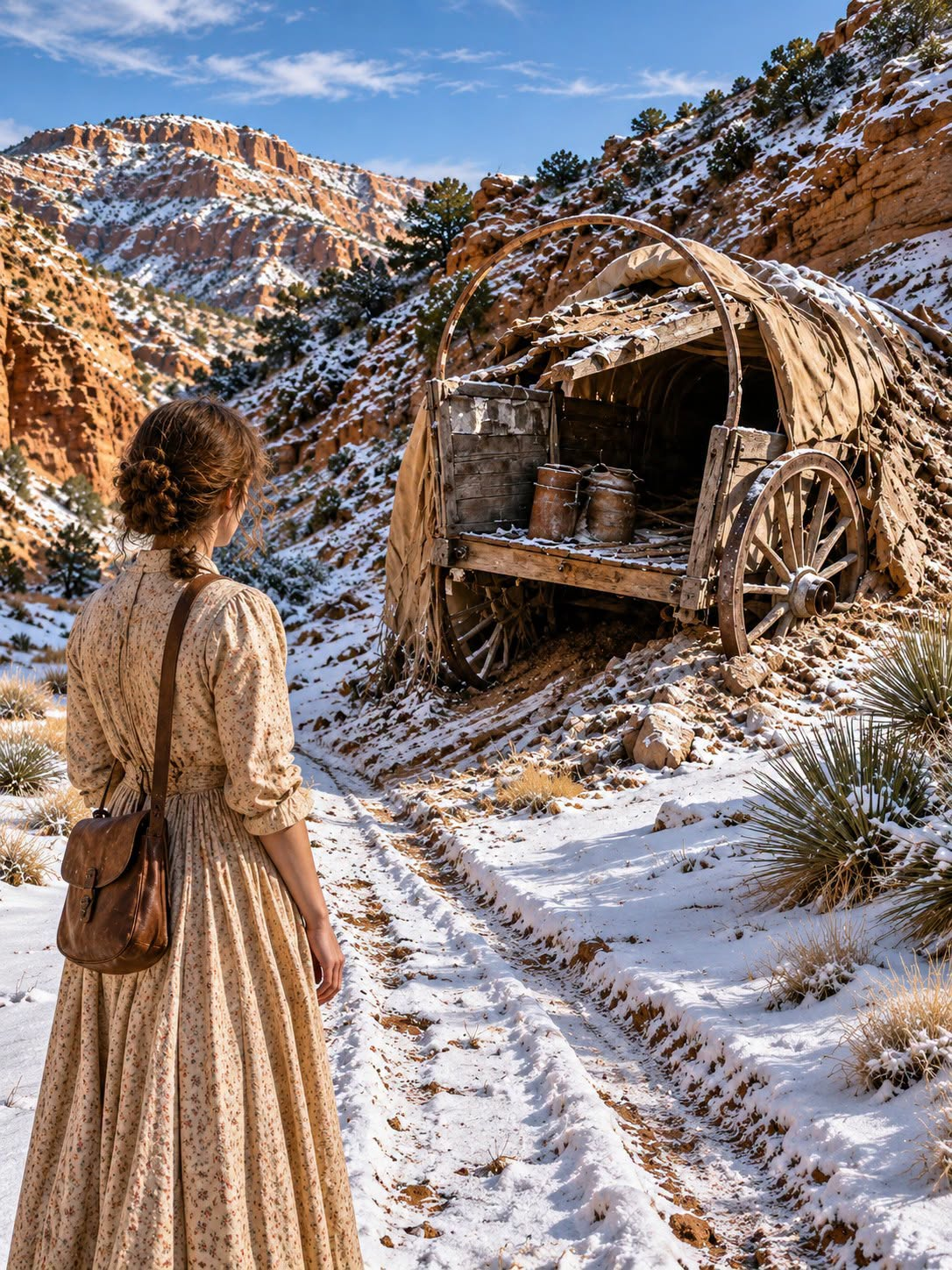
The road to the freight station was covered in fresh snow.
The building stood beside an old rail spur that had not been used in several months.
A wooden platform ran along one side.
A storage shed stood behind it.
The area was quiet.
Too quiet.
Thomas Bell examined the surroundings.
"Stay near the building."
I nodded.
Silas walked toward the far end of the platform.
Caleb positioned himself near the shed.
The marshal waited beside the entrance.
At precisely noon, a horse appeared on the road.
A man rode toward us.
He wore a dark overcoat and a gray scarf.
When he dismounted, I recognized him immediately.
Doctor Samuel Granger.
He looked older than I remembered.
His hair was almost entirely white.
His shoulders were bent.
But his eyes were sharp.
"Mary Mason."
"Doctor."
He looked at the marshal.
"I was told she would come alone."
Thomas Bell stepped forward.
"She came with the protection of the county."
The doctor sighed.
"Then I suppose we should speak quickly."
He looked at my locket.
"Do you have it?"
I did not move.
"First, tell me what happened to my father."
The doctor lowered his eyes.
For several seconds, he said nothing.
Then he removed his hat.
"Your father came to me because he was ill."
"I know."
"He had a severe respiratory infection. But that was not the only problem."
"What else?"
"He had been injured."
I felt my stomach tighten.
"How?"
The doctor looked toward the road.
"His ribs had been badly bruised. He had suffered internal bleeding."
"Who hurt him?"
"I cannot say with certainty."
"Did you know?"
He hesitated.
"Ford Kessler brought him to my office."
The world seemed to stop.
"Ford brought him?"
"Yes."
"Why?"
"He said Henley had fallen while working near the upper camp."
I remembered the bruises.
The way my father had avoided turning in bed.
The pain in his chest.
"Was that true?"
The doctor shook his head.
"Not according to what Henley told me."
I stepped closer.
"What did my father say?"
"He said he had been attacked."
"By whom?"
The doctor closed his eyes.
"He named Ford Kessler."
My fingers tightened.
"Why didn't you tell the authorities?"
"Because I was ordered not to."
"By whom?"
He looked at the marshal.
Then at me.
"Judge Whitcomb."
Thomas Bell's expression hardened.
The doctor continued.
"Whitcomb told me that Henley was a dangerous man who had become obsessed with an old property claim. He said that reporting the incident would cause trouble for the entire settlement."
I stared at him.
"So you kept silent."
The doctor nodded.
"Yes."
"And when my father died?"
"I was asked to sign a death certificate stating that he had died from complications of a lung infection."
"Did he?"
"Partly."
The doctor swallowed.
"But his injuries contributed to his death."
I looked away.
For nineteen months, I had believed my father had died because his body could no longer withstand the illness.
Now I was learning that someone had hurt him.
Someone had left him to suffer.
And the people who were supposed to protect him had hidden the truth.
"Why are you telling me now?"
The doctor reached into his coat.
He removed a folded paper.
"Because I kept a copy of the original medical report."
He handed it to me.
The report described the injuries.
The bruised ribs.
The damaged lung.
The signs of blunt-force trauma.
And beneath the medical notes was a handwritten statement.
Patient reports assault by Ford Kessler following disagreement concerning the Mason property.
I felt tears gather in my eyes.
I did not let them fall.
"Why did you keep this?"
The doctor looked ashamed.
"Because I knew what I had done."
He continued.
"Your father asked me to preserve it. He said that one day his daughter might need to know the truth."
I folded the report.
"Did you give Ames the information?"
"No."
"Then why did he visit you?"
The doctor's expression changed.
"Because he knew I had kept the report."
"Did he threaten you?"
"Yes."
The marshal stepped forward.
"Doctor, will you provide a sworn statement?"
Granger nodded.
"I will."
Then he looked at me.
"But there is something you need to understand."
I waited.
"Your father did not only ask me to preserve the report. He asked me to keep something else."
He reached inside his coat again.
This time, he produced a small envelope.
My name was written on it.
Mary.
I opened it.
Inside was a letter.
My dear girl,
If you are reading this, then the truth has finally found its way to you.
I am sorry I could not tell you everything.
There was a time when I believed I could protect you by keeping you away from the past.
But I have learned that silence does not always protect the people we love.
Sometimes it only protects the people who hurt them.
I stopped.
My father had written those words shortly before his death.
I continued.
I want you to know that I never accepted Ames's money.
I never surrendered the land.
And I never believed our family was worth less because we had little.
If you find a way to restore what was taken, do not use it to punish every person who stood against you.
Use it to build something good.
Make a place where a child can sleep without worrying that tomorrow someone will send her away.
That is what I wanted for you.
Love,
Father.
I held the letter against my chest.
The doctor looked away.
Silas stepped closer.
For a moment, nobody spoke.
Then a horse appeared on the road.
Thomas Bell turned.
Another rider followed.
It was one of his deputies.
He approached quickly.
"Marshal!"
Bell moved toward him.
"What happened?"
"The judge has filed an emergency order."
"What order?"
The deputy handed him a folded document.
Bell read it.
His face darkened.
"He's attempting to seize the Mason property before the hearing."
Silas stepped forward.
"On what grounds?"
The marshal looked at me.
"He's claiming the original declaration is fraudulent."
I stared at him.
"But we have the original register."
"He knows."
"Then what is he trying to do?"
Thomas Bell lowered his voice.
"He's asking the court to transfer temporary control of the land to the Ames estate."
I looked toward the mountains.
The property was still in danger.
The papers were not enough.
The truth was not enough.
We needed to prove the entire chain of ownership before the judge could act.
Then the marshal examined the order again.
His expression changed.
"There's a hearing scheduled."
"When?" I asked.
"Tomorrow morning."
"Where?"
"North Fork courthouse."
He folded the paper.
"And Judge Whitcomb has already appointed himself to preside."






Comments 0