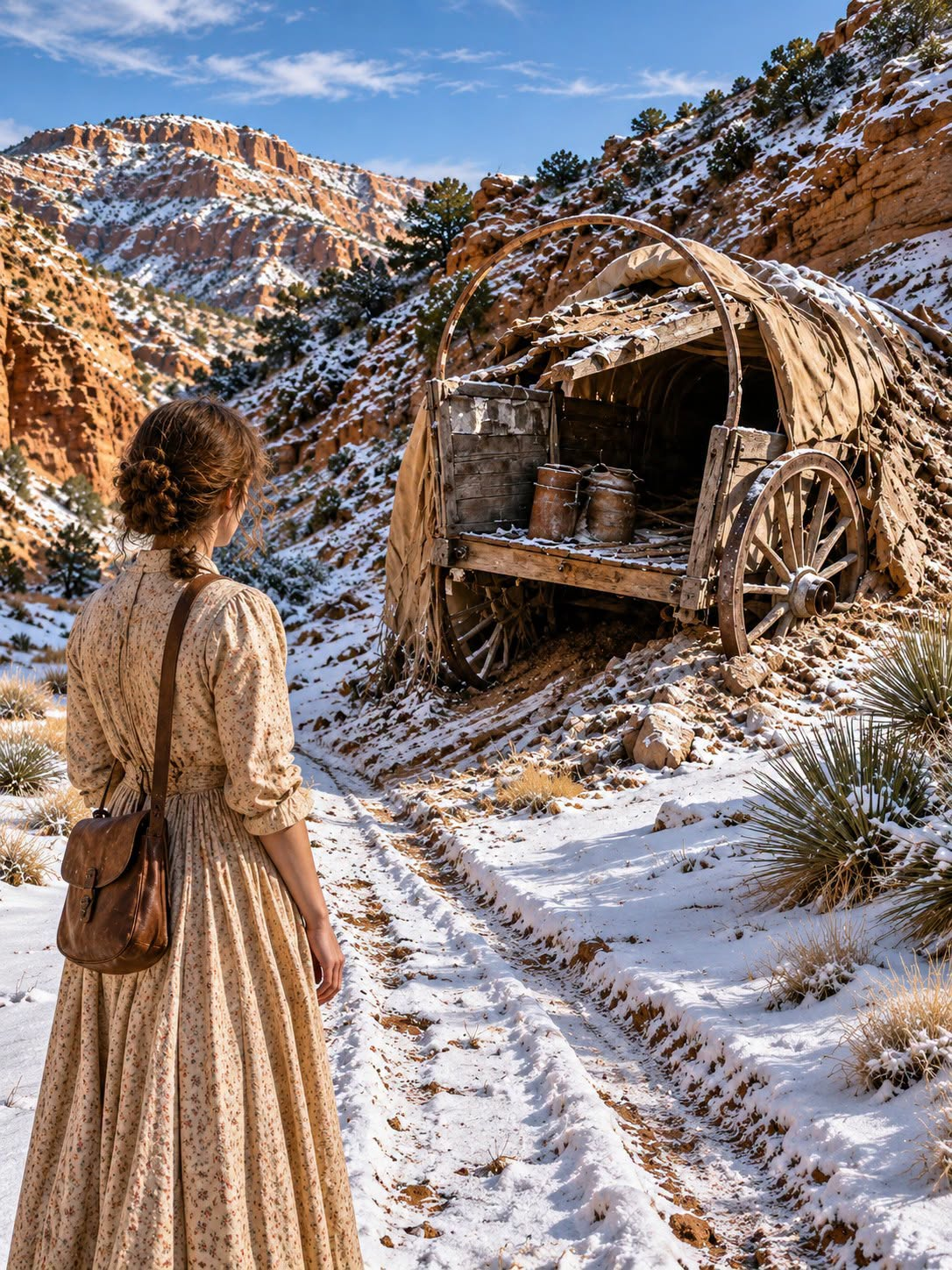
I reached the hallway before Silas could stop me.
Mrs. Price stood at the open door, holding a candle.
A man stood outside.
He was thin, perhaps sixty years old, with a weathered face and a dark wool hat.
Snow covered his shoulders.
He carried a small wooden case.
"Who are you?" I asked.
He looked at me.
"Joseph Miller."
The name meant nothing to me.
"You said you have a letter from Abigail Mason."
"I do."
"How do you know about her?"
He glanced toward Silas.
Then back at me.
"Because my grandmother was her daughter."
I stopped breathing.
The man removed his hat.
"My family has kept the story for generations. We were told that one day a Mason woman would come looking for the truth."
Silas approached.
"Why haven't you come forward before?"
Joseph looked down.
"Because the people who took the land were not the only ones with money and influence."
He stepped inside.
Mrs. Price closed the door.
Joseph placed the wooden case on the table.
"Your father came to see me shortly before he died."
I looked at him.
"When?"
"About two months before his death."
"What did he want?"
"To know whether the old family record still existed."
I felt my throat tighten.
"What did you tell him?"
"That it did."
Joseph opened the case.
Inside was a folded letter wrapped in cloth.
The paper was yellow with age.
The handwriting matched the one in the journal.
Abigail Mason.
I carefully unfolded it.
To my daughter,
If you are reading this, then the land has been taken from us.
Do not believe the men who say that we surrendered it willingly.
Your father built the holding with his own hands. He marked the boundaries. He paid the surveyors. He made agreements with the neighboring families.
The deed was signed before witnesses.
The record exists.
And if the family name survives, the truth may still be restored.
I looked at Joseph.
"Who was Abigail's daughter?"
He opened another folded paper.
A name appeared.
Clara Mason.
I read it aloud.
"Clara."
Joseph nodded.
"She was taken east as a child after her mother disappeared."
"Why?"
"Because someone wanted to separate the family."
"Who?"
Joseph looked toward the window.
"The men who wanted the property."
I thought about the photograph.
Abigail standing beside a small girl.
The tin locket.
The hidden cellar.
The message for the last Mason woman.
"Was Clara my ancestor?"
Joseph nodded.
"Yes."
I felt a strange warmth in my chest.
For the first time, the old photograph was no longer simply a mysterious image.
The little girl in it had survived.
She had grown up.
She had carried the family name forward.
And somehow, generations later, that family line had reached me.
"Did Clara know about the land?"
"She knew part of the story. But she was told never to return."
"Why?"
"Because her mother believed the men searching for the property would follow her."
Joseph looked at the letter.
"Clara eventually married a man named Mason. Their children carried the name. The land records were passed down through several generations, but the documents were separated."
"How?"
"Some were hidden with the Reeds. Some with the Bram family. And some remained with the Masons."
I looked at my locket.
"Then Hetty knew everything."
"She knew enough."
Joseph removed another object from the case.
A small brass plate.
It bore the same circular mark as the locket.
"Your father gave me this," he said. "He asked me to keep it safe."
I examined it.
There was a number engraved on the back.
Silas took the survey map.
"December 17."
Joseph nodded.
"The original witness record was placed in the cabin on that date."
I looked at the map.
"Where?"
Joseph pointed to the symbol beneath the line shack.
"Under the old hearth."
I thought of the fireplace.
The stonework.
The ashes.
We had searched the cabin, but we had never examined the hearth properly.
"Why didn't you tell my father?"
"I did."
"Then why didn't he retrieve it?"
Joseph lowered his eyes.
"He became ill before he could return."
I felt the familiar ache in my chest.
My father had come so close.
He had known where the record was.
He had tried to protect it.
And now I was standing in a boardinghouse with a stranger holding the final piece of a story that had begun ninety years earlier.
Joseph looked at me.
"There's something else."
I waited.
"Your father told me that Ames had offered him money."
"Thirty dollars?"
Joseph nodded.
"He refused."
"What happened afterward?"
"Ford Kessler came to the high camp."
My stomach tightened.
"What did he do?"
"He told Henley that the matter would be settled one way or another."
Joseph paused.
"The following morning, your father was found near the trail."
"Was he injured?"
"His ribs were badly bruised. He could barely breathe."
I closed my eyes.
The memory of my father's last months returned.
The coughing.
The pain.
The nights when he sat awake.
"Did you see him after that?"
"Once."
Joseph reached into the case and removed a second letter.
"This was written after the incident."
I opened it.
Mary,
I have been trying to keep the past away from you.
But the past has found us.
If I cannot finish what I started, I need you to know that the family never surrendered the land.
Do not let them tell you otherwise.
Your mother believed we would lose everything if we fought.
Hetty believed we could win if we waited.
I hope she was right.
Your loving father,
Henley.
I pressed the letter against my chest.
I did not cry.
Not because I felt no grief.
But because I could finally see the man behind the tired face I remembered.
He had not been weak.
He had been afraid.
And he had been trying to protect me with the only means he had.
Silas put a hand on my shoulder.
"We should return to the cabin."
Thomas Bell arrived a short time later.
He listened to Joseph's account and examined the letters.
Then he arranged for a deputy to accompany us.
We left before dawn.
The snow was deep, but the lower trail remained passable.
Joseph rode with Caleb.
I rode beside Silas.
When we reached the mountain, the cabin appeared between the trees.
Its roof was almost entirely covered in snow.
The door hung slightly open.
Silas dismounted.
"That isn't right."
We approached carefully.
The inside had been disturbed.
The table was overturned.
The chair lay near the fireplace.
Several drawers had been emptied.
Someone had searched the cabin again.
I looked toward the hearth.
A pile of ashes had been scattered across the floor.
"They found it," I whispered.
Joseph shook his head.
"Not necessarily."
He knelt beside the fireplace.
Then he examined the stones.
"Abigail told Clara that the first winter fire was built over a hollow chamber."
He touched the third stone from the left.
It moved slightly.
Caleb brought a small iron tool.
Together, they lifted it.
Beneath the stone was a narrow metal box.
It had been sealed with wax.
I removed the brass plate from Joseph's case.
The number 17 fitted into a small indentation.
The lock opened.
Inside lay a folded declaration.
The paper was still protected by oilcloth.
I unfolded it carefully.
The first line read:
Declaration of Abigail Mason regarding the original Elk Ridge holding.
Beneath it were three signatures.
Abigail Mason.
Thomas Reed.
And a third name.
A name I recognized from the county office.
Nathaniel Whitcomb.
I stared at the signature.
The judge's own ancestor had witnessed the original transfer.
He had not merely been connected to the dispute.
His family had known the truth from the beginning.
I looked at Silas.
"Now we have it."
He nodded.
"Now we have the witness record."
But before we could examine the remaining pages, the cabin door slammed.
Everyone turned.
Ford Kessler stood in the entrance.
Ridley was beside him.
Behind them was Rutherford Ames.
Ford held a revolver.
Ames looked at the document in my hands.
His expression was no longer controlled.
"Put that paper down, Mary."
I held it tighter.
"No."
Ames stepped inside.
"You have no idea what you're doing."
I looked directly at him.
"I know exactly what I'm doing."
He glanced toward Ford.
"Take it."
Ridley moved.
But instead of approaching me, he stepped between Ford and the fireplace.
"Enough."
Ford raised his revolver.
"Move, boy."
Ridley shook his head.
"Not again."
For several seconds, the two men stared at each other.
Then a loud voice came from outside.
"Nobody move!"
Thomas Bell entered with two deputies.
Ames turned.
His face changed.
The marshal pointed toward the revolver.
"Ford Kessler. Put it down."
Ford hesitated.
Then lowered his weapon.
Ames looked at the documents.
He knew he had lost control of the situation.
But he was not finished.
He turned toward me.
"You think a piece of paper will make you rich?"
I answered quietly.
"No. But it might finally make the truth visible."
Bell ordered the men outside.
The deputies escorted Ford and Ames toward their horses.
Ridley remained behind.
He looked at me.
"I should have stopped them on the ridge."
I held his gaze.
"Yes."
He nodded.
"I know."
Then he turned and followed the deputies.
I looked down at the declaration.
There were still several lines at the bottom that I had not read.
One sentence was written in Abigail's hand.
The northern spring and the winter road shall remain with the Mason family, and no person shall claim them by force, fraud, or silence.
I folded the paper.
For the first time, I felt that the past was finally beginning to speak.
But when Thomas Bell examined the final page, his expression changed.
"Mary," he said.
"What is it?"
He pointed to a paragraph beneath the signatures.
It was an additional clause.
A clause that had never appeared in any of the later copies.
And it said that the Mason family had inherited something far more valuable than the land itself.






Comments 0