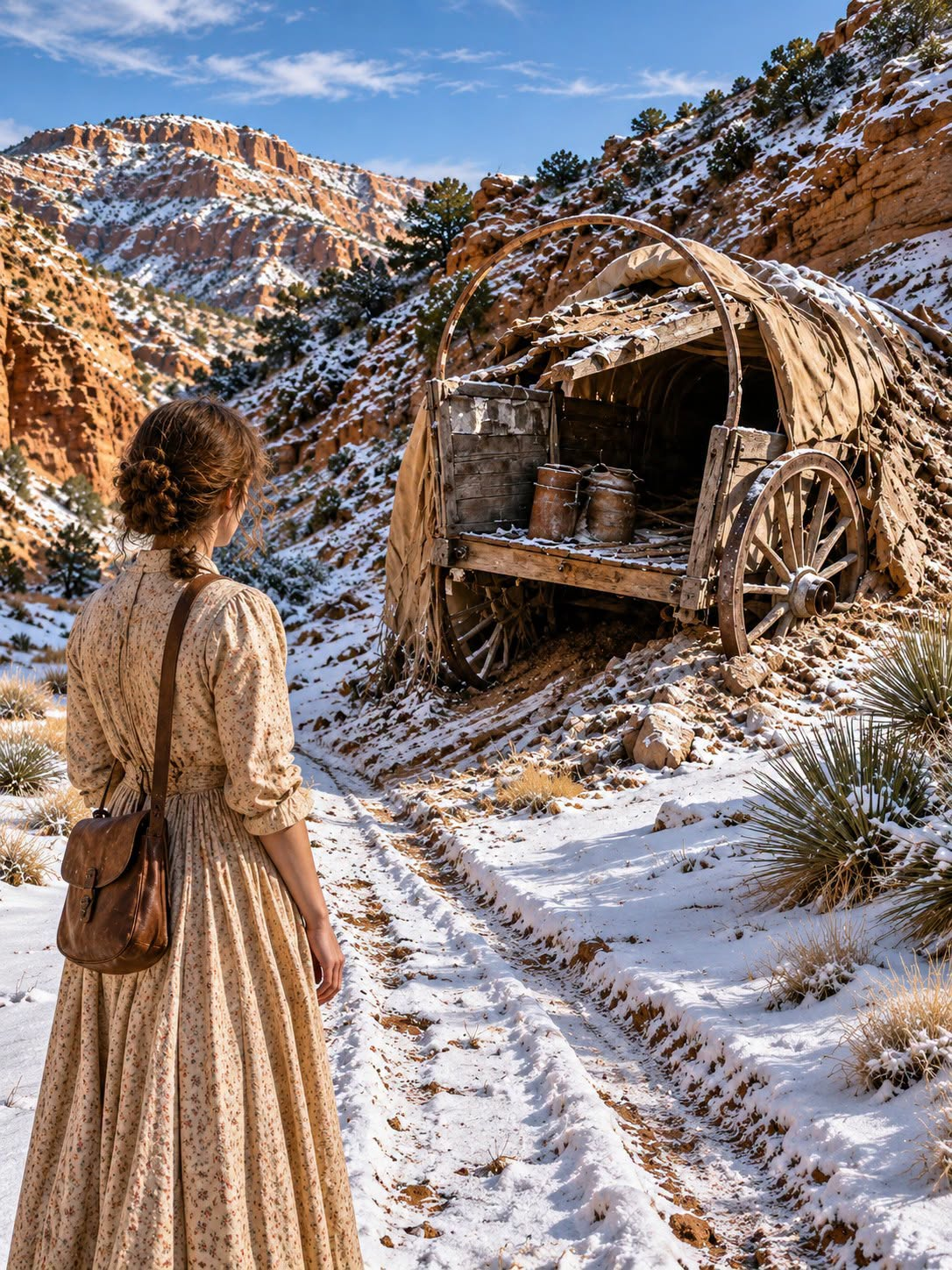
Ford Kessler dropped my belongings into the snow and said:
"Mr. Ames paid us to leave you here. You're not going to Bell Fork."
Rutherford Ames's two hired men stood beside their horses as I stared at the bundle lying at my feet.
Inside it were two dresses, a pair of stockings, a comb, a little soap, half a loaf of bread, and everything I owned in the world.
Ford looked down at me.
He was waiting for me to beg.
I didn't.
Instead, I reached beneath the collar of my coat and touched the little tin locket resting against my chest.
The scratched letter H was still there.
Be steady.
Hetty Bram had written those words on a folded piece of paper and placed it inside the locket years before she died.
I had carried it through every winter, every strange household, every funeral, and every lonely night since.
Now, standing on a mountain ridge with two men who had decided my life was worth less than their employer's money, I understood why she had given it to me.
I would need those words.
"Did you hear me, girl?" Ford asked.
His voice was flat.
I looked at him.
"I heard you."
Ridley Pace shifted in his saddle.
He was nineteen, perhaps twenty, with sandy hair sticking out from beneath his hat and the beginnings of a beard along his jaw. He had spent most of the journey laughing at things that were not funny.
He wasn't laughing now.
Ford reached for the reins of the small bay mare.
"Then you understand."
I looked past him toward the trail.
It descended along the mountain shoulder before disappearing around a granite outcrop. The horses had left a line of deep tracks in the packed snow.
Beyond the trail lay a valley I had never visited.
The wind came down from the northwest and cut through my borrowed wool coat.
"How far is Bell Fork?" I asked.
Ridley glanced at Ford.
Ford didn't answer immediately.
Then he said, "Far enough."
I looked at the sky.
The sun had already begun its descent behind the western cliffs.
I had been riding since morning. My fingers were stiff inside my mittens, and my legs ached from hours in the saddle.
I understood enough about winter mountains to know that a person without shelter could die before sunrise.
Hetty had taught me that.
She had also taught me never to mistake a man's silence for an absence of intention.
"Why?" I asked.
Ford tightened the reins.
"Because that's what we were told to do."
"By Mr. Ames?"
He looked directly at me.
"That's right."
I waited.
Perhaps he would explain.
Perhaps he would say there had been some misunderstanding, some mistake involving another girl or another destination.
But Ford merely turned toward his horse.
Ridley was already mounting.
"She'll freeze," the younger man muttered.
Ford gave him a sharp look.
"Then she should have thought about that before she made herself troublesome."
I had no idea what he meant.
I had worked for the Ames household for fourteen months.
I had washed their clothes, prepared their meals, cleaned their rooms, and helped Mrs. Ames care for her two small children.
I had never stolen from them.
I had never spoken disrespectfully.
I had never refused a task.
If anything, I had worked harder than anyone expected.
But I had learned that being useful did not necessarily make a person safe.
My father had spent his entire life working for other men's cattle.
He had died with no land, no savings, and no family gathered around his bed.
My mother had died when I was seven.
My three brothers had scattered across the country.
And now the last household that had employed me had decided to leave me on a mountain.
I bent down and picked up my bundle.
The cloth was already damp where it had fallen into the snow.
I brushed it off as best I could.
"Is there a settlement nearby?" I asked.
Ford placed one boot in his stirrup.
"Not one that concerns you."
Ridley looked down at his saddle.
I watched him for a moment.
"Did you know before we left?"
His eyes moved toward mine.
"What?"
"That you weren't taking me to Bell Fork."
He said nothing.
His silence answered me.
I nodded once.
Ford mounted.
"Come on, Ridley."
The younger man hesitated.
Then he pulled his reins.
Their horses turned toward the trail.
I stood beside my bundle.
For one brief moment, I considered calling after them.
Not because I believed they would help me.
But because a person can understand something in her mind and still need a moment for her heart to catch up.
I watched them ride away.
Ridley looked back once.
Ford did not.
The two men disappeared around the bend, leaving only their hoofprints and the fading sound of their horses.
Then the mountain became silent.
I was alone.
I pulled my coat tighter around my shoulders.
The first thing Hetty had taught me about surviving winter was that panic wasted warmth.
The second was that a person should never travel without knowing where the sun was.
I turned slowly and examined the country.
The trail ran along a narrow shelf of rock. Below it, the mountain dropped sharply into a valley filled with dark pine timber.
To the west stood the reddish cliffs I had been watching since noon.
The sky had turned the color of old milk.
Snow was gathering in the creases of my sleeves.
I tried to remember the route we had taken.
The leaning fir.
The burned snag.
The granite shoulder where we had stopped for water.
The drainage coming down from the north.
I had paid attention to all of it.
Hetty had insisted that a woman who knew how to read the land was never entirely helpless.
I opened my bundle.
There was half a loaf of bread wrapped in cheesecloth, a hard sausage, and a small cotton pouch containing the four dollars and eighty cents I had managed to save.
I counted the money without removing it from the pouch.
Four dollars and eighty cents.
It was everything I had.
I tucked it back inside my coat.
Then I touched the locket.
The metal was cold against my fingertips.
I could almost hear Hetty's voice.
Not the voice she used when she was tired, or annoyed, or telling me to stop wasting flour.
The other voice.
The quiet one she used when she was teaching me something she believed might save my life.
"Be steady, Mary."
I closed my eyes for a moment.
"I am trying, Hetty."
A gust of wind swept snow across the ridge.
I opened my eyes.
I needed shelter.
The question was where to find it.
I looked toward the pine-covered slope below the ridge. The trees grew thickly there, their branches carrying heavy blankets of snow.
There might be a place beneath the rocks where the wind could not reach.
There might be a fallen tree.
There might be nothing.
But staying where I was would accomplish only one thing.
I would freeze.
I tied my bundle securely and began moving along the edge of the trail.
My boots sank into the snow.
The ground beneath the surface was uneven, and several times I nearly slipped.
I kept one hand against the rock whenever the path narrowed.
After perhaps twenty minutes, I found a shallow depression between two large boulders.
The wind was weaker there.
I set down my bundle and examined the ground.
A patch of exposed earth showed beneath the snow.
Someone had passed through the area before me.
I found a few old tracks, almost erased by drifting snow.
They were not fresh.
They might have belonged to deer.
I crouched and brushed away the loose snow.
A narrow trail continued down the slope.
It was barely visible.
But it led toward the pines.
I remembered something Hetty had told me years earlier.
When the snow covered a road, the land still remembered where people had walked.
I followed the faint depression.
The trees gradually grew closer together.
The wind weakened.
My fingers began to ache.
I flexed them inside my mittens.
After another stretch of difficult walking, I stopped.
Something stood between the trees.
At first I thought it was a large fallen trunk.
Then I saw the angle of the roof.
A building.
I stared through the branches.
It was a small wooden cabin, partially hidden beneath snow-covered pine limbs.
The roof sagged slightly in the middle.
One shutter hung from a single hinge.
The front door was dark and weathered.
I stood perfectly still.
A cabin meant shelter.
Perhaps a fireplace.
Perhaps an old stove.
Perhaps a place where I could survive the night.
I approached carefully.
The snow around the building was deep, but the trees had protected the entrance from the worst of the drifting.
A rusted iron hook hung beside the door.
There was no smoke from the chimney.
No footprints leading away.
No sign of recent activity.
I placed my bundle beside the wall and knocked.
Nothing.
I waited.
Then I knocked again.
"Hello?"
Only the wind answered.
I tried the door.
It resisted at first.
Then the old wooden latch gave way with a long groan.
The door opened inward.
A smell of dry pine, dust, and old smoke drifted into the cold air.
I stepped inside.
The room was small.
A stone fireplace stood against the far wall.
There was an iron stove in one corner, a narrow wooden table, and a chair with one broken leg.
A rough shelf held several empty jars.
A thick layer of dust covered everything.
I closed the door behind me.
For the first time since Ford had ridden away, I felt the possibility of surviving the night.
I set down my bundle and examined the fireplace.
There were old ashes inside.
Some pieces of wood remained beside it, but they were too damp to burn easily.
I found a small stack of dry kindling beneath the table.
Hetty would have approved.
I built a modest fire, using the driest pieces first.
It took several attempts.
My hands were clumsy with cold, and I nearly dropped the flint.
But eventually a small flame caught.
I sat beside it and held my fingers near the warmth.
The cabin was not comfortable.
It was not safe in any permanent sense.
But it was better than the mountain.
I ate a little bread and sausage.
Then I examined the room more carefully.
The cabin looked abandoned for years.
There were scratches along the floorboards.
The table had been repaired with rough wooden pegs.
The fireplace stones were blackened by generations of smoke.
I wondered who had built it.
A trapper, perhaps.
A surveyor.
A pioneer family traveling through the mountains.
The building was too small for a permanent household.
It looked more like a line shack, the sort of shelter used by men working far from settlements.
I walked toward the back wall.
There was a narrow window, partly covered by an old piece of cloth.
Through the opening, I could see the trees and the snow beyond them.
Then something caught my attention.
A small mark had been carved into the wooden frame.
It was an H.
I leaned closer.
The letter was old and uneven.
I touched it with my gloved finger.
There were other marks beneath it.
Three short lines.
Then another letter.
M.
I stared at the carving.
My family name was Mason.
But the letter M could have meant anything.
I moved toward the floor.
One of the boards near the table looked slightly different from the others.
It was darker.
And its edges were cleaner.
I knelt.
The board did not appear to be broken.
It had been fitted into the floor with unusual precision.
I pressed my palm against it.
Something moved beneath my hand.
Not much.
Just enough to make me stop breathing for a moment.
I pressed again.
A hollow sound came from underneath.
I leaned closer.
There was space beneath the floor.
A considerable space.
I looked toward the fireplace.
Then back at the board.
For a moment, I considered leaving it alone.
The cabin was already sheltering me.
I had no reason to disturb an old building that did not belong to me.
But then I noticed something beside the board.
A small iron ring.
It was almost completely concealed beneath a layer of dust.
I brushed it clean.
The ring was attached to a narrow wooden panel.
A hidden hatch.
My heart began beating faster.
I reached for the iron ring.
Before I could lift it, a sound came from outside.
A horse.
Then another.
I froze.
The sound of hooves approached the cabin.
Slowly.
Carefully.
Someone was riding through the trees.
I moved away from the hatch and extinguished the small flame in the fireplace.
The room fell into darkness.
I stood beside the window, barely breathing.
Through a narrow gap in the cloth, I saw two riders approaching.
One wore a charcoal-gray coat.
The other wore a faded rust-brown jacket.
I recognized them immediately.
Ford Kessler.
And Ridley Pace.
They had come back.
But they were not alone.
A third horse was following them through the snow.
And the rider on it was carrying a lantern.
The cabin door suddenly creaked.
Someone dismounted outside.
Then Ford spoke.
"Check the building. She might have found it."






Comments 0