I hadn't heard my uncle Michael's name in eight years.
Yet there it was, printed on a document that could threaten the only home my son had ever truly known.
I stood in my kitchen, holding the phone against my ear.
"Are you certain that's the name?" I asked.
The man from the county office repeated it.
"Michael Mercer. He's listed as a witness to the alleged shoreline easement."
I closed my eyes.
My father's younger brother had left North Carolina years before Dad died. They had argued about money, family responsibilities, and several decisions concerning the property. Eventually, Michael moved to Virginia, and contact between them became almost nonexistent.
I hadn't seen him at the cottage since Noah was a toddler.
"Thank you," I said. "I'll have my attorney contact you."
I ended the call and immediately dialed Daniel.
He answered quickly.
"Rebecca?"
"There's another document."
"What kind?"
"A permanent shoreline easement. Grant claims my father signed it before he died."
Daniel became quiet.
"Who witnessed it?"
"Michael Mercer."
He exhaled.
"Your uncle?"
"Yes."
"All right. Don't contact him yet. I'll request the complete document and verify its filing history."
I looked toward the family photographs.
My father had always believed that property disputes should be handled with patience and proper documentation.
He had taught me never to mistake confidence for proof.
And now, years after his death, someone was attempting to use his name to claim something he had deliberately left to me.
"Daniel, I want the original."
"So do I."
He paused.
"Rebecca, there may be a perfectly legitimate explanation for why your uncle's name appears there. But if the document is inaccurate, we need to establish that."
"I understand."
We ended the call.
I stood at the kitchen window.
Beyond the glass, the tide was moving toward the dock.
Noah was outside with Morning Star.
He was adjusting the little golden nameplate he had recently painted.
I watched him for a moment.
Then I made a decision.
Whatever happened next, I would finish this properly.
Not for Grant.
Not for my mother.
Not even for myself.
For Noah.
Three days later, Daniel called.
He had obtained a complete copy of the alleged easement and the available filing records.
He asked me to come to his office.
When I arrived, the documents were arranged across his conference table.
He pointed toward the chair opposite him.
"Rebecca, we've got several things to discuss."
I sat down.
He placed the alleged easement in front of me.
The document was dated approximately six weeks before my father's death.
It claimed that my father had granted a permanent access easement to a development-related entity.
The description included the northern shoreline.
The same area Grant's company needed for its proposed marina.
I read the document carefully.
Then I looked at the signature.
It resembled my father's.
But the signature was not enough to establish authenticity.
"Did you contact Michael?" I asked.
"Yes. He agreed to speak with us."
"What did he say?"
"That he never witnessed your father signing this document."
I stared at Daniel.
"Then why is his name here?"
"He says he doesn't know."
Daniel turned another page.
"More importantly, he has agreed to provide a statement."
I leaned forward.
"Did he say anything about Grant?"
Daniel nodded.
"He remembers being contacted by Peter Langford several months ago."
I felt my stomach tighten.
"What did Peter want?"
"According to Michael, Peter asked him to confirm whether your father had ever discussed granting shoreline access."
"And?"
"Michael refused to confirm anything he couldn't personally verify."
I sat back.
For several seconds, I said nothing.
Then Daniel opened another folder.
"This is the most important part."
He showed me a document containing the original filing information.
The alleged easement had been submitted as part of a larger collection of development materials.
However, its supporting documentation contained inconsistencies.
The signature required authentication.
The witness statement was disputed.
And the survey description did not match the established boundary records.
Daniel explained that the county was reviewing the filing and had requested additional supporting information from the development company.
"Can they simply withdraw it?" I asked.
"They can request withdrawal, but that doesn't resolve every question about how it was prepared or submitted."
"What happens now?"
"We challenge it formally. We also ask the relevant authorities to preserve the records and investigate any potential misrepresentation."
I nodded.
"Do it."
Daniel looked at me.
"There's something else you should know."
He handed me a printed email.
It was from Michael.
The message was addressed to Daniel.
In it, my uncle explained that he had kept several old letters from my father.
One of them concerned the cottage.
I read the first paragraph.
Then I stopped.
My father's words were unmistakable.
Michael, I want Rebecca to have the cottage and the shoreline. I don't want anyone separating the two. Noah should grow up knowing that the water will always be part of his home.
My eyes filled.
I placed the paper on the table.
"Can I see the original letter?"
Daniel nodded.
"Michael is bringing it."
I looked toward the window.
For the first time, the situation felt different.
We weren't simply defending ourselves against Grant's claims.
We were finally uncovering what my father had wanted all along.
Michael arrived the following afternoon.
He looked older than I remembered.
His hair had turned almost completely gray, and his face carried the tired expression of someone who had spent years avoiding difficult conversations.
He stood outside Daniel's office holding a small leather folder.
When he saw me, he stopped.
"Rebecca."
I looked at him.
"Uncle Michael."
For several seconds, neither of us moved.
Then he approached.
"I'm sorry."
I didn't answer immediately.
He sat down and placed the folder on the table.
"I should have come back sooner."
I opened it.
Inside were several letters, old photographs, and a handwritten note.
I recognized my father's handwriting immediately.
Michael watched me read.
"Your father gave me those letters before he died."
"Why didn't you send them to me?"
He looked down.
"Because I was ashamed."
I looked up.
"Of what?"
"Of how I left things with him."
He explained that he and my father had argued about the development plans years earlier.
Michael had initially believed that Grant's company could bring economic opportunities to the coast.
My father disagreed.
He believed the development would eventually create pressure on smaller waterfront property owners.
Their disagreement became personal.
They stopped speaking regularly.
Michael moved away.
By the time he realized how seriously his brother viewed the situation, my father was already ill.
"I tried calling him," Michael said. "But we never managed to have the conversation we should have had."
I looked at the letters.
"Did Dad know you regretted it?"
"I hope so."
He pushed another paper toward me.
It was a handwritten statement.
"I want you to know something. I never witnessed that easement. I never signed anything confirming that your father had agreed to grant access."
I studied him.
"Why didn't you speak up earlier?"
He took a breath.
"Because Grant contacted me and suggested that the document was already being reviewed. He implied that challenging it could create problems for the development and for everyone involved."
I felt my jaw tighten.
"Did he threaten you?"
"Not directly. But he made it clear that he knew about my previous disagreement with your father."
I understood.
Grant had been using old family conflicts to his advantage.
He believed Michael would remain silent.
He believed my mother would cooperate.
And he believed I would eventually accept the money.
He had underestimated all three of us.
Michael looked at me.
"Rebecca, I don't expect you to forgive me."
I glanced at the letter.
"Did Dad ever forgive you?"
Michael's eyes filled.
"He told me that family arguments shouldn't last longer than the people involved."
I swallowed.
That sounded exactly like my father.
Michael continued.
"I want to help you correct this. I'll provide everything I have."
I nodded.
"Thank you."
He reached across the table.
I hesitated.
Then I took his hand.
It wasn't forgiveness for everything that had happened.
But it was a beginning.
The legal process took several weeks.
Daniel coordinated the responses.
Michael provided his written statement.
Mr. Harris supplied the original survey materials and his correspondence with Peter Langford.
My mother clarified how Grant had obtained her signature.
The county reviewed the disputed easement and requested authentication of the alleged signatures.
Grant's company was required to explain the discrepancies between its development plans and the recorded property boundaries.
The independent surveyor completed a detailed report.
The findings confirmed that the disputed access corridor crossed my property.
There was no established easement granting Grant's company the permanent shoreline access it had been claiming.
The alleged document also failed to establish a valid transfer of rights.
The county refused to treat it as proof of an authorized easement.
The disputed submission was referred for further review.
Daniel explained that the findings did not automatically determine every issue between me and Grant's company, but they removed the central claim on which the proposed access route depended.
For Grant, that was a serious problem.
His development plans had advertised private deep-water access.
Without the disputed shoreline, the proposed marina would require substantial changes.
The company could pursue an alternative design.
It could negotiate with other property owners.
But it could no longer treat my father's shoreline as though it already belonged to the project.
Daniel also sent a formal demand that Grant's company cease unauthorized entry onto my property and correct any inaccurate representations concerning my consent.
I read the final letter twice.
Then I signed it.
For the first time in months, I felt that the situation was moving toward a real resolution.
But Grant still had something to say.
He called me on a Thursday evening.
I was sitting at the kitchen table helping Noah with his homework.
My phone vibrated.
His name appeared.
I considered ignoring it.
Then I answered.
"Hello, Grant."
His voice was unusually controlled.
"Rebecca. We need to talk."
"Anything concerning the property can go through Daniel."
"This doesn't need to involve lawyers."
"It already does."
He exhaled.
"Your attorney has made this unnecessarily complicated."
I looked at Noah.
He was concentrating on a mathematics problem.
I lowered my voice.
"What's your purpose in calling?"
He paused.
"I want to offer a settlement."
I almost laughed.
"Another offer?"
"Six hundred thousand dollars."
I looked toward the window.
The dock was visible beyond the porch.
"No."
"You haven't even heard the terms."
"I don't need to."
"Rebecca, think about your son. That money could give him opportunities you can't provide on your military salary."
I closed my eyes.
"Don't use Noah to sell me my father's property."
"I'm trying to help you."
"No. You're trying to get access to land you don't own."
His voice hardened.
"You're going to destroy a development worth millions over a little cottage."
I looked at the family photograph.
My father stood beside Noah, holding Morning Star.
"Then build your development somewhere else."
He became silent.
Then he said:
"You really think you've won?"
I remained calm.
"I think the records speak for themselves."
He ended the call.
I placed the phone on the table.
Noah looked up.
"Was that Grant?"
"Yes."
"Is he still trying to buy the house?"
"Yes."
Noah looked toward the window.
"Are we going to sell?"
I smiled.
"No, sweetheart."
He nodded.
Then he returned to his homework.
I picked up my phone and sent Daniel a brief message documenting the call.
I had learned that the best response to Grant was no longer an argument.
It was a record.
The following Monday, Daniel received confirmation that Grant's company had withdrawn its request to rely on the disputed easement as evidence of an established access right.
The company also agreed to stop entering my property without written permission.
The separate question concerning the preparation and submission of the disputed documents remained under review.
Daniel called me that afternoon.
"Rebecca, this is significant progress."
I sat down.
"Does it mean we're safe?"
"It means your ownership is supported by the original recorded deed, the independent survey, and the county's review. Grant cannot simply claim the access corridor as part of his development."
I exhaled.
"What about the other documents?"
"We're preserving them. Your mother's statement, Mr. Harris's evidence, Michael's statement, and the camera recording are all relevant."
I nodded.
"Thank you, Daniel."
"You did the difficult part. You kept records and didn't let the situation become a shouting match."
I smiled faintly.
"I had a good teacher."
He laughed.
"Your father, perhaps."
I looked at the photograph on the shelf.
"Yes. Him."
My relationship with my mother took longer to repair.
She came to the cottage several weeks later.
This time, she arrived alone.
She carried a small cardboard box.
I opened the door.
"Hi, Mom."
"Hello, sweetheart."
She looked nervous.
"Can I come in?"
I stepped aside.
She placed the box on the kitchen table.
Inside were photographs, several old letters, and a small wooden compass that had belonged to my father.
I picked it up.
"Where did you find this?"
"It was in one of the storage boxes at my house."
I turned the compass over.
My father's initials were engraved on the back.
I remembered him carrying it during our childhood trips to the beach.
My mother sat down.
"I've been thinking about everything."
I remained standing.
She looked at her hands.
"I should have protected you and Noah."
I didn't interrupt.
"I kept telling myself I was trying to preserve the family. But I was really avoiding conflict with Grant."
Her voice broke.
"When he damaged Morning Star, I knew he had crossed a line. I still made excuses for him."
I sat across from her.
She continued.
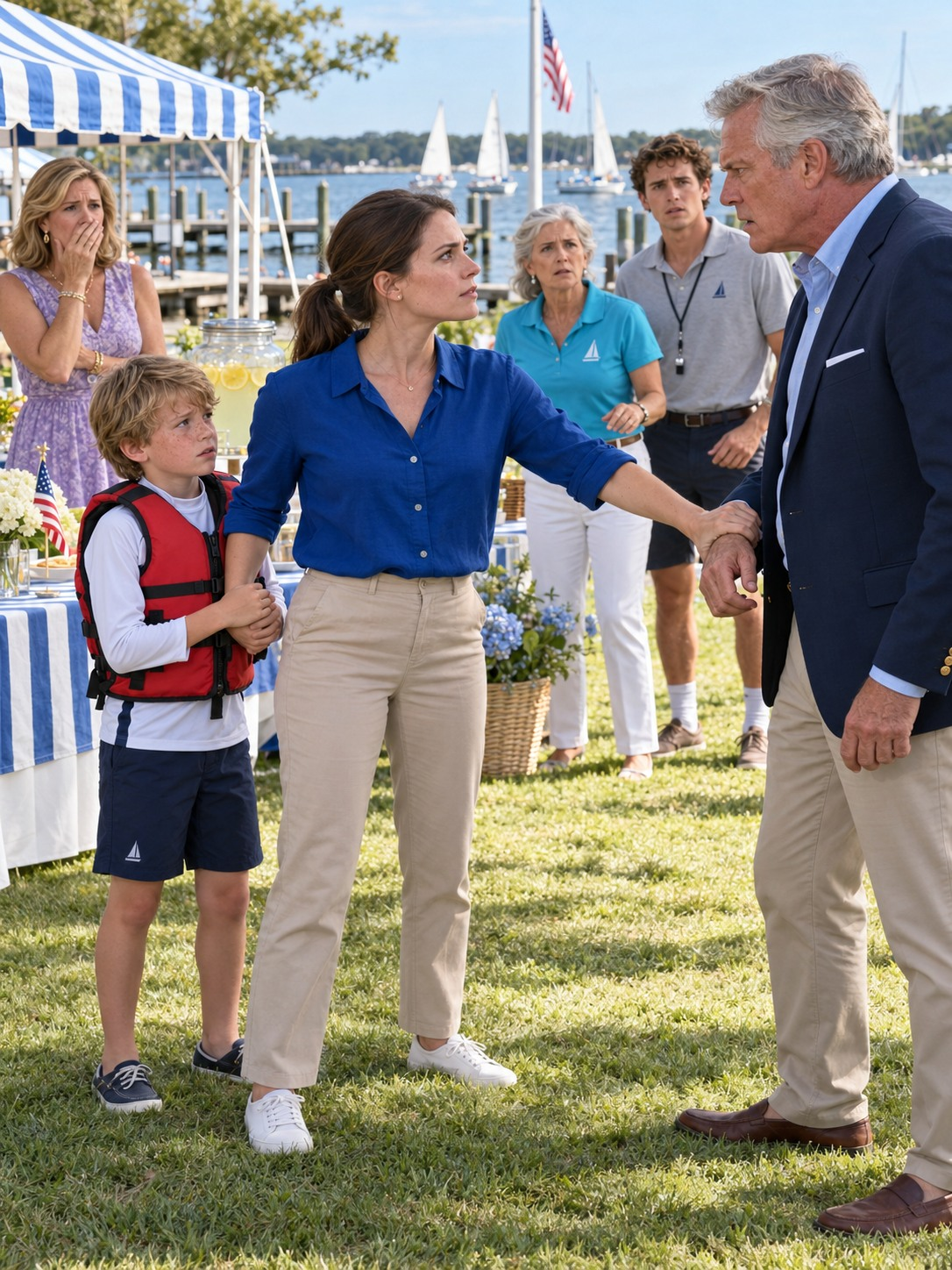
"And at the fundraiser, when he grabbed Noah, I should have stepped forward. I should have told him to let go."
I looked at her.
"Yes. You should have."
She nodded.
"I know."
Tears rolled down her cheeks.
"I'm sorry, Rebecca."
For a long moment, I didn't speak.
Then I reached across the table.
"Mom, I want you in our lives. Noah loves you. But things cannot go back to how they were."
"I understand."
"You cannot defend someone just because you're afraid of upsetting him."
She nodded.
"And you cannot ask Noah to pretend he wasn't hurt."
"I won't."
I took her hand.
"Then we can start again."
She began crying.
This time, I held her.
It wasn't an instant restoration of trust.
There were things we would need to discuss.
There were apologies that would need to become actions.
But my mother had finally acknowledged what had happened.
And that mattered.
Grant eventually faced consequences within his own company.
The disputed shoreline access created problems with the development schedule.
The project required revisions.
The investors demanded clarification.
The marina design had to be reconsidered.
Daniel informed me that the company's legal representatives had contacted him to discuss a formal resolution of the property dispute.
We reached an agreement.
Grant's company would recognize my ownership, remove the disputed access corridor from its plans, and refrain from entering the cottage property without permission.
The company also agreed to correct its previous representations concerning my consent.
I did not sell.
I did not grant the easement.
And I did not withdraw the truthful records of what had happened.
The separate review of the disputed documents continued through the appropriate channels.
Grant never apologized directly to me.
I stopped waiting for him to.
A few weeks later, I received a letter from Daniel confirming that the revised development plans no longer included the access corridor across my father's property.
I read it while sitting on the porch.
The tide was coming in.
Noah was outside.
He was sailing Morning Star.
The golden letters on the wooden hull caught the afternoon light.
I watched him guide the little boat across the water.
Then I folded the letter and placed it beside me.
For the first time in a long while, I wasn't waiting for another phone call.
I wasn't checking for survey markers.
I wasn't wondering whether someone would appear at the property line.
Our home was ours.
The following Saturday, we held a small gathering at the cottage.
Nothing extravagant.
Just family, a few friends, and the people who had helped us through the difficult months.
Mr. Harris arrived early.
He brought a new sailing rope for Noah.
Michael came too.
He stood beside the dock for several minutes before approaching the house.
When Noah saw him, he waved.
"Uncle Michael!"
Michael smiled.
"Hello, sailor."
He handed Noah a small wooden box.
Inside was a collection of photographs of my father.
One showed Dad standing on the dock.
Another showed him holding Morning Star while Noah sat beside him.
Noah studied the pictures.
"Thank you."
Michael knelt beside him.
"Your grandfather loved that boat."
Noah nodded.
"I fixed it."
Michael looked at the little sailboat.
"I can see that."
My mother arrived shortly afterward.
She brought food and helped arrange the table.
There was no mention of Grant.
Nobody discussed the development.
Nobody talked about lawyers or disputed documents.
We talked about my father.
We laughed about his habit of repairing things that weren't broken.
Mr. Harris told a story about the time Dad spent an entire afternoon trying to fix a dock light that only needed a new bulb.
Noah laughed so hard that he nearly spilled his lemonade.
I watched him.
He was happy.
And that was enough.
Later that afternoon, Noah asked me to walk down to the dock.
He carried Morning Star in both hands.
"Mom, can we sail her?"
I smiled.
"Absolutely."
We checked the rope and adjusted the sail.
Mr. Harris helped Noah position the boat.
Then Noah pushed away from the dock.
Morning Star moved slowly across the water.
The little golden nameplate gleamed in the sunlight.
Noah looked back at me.
"Watch this turn!"
I laughed.
"I'm watching!"
He adjusted the sail.
The boat changed direction.
Not perfectly.
Not quickly.
But it moved.
And Noah was smiling.
I sat on the dock.
For a moment, I imagined my father standing beside me.
I could almost hear his voice telling Noah to pay attention to the wind.
I looked at the water.
Then Noah called out.
"Mom!"
I waved.
He raised one hand.
"Do you think Grandpa can see us?"
I swallowed.
"I think he'd be very proud."
Noah smiled.
He continued sailing.
A month later, Daniel sent me the final set of documents confirming the property records had been corrected and the disputed easement was not recognized as a valid right over my shoreline.
The development company had revised its plans.
The cottage remained in my name.
The dock remained where my father had built it.
And Morning Star was sailing again.
I placed the final documents inside the wooden cabinet where my father had kept his Coast Guard records.
Then I added a new folder.
I labeled it:
THE MERCER FAMILY PROPERTY — ORIGINAL RECORDS AND FINAL RESOLUTION.
I closed the cabinet.
That evening, I stood in the kitchen while Noah finished dinner.
He had brought his fourth-place ribbon downstairs.
It was still pinned to the shirt he had worn at the fundraiser.
"Why are you keeping that ribbon?" I asked.
He looked at it.
"Because it was my first race after fixing Morning Star."
I smiled.
"That's a good reason."
He placed it beside the photograph of his grandfather.
Then he looked at me.
"Mom?"
"Yes?"
"Can we have another sailing day tomorrow?"
I laughed.
"Of course."
He ran upstairs to prepare his equipment.
I remained by the table.
My phone vibrated.
A message from my mother.
Thank you for letting me be part of today. I love you both.
I read it.
Then I replied.
We love you too. See you tomorrow.
I put the phone away.
Outside, the porch light illuminated the old wooden dock.
The water moved gently beneath it.
I thought about the months behind us.
The offers.
The threats.
The false documents.
The silence.
The people who had helped.
And the people who had finally found the courage to tell the truth.
Grant had believed that money gave him control.
He had believed that my quiet nature meant I would eventually surrender.
He had believed that a public threat would make me afraid.
But he had never understood something important.
I had never been trying to win a fight with him.
I had been protecting my son.
And I had never needed to become someone else to do it.
I turned off the kitchen light.
Then I looked once more toward the dock.
Morning Star was tied safely to its wooden post.
The little boat my father had built.
The home he had left us.
The future Noah would grow up remembering.
Everything that mattered was still there.
And this time, nobody was going to take it away.






Comments 0