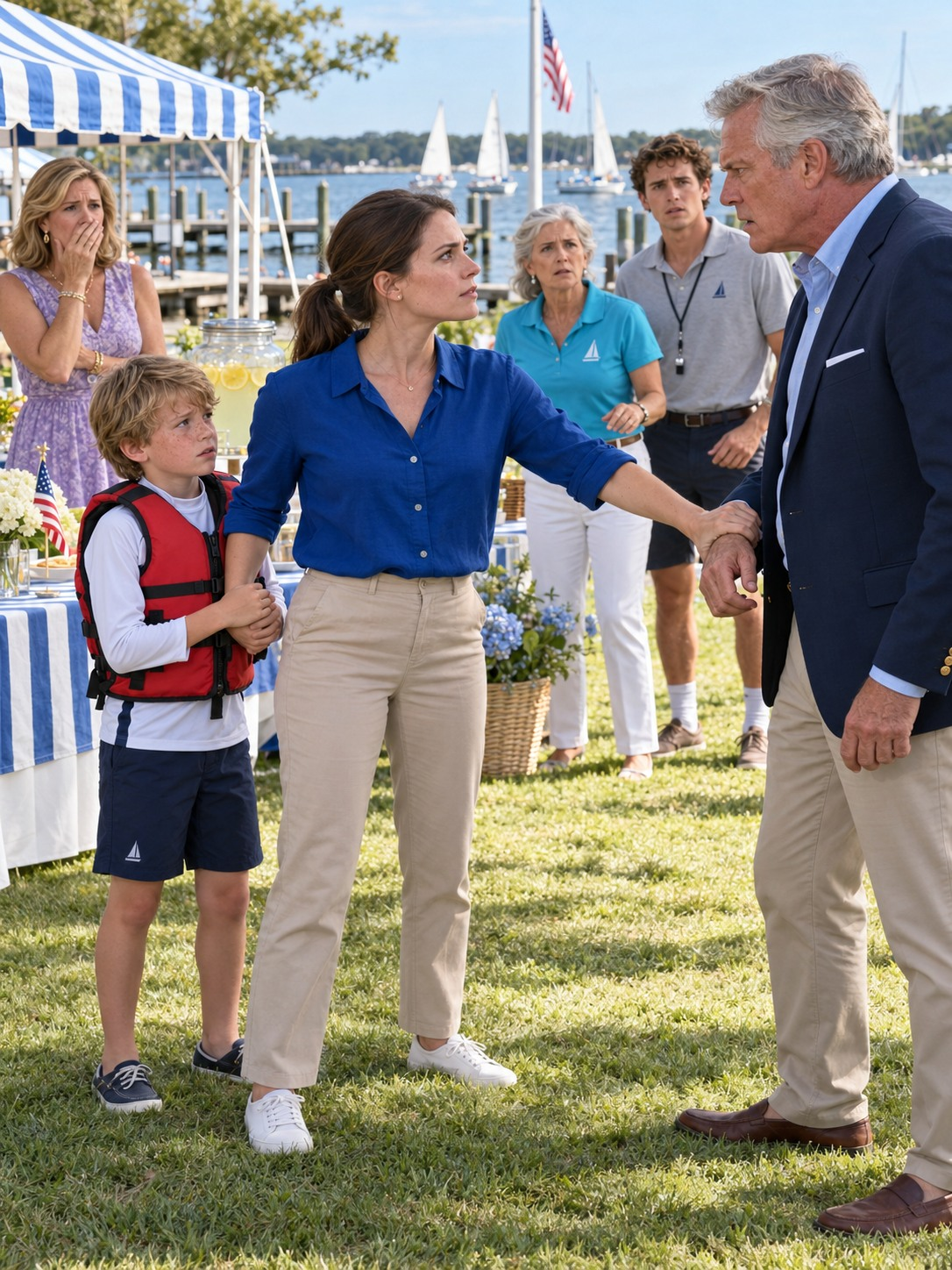
My nine-year-old son twisted against my stepfather's grip and whispered:
"Mom, Harbor."
Grant Holloway stood beside the lemonade stand, holding Noah's arm.
A tiny red recording light blinked on the camera attached to my son's life jacket.
Grant thought he was humiliating a powerless office clerk.
He was wrong.
Three weeks before that Saturday, I had been sitting at my kitchen table, repairing a loose strap on Noah's sailing bag.
It was an ordinary Thursday evening.
Noah was on the back porch, talking to his little wooden sailboat as though it were a person.
"You're going to win next time," he told it.
I smiled.
"Are you making promises on behalf of the boat?"
He looked over his shoulder.
"Mom, Morning Star is going to be faster when I fix the sail."
I set down the needle.
Morning Star was a small wooden sailboat my father had built with Noah over an entire winter. It wasn't expensive, and it certainly wasn't impressive compared with the polished racing boats at the marina.
But it was the most important thing Noah owned.
My father had spent twenty-two years in the United States Coast Guard. He was a practical man who believed that children learned responsibility by doing things themselves.
He taught Noah to tie knots, recognize changing tides, and respect the water.
Most importantly, he taught him that courage wasn't about being the loudest person in a room.
It was about doing the right thing when nobody was watching.
Seven months earlier, Dad had passed away.
After his funeral, Noah and I moved into the little waterfront cottage he had left me.
The property wasn't luxurious.
The porch needed repairs. The kitchen cabinets were old, and the screen door required a firm push before it would close.
But it had something no expensive house could replace.
It had my father's fingerprints everywhere.
There were pencil marks on the kitchen doorway showing how tall Noah had grown each year.
There was a rusty toolbox beneath the porch.
There was a small wooden bench beside the dock where Dad used to sit and watch the sunset.
And there was a photograph of my father holding Noah's hand while they stood beside Morning Star.
I kept that photograph on the living-room shelf.
Sometimes, when the house became too quiet, I found myself looking at it.
"Mom?"
Noah's voice pulled me back.
"Yeah, sweetheart?"
"Do you think Grandpa can see me sailing?"
I looked toward the porch.
He was holding Morning Star's little wooden rudder.
"I think he'd be proud of you."
Noah smiled.
"Even when I come in fourth?"
"Especially when you keep trying."
He nodded seriously, as though I had just given him an important military briefing.
I laughed.
Then my phone vibrated.
A message from my mother.
Grant wants everyone over for dinner on Sunday. Please come. We need to talk about the property.
I stared at the screen.
I already knew what that meant.
Grant had been interested in my father's shoreline since the day he learned I had inherited it.
My stepfather owned a successful coastal development company. He had spent years buying waterfront parcels, renovating old marinas, and constructing expensive condominium buildings.
His latest project was a luxury development directly beside my cottage.
The buildings were beautiful.
White balconies overlooked the water. Private boat slips stretched along the shoreline, and the marketing photographs showed families enjoying a lifestyle most people could only afford in retirement.
But there was a problem.
My father's property stood between Grant's development and a particularly useful section of deep-water shoreline.
Without access to that land, his plans would become considerably more complicated.
Grant had tried to approach the subject politely at first.
He called me several times.
He sent a representative to discuss the possibility of a sale.
He even offered to pay for an independent property valuation.
I refused every time.
I wasn't interested in selling.
The cottage was Noah's home.
It was the only place he had lived where he could walk down to the water and remember his grandfather without needing to look at a photograph.
I wasn't going to trade that for a condominium project.
On Sunday afternoon, Noah and I drove to my mother's house.
Grant greeted us at the door.
He wore an expensive blue sweater, pressed trousers, and a smile that never quite reached his eyes.
"Rebecca. There she is."
He leaned forward and gave me an unnecessarily firm handshake.
"Still keeping the Marine Corps running with those important papers?"
I smiled politely.
"Something like that."
He laughed.
"Well, come in. Your mother has been preparing dinner all afternoon."
My mother, Diane, appeared from the kitchen.
She was wearing a pale pink blouse and pearl earrings.
"There's my girl."
She hugged me.
Then she bent down to greet Noah.
"How's my favorite sailor?"
"Good, Grandma. I got fourth place last weekend."
"That's wonderful, sweetheart."
Grant interrupted.
"Fourth place. Not bad. Although I suppose there's always room for improvement."
Noah looked down.
I noticed.
I always noticed.
We sat at the dining table.
For the first twenty minutes, Grant talked about his business.
He described construction schedules, new investors, and the increasing value of coastal property.
My mother listened attentively.
I helped Noah cut his chicken.
Eventually, Grant reached for a large envelope beside his chair.
He slid it across the table toward me.
"Now, Rebecca. Let's discuss something practical."
I opened it.
Inside was a purchase offer for my father's cottage.
Three hundred twenty-five thousand dollars.
I read the figure twice.
Then I looked at him.
"What's this?"
"An opportunity."
"I'm not selling."
He smiled.
"You haven't even considered the offer."
"I don't need to."
"Rebecca, the market is changing. That property is becoming increasingly valuable."
"It's my home."
"That's an emotional argument."
"It's also the truth."
My mother placed her fork down.
"Sweetheart, think about what that money could do for Noah."
I looked at her.
"He already has what he needs."
Grant leaned back.
"Everyone has a number."
I folded the offer and placed it on the table.
"Then you haven't found mine."
His smile faded.
For several seconds, nobody spoke.
Then he chuckled and lifted his glass.
"All right. No need to make dinner unpleasant."
My mother gave me a pleading look.
I understood what she wanted.
She wanted me to apologize.
She wanted Grant to feel respected.
She wanted everyone to pretend that nothing uncomfortable had happened.
I had spent years doing exactly that.
I wasn't going to do it anymore.
After dinner, Noah and I left.
On the drive home, he watched the streetlights pass through the car window.
"Mom?"
"Yes?"
"Why does Grant always talk to you like you're a little kid?"
I tightened my hands around the steering wheel.
"He thinks he knows what's best."
"But he doesn't."
I glanced at him.
"No. He doesn't always."
"Then why don't you tell him?"
I considered the question.
Because explaining myself to someone who had already decided I was insignificant was a waste of energy.
Because my military career had taught me that not every provocation deserved a response.
And because Noah was listening.
I wanted him to understand the difference between being quiet and being powerless.
"Because I don't need Grant to understand who I am," I said.
Noah looked down at his hands.
"Grandma laughs when he makes fun of you."
That one hurt more than I expected.
"Sometimes people choose what's comfortable instead of what's right."
"Is that what Grandma does?"
I didn't answer immediately.
"I think she's afraid of arguing with him."
Noah nodded.
Then he looked toward the dark water beyond the road.
"I wouldn't be afraid to stand up for you."
I reached across the center console and squeezed his hand.
"I know, sweetheart."
When we arrived home, I carried the purchase offer inside.
I placed it in a folder with the property deed and the documents my father had left behind.
Then I opened my laptop.
I searched the county property records.
I checked the boundaries.
I compared the survey information against the original deed.
Something caught my attention.
The proposed access route on Grant's development plan appeared to extend beyond his property.
It wasn't a dramatic discovery.
Just a narrow section of shoreline.
But it was part of my father's land.
I printed the plan.
Then I opened a new folder and labeled it:
PROPERTY RECORDS — GRANT HOLLOWAY
I began saving everything.
Emails.
Letters.
Photographs.
Survey documents.
Dates and descriptions of conversations.
I wasn't looking for a fight.
I simply wanted a reliable record of what was happening.
Before going to bed, I walked onto the porch.
Noah was already asleep.
The tide was coming in.
Morning Star rested beside the dock, its small sail tied neatly against the mast.
I ran my fingers over the smooth wooden hull.
My father had built it with patience.
He had never hurried a single detail.
I thought about the offer.
I thought about Grant's smile.
And I remembered something Dad used to tell me whenever someone tried to provoke me.
Never let another person's temper decide your next move.
I went back inside.
The following Monday, I returned to Camp Lejeune.
My official duties had nothing to do with the harmless paperwork job Grant imagined.
I was a Staff Sergeant in the United States Marine Corps.
I trained Marines.
I taught discipline, judgment, and the ability to remain composed when someone deliberately tried to provoke a reaction.
I understood the importance of controlling my emotions.
I also understood that strength didn't require an audience.
Grant had spent years underestimating me.
I had never considered correcting him necessary.
Until that week.
On Wednesday evening, I received an email from a county survey office.
The subject line read:
NOTICE OF RECENT PROPERTY BOUNDARY ACTIVITY.
I opened it.
A surveyor had reported that several markers near my father's shoreline had been moved.
The email included photographs.
I enlarged the first image.
Then the second.
My stomach tightened.
Someone had placed a bright orange survey stake inside my property boundary.
And beside it was a small white sign bearing the name of Grant Holloway's development company.
I saved the photographs.
I checked the date.
Then I picked up my phone and called my attorney.
Because for the first time, I had something more important than an unpleasant family disagreement.
I had evidence.
And Grant had just given me a reason to start using it.






Comments 0