I stared at the name beneath the signature.
Daniel Harris.
For several seconds, I couldn't move.
The man who had taught Noah to repair Morning Star.
The man who had helped my father build the dock.
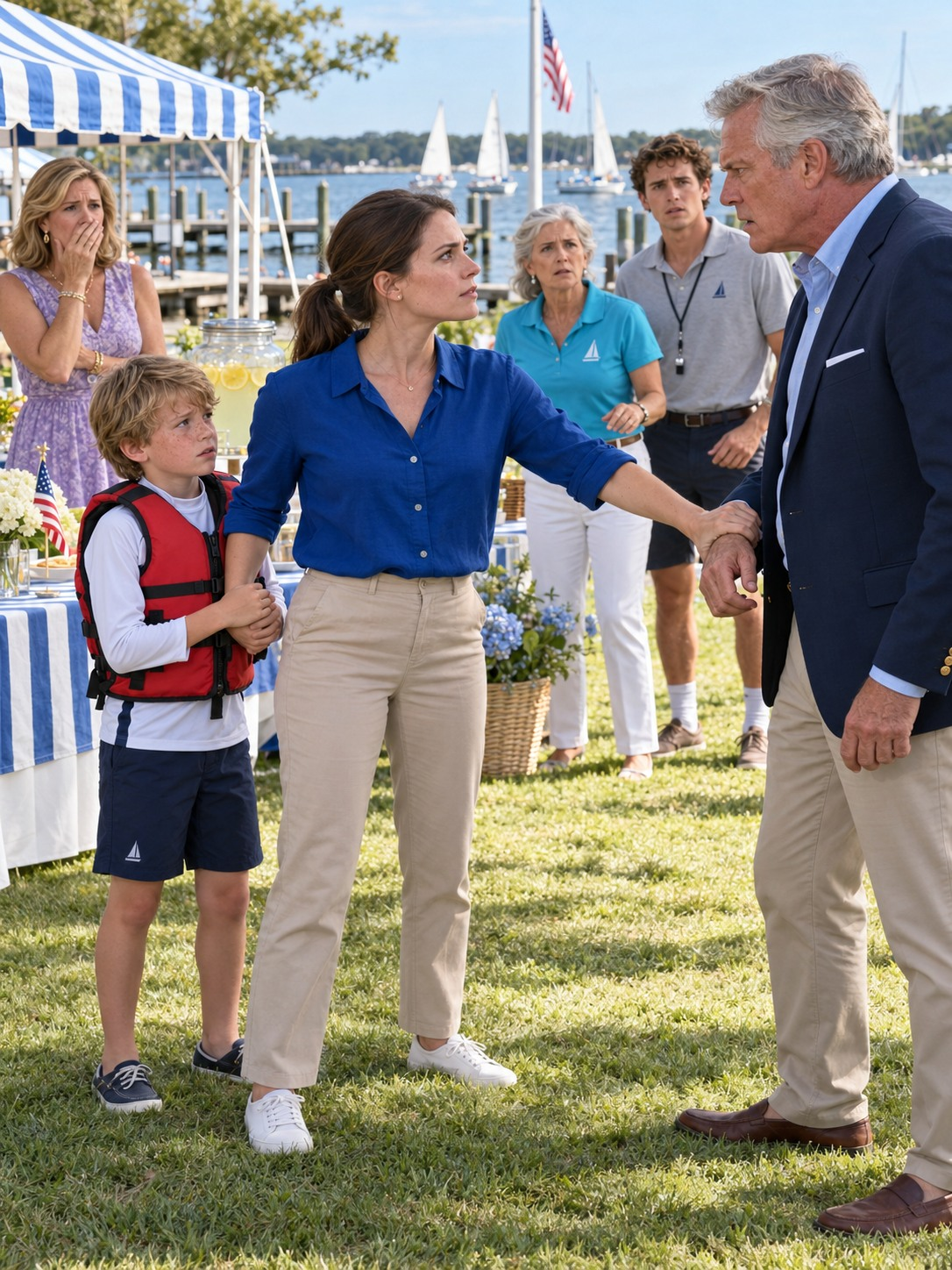
The man who had stood beside us at the sailing fundraiser when Grant grabbed my son's arm.
His name was on a document that appeared to contradict the original deed.
I picked up my phone.
"Daniel, are you certain this is the same Harris?"
"That's the name listed as the witness."
"But Mr. Harris has known my father for years."
"I understand."
"He helped him build the dock."
"Rebecca, I don't want you jumping to conclusions. The document may have an innocent explanation. That's why we need to speak with him."
I looked at the signature again.
It was similar to the handwriting I remembered from my father's old paperwork.
But something about the date bothered me.
My father had been extremely careful with legal documents.
He had spent twenty-two years serving in the Coast Guard. He understood the importance of keeping records and maintaining accurate information.
He would never have casually signed something affecting his property without telling me.
"Did Mr. Harris contact you directly?" I asked.
"Yes. He requested a private meeting."
"What exactly did he say?"
"He said he had information about the preparation of the second deed."
I swallowed.
"Does he know what Grant is doing?"
"Apparently, he knows more than he originally told us."
I looked toward the stairs.
Noah was still asleep.
"Arrange the meeting," I said.
Daniel agreed.
Before ending the call, he gave me one warning.
"Rebecca, bring someone you trust if you feel uncomfortable. And don't accept any documents without allowing me to review them."
"I won't."
I ended the call.
Then I returned to the kitchen table.
I opened the original property folder.
My father's deed was there.
The original document was slightly yellowed at the edges. His signature was clear.
I placed the new scanned document beside it.
The two descriptions were similar.
But the second document contained additional language concerning a shoreline access corridor.
It also referred to a transfer of certain property rights.
I read the paragraph several times.
Then I noticed another detail.
The document referenced a survey number that I recognized.
It was the same number associated with Peter Langford's recent work.
I photographed both pages.
Then I put everything away.
I wasn't going to make accusations without evidence.
But I was no longer willing to ignore the possibility that someone had been trying to change the legal description of my father's property.
And I needed to know why Daniel Harris had allowed his name to appear on that document.
Mr. Harris agreed to meet us at a small coffee shop near the waterfront.
I arrived with Daniel shortly before ten.
The place was quiet.
A few customers were seated near the windows, and a woman behind the counter was preparing coffee.
Mr. Harris was already waiting at a corner table.
He stood when he saw me.
"Rebecca."
His voice sounded different from usual.
I shook his hand.
"Mr. Harris."
He glanced at Daniel.
"Thank you for coming."
We sat down.
For several seconds, nobody spoke.
Mr. Harris looked older than I remembered.
His gray hair was neatly combed, and he wore the same weathered jacket he usually wore when working around the marina.
He placed a thick envelope on the table.
"I should have told you earlier."
I looked at the envelope.
"About what?"
He lowered his eyes.
"About Grant."
Daniel leaned forward.
"Let's start with the document."
Mr. Harris nodded.
He removed several pages from the envelope.
The first was a copy of the second deed.
The second was a survey map.
The third was a handwritten note.
I recognized my father's handwriting immediately.
My chest tightened.
"Where did you get this?"
Mr. Harris looked at me.
"Your father gave it to me several years ago."
I stared at him.
"Why?"
He unfolded the note.
"Because he was concerned about a proposed access route near the northern edge of the property."
Daniel examined the survey map.
"Was this related to the current development?"
"Not originally. Your father had noticed that someone had been measuring the shoreline near the old dock. He asked me to help him understand what was happening."
I looked at him.
"Did Dad know Grant?"
Mr. Harris nodded.
"He had met him several times."
I felt a chill.
"What did he think of him?"
Mr. Harris hesitated.
"He didn't trust him."
I sat back.
"Why didn't anyone tell me?"
"Your father didn't want you worrying about it. He believed the issue could be resolved through the county."
Daniel opened the handwritten note.
He studied it carefully.
"Is this the original?"
"Yes."
Mr. Harris pushed the envelope toward him.
"Your father asked me to keep it safe."
I looked at the note.
The handwriting was unmistakable.
My father had written:
The shoreline belongs with the cottage. No one should separate them without Rebecca's knowledge and consent.
I felt my eyes burn.
I remembered him standing on the dock with Noah.
I remembered him explaining why the property mattered.
It had never been about the money.
He wanted the cottage and the water to remain together.
For Noah.
For the future.
I looked at Mr. Harris.
"Why didn't you tell me about this after Dad passed away?"
He lowered his head.
"Because I made a mistake."
"What mistake?"
He took a slow breath.
"Grant approached me shortly after your father died. He said he was interested in purchasing the neighboring property and wanted to understand the shoreline boundaries."
I stared at him.
"What did you tell him?"
"I explained the general survey information. Nothing confidential."
"Then what happened?"
"He asked me to review a proposed document."
Daniel looked up.
"What document?"
Mr. Harris tapped the second deed.
"This one."
I felt my stomach tighten.
"You reviewed this?"
"Yes."
"Did you sign it?"
He looked directly at me.
"No."
The answer came immediately.
I blinked.
"But your name is on it."
"I know."
He leaned back.
"That signature isn't mine."
Daniel examined the page.
"Are you certain?"
"Absolutely."
Mr. Harris pulled a small notebook from his jacket.
He opened it to a page containing several examples of his signature.
"I've signed documents for marina equipment, insurance forms, and property maintenance records. You can compare them."
Daniel placed the notebook beside the scanned deed.
The signatures looked similar at first glance.
But there were differences.
The second deed contained a signature with an unusually sharp final stroke.
Mr. Harris's usual signature ended in a rounded curve.
Daniel took photographs.
"Did you authorize anyone to sign on your behalf?"
"No."
"Did you witness your father signing this document?"
Mr. Harris shook his head.
"Your father never signed it."
I looked at the pages.
"Then who prepared it?"
Mr. Harris hesitated.
He looked toward the windows.
Then he said:
"Peter Langford brought it to me several months ago."
I leaned forward.
"Peter?"
"Yes."
"Why?"
"He said Grant's company needed confirmation that the access corridor had been discussed with your father before he died."
Daniel's expression hardened.
"Did Peter tell you the document was already signed?"
"He said it was a draft that needed a witness."
"And what did you do?"
"I refused."
I stared at him.
"Then why does it carry your name?"
He rubbed his forehead.
"I don't know."
I studied his face.
He looked genuinely troubled.
"Mr. Harris, did you tell Grant you refused?"
"Yes."
"What did he say?"
Mr. Harris looked down.
"He told me I was making things unnecessarily difficult."
Daniel wrote something in his notebook.
"Did you keep any correspondence?"
Mr. Harris nodded.
He removed another sheet from the envelope.
It was a printed email.
The sender was Peter Langford.
The message was short.
We need to finalize the shoreline documentation before the next development review. Grant expects this to be resolved.
Below it was another line.
Please reconsider your position.
Daniel read it twice.
"Do you still have the original email?"
"Yes."
"Don't delete anything. Forward the entire message thread to me."
Mr. Harris nodded.
I looked at him.
"Why did you wait until now?"
He looked ashamed.
"Because I thought Grant would eventually abandon the idea."
"And when he didn't?"
"I became concerned."
I took a breath.
"Was there anything else?"
Mr. Harris stared at the envelope.
Then he said:
"Yes."
He reached inside and removed a small photograph.
It showed my father standing beside the dock.
He was holding a folder.
The picture had been taken several years earlier.
On the back, in my father's handwriting, were four words.
Keep this with Daniel.
I looked at it.
"Daniel?"
Mr. Harris nodded.
"Your father was referring to me."
Daniel leaned closer.
"What did he mean?"
Mr. Harris took another breath.
"Your father believed the original shoreline survey contained an error. He wanted me to preserve the corrected version."
He removed one final document.
It was an older survey map.
The northern boundary was marked in blue.
A second line had been drawn in red.
The red line showed the disputed access corridor.
Daniel examined it.
Then he looked up.
"This is important."
I stared at the map.
"What does it show?"
"It appears to establish that the corridor Grant's company is claiming falls entirely within your father's property boundary."
I looked at Mr. Harris.
"You're saying they have no legal right to use it?"
"That's what the original survey indicates."
Daniel nodded.
"We'll need an independent review, but this could be very useful."
I leaned back.
For the first time, I felt that the truth was beginning to emerge.
But I still had one question.
"Mr. Harris, why would Grant go to so much trouble to obtain that particular strip of land?"
He looked at me.
Then he pointed toward the northern edge of the map.
"Because of what's underneath it."
I stared at the red line.
"What do you mean?"
Mr. Harris unfolded another sheet.
It was a technical drawing.
The paper was old and slightly faded.
There were measurements along the shoreline and several markings near the northern boundary.
"Your father discovered that the deep-water channel runs close to this section of land."
I looked at the drawing.
"Is that unusual?"
"Not necessarily. But the depth and access conditions make it valuable for certain types of development."
Daniel examined the map.
"Are you saying Grant's project requires this specific access point?"
Mr. Harris nodded.
"His proposed condominium development includes a private marina. Without the deeper channel, the marina would be much more limited."
I looked toward the window.
The neighboring development had been under construction for months.
I had seen the advertisements.
Luxury apartments.
Private waterfront access.
A marina for residents.
I had never realized how much the project depended on our property.
"Could he build the marina without our shoreline?"
"He could build a smaller one. But it wouldn't accommodate the vessels he has advertised to investors."
Daniel leaned forward.
"Has Grant obtained any permits based on the disputed access corridor?"
Mr. Harris hesitated.
"I believe so."
Daniel looked at him.
"Do you have proof?"
Mr. Harris reached into the envelope again.
He removed a printed brochure.
It showed an artist's rendering of the proposed development.
At the bottom was a description of the marina.
PRIVATE DEEP-WATER ACCESS.
I examined the image.
The proposed marina extended along the shoreline.
The access route crossed the area marked on my father's survey.
Daniel studied the brochure.
"Do you know when this was published?"
"Three months ago."
I looked at the date.
Three months.
That was before Grant had approached me with the original three-hundred-and-twenty-five-thousand-dollar offer.
Before the survey markers appeared.
Before the damaged boat.
Before the dinner.
Everything was connected.
Grant hadn't simply become interested in my property after learning I might sell.
He had already built part of his development plan around obtaining it.
And he had expected me to cooperate.
I looked at Daniel.
"What happens if his permits rely on incorrect information?"
"We need to establish whether they do. If they do, the relevant authorities will need to review the submissions."
I turned toward Mr. Harris.
"Did my father know about the marina plans?"
"He suspected Grant wanted more than a simple property purchase."
"What did he say?"
Mr. Harris looked at the handwritten note.
"He told me he didn't want you pressured into selling."
I swallowed.
"Did he say anything else?"
Mr. Harris nodded.
"He said the cottage was the last place he wanted Noah to lose."
My eyes filled.
I looked away.
For several seconds, I couldn't speak.
Daniel waited.
Finally, I folded my hands on the table.
"Thank you for keeping these documents."
Mr. Harris nodded.
"I should have done more."
"Maybe. But you're telling the truth now."
He looked relieved.
Daniel collected copies of the documents.
He asked Mr. Harris to prepare a written statement explaining the disputed signature and the history of the survey.
Mr. Harris agreed.
Before we left, he touched my arm.
"Rebecca?"
I turned.
"Your father trusted you."
I nodded.
"I know."
"He would have wanted you to protect that place."
I looked at the photograph of Dad standing beside the dock.
"I will."
The following week was a blur of meetings and paperwork.
Daniel arranged for an independent surveyor to review the property boundaries.
He also contacted the appropriate county office to request a complete copy of the records associated with the second deed.
I provided the original footage from Noah's camera.
The sailing event's incident report was added to the file.
Evelyn supplied written statements from the volunteers and parents who had witnessed the confrontation.
Mr. Harris submitted his own statement.
He explained that he had never witnessed or authorized the second deed.
He also provided the email correspondence from Peter Langford.
My mother agreed to give a full account of how Grant had presented the preliminary property statement to her.
I wasn't present when she spoke with Daniel.
But afterward, she called me.
"I told him everything."
I sat at the kitchen table.
"Thank you."
She sighed.
"Rebecca, I know you're disappointed in me."
I didn't answer.
"I should have asked more questions."
"Yes."
"I thought Grant was trying to make the situation easier for everyone."
"Mom, it was never going to be easier for everyone if the truth was ignored."
She began crying.
"I understand that now."
I softened my voice.
"Then keep telling the truth."
She agreed.
We ended the call.
I didn't know whether our relationship could return to what it had been.
But I knew that trust would have to be rebuilt through actions.
Not promises.
Two days later, Daniel called with an update.
"Rebecca, the county has confirmed receipt of the disputed document."
"What does that mean?"
"It means the document is now being reviewed. They have also agreed to examine the original property records and the supporting survey materials."
"Will they stop Grant's development?"
"That's not something I can promise. But the disputed shoreline access will need to be clarified before anyone can rely on it as an established property right."
I nodded.
"That's progress."
"It is."
He paused.
"There's something else."
I sat up.
"What?"
"The independent surveyor has completed an initial comparison."
I waited.
"Your father's original boundary description is consistent with the recorded deed."
I closed my eyes.
"And the second deed?"
"It contains discrepancies that need further examination."
I exhaled.
"Does that mean it isn't valid?"
"It means we have grounds to challenge it. We need the county's final review and, if necessary, further legal action."
I thanked him.
After the call, I went outside.
Noah was sitting on the dock with Mr. Harris.
Morning Star rested beside them.
The little boat had a new mast.
Its wooden hull had been carefully repaired.
Noah was holding a small paintbrush.
Mr. Harris was showing him how to apply the final protective coat.
I stood near the porch.
"How's the boat coming?"
Noah looked up.
"Almost finished!"
Mr. Harris smiled.
"Your grandfather would recognize it now."
Noah carefully dipped the brush.
"I want to paint the name again."
I walked closer.
"What color?"
He considered it.
"Gold."
I smiled.
"That sounds beautiful."
He looked toward the water.
"Mom?"
"Yes?"
"Will we still live here next year?"
I crouched beside him.
"I believe we will."
"Promise?"
I took his hand.
"I can't promise things I don't control. But I can promise that I'll keep protecting our home."
He nodded.
Then he returned to painting.
I watched the little wooden boat.
For the first time in weeks, it looked almost like it had before Grant took it.
I thought about my father.
About the dock he had built.
About the property lines he had carefully recorded.
And about the man who had quietly preserved the evidence when everyone else seemed to be looking away.
That evening, I received a call from an unfamiliar number.
I answered.
"Hello?"
A man's voice spoke.
"Staff Sergeant Mercer?"
"Yes."
"My name is Thomas Reed. I'm contacting you regarding the shoreline documentation submitted by Holloway Coastal Development."
I sat down.
"How can I help you?"
"We're reviewing several records connected to the proposed marina access."
"All right."
"There appears to be a discrepancy between the original survey and the additional document submitted to the county."
I glanced toward the kitchen table.
"Daniel Mercer is representing me. He can provide the relevant materials."
"Of course. We've already received some of them."
I waited.
The man continued.
"There's one issue we'd like to clarify."
"What issue?"
"Mr. Holloway has informed our office that he possesses another document supporting the access claim."
My stomach tightened.
"Another document?"
"Yes. He says it was signed by your father shortly before his death."
I stood.
"That isn't possible. My father never authorized an access agreement."
"I understand. That's why we're asking you to contact your attorney."
I took a breath.
"Can you tell me what the document contains?"
There was a pause.
Then Thomas Reed said:
"According to the description provided by Mr. Holloway, it contains a permanent shoreline easement."
I looked toward the original deed.
"Who witnessed it?"
The man hesitated.
Then he read the name.
I felt my blood run cold.
It wasn't Peter Langford.
It wasn't my mother.
And it wasn't Daniel Harris.
It was the name of a person I had believed was no longer connected to our family.
A person who had attended my father's funeral.
A person who had stood beside me when we buried him.
Thomas Reed continued speaking.
But I barely heard him.
Because the name he had just read belonged to my father's younger brother, Michael Mercer.
And I hadn't seen Michael in nearly eight years.






Comments 0