"Rebecca, I need you to listen carefully," Daniel said.
I stood in the middle of my kitchen, staring at the dark window.
"What exactly did you find?"
"A written statement submitted alongside the development company's latest property documents. It claims you verbally agreed to sell your father's shoreline and authorized preliminary negotiations."
I tightened my grip on the phone.
"I never agreed to sell."
"I know."
"Then whose signature is on it?"
Daniel paused.
"Your mother's."
For several seconds, I couldn't speak.
I looked toward the family photograph on the shelf. My mother stood beside my father, holding a young version of me between them. She was smiling.
My father had one arm around her shoulders.
I remembered that photograph being taken during a summer picnic years ago.
Back then, I had believed my parents would always protect each other.
"Are you certain?" I finally asked.
"Yes. The signature appears to be Diane's. But we don't yet know what she was told when she signed it."
"Does the document say I agreed to sell?"
"It says you expressed an intention to negotiate a transfer of the property. That's not the same as a completed sale, but it's potentially misleading."
I walked toward the kitchen table.
"Can they use it to claim they have permission?"
"Not by itself. Your deed remains in place. But I want to challenge the statement and establish exactly how it was obtained."
I closed my eyes.
My mother.
The woman who had spent years telling me that family was supposed to protect one another.
The woman who had watched Grant humiliate me.
The woman who had defended him after he destroyed Noah's boat.
Now her name was attached to a document that could damage our position.
"Send me a copy," I said.
"I will. And Rebecca?"
"Yes?"
"Don't accuse your mother of anything until we understand the circumstances."
I looked at the damaged Morning Star resting on the kitchen table.
"I'll speak to her."
"Do it carefully."
We ended the call.
A few minutes later, Daniel emailed me the document.
I opened it.
The heading read:
PRELIMINARY STATEMENT OF PROPERTY OWNER'S INTENT.
Below it was a paragraph describing an alleged conversation about the future transfer of my father's property.
The statement included my mother's signature.
At the bottom was the date.
It had been signed five days before Grant's four-hundred-thousand-dollar dinner invitation.
I read the wording again.
It didn't say I had completed a sale.
It said I had expressed a willingness to consider one.
But I had never expressed that willingness.
Not once.
I saved the document.
Then I called my mother.
She answered after several rings.
"Rebecca?"
"Mom, we need to talk."
There was a pause.
"What's happened?"
"Did you sign a statement about Dad's property?"
Silence.
I waited.
Finally, she said, "Grant told me it was just something for the development office."
"What exactly did you sign?"
"I don't remember every word."
"Did you sign a document saying I had agreed to sell?"
Her breathing changed.
"Rebecca, he said you were considering the offer."
"I wasn't."
"He said you might be willing to negotiate."
"I told him I wasn't selling."
"I know you said that, but he thought you could change your mind."
I gripped the edge of the counter.
"Mom, did you understand that your signature was being used to represent my intentions?"
She didn't answer.
Then she said quietly, "He told me it was a preliminary family statement."
I stared at the phone.
"A family statement?"
"He said it would help the development company understand that we were discussing the property."
"We weren't discussing it. He was trying to buy it."
"Rebecca, I didn't think it would become a problem."
I took a slow breath.
"Did you read the document before signing?"
Another silence.
"I trusted him."
That answer hurt more than I expected.
I sat down.
"Mom, you cannot authorize the sale of property you don't own."
"I wasn't trying to."
"Then why did you sign something that makes it look as though I agreed?"
Her voice became defensive.
"Because I wanted the situation to settle down. Grant said the investors were waiting, and he needed to show them that the family wasn't completely opposed."
I looked toward the window.
"So you gave him something he could use."
"I didn't think—"
"That's the problem, Mom."
She began crying.
I closed my eyes.
For a moment, I wanted to comfort her.
I wanted to tell her that everything would be fine.
But Noah's face appeared in my mind.
The way he had looked at Morning Star after Grant damaged it.
The way he had asked whether we would have to leave our home.
I couldn't pretend this was harmless.
"Mom, I need you to understand something. Your signature doesn't give Grant permission to use our property."
"I know."
"And I need you to tell Daniel exactly what happened."
She hesitated.
"Will that make things worse for Grant?"
I stared at the wall.
"Mom, this isn't about making things worse for Grant. It's about telling the truth."
She didn't respond.
I ended the call gently.
Then I forwarded Daniel the details of our conversation.
He replied that he would contact her directly to arrange a proper statement.
I put my phone down.
For the first time in months, I felt genuinely disappointed.
Not angry.
Not frightened.
Just disappointed.
I had spent years believing my mother was caught between two difficult personalities.
Now I was beginning to understand that she had made choices.
And those choices had consequences.
The following afternoon, I collected Noah from school.
He climbed into the passenger seat carrying a paper bag.
"What's that?"
"Something for Morning Star."
He opened the bag.
Inside were small pieces of sandpaper, a packet of wood glue, and a little paintbrush.
I smiled.
"Planning a repair project?"
"Yes."
"Who helped you choose those?"
"Mr. Harris."
Mr. Harris was an old family friend who had worked with my father in the Coast Guard. He had agreed to examine the damaged boat.
Noah placed the bag carefully between his feet.
"He said we can save the boat if we don't rush."
I nodded.
"That sounds like good advice."
We drove home.
When we arrived, Noah carried the supplies to the kitchen table.
He placed Morning Star in front of him and began examining the damaged hull.
I watched him for a moment.
He was so much like my father.
The same concentration.
The same habit of studying a problem before attempting to solve it.
I sat beside him.
"How about we wait for Mr. Harris before using the glue?"
Noah nodded.
Then he asked:
"Mom, is Grant still trying to buy our house?"
I looked at him.
"Yes."
"Why?"
"Because he wants something on our property for his development."
"Can't he just build somewhere else?"
"That would be a question for him."
Noah frowned.
"Grandpa wouldn't like him."
I didn't answer immediately.
Then I said, "Your grandfather believed people should respect what belonged to others."
Noah nodded.
He continued examining the boat.
After a while, he looked up.
"Mom, can I tell you something?"
"Always."
"When Grant took Morning Star, I wanted to shout at him."
I put down the cloth I was holding.
"That's understandable."
"But I remembered what Grandpa told me."
"What did he tell you?"
Noah looked at the damaged mast.
"He said that when somebody makes you feel scared, you should remember where the safe place is."
I felt my throat tighten.
"That's right."
"And if I can't get there?"
I turned toward him.
"Then you find a trusted person and ask for help."
He nodded.
I reached across the table and squeezed his hand.
"Exactly."
He returned to his work.
But his question stayed with me.
I knew Grant's behavior was becoming increasingly unpredictable.
I knew Noah was hearing conversations that no nine-year-old should have to worry about.
And I knew I needed to give him a simple way to ask for help without having to explain himself in front of someone intimidating.
That evening, after dinner, I sat with him on the back porch.
The tide was moving slowly beneath the dock.
Morning Star rested on the workbench.
I pointed toward the water.
"Do you remember when Grandpa taught you what to do if you ever felt uncomfortable around someone?"
Noah nodded.
"He said to stay close to the dock."
"That's right. And to find someone you trust."
I took a moment.
"I want us to have a special word."
He looked at me curiously.
"What word?"
"Harbor."
He repeated it.
"Harbor?"
"Yes. It means you need me. You don't have to explain anything. You don't have to argue with anyone. You just say that word, and I know I need to come to you."
Noah thought about it.
"Even if we're somewhere crowded?"
"Especially then."
"What if you're far away?"
"Then you go to a trusted adult, stay somewhere visible, and ask for help. The word tells me something is wrong as soon as I hear it."
He smiled faintly.
"I like that."
I leaned back against the porch chair.
"Let's practice."
He pretended to be standing near the lemonade stand at a crowded sailing event.
I pretended to be several feet away.
He looked at me.
"Harbor."
I immediately walked toward him.
"What's wrong?"
"Nothing. I just wanted to see if you remembered."
I laughed.
"I'll always remember."
He leaned against my shoulder.
"Grandpa would like that word."
I looked toward the dock.
"I think he would."
The next week, Daniel arranged a meeting with my mother.
She agreed to provide a written explanation of how Grant had presented the statement to her.
I wasn't present.
I didn't want the conversation to become another family argument.
Instead, I focused on collecting the remaining property records.
I reviewed the original deed.
I organized the photographs.
I copied the correspondence.
I also saved the anonymous photograph of Grant meeting Peter Langford.
Daniel later confirmed that the meeting had taken place around the time the statement was signed.
He couldn't establish what had been discussed.
But the timing concerned him.
"Rebecca, your mother says Grant described the document as a preliminary family acknowledgment."
"And did she understand that it would be submitted to the development office?"
"She says she believed it would remain an internal discussion document."
I leaned back.
"Did she admit she hadn't read the entire thing?"
"Yes."
I closed my eyes.
"That sounds like her."
Daniel continued.
"She is willing to clarify that you never authorized her to negotiate a sale on your behalf."
"Good."
"However, I want to be careful. Her statement needs to be accurate and voluntary."
"Of course."
After we finished, I thanked him.
For the first time since the dispute began, I felt that my mother's actions might finally be corrected.
But Grant wasn't finished.
Two days later, a delivery arrived at my cottage.
It was a large envelope bearing the logo of his development company.
Inside was a letter.
The company stated that it intended to continue discussions concerning potential shoreline access.
It also suggested that my refusal to cooperate could create complications for the wider development.
I read it twice.
Then I forwarded it to Daniel.
He replied with a single sentence.
Do not respond directly. I'll handle it.
I placed the letter in the folder.
That evening, my mother called.
"Rebecca, Grant is furious."
I was sitting beside Noah while he worked on Morning Star.
"Why?"
"He says you've made him look dishonest."
I looked at the damaged sail.
"I haven't said anything publicly."
"He knows you're collecting documents."
"Because he keeps creating problems that require documentation."
My mother sighed.
"He says the whole development could be delayed."
"Then he should stop trying to use land he doesn't own."
She became quiet.
Then she said something that surprised me.
"Rebecca, I think he believes you have more information than you actually do."
I sat up.
"What do you mean?"
"He keeps asking me whether you've spoken to anyone at the development office."
I looked toward the window.
"Why?"
"I don't know."
I considered the anonymous photograph.
Grant and Peter.
The envelope.
The documents.
"Mom, has he shown you any other papers?"
"No."
"Has he asked you to sign anything else?"
She hesitated.
Then she answered.
"Not yet."
That last phrase stayed with me.
Not yet.
I asked her to call Daniel if Grant approached her with another document.
She agreed.
Before ending the call, she said quietly:
"I should have listened to you."
I didn't know what to say.
So I simply replied:
"I hope you will from now on."
The following Saturday, Noah and I attended another sailing practice.
The marina was busy.
Children were carrying sails.
Parents were arranging equipment.
Volunteers were preparing tables for an upcoming fundraiser.
Noah was excited.
He had been practicing his turns all week.
Mr. Harris had repaired the damaged hull enough for a short supervised test.
Morning Star wasn't ready for competition, but it could move through calm water again.
Noah carried the boat down to the dock.
He looked at it with a huge smile.
"She's going to sail again."
I laughed.
"Apparently."
Mr. Harris checked the sail.
"Your grandfather would have been proud of this repair."
Noah looked at him.
"Really?"
"Absolutely."
I watched my son climb into the small boat.
He pushed away gently.
For the first time in weeks, he looked genuinely happy.
I took a photograph.
Then another.
I wanted to remember the moment.
After practice, I spoke with Evelyn Price, the event director.
She was a professional woman in her early forties who had helped organize several youth sailing programs along the coast.
I had met her briefly during previous events.
She was efficient, direct, and particularly protective of the children participating in the races.
"Rebecca, how's Noah doing?"
"Better. He's been looking forward to getting back on the water."
"He's a determined little sailor."
I smiled.
"He gets that from his grandfather."
Evelyn looked toward the dock.
"Your father was a good man. I remember him helping with the old junior sailing equipment."
I was surprised.
"You knew him?"
"Not well, but I remember him. He always seemed to know exactly what needed fixing."
I smiled.
"That sounds like him."
Evelyn hesitated.
"Can I ask you something?"
"Of course."
"I heard there may have been some tension involving your family and the upcoming fundraiser."
I looked at her.
"Who told you?"
"Someone mentioned that your stepfather might attend."
I nodded.
"Grant may be there."
"Is there anything we need to know?"
I considered my answer carefully.
I didn't want to create unnecessary drama at a children's event.
But I also didn't want Noah placed in an uncomfortable situation.
"There have been some issues involving my property and my stepfather. He's made some inappropriate comments, and there was an incident involving Noah's boat."
Evelyn's expression became serious.
"Is Noah safe?"
"Yes. But I would appreciate it if he wasn't left alone with Grant."
"Absolutely."
I thanked her.
She made a note on her clipboard.
"If anything happens during the fundraiser, come directly to me."
"I will."
Before leaving, I glanced toward Noah.
He was standing beside Morning Star, explaining the repaired mast to another child.
He looked happy.
I wanted the upcoming fundraiser to remain a good memory for him.
I wanted him to enjoy the race.
I wanted him to collect his ribbon, eat something sweet, and spend the afternoon talking about boats.
I had no intention of letting Grant ruin another day.
The next evening, I checked the camera equipment I had purchased for Noah's sailing activities.
It was a small action camera designed for outdoor recording.
He liked using it to review his races.
It helped him see where he had turned too early or failed to adjust his sail.
I charged the battery.
Then I showed him how to attach it securely to his life jacket.
"Make sure the strap is tight," I told him.
"I know, Mom."
"Check it anyway."
He rolled his eyes playfully.
I laughed.
He adjusted the mount.
Then he looked at me.
"Can I record the next race?"
"Of course."
"Even if I come in fourth again?"
"Especially if you come in fourth again."
He laughed.
We tested the camera.
The image was clear.
The sound was good.
I showed him how to stop and start recording.
Then I explained that the camera was for sailing practice, not for spying on people.
He understood.
Afterward, I placed the equipment beside his sailing bag.
I didn't think much about it.
I had no idea how important that small device would become.
Three days before the fundraiser, my mother visited the cottage.
She brought groceries and a box of old photographs.
"I thought Noah might enjoy these," she said.
I opened the box.
Inside were pictures of my father.
Some showed him wearing his Coast Guard uniform.
Others showed him repairing the dock, standing beside his fishing boat, or teaching Noah to tie knots.
Noah sat down immediately.
"Grandpa!"
He began sorting through them.
My mother smiled.
"He was always so patient with you."
Noah nodded.
"He let me do everything."
My mother looked at me.
"He was a wonderful grandfather."
"Yes, he was."
For a moment, the room felt almost normal.
Then my mother looked toward the kitchen.
"Has Grant contacted you?"
"No."
"He's very upset about the attorney."
"That's his choice."
She lowered her voice.
"He thinks you're trying to destroy his business."
I looked at her.
"Mom, I'm trying to protect my home."
"I know."
She seemed genuinely tired.
Then she said:
"I told him I wouldn't sign anything else without reading it."
I nodded.
"That's good."
She looked relieved.
"Maybe this will all settle down."
I hoped she was right.
After she left, Noah continued looking through the photographs.
He found one showing my father standing on the dock with Morning Star.
His expression brightened.
"Mom, look."
I sat beside him.
In the picture, Dad was holding the little wooden boat while Noah, barely five years old, stood beside him.
They were both smiling.
I touched the photograph.
"That's a good one."
Noah looked at me.
"Can we put it near my bed?"
"Absolutely."
He carried it upstairs.
I stayed at the table.
My phone vibrated.
An unfamiliar number appeared.
I opened the message.
Grant knows about the event director. Be careful.
I stared at it.
Then another message arrived.
He has already decided what he wants to do at the fundraiser.
My stomach tightened.
I immediately called Daniel.
He advised me not to engage with the sender until we knew who it was.
Then I contacted Evelyn.
She answered while preparing event materials.
"Rebecca?"
"I need to tell you something."
I explained the anonymous warning.
Evelyn listened carefully.
"Has Grant threatened you directly?"
"Not recently."
"Has he contacted Noah?"
"No. But he may approach him at the fundraiser."
Evelyn became serious.
"Then we'll make sure Noah stays with you or a designated volunteer."
"Thank you."
"Don't worry. The children come first."
I appreciated her response.
But after ending the call, I couldn't shake the feeling that Grant was planning something.
The next morning, I received a message from my mother.
Grant wants to speak with you before Saturday. He says it's important.
I didn't answer.
Instead, I packed Noah's sailing bag.
I checked his life jacket.
I charged the camera.
And I placed the little wooden photograph of my father beside Noah's bed.
That evening, he came into the kitchen carrying his ribbon from the previous race.
"Mom?"
"Yes, sweetheart?"
"Do you think I can get third place this time?"
I smiled.
"Anything is possible."
He looked thoughtful.
Then he asked:
"Will you be watching?"
"Every second."
He grinned.
"Good."
He walked toward the stairs.
At the top, he turned around.
"Harbor still works, right?"
I looked directly at him.
"Always."
He nodded.
Then he disappeared into his bedroom.
I stood alone in the kitchen for a moment.
Outside, the water moved gently beneath the dock.
Everything seemed quiet.
Until my phone rang.
It was Evelyn.
I answered.
"Hello?"
Her voice was unusually tense.
"Rebecca, I just received a call from someone at the marina."
"What happened?"
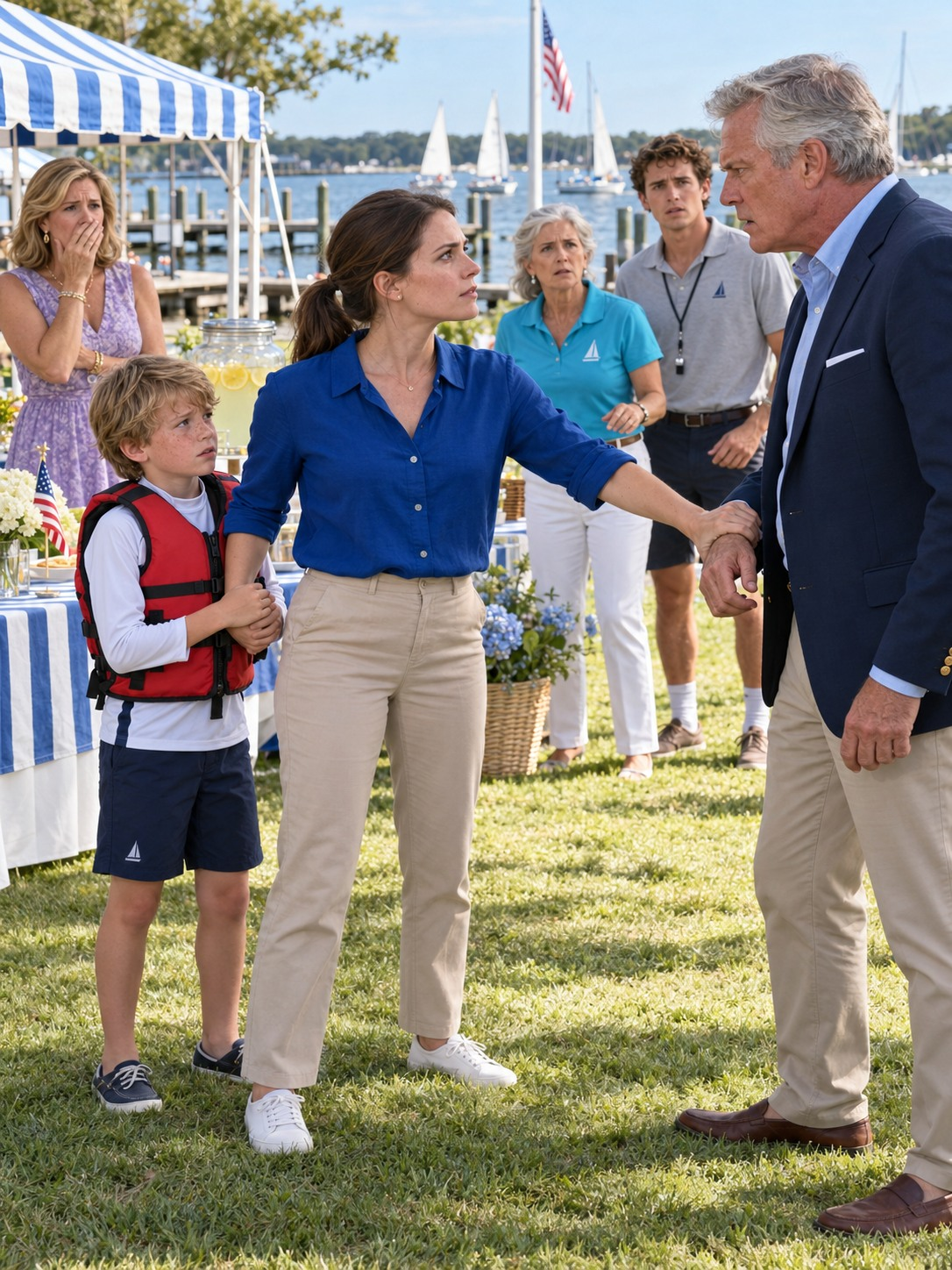
"They said Grant Holloway has arranged to make a special announcement at Saturday's fundraiser."
I felt my stomach tighten.
"What kind of announcement?"
Evelyn hesitated.
Then she said:
"He's bringing an oversized donation check, and he specifically requested that Noah be present when he makes his speech."






Comments 0