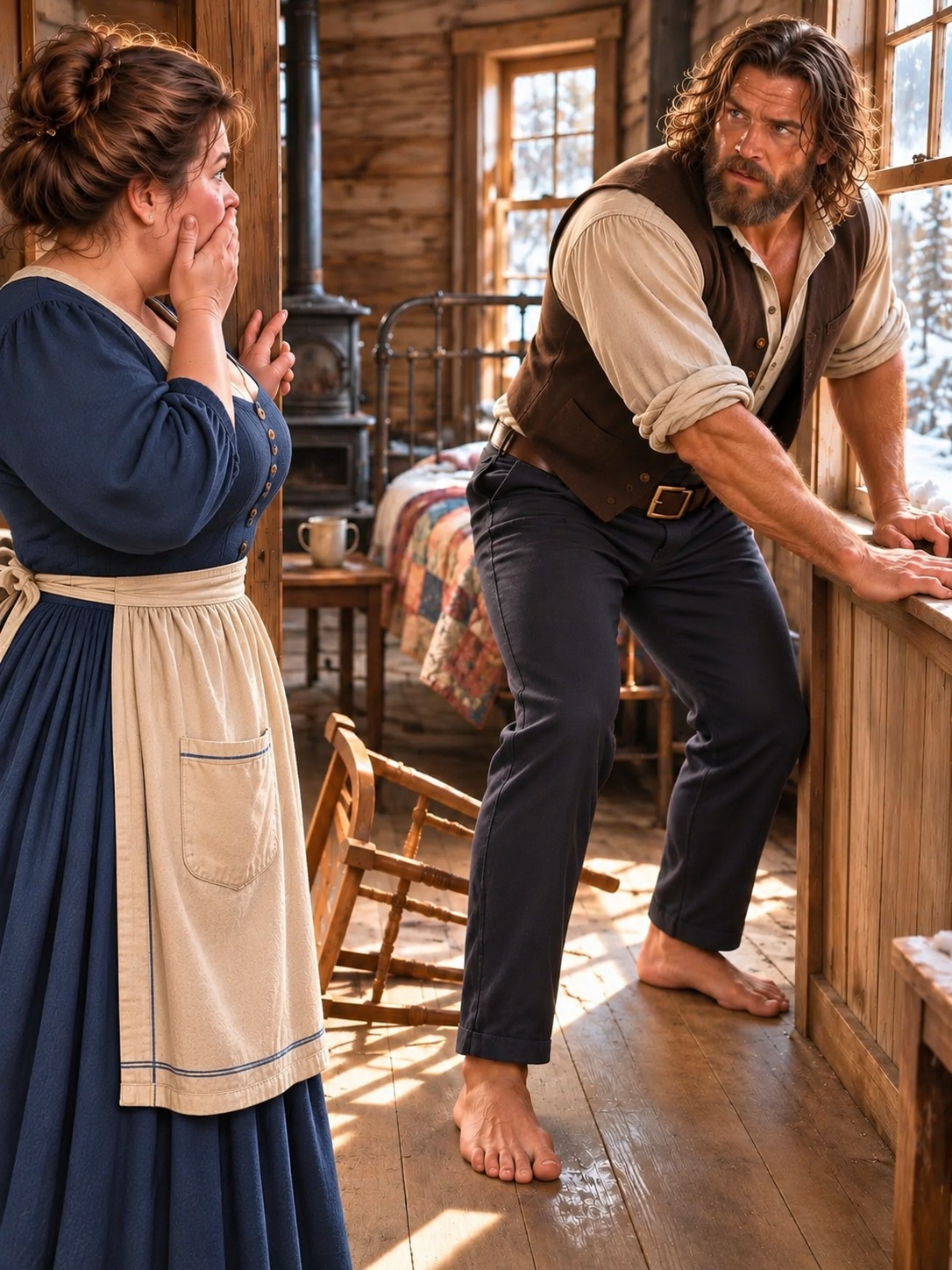
"Get your hands off him!" Martha Higgins shouted as Amos dragged the injured stranger from the wagon.
Her brother-in-law stopped with one boot planted against the wagon wheel.
In his right hand, he held a folded document bearing the town council's official seal.
Across the bottom, beneath three signatures, someone had written two words in red ink.
Widow's burden.
Martha looked from the paper to the enormous man lying in the straw.
This was no act of charity.
Amos Higgins smiled as though he had just delivered a prize hog.
"Well, Martha, don't stand there gawking. Come collect your present."
The man in the wagon did not move.
Not his legs, anyway.
His hands were another matter.
They were enormous, scarred hands, and they had closed around the wooden sides of the wagon with enough force to make the boards creak.
Martha had never seen a man so large.
Even stretched across the wagon bed, he seemed too big for it. His shoulders nearly touched both sides. His dark hair was matted against a bruised forehead, and a heavy beard covered the lower half of his face.
His trousers had been cut open at the knees.
Beneath them, two crude wooden splints held his legs straight.
But it was his eyes that stopped Martha.
Pale blue.
Clear.
Burning with a fury so fierce that she instinctively straightened her back.
Those were not the eyes of a dying man.
They were the eyes of someone who had been robbed of everything except his pride.
"What have you done?" Martha asked.
Amos gave a short laugh.
"Me? Nothing. Found him like this."
"Where?"
"Up in the mountains. Bear got him, according to the fellows who brought him down."
Martha stepped closer.
The stranger's left cheek was swollen. A long scrape crossed his temple. His shirt had been torn and badly mended.
He smelled of sweat, old blood, and the sour straw beneath him.
"Has a doctor seen him?"
"Two."
"And?"
Amos shrugged.
"Spine's ruined. Legs are finished. He'll never walk again."
The stranger's fingers tightened around the wagon rail.
Martha noticed.
So did Amos.
"Don't waste your temper, mountain man," Amos said. "Nobody's frightened of a fellow who can't stand."
The stranger's jaw worked.
For a moment, Martha thought he might speak.
Instead, he looked away.
Amos turned back to her.
"Town council says the poorhouse won't take him. Too big. Eats too much. Needs somebody to wash him, feed him, and keep him from rotting in his own bed."
"Then the town ought to pay someone."
"Now, Martha, don't go getting ideas."
"Why bring him here?"
Amos leaned against the wagon.
His grin widened.
"Because you're the only woman around here big enough to manage him."
Martha felt the words strike exactly where he intended.
She had heard versions of that joke for years.
At church.
Outside the general store.
At the harvest fair.
Sometimes whispered.
Sometimes shouted across the street.
Ever since her husband died, the people of Briar Glen had treated her body as though it were public property, something anyone could laugh at whenever conversation grew dull.
Three hundred pounds.
That was the number they loved.
They said it more often than they said her name.
But Martha had learned that a cruel remark did not require an answer.
She had survived worse things than Amos Higgins's mouth.
"Take him to the house," she said.
Amos blinked.
"What?"
"You brought him. You can help carry him."
The smile disappeared.
"Now hold on. I didn't come all this way to do your chores."
"Then why did you come?"
"Christian charity."
Martha looked at the document in his hand.
"Is that what they're calling it?"
Amos folded the paper quickly.
"Council's orders."
"Let me see."
"No need."
"Amos."
He tucked the document inside his coat.
"You always were a difficult woman."
"And you always did mistake cruelty for cleverness."
His face hardened.
For a moment, the old resentment between them stood in the yard like a third person.
Martha knew what Amos wanted.
He wanted her angry.
He wanted her humiliated.
He wanted her to refuse the stranger so he could return to town and tell everyone that Martha Higgins, the fat widow who barely kept her own farm alive, had turned away a helpless man.
Or perhaps he wanted her to accept him.
That might have been worse.
Then the town could laugh at two broken people trapped together in a collapsing farmhouse.
Either way, Amos would have his story.
Martha refused to give it to him.
"Help him down," she repeated.
Amos spat into the dirt.
"Fine."
He climbed onto the wagon.
The stranger immediately stiffened.
"Don't touch me," he said.
His voice was deep and rough.
It sounded as though he had spent too many days without water.
Amos chuckled.
"Well, listen to that. The corpse talks."
"I said don't touch me."
"Then get down yourself."
The mountain man's face darkened.
He planted both hands against the wagon bed.
His shoulders rose.
His arms trembled.
For one astonishing second, Martha thought he might lift his entire body.
Then his injured legs shifted.
Pain crossed his face.
His strength failed.
He dropped back onto the straw with a harsh breath.
Amos laughed.
"That's what I thought."
"Stop it," Martha said.
But Amos had already grabbed the man's shirt.
He dragged him toward the rear of the wagon.
The stranger fought with his arms, but he could not control the weight of his lower body.
His splinted legs scraped across the boards.
Martha hurried forward.
"Amos, wait!"
He did not.
With one final pull, he tipped the injured man over the edge.
The stranger struck the dirt hard.
A sound escaped him.
Not quite a scream.
Something lower.
Something he seemed determined to swallow before anyone heard it.
Martha stared.
For a moment, she could not believe what she had seen.
Amos dusted off his hands.
"There. Delivered."
"You animal."
He looked pleased.
"Careful, Martha. That's no way to speak to family."
"You are not my family."
The words landed harder than she expected.
Amos's expression changed.
Her late husband, Samuel Higgins, had been Amos's older brother.
Samuel had been a quiet man, patient with animals and awkward with words. He had never made Martha feel ashamed of her size.
When he died three winters earlier, he left her forty acres of struggling farmland, a farmhouse with a leaking roof, and debts she had been paying ever since.
Amos had offered to buy the property six times.
Each offer had been lower than the last.
Martha had refused every one.
Now he glanced toward the house.
The peeling paint.
The sagging porch.
The garden where the radishes had failed.
"You won't last another winter out here," he said.
"Then you needn't trouble yourself about it."
"Still stubborn."
"Still standing."
His gaze moved to the injured stranger.
"More than I can say for your new husband."
Martha took one step toward him.
"Leave."
Amos climbed onto the wagon.
Before he gathered the reins, he leaned down.
"Town council will want to hear how you two get along."
"Tell them to mind their own business."
"Oh, they will."
He laughed again.
Then the wagon rolled away.
Its wheels rattled over the dry road.
Dust rose behind it.
Martha watched until Amos disappeared beyond the bend.
Only then did she turn toward the stranger.
He had managed to roll onto his stomach.
His enormous palms were pressed against the earth.
His arms shook as he tried to raise himself.
Martha could see every muscle in his shoulders straining.
His face was red with effort.
He lifted his chest.
Then his hips.
But his legs remained lifeless behind him.
He tried again.
And again.
On the fourth attempt, his arms gave way.
He fell forward.
His fists struck the dirt.
Martha stood quietly beside him.
She understood that expression.
Not because she had ever lost the use of her legs.
But because she knew what it felt like to have strangers decide what a person was worth.
"What's your name?" she asked.
He said nothing.
She waited.
A fly settled on his sleeve.
He shook it off angrily.
"Didn't ask you to stand there staring," he muttered.
"Didn't ask you to throw yourself into my yard, either."
His head turned.
For the first time, he looked directly at her.
Martha folded her arms.
"Now, are you going to tell me your name, or should I call you Mountain?"
His eyes narrowed.
"Colum."
"Colum what?"
"Just Colum."
"All right, Just Colum."
His expression flickered.
It might have been irritation.
It might have been surprise.
Martha pointed toward the farmhouse.
"My name's Martha. That's my house. You're welcome inside, but I won't have you lying in the dirt all afternoon."
He looked toward the porch.
It was a long distance.
Longer still for a man who could not move his legs.
"Leave me," he said.
"No."
"I didn't ask for your help."
"Well, I didn't ask for a mountain man to be delivered with my laundry."
He stared at her.
She stared back.
Then she crouched beside him.
Her knees complained.
Her back ached.
She ignored both.
"Listen carefully," she said. "I'm not carrying you like a sack of potatoes."
"Good."
"Because you're helping."
He gave a bitter laugh.
"With what?"
"Those arms of yours."
He looked down at them.
"They're about the only useful things I've got left."
"Then we'll put them to work."
Martha went to the barn.
She returned with a broad wooden board once used to move feed sacks.
It was heavy and rough, but strong.
She laid it beside him.
"We'll get you onto this."
Colum examined it.
"That board won't hold me."
"It's held heavier."
"Like what?"
"My brother-in-law's ego, if I could ever get him to sit still."
Colum looked at her sharply.
She was not smiling.
For some reason, that seemed to surprise him more than the joke itself.
Getting him onto the board took twenty minutes.
Twice, he cursed.
Once, he knocked her hand away.
The third time, Martha sat back on her heels and looked him squarely in the face.
"You can be angry all you like," she said. "But if you strike my hand again, you'll spend the night arguing with the chickens."
He glared.
She waited.
Finally, he lowered his eyes.
"Didn't mean to."
"Good."
They continued.
Martha used a rope and an old barn pulley to help pull the board toward the porch while Colum pushed with his arms.
Every few feet, they stopped.
His face shone with sweat.
Her dress clung to her back.
By the time they reached the porch steps, Martha's arms felt as though they might fall off.
Colum looked at the three wooden steps.
"Can't do it."
"Didn't ask whether you could."
"You don't understand."
"Then explain."
He swallowed.
"My legs are dead."
Martha followed his gaze.
The splints were badly tied.
His boots were missing.
His feet lay motionless.
She looked back at him.
"Your legs aren't the whole of you."
His expression changed.
For one brief moment, the fury disappeared.
Something raw and wounded showed beneath it.
Then he turned away.
"Easy for you to say."
Martha stood.
She was tired.
Her hands were blistered.
The August sun pressed against her shoulders.
And this enormous stranger, whom she had known for less than an hour, had already exhausted nearly every ounce of patience she possessed.
"You're right," she said.
Colum looked up.
"I don't know what it feels like to lose the use of my legs. I won't pretend I do."
He said nothing.
"But I know what it feels like when folks look at you and decide your life is finished."
His eyes returned to her face.
"And I know what happens when you start believing them."
The silence between them changed.
Not softened.
Not yet.
But changed.
At last, Colum planted his palms against the porch.
"Tell me what to do."
Martha nodded.
"That's better."
It took another forty minutes to get him inside.
They moved through the narrow doorway, across the parlor, and into the small bedroom beside the kitchen.
Martha had prepared it years earlier for Samuel when his lungs grew too weak for the stairs.
The iron cot was narrow.
Colum looked at it.
"That thing's going to fold."
"It's sturdier than it looks."
"Doesn't look sturdy."
"Neither do I, according to half the town."
She checked the frame.
The joints were solid.
With great difficulty, they transferred him onto the mattress.
Colum lay back.
His chest rose and fell heavily.
Martha brought water.
He drank an entire cup without stopping.
Then another.
When she reached for the empty cup, he held it a moment longer.
"Why?" he asked.
Martha frowned.
"Why what?"
"Why'd you bring me in?"
"Because you were lying in the yard."
"You could've left me."
"Yes."
"Most people would."
Martha took the cup.
"Then it's fortunate I'm not most people."
She turned toward the door.
"Rest. I'll bring supper."
"Don't need charity."
She stopped.
"Neither do I."
He looked confused.
She glanced back.
"You'll eat what I cook. You'll help where you can. And you'll speak to me like a human being. That's the arrangement."
"Arrangement?"
"Unless you've got a better one."
He stared at the ceiling.
After a long silence, he said, "No."
Martha nodded.
"Then we're agreed."
She left him there.
In the kitchen, she stood over the washbasin and examined her hands.
The rope had torn the skin near her thumb.
Her shoulders ached.
She had half a loaf of bread, a little salt pork, and enough potatoes for perhaps three meals.
Now there were two mouths to feed.
She looked out the window toward the dying garden.
For the first time that afternoon, fear settled in her stomach.
Not fear of Colum.
Fear of winter.
Fear of hunger.
Fear of losing the farm.
She knew Amos had brought the man to break her.
What troubled her was how carefully he had chosen his weapon.
A helpless stranger.
A woman barely surviving.
Two people the town considered useless.
Martha placed the potatoes in a pot.
She would worry about tomorrow when tomorrow arrived.
That evening, she carried a bowl of stew into Colum's room.
He was awake.
He had not moved from the position in which she left him.
His eyes followed her as she set the bowl beside the bed.
"Can you sit up?" she asked.
"With help."
"Then let's get to it."
She supported his back while he used his arms to pull himself upright.
He winced.
Martha noticed.
"Where does it hurt?"
"Everywhere."
"That's not very helpful."
"My back. My hips. Sometimes my legs."
She stopped.
"Your legs?"
He looked annoyed.
"Yes."
"I thought you couldn't feel them."
"Can't move them."
"But you feel pain?"
"Sometimes."
Martha considered that.
She knew little about medicine.
But she knew the difference between a thing that was dead and a thing that still hurt.
"Did you tell the doctors?"
"Of course."
"What did they say?"
"Didn't matter."
His voice had gone flat.
"They said I'd never walk again."
Martha placed the spoon in his hand.
"Doctors can be wrong."
He looked at her.
"Not about this."
She did not argue.
Instead, she sat on the chair beside the bed.
"Eat before it gets cold."
He took one mouthful.
Then another.
For several minutes, the only sound was the spoon against the bowl.
Finally, Colum spoke.
"That man."
"Amos?"
"He your husband?"
Martha nearly laughed.
"Good Lord, no."
"Looked like he owned the place."
"He thinks he does."
"Does he?"
"No."
Colum studied her.
"Then why'd he talk to you that way?"
Martha looked toward the window.
Outside, the last light was fading across the fields.
"Because some men mistake a woman's patience for permission."
Colum lowered his spoon.
For the first time since arriving, he seemed to be listening without anger.
"Your husband dead?"
"Three years."
"Sorry."
"Thank you."
"Was he good to you?"
Martha's expression softened.
"Yes."
Colum nodded.
"That's something."
"It was."
He finished his stew.
Martha took the bowl and stood.
At the doorway, she paused.
"Colum?"
He looked at her.
"Tomorrow, we'll see about getting those splints checked."
His face hardened.
"Don't bother."
"Why?"
"Because it won't change anything."
Martha rested one hand against the doorframe.
"Maybe not."
She looked at his enormous hands.
"But I've never seen a man built like you who was meant to spend his whole life staring at a ceiling."
He looked away.
She left the room.
Later that night, Martha returned to bring him a blanket.
The lamp had burned low.
Colum appeared to be asleep.
She approached quietly.
Then she noticed something beneath the bed.
A small leather pouch had slipped from the torn lining of his coat.
She picked it up.
It was worn, darkened by years of use, and tied with a thin cord.
Inside was a folded piece of paper.
Martha hesitated.
She had no right to examine a stranger's belongings.
But as she lifted the pouch, the paper unfolded slightly.
She saw a name.
Not Colum's.
Amos Higgins.
Martha went still.
She held the paper closer to the lamplight.
Beneath Amos's name was a date from six weeks earlier.
And below that, in cramped handwriting, were the words:
Payment received.
Martha stared at the document.
Then a voice spoke from the bed.
"Where did you get that?"
She turned.
Colum was awake.
His pale blue eyes were fixed on the paper.
For the first time since she had met him, he looked genuinely afraid.
"Colum," Martha whispered, "why is my brother-in-law's name in your pocket?"
He reached toward her.
"Give me that."
But before Martha could move, she noticed the final line beneath the signature.
It contained the name of the man who had arranged Colum's removal from the mountains.
And when she read it, her hand began to tremble.






Comments 0