"Did my mother survive?"
The question came from the darkness behind the iron bars.
Martha Higgins stood frozen, holding the lantern with both hands.
She knew that voice.
Not because she had heard it recently, but because she had spent years remembering the boy who owned it.
"Thomas?" she whispered.
A thin face appeared between the bars.
The man could not have been more than twenty-five, but his cheeks were hollow, his hair hung in tangled strands, and his eyes had the frightened look of someone who had forgotten what daylight felt like.
"Mrs. Higgins?"
Martha stepped forward.
"Thomas Miller?"
The young man nodded.
Then he looked at her with desperate hope.
"My mother. Is she alive?"
Martha felt tears gathering.
She remembered Anna Miller, a quiet seamstress who had lived three miles from the Higgins farm.
She remembered Anna searching the woods when her sixteen-year-old son disappeared.
She remembered helping her hang notices outside the general store.
And she remembered the day Anna stopped coming into town.
"Thomas," Martha whispered, "your mother is alive."
His knees buckled.
He caught the bars.
"She is?"
"Yes."
He covered his mouth.
For a moment, he made no sound.
Then he began to cry.
Martha reached through the bars and took his hand.
"She's alive," she repeated. "And you're going home."
Behind her, Daniel Mercer approached with his revolver drawn.
He looked along the corridor.
There were twelve cells.
Some stood empty.
Others contained figures huddled beneath filthy blankets.
The air smelled of damp stone, sickness, and years of neglect.
Mercer's face hardened.
"Samuel," he said, "where are the keys?"
Samuel Higgins stood near the entrance.
He looked as though the blood had drained from his body.
"I don't know."
Mercer turned.
"You worked here."
"I kept shipment records. I never entered this section."
"Then help us find them."
Colum Rowan moved toward the nearest door.
He examined the lock.
"Old mining locks," he said. "I can break these."
Mercer nodded.
"Do it."
Colum took a heavy iron bar from the floor.
He wedged it beneath the first lock.
The metal groaned.
He pulled again.
The lock snapped.
Inside, an elderly man raised his head.
He stared at the open door as though he could not understand what he was seeing.
"You're free," Mercer told him.
The man didn't move.
Martha approached gently.
"It's all right. We're getting everyone out."
The old man looked at her.
Then whispered, "Is this real?"
Martha knelt beside him.
"Yes."
He began shaking.
She wrapped a blanket around his shoulders.
Then helped him stand.
One by one, the cells opened.
Seven prisoners were alive.
Two were too weak to walk.
A third had a badly infected leg.
Thomas Miller could stand, but years of confinement had left him painfully thin.
Mercer questioned each prisoner briefly, recording names and what they could remember.
Martha moved between them with water and blankets.
Her own exhaustion disappeared beneath the urgency of helping people who had suffered far more than she had imagined.
Then she reached the final cell.
A woman sat against the wall.
Her silver hair was tangled.
Her face was gaunt.
But her eyes were clear.
She looked at Martha.
"Are you Samuel Higgins's wife?"
Martha stopped.
"Yes."
The woman nodded slowly.
"I knew your husband."
Martha felt her heart tighten.
"How?"
"He came here once."
Samuel stepped forward.
The woman looked at him.
Her expression changed.
"You."
Samuel froze.
Martha turned toward him.
"What happened?"
The woman struggled to stand.
"Three years ago, he came with Charles Voss."
Samuel lowered his eyes.
Martha felt cold.
The woman continued.
"They brought a man into the corridor. He was badly beaten. I heard them arguing."
Mercer approached.
"What man?"
"I never learned his name."
She looked toward Samuel.
"But he knows."
Samuel closed his eyes.
Martha stared at him.
"Samuel."
He swallowed.
"The man they buried in my place."
Silence fell.
Martha felt sick.
"Who was he?"
Samuel looked at the floor.
"His name was Peter Weller."
Mercer frowned.
"The missing railway clerk?"
Samuel nodded.
"He discovered false shipping records. Voss wanted him silenced."
Martha's voice trembled.
"And they used his body to pretend you were dead?"
Samuel nodded.
"I didn't know they would kill him."
The woman in the cell spoke sharply.
"He was alive when they brought him here."
Samuel looked up.
She stared at him.
"He begged you to help him."
Martha felt the room sway.
Samuel whispered, "I remember."
"And you walked away."
He covered his face.
For several seconds, nobody spoke.
Then Martha looked at her husband.
The man she had mourned.
The man she had loved.
The man who had returned from the dead carrying secrets that had destroyed other lives.
She felt grief rise again.
But this time, it was different.
She was no longer grieving a man she had lost.
She was grieving the man she had believed him to be.
"Samuel," she said quietly, "you have to tell the truth."
He lowered his hands.
His eyes were filled with tears.
"I will."
"All of it."
He nodded.
"All of it."
Mercer stepped forward.
"Then you'll give a sworn statement."
Samuel looked at Martha.
She did not look away.
Finally, he nodded.
"Yes."
Mercer turned toward Colum.
"We need to get these people out."
Colum looked toward the tunnel.
"The eastern passage leads to an old ventilation shaft. We can bring a wagon close enough to carry them."
Caleb Rowan lifted his head from the sled.
His face was pale, and sweat dampened his shirt.
"I know that shaft."
Martha immediately approached him.
"You need to rest."
He gave a tired smile.
"Been trying."
She touched his forehead.
His fever had not worsened, but he was exhausted.
Colum knelt beside his brother.
"Tell me where the shaft opens."
Caleb explained the route.
Then Colum and Mercer began preparing the prisoners for the journey.
Martha remained beside Caleb.
For a moment, neither spoke.
Then he looked at her.
"Are you all right?"
She almost laughed.
It was such a ridiculous question.
Her house had been set on fire.
Her husband had returned from the dead.
She had discovered a prison beneath her land.
And the man she loved—though she had not yet dared admit that word to herself—was lying injured on a wooden sled.
"No," she whispered.
Caleb nodded.
"Fair enough."
She sat beside him.
Then he reached for her hand.
Martha took it.
For a moment, she simply held on.
"I thought seeing Samuel again would make everything right," she said.
Caleb looked at her.
"Did it?"
She shook her head.
"No."
He waited.
Martha swallowed.
"I wanted him back for so long. I used to imagine hearing his footsteps outside the kitchen door."
Her voice broke.
"I thought if he returned, all those lonely years would disappear."
Caleb gently squeezed her hand.
"But they didn't."
"No."
Martha looked toward the corridor.
"He's alive. And I'm grateful for that."
She paused.
"But I don't know the man standing over there."
Caleb said nothing.
She looked at him.
"Does that make me cruel?"
His expression softened.
"No."
Martha lowered her eyes.
"I still remember loving him."
"Of course you do."
"But I can't pretend he hasn't hurt people."
Caleb nodded.
"Then don't."
She looked at him.
His pale blue eyes were steady.
There was no judgment in them.
No demand.
Only understanding.
Martha felt something inside her ease.
For months, Caleb had needed her hands to survive.
Now, when she felt as though the world had collapsed, he offered her something just as necessary.
A place where she did not have to pretend.
They reached the ventilation shaft shortly before dawn.
Colum and Mercer had cleared the narrow passage.
Eleanor Higgins and Nathaniel Pike helped bring the prisoners through.
Samuel carried supplies.
Henry Bell, still restrained, was forced to assist under Mercer's supervision.
Outside, the sky was turning gray.
Cold mist lay over the fields.
For the first time in years, Thomas Miller stood beneath an open sky.
He stopped walking.
Raised his face.
And began crying again.
Martha watched him.
Then she looked toward the distant valley.
Her farmhouse was hidden beyond the trees.
She could not see whether it still stood.
She was afraid to ask.
Mercer approached.
"Mrs. Higgins."
She turned.
"I sent two of my men ahead when the shooting began. They should be bringing help from the district station."
Martha frowned.
"Your men?"
Mercer nodded.
"I had arranged for federal deputies to follow us at a distance. I didn't know whether I could trust the local authorities."
As if summoned by his words, hoofbeats sounded along the logging road.
Everyone turned.
Six riders appeared through the mist.
They wore dark coats and carried rifles.
Mercer raised one hand.
The lead rider answered with the same signal.
Martha felt relief wash through her.
The man dismounted.
"Marshal Mercer."
"Captain Hayes."
The two men shook hands.
Hayes looked toward the prisoners.
His expression changed.
"Good Lord."
Mercer nodded.
"We've found the missing people."
Hayes stared.
"All of them?"
"Not all. But enough to expose what happened here."
He turned toward the woods.
"Charles Voss and his men are nearby. Sheriff Rourke is with them."
Hayes nodded.
"We have twenty more men coming from the western road."
Mercer's expression hardened.
"Then we finish this today."
Martha looked toward Caleb.
He was lying quietly on the sled.
His eyes were closed.
She touched his shoulder.
"Caleb?"
He opened them.
"Still here."
She smiled faintly.
"Good."
Mercer approached.
"Mrs. Higgins, Captain Hayes will escort the prisoners to safety. I need you to go with them."
Martha shook her head.
"I want to know what happens to Amos."
"You will."
"And Voss."
"You will."
She looked toward Samuel.
"And my husband."
Mercer followed her gaze.
Samuel stood beside Eleanor.
His head was lowered.
The marshal's voice softened.
"That part will be difficult."
Martha nodded.
"I know."
By noon, the valley was surrounded.
The federal deputies secured the courthouse, the old county hospital, and the entrances to the illegal mine.
Nathaniel Pike identified the altered survey markers.
Henry Bell provided the location of the hidden records vault.
Samuel surrendered the shipment ledgers and signed a detailed statement describing the transactions he had helped conceal.
The prisoners rescued from beneath the mine gave testimony about their confinement.
Some had been held for years.
Others had disappeared only months earlier.
Their accounts established a pattern that no forged deed or false death certificate could hide.
And when Mercer opened the courthouse vault, he found the documents that finally connected the crimes.
Original land deeds.
False transfers.
Payments to Whitcomb.
Orders signed by Robert Bell.
Letters from Charles Voss.
And the document declaring Martha Higgins dead.
Mercer examined it carefully.
The signature was a crude imitation of her handwriting.
The witness was Amos Higgins.
Martha stared at the paper.
For three years, Amos had mocked her.
Threatened her.
Told everyone she was incapable of managing the farm.
All while helping create a legal record that claimed she no longer existed.
Mercer looked at her.
"This document is fraudulent."
Martha nodded.
"I know."
He folded it.
"And we'll prove it."
She looked at him.
"Will I get my farm back?"
Mercer met her eyes.
"The court will have to correct the records. But the evidence is strong."
Martha swallowed.
For the first time in days, she allowed herself to hope.
Charles Voss was captured before sunset.
His men attempted to escape through the northern ridge.
But the federal deputies had already blocked the road.
Sheriff Rourke surrendered after a brief exchange of gunfire.
Robert Bell was arrested in his courthouse office.
Dr. Elias Whitcomb was taken into custody while attempting to leave town.
And Amos Higgins was found hiding in the loft of an abandoned barn.
When Mercer brought him into the courthouse, Martha was waiting.
Amos stopped.
His face changed.
For a moment, he looked exactly as he had on the day he brought Caleb to her farm.
Arrogant.
Certain.
Ready to laugh.
Then he saw the federal deputies.
The ledgers.
The witnesses.
And Martha standing beside Caleb's chair.
His smile vanished.
"Martha."
She looked at him.
"Amos."
He swallowed.
"You don't understand."
She almost smiled.
"That's what everyone keeps telling me."
He stepped closer.
"I was only trying to protect the family property."
Martha stared.
"By declaring me dead?"
Amos looked away.
"That wasn't my idea."
"By trying to have me declared incapable?"
He said nothing.
"By leaving an injured man in my yard and hoping he'd die?"
Amos's face tightened.
"I didn't know he'd recover."
Martha felt Caleb shift beside her.
She placed a hand on his shoulder.
Then looked at Amos.
"That's the first honest thing you've said to me."
Amos stared.
Martha continued.
"You thought neither of us was worth saving."
His eyes lowered.
"You thought I was too large to be respected, too lonely to be loved, and too foolish to understand what you were doing."
She stepped closer.
"You were wrong about all three."
Amos opened his mouth.
But no words came.
Mercer took him away.
Martha watched him go.
She had imagined that moment many times.
She had imagined shouting.
Crying.
Demanding that he apologize.
But now that he was finally powerless, she discovered she didn't need anything from him.
Not even regret.
Three weeks later, the first snow fell.
Martha stood beside the farmhouse gate and looked at the damage.
The porch had burned.
Two windows were broken.
The kitchen ceiling was stained with smoke.
But the main structure had survived.
The fire had been stopped before it reached the bedrooms.
Samuel's house still stood.
Her house.
Martha pressed a hand against the gate.
For a long moment, she simply looked.
Then a wagon approached.
Colum Rowan sat beside the driver.
In the back, wrapped in blankets, was Caleb.
Martha hurried forward.
"You're supposed to be resting!"
Caleb smiled.
"I was resting. The wagon did all the work."
She shook her head.
"Stubborn man."
"Been told."
Colum climbed down.
"Doctor says he can begin walking practice again."
Martha stared.
"Already?"
"Carefully," Colum said. "Very carefully."
Caleb looked at her.
"I've been waiting four months to hear that word."
Martha smiled.
"Carefully?"
"Walking."
She laughed.
It was the first full laugh she had managed in weeks.
The sound surprised her.
Caleb smiled too.
Then he looked toward the house.
His expression softened.
"You came back."
Martha nodded.
"Of course."
"After everything?"
She looked at the damaged porch.
The broken windows.
The familiar fields.
"Especially after everything."
Colum helped Caleb into the house.
The kitchen was cold, but the stove still worked.
Martha lit a fire.
Soon, warmth began filling the room.
She prepared soup.
Colum repaired a loose shutter.
Caleb sat near the stove, watching her move around the kitchen.
For a while, the house sounded almost ordinary again.
Then Martha noticed Caleb looking toward the bedroom.
"What is it?"
He hesitated.
"Nothing."
She raised an eyebrow.
"Caleb."
He smiled faintly.
"I was thinking about the window."
"The window?"
"The one beside my bed."
Martha looked toward the room.
The glass was still cracked.
Frost gathered along its edges.
Caleb continued.
"All those months, I stared through that window and wondered whether I'd ever stand beside it."
Martha felt her throat tighten.
"You will."
He looked at her.
"How can you be sure?"
She stepped closer.
"Because you already stood once."
"With the bed holding me up."
"Still counts."
He smiled.
Martha knelt beside him.
"And because you're not doing this alone."
Caleb looked at her.
For a moment, neither spoke.
Then he whispered, "Neither are you."
The winter brought hard work.
The porch had to be rebuilt.
The damaged windows replaced.
The barn roof repaired.
Neighbors who had once mocked Martha began appearing with tools and supplies.
Some came out of guilt.
Others came because the truth about Amos had changed what they believed.
A few came because they had always wanted to help but had been afraid to stand against the town council.
Martha accepted the help.
But she did not pretend the past had vanished.
When Mrs. Pritchard, the general storekeeper's wife, apologized for laughing at her, Martha listened.
Then she said, "I appreciate your apology."
Mrs. Pritchard began crying.
Martha handed her a clean cloth.
"But if you see someone else being treated the way I was, don't wait three years to speak up."
The woman nodded.
And this time, Martha believed she meant it.
Thomas Miller returned to his mother.
The reunion took place outside the little house near the creek.
Anna Miller saw her son step down from the wagon and dropped the basket she was carrying.
For several seconds, she could only stare.
Then she ran.
Thomas caught her.
They fell to their knees in the dirt, holding each other.
Martha stood nearby.
She wiped her eyes.
Caleb, sitting beside her in the wagon, took her hand.
Neither spoke.
There was nothing to say.
The legal proceedings continued through December.
The court voided the fraudulent transfer of Martha's property and confirmed her ownership of the farm.
The mining company was placed under federal investigation.
Its stolen land claims were suspended.
The surviving prisoners received medical care, and arrangements were made to return them to their families.
The remains of Peter Weller were identified through the investigation, and his family was finally told what had happened.
Robert Bell, Charles Voss, Amos Higgins, Sheriff Rourke, and Dr. Whitcomb faced criminal charges supported by the recovered records and witness testimony.
Henry Bell cooperated with investigators.
His testimony helped establish how the operation had functioned.
But cooperation did not erase his crimes.
He remained in custody.
Samuel also gave a full confession.
He admitted his part in the fraudulent transactions.
He admitted revealing Caleb's location.
And he admitted that fear had kept him silent while others suffered.
The court proceedings against him were still underway when Martha visited him one final time.
He sat across from her in a small room at the county jail.
For a moment, they simply looked at each other.
Then Samuel spoke.
"I'm sorry."
Martha nodded.
"I know."
His eyes filled.
"I loved you."
She swallowed.
"I believe you did."
He looked up.
"Did?"
Martha lowered her eyes.
Then met his gaze again.
"I loved the man I knew."
Samuel flinched.
She continued gently.
"And I mourned him."
He began crying.
Martha felt tears rise too.
But she did not reach across the table.
"I don't hate you, Samuel."
He looked at her.
"I don't know if I deserve that."
"Maybe not."
She took a slow breath.
"But I can't build my life around the man I hoped you were."
Samuel lowered his head.
For several seconds, he said nothing.
Then he whispered, "What happens to us?"
Martha looked at him.
"We let the law decide what happens to the crimes."
She paused.
"And we let the truth decide what happens to our marriage."
He nodded slowly.
Martha rose.
At the door, she stopped.
"Samuel."
He looked up.
"Yes?"
"I hope you become a better man."
His face crumpled.
Then he nodded.
"So do I."
Martha left without looking back.
In the months that followed, Samuel accepted responsibility for his actions and did not contest the dissolution of their marriage.
Martha grieved what had been lost.
But she no longer waited for a dead man to come home.
On a bitter December morning, frost covered every window of the farmhouse.
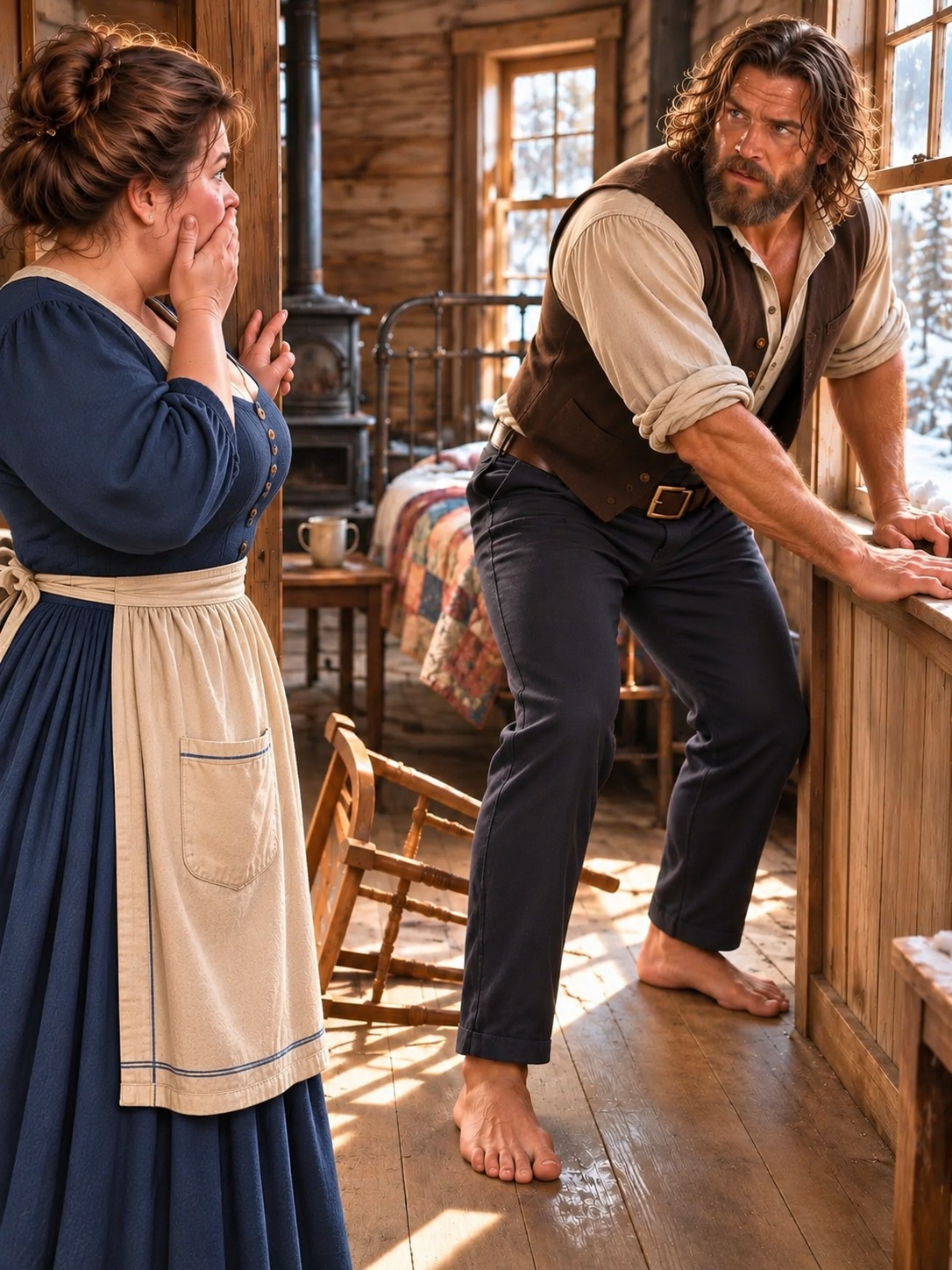
Martha was in the kitchen kneading bread when she heard a tremendous crash.
The sound came from Caleb's bedroom.
Her heart stopped.
"Caleb!"
She dropped the dough.
Flour scattered across the table.
She hurried down the hallway.
"Caleb!"
There was no answer.
She pushed open the bedroom door.
The iron cot was empty.
A chair lay overturned beside the window.
One of the blankets had fallen to the floor.
Martha froze.
For one terrible second, she thought he had fallen.
Then she heard his voice.
"Martha."
She turned.
Caleb Rowan stood beside the frosted window.
Standing.
Without holding the bed.
Without leaning against the wall.
His enormous body trembled with effort.
One hand rested lightly against the window frame.
But his feet were planted firmly on the floor.
Martha covered her mouth.
"Caleb?"
He looked at her.
His pale blue eyes shone.
A smile spread slowly across his face.
"Martha," he whispered, "I think you ought to come see this."
She stared.
Then she hurried toward him.
"You're standing!"
He laughed.
A deep, astonished laugh.
"Seems I am."
Tears filled her eyes.
"Oh, Caleb."
She reached him just as his knees began to shake.
He caught her shoulders.
She wrapped her arms around his waist.
Together, they steadied him.
For a moment, neither moved.
Then Caleb looked down at her.
"I wanted to surprise you."
Martha laughed through her tears.
"You nearly frightened me to death!"
"Sorry."
"No, you're not."
He smiled.
"Not entirely."
She looked at his legs.
"How long?"
"About a minute."
"A minute?"
"Maybe two."
Martha shook her head in wonder.
Four months earlier, Amos had dumped him into her yard like unwanted cargo.
He had been filthy.
Injured.
Angry.
Unable to stand.
Now he was upright beside the window.
Not cured.
Not suddenly free from pain.
But standing.
On his own feet.
Martha began crying openly.
Caleb's expression softened.
"Hey."
She shook her head.
"I can't help it."
He smiled.
"Then don't."
She pressed her face against his chest.
He held her carefully.
For a long moment, they stood together.
Then his knees weakened.
Martha helped him sit on the chair.
He exhaled heavily.
"Well," he said, "that was enough excitement for one morning."
She laughed.
Then knelt beside him.
"Are you hurting?"
"A little."
"Too much?"
"No."
She looked at him sternly.
"Caleb."
He smiled.
"All right. Quite a bit."
Martha shook her head.
"You're impossible."
"That's what the doctor said."
She laughed again.
Then she looked toward the window.
Beyond the frost lay the farm.
The repaired porch.
The barn.
The orchard.
The fields waiting beneath snow.
And a new morning.
Caleb followed her gaze.
"You know what I was looking at?"
"What?"
"The road."
Martha frowned.
"The road?"
He nodded.
"The one Amos brought me down."
She looked toward the distant gate.
Caleb continued.
"I used to hate that road."
Martha turned toward him.
"Why?"
"Because I thought it was the last road I'd ever travel."
Her eyes filled again.
He looked at her.
"But it brought me here."
Martha swallowed.
"To a broken farmhouse and a woman who barely had enough food for herself."
Caleb shook his head.
"To the first place I'd felt wanted in years."
She looked away.
He gently touched her hand.
"Martha."
She turned.
His expression was serious.
"I need to tell you something."
Her heart began pounding.
He continued.
"When Amos dumped me in your yard, I thought my life was over."
She squeezed his hand.
"I know."
"But every morning you brought me breakfast. Every night you checked the fire. Every time I fell, you helped me try again."
His voice softened.
"You never made me feel like I was a burden."
Martha felt tears gathering.
Caleb swallowed.
"I don't know what the future looks like. I may never walk the way I used to."
She shook her head.
"That doesn't matter."
He looked at her.
"It matters some."
She smiled faintly.
"All right. Some."
He laughed softly.
Then his expression grew serious again.
"But I know what I want."
Martha felt her heart beating faster.
"What?"
He took both her hands.
"I want to stay."
She stared.
"Here?"
He nodded.
"With you."
For a moment, she could not speak.
Caleb continued.
"Not because I need a place to sleep."
Martha looked at him.
"Then why?"
His eyes filled with emotion.
"Because I love you."
The words were simple.
Quiet.
Without drama.
And they changed everything.
Martha felt tears slide down her cheeks.
For years, she had believed love belonged to the life she had lost.
She had believed her size made her undesirable.
She had believed she was too old to begin again.
She had believed the best she could hope for was a quiet life without cruelty.
Now Caleb sat before her.
A man who had seen her anger.
Her grief.
Her stubbornness.
Her fear.
A man who knew how hard she worked.
How loudly she laughed.
How often she worried.
And he loved her.
Not despite who she was.
Because of who she was.
Martha smiled through her tears.
"I love you too."
Caleb closed his eyes.
For a moment, he looked overwhelmed.
Then he opened them.
"Good."
She laughed.
"Good?"
He smiled.
"I was getting worried."
Martha leaned forward.
And kissed him.
It was gentle.
Unhurried.
A kiss that carried months of friendship, fear, loyalty, and hope.
When they separated, Caleb rested his forehead against hers.
"Well," he whispered, "that's better than standing."
Martha laughed so hard she nearly fell from the chair.
By spring, the farm had changed.
The porch was rebuilt.
The orchard had been pruned.
The fields were ready for planting.
Colum Rowan stayed in a small cabin near the creek.
He helped repair fences and spent his evenings telling stories about the mountains.
Thomas Miller visited often, bringing fresh bread from his mother's kitchen.
Nathaniel Pike returned to honest surveying work.
And Daniel Mercer stopped by whenever his duties brought him through the valley.
Caleb continued his recovery.
Some days were difficult.
Some mornings his legs ached so badly that he could barely move.
There were falls.
Frustrations.
Long hours of practice.
But there were also victories.
A step beside the bed.
Three steps across the bedroom.
A slow walk to the kitchen.
And one bright April morning, with Martha beside him, a careful journey onto the rebuilt porch.
He stood there looking across the fields.
Then turned toward her.
"Think I can make it to the gate?"
Martha smiled.
"Not today."
He sighed.
"You're no fun."
She took his hand.
"Tomorrow, maybe."
He smiled.
"I'll hold you to that."
And he did.
By summer, Caleb could walk short distances with a sturdy cane.
He still needed rest.
He still had pain.
But he was no longer confined to the iron cot.
One warm evening, he asked Martha to walk with him to the orchard.
She took his arm.
They moved slowly beneath the apple trees.
The sun was setting.
The air smelled of grass and warm earth.
At the oldest tree, Caleb stopped.
Martha looked at him.
"Need a rest?"
He shook his head.
"Actually, I need to ask you something."
She smiled.
"What?"
He reached into his pocket.
Then removed a small silver ring.
Martha stared.
Caleb looked suddenly nervous.
More nervous than he had been facing armed men.
More nervous than he had been trying to stand.
"Martha Higgins," he said, "you took in a stranger when nobody else wanted him."
Her eyes filled.
"You gave me a home."
He swallowed.
"You gave me a reason to fight."
Martha covered her mouth.
Caleb continued.
"And somewhere along the way, you became the person I want beside me for whatever years I have left."
He held out the ring.
"Will you marry me?"
Martha began crying.
Then laughing.
Then crying again.
Caleb smiled nervously.
"That's not exactly an answer."
She threw her arms around him.
"Yes!"
He laughed.
"Yes?"
"Yes, you foolish man!"
He held her tightly.
And beneath the apple tree, they kissed.
They married in September.
Not in a grand church.
Not before a crowd of important people.
But in the farmhouse yard, beneath a sky so blue it seemed impossible that winter had ever existed.
Colum stood beside his brother.
Daniel Mercer attended in his best coat.
Nathaniel Pike brought flowers.
Anna and Thomas Miller carried baskets of food.
Neighbors filled the tables with bread, pies, roasted chicken, and fresh vegetables.
Martha wore a simple cream-colored dress.
She had sewn it herself.
For the first time in years, she did not worry whether people thought she was too large to look beautiful.
She knew she was beautiful.
Caleb told her so before the ceremony even began.
When she stepped onto the porch, he stared.
Then whispered, "Good Lord, Martha."
She laughed.
"What?"
He shook his head.
"I don't deserve this."
She took his hand.
"Then you'd better spend the rest of your life trying."
He grinned.
"Gladly."
They stood beneath the apple trees.
The minister spoke about love.
About patience.
About keeping promises.
But Martha barely heard him.
She was looking at Caleb.
At the man who had arrived broken.
At the man she had helped stand.
At the man who had helped her stand in ways nobody could see.
When the minister asked whether she would take Caleb Rowan as her husband, Martha answered clearly.
"I will."
And when he asked Caleb, the giant mountain man smiled.
"I've been trying to get to this moment since last winter."
Everyone laughed.
Then he said, "I will."
They exchanged rings.
They kissed.
And the yard erupted in applause.
That evening, after the guests had gone, Martha and Caleb sat together on the porch.
The stars were bright.
The fields lay quiet.
A warm breeze moved through the orchard.
Caleb rested his cane beside the chair.
Martha leaned against his shoulder.
For a while, neither spoke.
Then Caleb looked toward the road.
The same road Amos had traveled with the wagon.
The same road Martha had watched through tears.
The same road that had brought suffering to her door.
He smiled faintly.
"Funny thing."
Martha looked up.
"What?"
"I used to think that road brought me to the end of my life."
She took his hand.
"And now?"
He looked at her.
"Now I think it brought me to the beginning."
Martha smiled.
Then she rested her head against his shoulder.
Inside the farmhouse, the kitchen stove glowed warmly.
The repaired windows reflected the stars.
The old iron cot remained in the spare bedroom, no longer a symbol of helplessness but a reminder of how far they had come.
Beyond the porch, the fields belonged to Martha.
Not to Amos.
Not to Voss.
Not to any man who believed her weakness could be measured by her weight, her widowhood, or her willingness to be kind.
The farm was hers.
Her future was hers.
And the love beside her had been freely chosen.
Caleb kissed the top of her head.
"Happy, Mrs. Rowan?"
Martha looked up at him.
Then smiled.
"Very."
He grinned.
"Good."
She laughed softly.
Then took his hand and placed it against her heart.
For the first time in many years, Martha did not dread the coming winter.
She had a warm home.
A man who loved her.
A family made not only by blood, but by loyalty and kindness.
And a life that no longer belonged to the people who had tried to destroy it.
The town had once delivered a helpless giant to her doorstep because they believed a lonely, three-hundred-pound widow deserved nothing better.
They had expected two unwanted people to disappear quietly.
Instead, those two people had saved each other.
And together, they had built a home where neither would ever be unwanted again.






Comments 0