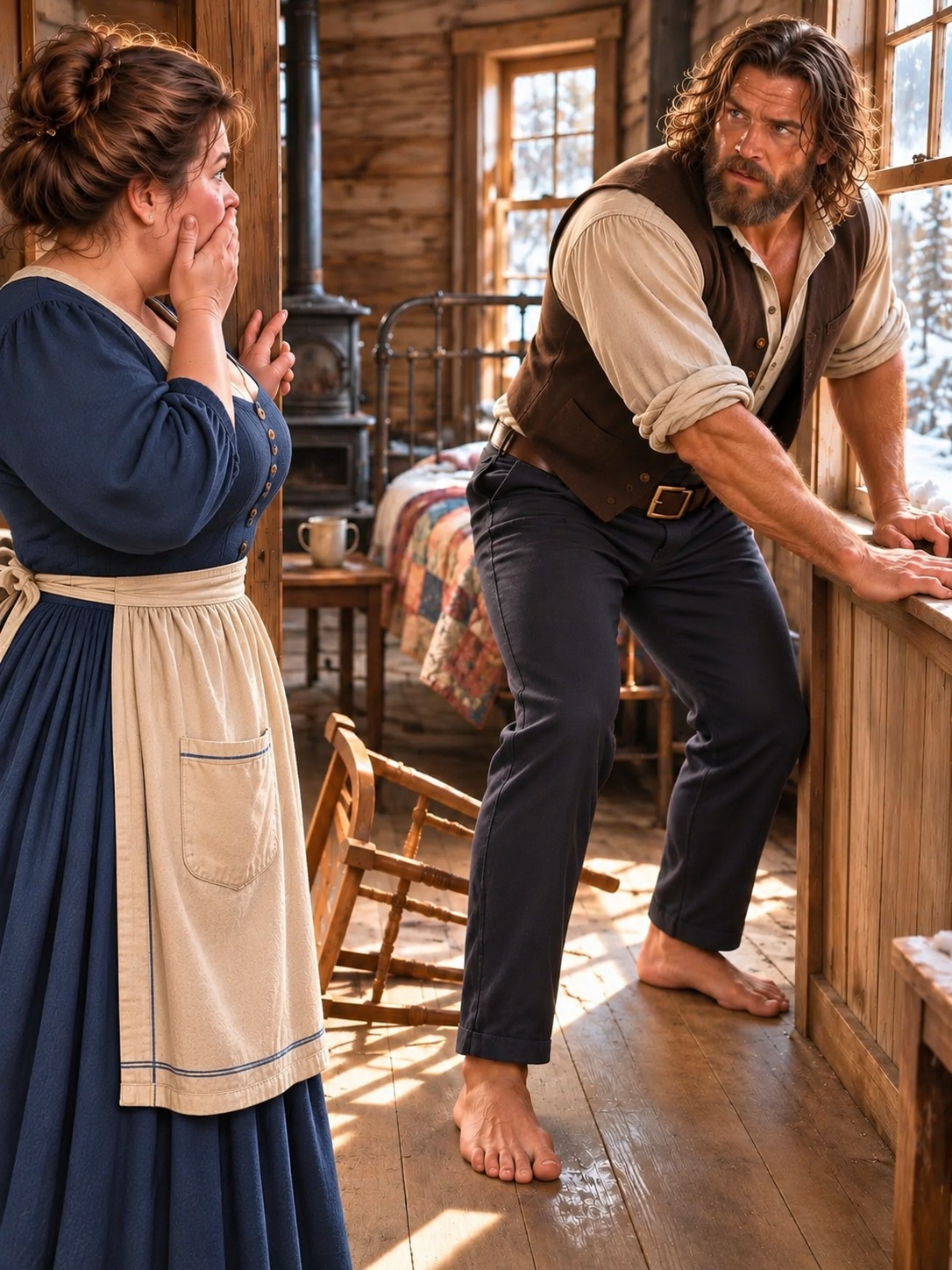
Martha extinguished the parlor lamp.
The farmhouse fell into darkness.
Outside, the lantern remained motionless beside Colum's window.
She listened.
The wind moved through the dry grass.
A loose shutter tapped against the wall.
Then came the unmistakable sound of a boot scraping against the foundation.
Someone was trying to look inside.
Martha crossed the room without lighting another lamp.
She took Samuel's old shotgun from its place above the fireplace.
It had not been fired in years.
She did not intend to fire it now.
But she knew that a woman alone on an isolated farm could not afford to look defenseless.
She approached Colum's room.
He was awake.
His head turned before she spoke.
"Someone's outside," she whispered.
"I know."
Martha stopped.
"You heard?"
"Been there a while."
She looked toward the window.
The lantern's glow moved across the frostless August glass.
Colum's hands were planted against the mattress.
His body was tense.
"Stay here," Martha whispered.
He gave her a look of disbelief.
"Where exactly did you think I was going?"
She almost smiled.
Almost.
Then she moved toward the kitchen door.
Outside, the night air was heavy and damp.
Martha stepped onto the porch.
"Who's there?"
The lantern disappeared.
Silence.
She waited.
"I know you're out there."
A branch cracked near the barn.
Martha turned.
A figure moved between the fence posts.
She raised the shotgun.
"Stop!"
The figure ran.
Martha hurried down the porch steps.
But the stranger had already reached the road.
She heard a horse snort.
Then hoofbeats.
A rider disappeared into the darkness.
Martha stood motionless.
Her heart pounded.
She had not seen the person's face.
But she had seen something else.
The horse was dark.
And its saddle carried a pale blanket folded behind the seat.
Amos owned a horse like that.
She returned to the house.
Colum watched her enter.
"Who was it?"
"Didn't see."
"Amos?"
"Maybe."
He looked toward the window.
"Then he knows."
"Knows what?"
"That I'm not as helpless as he thinks."
Martha sat beside him.
"How could he know?"
Colum looked down at his hands.
"I've been making noise."
She remembered the thumps.
The bruises.
The scrape marks.
The cloth tied beneath the bed.
"Trying to stand?"
He nodded.
Martha stared.
"Colum, you could hurt yourself."
"Already hurt."
"You could make it worse."
"Could."
"Then why?"
His expression hardened.
"Because every morning I wake up and hear that doctor telling me my life is over."
Martha said nothing.
Colum looked toward the window.
"And every morning I decide he doesn't get the last word."
She studied him.
For the first time, she understood the full force of his determination.
He was not simply trying to move his legs.
He was fighting against the future other people had chosen for him.
Martha reached for the blanket.
"Show me."
He looked at her.
"What?"
"What you've been doing."
He hesitated.
Then he planted both hands against the bedframe.
Slowly, he pushed his shoulders upward.
His arms trembled.
His body rose several inches.
Martha watched.
He shifted his weight.
Then lowered himself.
His breathing was heavy.
"Again?" she asked.
He shook his head.
"Not tonight."
She nodded.
"Then tomorrow."
Colum looked surprised.
"You're not going to tell me to stop?"
"I'm going to tell you to be careful."
He studied her face.
"That's different."
"Yes."
Martha stood.
"And if you're going to break my furniture, at least warn me first."
For the first time, Colum laughed.
It was brief.
Rough.
Almost unwilling.
But it filled the small room.
Martha carried that sound with her as she returned to the kitchen.
The following morning, she found fresh hoofprints near the barn.
She knelt to examine them.
The ground was soft from the previous evening's rain.
One print was unusually deep along the outer edge.
She remembered Amos's horse had a damaged shoe.
She followed the tracks toward the road.
Then she noticed another set.
Bootprints.
They led directly to Colum's window.
Martha stood slowly.
Whoever had come during the night had not been wandering.
They had been watching.
She returned to the house and locked the back door.
Then she made a decision.
She would not tell Amos anything.
She would not sign the council's paper.
And she would not allow Dr. Whitcomb to examine Colum again without another physician present.
But finding another doctor would require money.
Money she did not have.
For the next several weeks, Martha worked harder than she had in years.
She sold eggs.
She repaired clothing for neighbors.
She gathered late vegetables.
She preserved what she could.
Colum helped from his bed.
He sharpened tools.
Repaired broken handles.
Taught her how to set fishing lines.
And showed her how to reinforce the barn door with scraps of timber.
Their arguments continued.
So did their laughter.
But beneath the ordinary work, a quiet agreement had formed.
Neither would surrender.
One afternoon, Martha returned from town carrying flour and a small parcel of medicine.
She found Colum sitting on the floor beside his bed.
Her heart stopped.
"Colum!"
He looked up.
"Don't start."
"What happened?"
"Slipped."
"Are you hurt?"
"No."
She hurried toward him.
He raised one hand.
"Wait."
Martha stopped.
Colum planted both palms against the bedframe.
His shoulders tightened.
Slowly, painfully, he lifted his upper body.
Then he dragged himself closer to the mattress.
Martha watched every movement.
He was exhausted.
But he refused her help until he reached the edge.
Only then did he look at her.
"Now."
She supported his shoulder.
Together, they got him back onto the cot.
He collapsed against the pillow.
Sweat covered his face.
Martha stood beside him, breathing hard.
"You frightened me."
Colum closed his eyes.
"Didn't mean to."
She looked at his legs.
"Did you feel anything?"
He was silent.
Then he nodded.
"A little."
"Where?"
"Left knee."
Martha stared.
"Colum..."
He opened his eyes.
"Don't say it."
"Say what?"
"That I'm getting better."
She sat down.
"Why not?"
"Because if I believe it, and it turns out not to be true..."
His voice faded.
Martha understood.
Hope could be dangerous.
Especially when a person had been taught to expect disappointment.
She placed a hand on his shoulder.
"Then we won't make promises."
He looked at her.
"We'll just keep trying."
For a long moment, he said nothing.
Then he nodded.
Outside, the first leaves were beginning to turn.
Autumn was approaching.
And with it came a new problem.
The farm's taxes were due.
Martha had expected to pay them with the sale of her remaining livestock.
But when she visited the county office, the clerk told her something impossible.
Her tax account had been placed under review.
"Under review?" she repeated.
The clerk avoided her eyes.
"There's a question concerning ownership."
"Ownership?"
"Yes, ma'am."
"I own that farm."
"According to the petition filed last week, your brother-in-law disputes that."
Martha stared.
"Amos?"
The clerk nodded.
"He claims your late husband promised him a controlling interest."
"That's a lie."
"I'm only telling you what's written."
Martha gripped the counter.
"Who signed the petition?"
The clerk hesitated.
Then he turned the document toward her.
At the bottom were two signatures.
Amos Higgins.
And Dr. Elias Whitcomb.
Martha felt the room grow cold.
She read the document again.
Then she noticed a third name listed as a witness.
It belonged to a man she had believed dead for eleven years.
She looked up at the clerk.
"Where did you get this?"
He swallowed.
"Mrs. Higgins, I think you'd better speak to the sheriff."
"Why?"
The clerk lowered his voice.
"Because the man named on that paper came into town yesterday."
Martha stared at him.
Then the clerk pointed toward the courthouse window.
Across the street, a tall stranger stood beside Amos Higgins.
And in his hands, he carried Samuel's missing ledger pages.






Comments 0