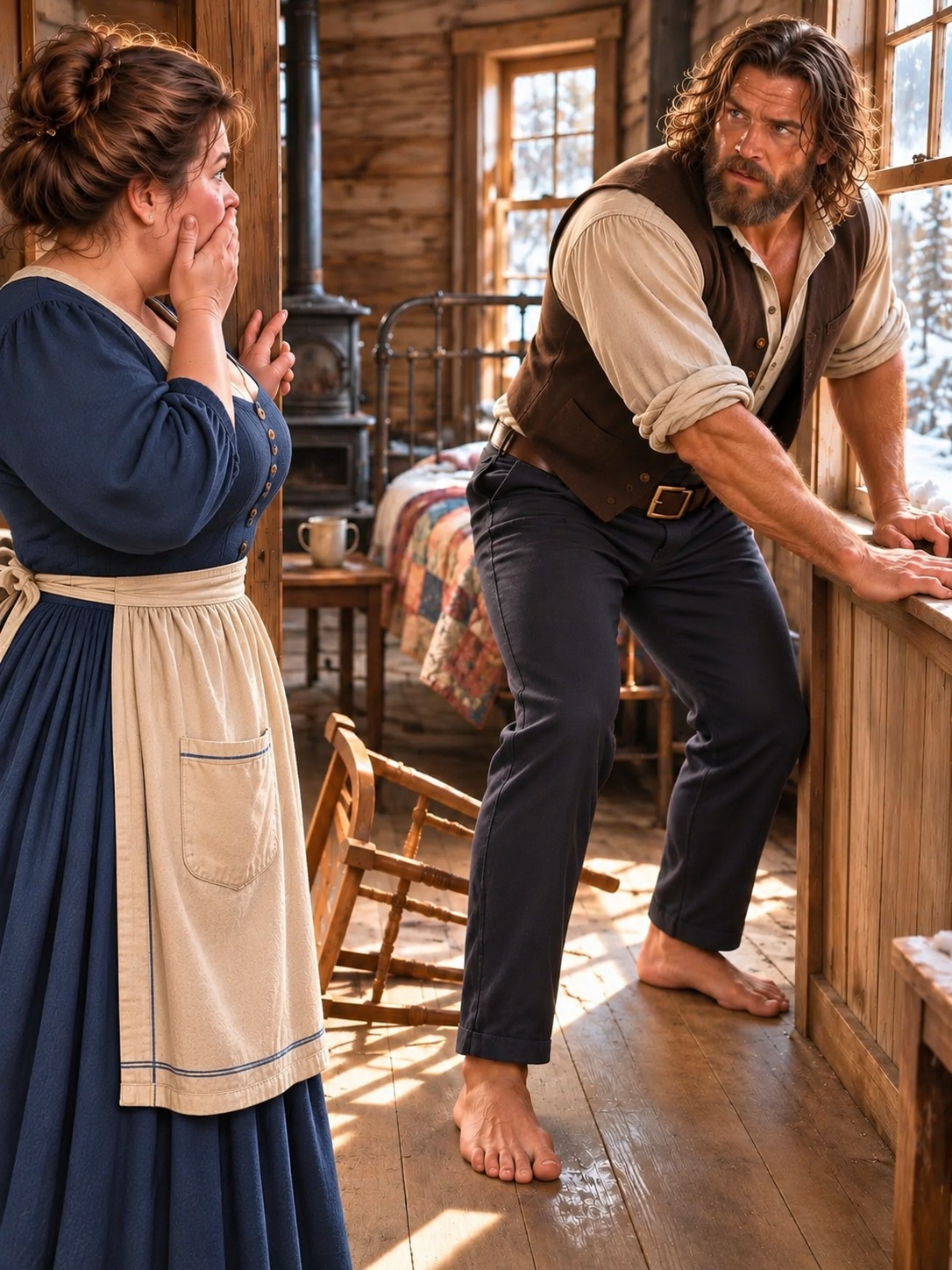
Martha stood beside the iron cot, the paper trembling between her fingers.
Colum watched her with an expression she could not read.
"Give it back," he said.
His voice was low.
Not threatening.
Almost pleading.
Martha looked at the signature again.
The name was familiar.
Too familiar.
Dr. Elias Whitcomb.
The same physician who had treated her husband during the final winter of his life.
The same man who had signed Samuel Higgins's death certificate.
And now his name appeared on a payment receipt connected to the injured stranger Amos had dumped in her yard.
Martha slowly lowered the paper.
"Why would Doctor Whitcomb be paying my brother-in-law?"
Colum's eyes narrowed.
"I don't know."
"Then why do you have this?"
"I took it."
"From whom?"
He hesitated.
"One of the men who brought me down from the mountain."
Martha pulled the chair closer.
"Tell me everything."
Colum looked toward the window.
For a long time, he said nothing.
Then he began.
He had lived alone in the northern mountains for almost twelve years.
He trapped game, repaired cabins for logging crews, and occasionally guided travelers through the high passes.
He had never been a sociable man.
But he had never needed much company.
The mountains had given him everything he required.
Food.
Shelter.
Work.
Silence.
Then, six weeks earlier, a bear had attacked him near a narrow ravine.
He remembered the animal charging from the brush.
He remembered raising his rifle.
He remembered the impact.
And he remembered falling backward against a shelf of stone.
After that, his memories came in pieces.
Pain.
Rain.
Men shouting.
A wagon.
A doctor pressing something sharp against his feet.
Then a voice saying that the damage was permanent.
"Whitcomb?" Martha asked.
Colum nodded.
"He was there."
"Did he examine you?"
"Some."
"What does that mean?"
Colum's jaw tightened.
"He asked whether I could move my legs. I said no. He pressed on my feet. Asked if I felt it."
"And?"
"Not much."
Martha waited.
"He told the others my spine was broken."
"Was it?"
"I don't know."
The answer disturbed her.
"Didn't anyone take you to a hospital?"
Colum gave a bitter laugh.
"With whose money?"
Martha looked down.
Of course.
In Briar Glen, medical care was not simply a matter of illness.
It was a matter of whether a person could pay.
Colum continued.
"They kept me in a shed behind the doctor's place for a while. Then two men came with a wagon."
"Amos?"
"Didn't see him then."
"Who were the men?"
"One worked at the sawmill. Other fellow I didn't know."
He looked at the paper.
"They were drinking. One dropped that pouch. I heard them talking about payment."
"What payment?"
Colum's expression darkened.
"For getting rid of me."
Martha felt a chill.
She had assumed the town council simply wanted to avoid the cost of caring for a disabled man.
That was cruel enough.
But a private payment suggested something else.
"Did they say why?"
Colum shook his head.
"Only that the matter would be finished once I was gone."
Martha read the receipt again.
There was no amount written beside the word payment.
Only a mark indicating that the transaction had been completed.
"Why didn't you tell me?"
"Because I didn't know you."
"You know me now."
"Known you half a day."
"Long enough to know I didn't throw you out of a wagon."
His expression softened slightly.
Martha folded the paper.
"I'll keep this safe."
Colum reached toward her.
"No."
She stopped.
"Why?"
"Because whoever paid those men might come looking for it."
Martha considered that.
Then she returned the paper to the leather pouch.
She placed it beneath his pillow.
"All right."
He watched her.
"You're not frightened?"
"Of a piece of paper?"
"Of what it means."
Martha looked toward the darkened window.
She thought of Amos.
Of the farm.
Of Samuel's final illness.
Of Dr. Whitcomb standing beside her husband's bed and telling her there was nothing more to be done.
Then she looked back at Colum.
"I'm frightened of plenty of things," she said. "But I learned a long time ago that being frightened doesn't mean I have to run."
Colum said nothing.
Martha adjusted his blanket.
"Get some sleep."
She extinguished the lamp.
But long after she returned to her own room, sleep refused to come.
The following morning, she began caring for Colum in earnest.
His wounds needed cleaning.
The splints needed checking.
And his temper, Martha soon discovered, required more patience than both tasks combined.
When she washed the scrape along his shoulder, he snapped at her.
"You're scrubbing too hard."
"Then grow yourself another pair of legs and do it yourself."
He stared.
She continued working.
"That hurt," he muttered.
"Then say it hurts. Don't bark at me like I'm a hired mule."
For a moment, he looked offended.
Then he fell silent.
By the third day, Martha had learned several things about her unexpected guest.
He disliked being helped.
He hated being watched while he struggled.
He preferred his coffee strong.
He could repair nearly anything made of wood, provided someone brought it within reach.
And he became furious whenever anyone referred to him as helpless.
Martha understood that last part better than he knew.
She also discovered that he was observant.
From his bed, Colum noticed the loose hinge on the bedroom door.
He noticed the draft coming through the window.
He noticed that the farmhouse roof leaked above the parlor.
And he noticed that Martha ate less than she served him.
On the third evening, he pushed his bowl away.
"You're not eating enough."
Martha looked up from her sewing.
"I'm eating."
"Half a potato isn't supper."
"Mind your own plate."
"There's enough in mine for two."
"Then eat it."
He studied her.
"You're running out of food."
Martha's needle stopped.
"That's my concern."
"I'm here now."
"Yes, you are."
"Then it's mine too."
She looked at him.
The words were simple.
But no one had spoken to her that way since Samuel died.
For three years, every problem on the farm had belonged to Martha alone.
The roof.
The debts.
The crops.
The animals.
The winter firewood.
Now a man who could not stand was telling her that her burdens were partly his.
She lowered her eyes.
"There's still flour in the pantry."
"How much?"
"Enough."
"Martha."
She looked up.
He was not angry.
He was waiting.
She sighed.
"About ten pounds."
"Salt pork?"
"A little."
"Beans?"
"Some."
"Potatoes?"
"Not many."
He nodded thoughtfully.
"Then tomorrow, bring me the old fishing line from my coat."
She frowned.
"Why?"
"Because there's a creek behind your pasture."
"How do you know?"
"Heard it."
"You can hear the creek from here?"
"At night."
Martha studied him.
The man seemed to notice things the rest of the world ignored.
"That creek hasn't given me a decent fish in two years."
"Maybe you've been asking it wrong."
She almost smiled.
Almost.
The next morning, she brought him the line.
He spent hours repairing the hooks, replacing knots, and explaining where she should cast.
Martha listened skeptically.
Then she went to the creek.
She returned with three trout.
Colum looked unbearably pleased with himself.
"Well?" he asked.
Martha placed the fish on the table.
"Don't get proud. Could've been luck."
"Three times?"
"Creek might've felt sorry for me."
He gave a short sound.
It was not quite a laugh.
But it was close.
That evening, they ate better than either had expected.
For the first time, the farmhouse felt less empty.
Then, on the fourth night, the storm arrived.
Thunder rolled over the fields.
Rain battered the windows.
Wind pushed against the walls.
Martha had just finished banking the kitchen fire when she heard something break.
CRASH!
She hurried into Colum's room.
A ceramic cup lay shattered beside the bed.
Water spread across the floorboards.
Colum sat rigidly against his pillows.
His face was dark with frustration.
"Trying to do something yourself?" Martha asked.
He looked away.
"Was thirsty."
"You could've called."
"Didn't want to."
She fetched a cloth.
As she knelt to clean the floor, she noticed that the cup had fallen farther from the bed than she expected.
She looked at his hands.
They were resting on either side of his hips.
"How'd you reach it?"
Colum frowned.
"What?"
"The cup."
"With my hand."
"From where?"
He pointed toward the bedside table.
Martha examined the distance.
It was just beyond his normal reach.
Unless he had leaned forward.
Or lifted himself.
She looked back at him.
He was watching her carefully.
"Never mind," she said.
She cleaned the broken pieces.
Then she brought him another cup.
"Spill this one," she warned, "and you're licking it off the boards."
Colum's mouth twitched.
For one brief moment, the mountain man almost smiled.
Martha saw it.
She said nothing.
Outside, thunder shook the house.
Inside, something small had begun to change.
Over the following days, Colum started asking questions.
How far was the barn?
How high was the porch?
How much weight could the bedroom window frame hold?
Martha answered most of them.
The last question made her pause.
"Why do you want to know?"
Colum shrugged.
"Just wondering."
She narrowed her eyes.
"You're a terrible liar."
"Didn't say I was lying."
"No. You just made it obvious."
He looked away.
Martha let the matter rest.
She had learned that some kinds of pride could not be forced open.
They had to be given room.
But she was not foolish.
She began noticing things.
His blanket was often twisted in the morning.
His arms seemed more tired than they should have been.
Once, she found a dark bruise along his elbow.
Another time, she heard a heavy thump after midnight.
When she asked about it, Colum blamed the old floorboards.
Martha looked at the floor.
Then at him.
"Funny," she said. "Those boards never made that sound before you arrived."
Colum said nothing.
She left him alone.
But that evening, while gathering his laundry, Martha discovered a narrow strip of cloth tied beneath the bedframe.
It was knotted into a loop.
The cloth had been stretched so tightly that several threads had snapped.
She touched it.
Then she looked toward the window.
Colum was asleep.
Or pretending to be.
Martha slowly released the cloth.
Her heart began beating faster.
She understood what he had been doing.
At least, she thought she did.
Then she noticed something else.
A fresh mark on the floorboards.
A deep scrape.
It ran from the side of the bed toward the window.
Martha followed it with her eyes.
At the far end, beside the wall, lay a small piece of broken wood.
She picked it up.
It had come from the bottom of the window frame.
And pressed into its surface was the unmistakable shape of a man's fingers.
Martha looked back at Colum.
His eyes were open.
He was watching her.
Neither spoke.
Then he whispered something that made her stop breathing.
"Martha, I need you to promise me one thing."
She waited.
"If I ever get back on my feet, don't tell Amos."
Before she could ask why, three hard knocks sounded at the front door.
And a familiar voice called from the porch.
"Martha Higgins! Open up. Doctor Whitcomb's here to examine your guest."






Comments 0