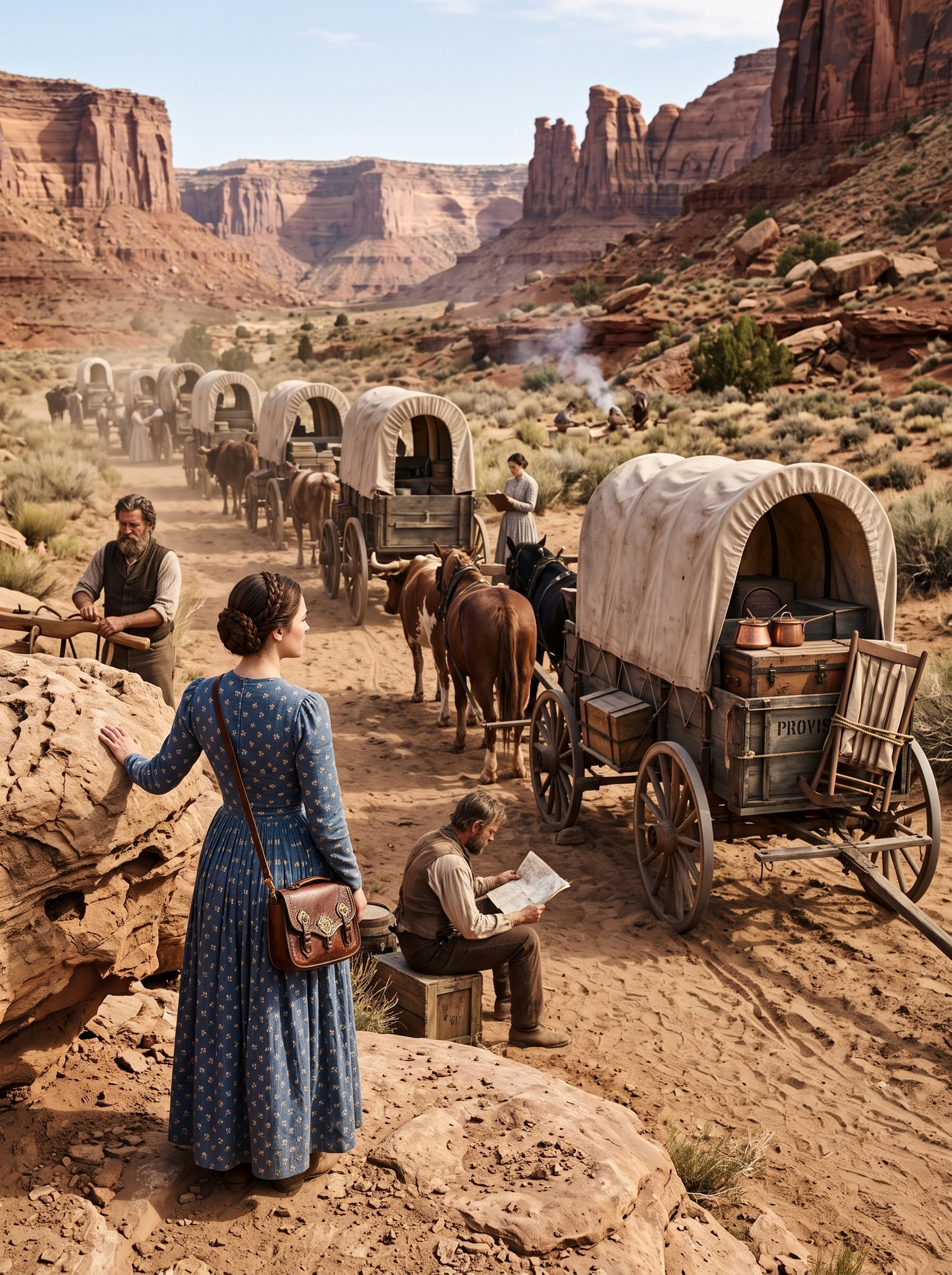
"Put the knife down, Margaret."
The voice came from beyond the creek bed.
Margaret tightened her grip instead.
The stranger beside her, the man called Rusk, raised one hand slowly.
"Don't do anything foolish," he whispered.
Margaret looked at him.
"You lied to me."
"I know."
"You said my father sent you."
"I needed you to come out."
"And now someone has a rifle pointed at us."
Rusk's jaw tightened.
"That's why you need to listen."
Across the creek bed, the unseen man shifted his weight.
Gravel crunched beneath his boots.
"Rusk," he called. "I won't ask again."
Margaret could barely make out the figure against the dark rocks.
The man stood twenty yards away.
His rifle was pointed toward them.
She had never been threatened with a gun before.
She had seen rifles all her life. Her brothers used them to hunt rabbits, and her father kept one above the kitchen door.
But a rifle in someone's hands was different when its barrel was aimed at her chest.
"Who are you?" she called.
The man laughed.
"That doesn't concern you."
"Then why do you know my name?"
"Because your grandfather made a very expensive mistake."
Rusk moved slightly in front of Margaret.
"She doesn't know anything, Calder."
The name hung in the darkness.
Calder.
Margaret filed it away.
The man with the rifle took another step forward.
"Then she won't mind handing over the notebook."
Margaret felt the weight of Elias's satchel against her hip.
Rusk had told her not to let them see it.
Now she understood why.
"There's no notebook," she said.
Calder laughed again.
"Your father spent six years pretending that old man left nothing behind. You expect me to believe his granddaughter walked out of that house carrying nothing but spare clothes?"
Margaret's stomach tightened.
He knew about the farm.
He knew about Thomas.
And he knew about Elias.
"Who sent you?" she asked.
Calder ignored her.
"Put the bag on the ground."
Margaret looked toward the narrow path leading out of the creek bed.
Too far.
Even if she ran, the man could fire before she reached the rocks.
Rusk leaned closer.
"Do exactly what I say."
Margaret kept her eyes on Calder.
"You haven't given me a reason to trust you."
"Fair enough."
Rusk lowered his voice.
"But I'm the only man standing here who doesn't want you dead."
Before Margaret could answer, Calder raised the rifle.
"Bag. Ground. Now."
Margaret slowly bent her knees.
She placed the satchel beside her boots.
The movement made her heart pound so hard that she could hear it.
Calder stepped closer.
"That's better."
Rusk remained motionless.
Margaret noticed his right hand hanging beside his coat.
Two fingers moved.
Once.
Then again.
He was pointing toward the dry creek bed.
She followed the gesture with her eyes.
A narrow channel cut through the sand behind a cluster of rocks.
It was barely deep enough for a person to crawl through.
Rusk wanted her to run.
But he had not explained what would happen to him.
Calder approached the edge of the campsite.
"Step away from the bag."
Margaret rose.
She took one small step backward.
Then another.
Calder lowered the rifle slightly.
Rusk moved.
It happened so quickly that Margaret barely understood what she saw.
He kicked the remains of her campfire toward Calder.
Ash and glowing embers scattered across the sand.
Calder shouted.
His rifle fired.
The explosion shattered the silence.
Margaret dropped instinctively.
A bullet struck the rock behind her.
Stone fragments sprayed across her shoulder.
"Run!" Rusk shouted.
She grabbed the satchel and threw herself into the dry channel.
Another shot rang out.
Margaret scrambled forward on her hands and knees.
Sand filled her sleeves.
Her skirt caught on a sharp stone.
She pulled it free.
Behind her, men shouted.
She heard the sound of a struggle.
Then a heavy impact.
Someone cried out.
Margaret kept crawling.
She reached a bend in the channel and rose into a crouch.
The darkness was nearly complete.
She could not see the campsite anymore.
She could only hear her own breathing.
Then Rusk shouted from somewhere behind her.
"Keep going, girl!"
A third shot cracked through the night.
Margaret ran.
She did not stop until her lungs burned.
The creek bed twisted between low sandstone ridges, forcing her to climb over loose rocks and squeeze through narrow passages.
Twice, she stumbled.
Once, she fell hard enough to scrape both palms.
But she kept moving.
The satchel struck her hip with every step.
Inside it were her grandfather's maps.
The notebook.
The compass.
The twenty dollars her father had given her.
Everything she owned.
Everything those men wanted.
Margaret finally stopped beneath a rocky overhang.
She pressed herself against the stone and listened.
No footsteps.
No voices.
No gunshots.
Only wind.
She waited.
A minute passed.
Then another.
She counted slowly to one hundred.
Nothing.
Margaret lowered herself onto the sand.
Her hands were shaking.
She tried to steady them.
It did not work.
She had imagined danger when she planned the journey.
Thirst.
Heat.
Snakes.
A broken ankle.
Getting lost.
She had never imagined men waiting in the darkness with rifles.
And she had certainly never imagined that the name hidden beneath her grandfather's ink would belong to a living man.
Rusk.
The stranger who had tried to frighten her.
The stranger who had just saved her life.
Margaret looked toward the distant ridge.
Had he survived?
She did not know.
She wanted to believe he had escaped.
But the last sound she remembered was a gunshot.
She pressed her palms against her knees.
"Think," she whispered.
Her grandfather had taught her that panic wasted strength.
When you're frightened, Maggie, give your mind a job.
She opened the satchel.
First, she checked the water flasks.
Both remained intact.
Then the food.
Most of it was undamaged.
Her knife was still in her hand.
She had not realized she was holding it.
She carefully returned it to its sheath.
Then she took out the notebook.
The pages had bent during her escape, but none had torn.
She turned to the final page.
The crossed-out name seemed almost to stare back at her.
Rusk.
She was certain now.
Elias had written that name.
Someone had tried to hide it.
And the man himself had appeared on the first night of her journey.
That could not be a coincidence.
Margaret examined the entry again.
R. Rusk—statement inconsistent.
The note was surrounded by calculations and route markings.
She remembered Rusk's words.
Your grandfather didn't come back from the Mojave alone.
Perhaps he had been speaking about himself.
Perhaps Rusk had accompanied Elias on his final expedition.
But why would Elias describe his statement as inconsistent?
And why had Calder accused her grandfather of making an expensive mistake?
Margaret closed the notebook.
She needed answers.
But she needed to survive long enough to ask the questions.
Dawn arrived slowly.
Margaret had slept less than an hour.
She woke with a stiff neck and sand inside her boots.
Her right palm had swollen around a shallow cut.
She cleaned it with a small amount of water and wrapped it in a strip of cloth.
Then she climbed the ridge above her hiding place.
The land stretched in every direction.
Low hills.
Dry washes.
Scattered rocks.
No houses.
No smoke.
No sign of the men.
She took out Elias's compass.
The needle settled.
North.
She turned toward the southwest.
Somewhere beyond those distant hills lay the old freight road.
And beyond that, the Mojave.
Margaret considered returning to Red Hollow.
She could tell Walter Finch what had happened.
Perhaps the sheriff would investigate.
Perhaps someone could identify Calder.
But she remembered the rifle.
She remembered how confidently the man had spoken about her father.
And she remembered that Rusk had known exactly where to find her.
If she returned to town, would she be safer?
Or would she simply lead those men back to the people who had helped her?
Margaret looked down at the notebook.
She could not answer those questions.
Not yet.
She slipped the compass into her pocket.
Then she started walking.
By noon, the heat had become punishing.
Margaret followed a shallow wash between two ridges.
The sun reflected off pale stones.
Her mouth dried.
Sweat collected beneath her vest.
She removed it and tied it around her waist.
She drank only a few mouthfuls of water.
Every instinct told her to drink more.
But Elias's notebook contained a warning she remembered clearly.
Never spend tomorrow's water to satisfy today's fear.
She kept walking.
The landscape changed gradually.
The soil became sandier.
Vegetation grew sparse.
The low hills gave way to broader stretches of open ground.
By late afternoon, she reached the remains of an abandoned freight stop.
Only three walls stood.
A roof beam lay broken across the entrance.
Beside the building was a stone trough filled with sand.
Margaret approached cautiously.
The place appeared deserted.
She checked behind the walls.
Nothing.
Then she found a small patch of shade.
She sat down and removed her boots.
The repaired seam had held.
But blisters had formed along both heels.
She cleaned them carefully and wrapped the worst places with cloth.
Then she opened her grandfather's notebook.
A sketch of the freight stop appeared on one page.
Beside it, Elias had written:
Last reliable shelter before the western crossing.
Margaret looked around.
So far, the route matched.
She turned the page.
Another note described a water source two days farther west.
A shallow seep near a stand of desert willows.
She traced the route with her finger.
The willows were marked just before the black ridge.
Beyond them lay the Basin of Whispering Winds.
Margaret felt a small surge of hope.
She was following the right road.
Then she noticed something else.
A date.
Written beneath the drawing of the freight stop.
September 17, 1936.
She frowned.
Elias had been alive then.
It was several years before his final illness.
But the date was followed by a short sentence.
Rusk arrived before sunset. Refused to explain who followed him.
Margaret read the sentence again.
Rusk had been here.
Years ago.
At the same abandoned stop.
She looked toward the empty doorway.
A strange feeling settled over her.
For the first time, she wondered whether the men hunting her were following the same route Elias had taken.
Not because they knew where the wagons were.
But because they believed she did.
Margaret spent the afternoon examining the old freight stop.
She did not expect to find anything useful.
The building had been abandoned for decades.
Most of the roof was gone.
Wind had pushed sand through the doorways.
But Elias had been here.
And Margaret wanted to understand what he had seen.
Behind the building, she found a collapsed storage shed.
Several wooden boards remained beneath the rubble.
One bore faded lettering.
She brushed away the dust.
Only part of the word remained.
FREIGHT.
She smiled faintly.
Then she noticed a narrow metal hook attached to the wall.
It held a small piece of leather.
Margaret pulled it free.
The leather was dry and cracked.
A hole had been punched through one end.
Perhaps it had once been part of a harness.
Perhaps it had belonged to a freight wagon.
She turned it over.
A symbol had been burned into the surface.
A circle.
With a small vertical line through its center.
Margaret froze.
She had seen that mark before.
In Elias's notebook.
She hurried back to the shade and opened the pages.
Near the description of the Silica Queen, her grandfather had drawn several cargo markings.
One matched the symbol on the leather.
Margaret compared them.
The same circle.
The same line.
She looked toward the ruined building.
Had a wagon from the missing train passed through this stop?
Or had someone carried an object from the wreckage here years later?
She could not know.
But the leather was evidence.
Something physical.
Something that connected the old freight stop to the Silica Queen.
She wrapped it carefully and placed it inside her satchel.
Then she heard a horse.
Margaret went still.
The sound came from the road east of the building.
Hooves.
Slow and uneven.
She crouched behind the broken wall.
A rider appeared between the hills.
The horse was dark brown.
Its head hung low.
The man in the saddle leaned forward as though struggling to remain upright.
Margaret watched him approach.
He wore a dark coat.
A hat.
And there was blood on his left sleeve.
Rusk.
The horse stopped beside the stone trough.
Rusk nearly fell while dismounting.
He caught himself against the saddle.
Margaret remained hidden.
She did not know whether to trust him.
He had lied.
He had frightened her.
And he had led armed men directly to her campsite.
But he had also given her a chance to escape.
Rusk took several unsteady steps toward the ruined building.
Then he stopped.
"Margaret?"
She held her breath.
"I know you're here."
She did not answer.
Rusk leaned against the wall.
"Your tracks are all over the road."
Margaret looked down at her boots.
Of course.
The soft ground had preserved every step.
Rusk lowered himself onto a broken stone.
"I'm not going to hurt you."
Margaret stepped from behind the wall.
"That's what you said last night."
Rusk looked up.
His face was pale.
A dark stain spread across his sleeve.
"You made it."
"Apparently."
He gave a weak smile.
"Your grandfather would have liked that answer."
Margaret kept her distance.
"Who are you?"
"Reuben Rusk."
"I know your name."
"Then you know more than I wanted you to."
"Why did Grandfather write it in his notebook?"
Rusk closed his eyes briefly.
"Because I lied to him."
Margaret felt her stomach tighten.
"About what?"
Rusk opened his eyes.
"The route."
She said nothing.
He looked toward the empty road.
"Years ago, your grandfather hired me to guide him through part of the Mojave. I knew the old freight trails. My father had traveled them before the railroads changed everything."
"And?"
"I told Elias the Silica Queen had gone east."
"But it didn't."
Rusk looked at her sharply.
"You found that entry."
"Yes."
He lowered his head.
"Then he figured it out."
Margaret stepped closer.
"Why did you lie?"
Rusk did not answer immediately.
He pressed his injured arm against his chest.
Blood seeped between his fingers.
Margaret looked at the wound.
"You need a bandage."
"I need you to listen."
"You're bleeding."
"I've been bleeding since last night. Another minute won't kill me."
Margaret hesitated.
Then she knelt beside her satchel.
She took out a clean cloth and a flask of water.
Rusk watched silently as she cleaned the wound.
The bullet had grazed his upper arm.
It was painful but did not appear to have struck bone.
She wrapped it firmly.
Rusk winced.
"You're not gentle."
"Neither were you."
He almost smiled.
Margaret tied the cloth.
"Now tell me why you lied."
Rusk looked toward the hills.
"Because someone paid me."
Margaret's hands stopped.
"Who?"
"A man named Arthur Calder."
"The man with the rifle?"
"His son."
Margaret stared at him.
Rusk continued.
"Arthur Calder was a freight contractor. His family had been connected to the old desert routes for generations. He believed the Silica Queen carried something valuable."
"What?"
"I never knew."
"Then why help him?"
Rusk looked ashamed.
"Money."
Margaret sat back.
"How much?"
"Enough to make a poor man forget his principles."
She studied him.
"And Grandfather discovered the truth?"
"Not all of it."
"What did he discover?"
Rusk looked directly at her.
"That the search parties had been sent in the wrong direction."
Margaret felt a chill.
"Deliberately?"
Rusk nodded.
"The old records weren't wrong by accident."
She remembered Elias's note.
Statement inconsistent.
The words suddenly made sense.
Someone had lied about the route.
Someone had wanted the wagons to remain missing.
And decades later, someone still cared enough to threaten her with a rifle.
"Why?" Margaret whispered.
Rusk looked down at his injured arm.
"Because whatever those wagons carried, someone wanted it buried."
Margaret spent the next hour questioning him.
Rusk answered some things.
Others he refused to discuss.
He admitted that Elias had hired him during his final expedition.
He admitted that he had given false directions.
And he admitted that Arthur Calder had promised him money if he kept the old man away from a particular section of the desert.
But Rusk insisted he had never seen the missing wagons.
"Then why are they still looking?" Margaret asked.
"Because Arthur Calder died without finding what he wanted."
"And his son inherited the obsession."
"Something like that."
Margaret folded her arms.
"Why did you come after me?"
Rusk looked uncomfortable.
"Because I heard your father had sold the farm."
"That doesn't answer my question."
"I knew you might leave."
"How?"
"Your grandfather talked about you."
Margaret felt her expression soften despite herself.
Rusk continued.
"He said you remembered every landmark he showed you. Said you could read a map better than men twice your age."
She looked away.
For a moment, she could almost hear Elias speaking.
Then she remembered the rifle.
"That still doesn't explain why you followed me."
Rusk sighed.
"Because Calder's son found out about the notebook."
"How?"
"I don't know."
"Did my father tell him?"
Rusk hesitated.
Margaret saw it.
"Did he?"
"I don't know what Thomas told anyone."
"That's not the same as saying no."
Rusk rubbed his face.
"Your father and I have a history."
Margaret stared.
"What kind of history?"
"One I'm not proud of."
"Tell me."
Rusk looked toward the western horizon.
"The sun's getting low."
"Don't change the subject."
"We need to move before Calder finds us."
Margaret stood.
"I'm not going anywhere with you until you tell me the truth."
Rusk looked up.
For a long moment, he seemed to consider arguing.
Then he reached inside his coat.
Margaret stiffened.
He slowly withdrew the folded paper he had shown her the previous night.
He placed it on the ground between them.
"Your grandfather gave me this."
Margaret picked it up.
The paper was old.
The edges were worn.
Across the center was a rough drawing of a wagon wheel.
Beside it were several numbers.
Distances.
Compass bearings.
And a small symbol matching the one she had found on the leather strap.
At the bottom, Elias had written:
The first wheel is not the last.
Margaret felt her heartbeat quicken.
"What does that mean?"
Rusk looked at her.
"It means he believed the wagons were still together."
"All seven?"
"Maybe."
Margaret stared at the paper.
For ninety years, people had searched for a vanished freight train.
Most assumed the wagons had been scattered, destroyed, or dismantled.
But Elias believed they remained in one place.
Buried.
Hidden beneath the shifting desert.
"Why didn't he go back?" she asked.
Rusk's expression darkened.
"Because he was afraid someone would follow him."
Margaret looked up.
"Someone did follow him."
Rusk said nothing.
"Didn't they?"
He lowered his eyes.
Margaret felt the truth approaching.
Slowly.
Painfully.
"Grandfather didn't come back alone," she said.
Rusk nodded.
"No."
"Who came with him?"
Rusk swallowed.
Then he said, "Your father."
Margaret stared at him.
The words made no sense.
Thomas had always insisted that Elias wasted his life searching for the Silica Queen.
He had mocked the maps.
Burned the journals.
Forbidden Margaret from discussing the missing wagons.
And now Rusk was telling her that Thomas had accompanied Elias into the desert.
"You're lying."
"I wish I were."
"My father said Grandfather went alone."
"He didn't."
"Why would Pa go with him?"
Rusk looked toward the ruined freight stop.
"Because Elias promised him something."
"What?"
"A chance to save the farm."
Margaret felt the ground shift beneath her.
The farm.
The drought.
The debts.
The twenty dollars.
All the pieces of her life seemed suddenly connected to a secret she had never known existed.
"What did Grandfather promise?" she asked.
Rusk hesitated.
"Something he believed was inside the Silica Queen."
Margaret's voice dropped.
"Treasure?"
Rusk shook his head.
"I don't know."
"Then what?"
He looked at her with tired eyes.
"Your grandfather believed the wagons carried more than freight. He thought they held records that could change who owned certain land."
Margaret frowned.
"Land?"
"Old claims. Survey papers. Property agreements. Things men were willing to kill for."
She looked down at the drawing.
A wagon wheel.
A symbol.
A set of numbers.
Nothing about it looked valuable.
Yet men had threatened her life to obtain it.
"Did my father see those records?"
Rusk did not answer.
"Reuben."
He looked away.
Margaret stepped closer.
"Did my father find the wagons?"
Rusk's face tightened.
"I can't tell you that."
"Can't or won't?"
"Both."
She stared at him.
Then she understood something.
Rusk was not merely afraid of Calder.
He was afraid of the truth.
The afternoon shadows lengthened.
Rusk insisted they could not remain at the freight stop.
Calder would search the roads.
He knew the old routes.
And he had men willing to ride through the night.
Margaret refused to travel with Rusk.
"I'll take my own chances."
"You won't last three days if they catch your trail."
"Then I'll hide it."
Rusk studied her.
"You're stubborn."
"Grandfather said that was useful."
"He was right."
Margaret gathered her supplies.
Rusk watched her.
"Where are you going?"
"West."
"Toward the basin?"
She stopped.
"Don't say that name."
Rusk's expression changed.
Margaret continued.
"You know the place. You know the route. And you know why those men want the notebook."
"Margaret—"
"But you won't tell me everything."
He lowered his gaze.
She tightened the satchel strap.
"Then I don't need you."
Rusk stood slowly.
His injured arm hung stiffly at his side.
"Your grandfather once told me that the desert rewards patience."
Margaret looked at him.
"He also said it punishes liars."
Rusk accepted the words without protest.
She turned toward the western road.
Then he called after her.
"Wait."
Margaret stopped.
Rusk reached into his coat again.
This time he withdrew a small brass key.
It was dark with age.
A narrow piece of red thread had been tied through the handle.
He held it out.
Margaret did not move.
"What is that?"
"Something Elias made me promise to keep."
"Why?"
"Because he didn't trust your father to protect it."
Margaret stared at the key.
"What does it open?"
Rusk looked toward the western hills.
"A box."
"Where?"
He swallowed.
"Somewhere near the black ridge."
Margaret felt a chill.
"Then why didn't you give it to Grandfather?"
Rusk's face changed.
For a moment, he looked as though he might break.
"Because when we came back from the desert, Elias wasn't the same man."
Margaret stepped closer.
"What happened to him?"
Rusk lowered the key.
"He saw something."
"What?"
"Something that made him believe the Silica Queen should never be disturbed."
Margaret stared.
That contradicted everything Elias had told her.
He had spent years searching.
He had drawn maps.
Hidden notebooks.
Left clues.
Why would he want the wagons to remain buried?
Rusk seemed to understand her confusion.
"He changed his mind later," he said. "Before he died, he wanted someone to find them."
"Why?"
"Because he realized the wrong people were still looking."
Margaret looked at the key.
Then at the paper in her hand.
She felt the weight of the decision before her.
She could turn back.
Return to Red Hollow.
Find work.
Live quietly.
Forget the wagons.
Forget Calder.
Forget the name hidden beneath the ink.
Or she could continue.
She thought of her father's face when he saw the notebook.
The fear.
The anger.
The desperate attempt to stop her from reading.
Then she thought of her mother standing at the stove.
Her brothers receiving jobs.
The twenty-dollar bill sliding across the table.
Margaret reached for the key.
Rusk placed it in her palm.
The metal was cold.
"Be careful," he whispered.
She closed her fingers around it.
"Why?"
Rusk looked past her.
Toward the road.
His expression changed.
Margaret turned.
A faint cloud of dust rose beyond the eastern ridge.
Riders.
Three of them.
Moving fast.
Rusk grabbed his horse's reins.
"Get behind the building."
Margaret did not move.
"Who are they?"
Rusk's voice hardened.
"Calder."
The riders disappeared briefly behind a low hill.
Then reappeared closer.
Rusk pulled Margaret toward the ruined wall.
She stumbled.
The brass key dug into her palm.
"Listen to me," he said urgently. "There's a narrow trail behind the storage shed. Follow it west until you reach the split rock."
Margaret looked toward the approaching riders.
"What about you?"
"I'll slow them down."
"They'll kill you."
Rusk gave a grim smile.
"They've been trying for years."
He pushed the horse's reins into her hand.
"Take him."
Margaret stared.
"You're injured."
"And you're the one with the map."
She hesitated.
Rusk gripped her shoulder.
"Your grandfather trusted you, Margaret. More than he trusted any of us."
The riders were close enough now that she could hear their horses.
Rusk stepped away.
"Go."
Margaret mounted awkwardly.
The horse shifted beneath her.
She tightened the reins.
Then she looked down at Rusk.
"Tell me one thing."
He looked up.
"Did my father really find the Silica Queen?"
Rusk's expression went still.
For a moment, the approaching riders seemed to disappear.
He looked at her with something close to pity.
Then he whispered, "Your father knows exactly why those wagons vanished."
Margaret felt the words strike her.
Before she could ask another question, Rusk slapped the horse's flank.
The animal lunged forward.
Margaret grabbed the saddle.
The ruined freight stop fell behind her.
She heard Rusk shouting.
Then the sound of approaching riders.
She did not look back.
The narrow trail climbed sharply between two ridges.
Margaret struggled to control the horse.
She had ridden before, but never at this speed over unfamiliar ground.
Loose stones scattered beneath the hooves.
The path twisted.
The animal snorted and tossed its head.
Margaret leaned forward.
"Easy," she whispered. "Easy now."
Behind her, a gunshot echoed.
She flinched.
The horse surged.
Another shot followed.
Then silence.
Margaret forced herself to keep moving.
She reached the split rock Rusk had described.
Two enormous sandstone slabs stood beside the trail.
Between them was a narrow passage.
She guided the horse through.
On the other side, the land opened into a shallow valley.
She stopped beneath a rocky ledge.
The horse breathed heavily.
Margaret slid from the saddle.
Her legs trembled.
She pressed one hand against the animal's neck.
Then she listened.
No riders.
No gunshots.
No voices.
She waited until the sun touched the western hills.
Only then did she open her satchel.
The notebook was safe.
The map was safe.
The brass key remained in her pocket.
But something else had appeared among her belongings.
A folded piece of paper.
Margaret frowned.
She had not placed it there.
She unfolded it carefully.
The handwriting was unfamiliar.
Only one sentence appeared on the page.
Ask your father what happened at the seventh wagon.
Margaret stared at the words.
The seventh wagon.
Not the first.
Not the last.
The seventh.
She looked toward the distant desert.
Somewhere beyond the hills, seven freight wagons had disappeared ninety years earlier.
Her grandfather had searched for them.
Her father had apparently traveled with him.
Rusk had lied about their route.
And Calder's men were willing to kill to recover the notebook.
Margaret folded the message.
She placed it beside the brass key.
Then she opened Elias's map.
The black ridge lay farther west.
Beyond it waited the Basin of Whispering Winds.
She traced the route.
The distance was greater than she had hoped.
Even with the horse, the journey would be dangerous.
And she could not rely on finding water.
She would need to travel carefully.
She would need to conserve every drop.
She would need to trust her grandfather's notes.
Margaret looked at the darkening sky.
She had left home with twenty dollars and a map.
Now she carried a secret that frightened armed men.
She did not know whether Rusk was alive.
She did not know whether Calder would follow.
And she no longer knew whether her father had been protecting her or protecting himself.
But she knew where she was going.
The desert.
The black ridge.
The lost wagons.
She folded the map.
Then she heard something.
A faint metallic sound.
It came from beneath the saddle.
Margaret turned.
A small leather pouch had been tied to the saddle frame.
She had not noticed it before.
She reached beneath the strap.
The pouch was old.
Its stitching was nearly worn through.
She loosened the cord and opened it.
Inside lay a single brass object.
A pocket watch.
The glass was cracked.
The hands had stopped.
Margaret turned it over.
An inscription had been engraved into the back.
To Thomas Cole.
From Elias.
May 14, 1936.
Margaret's breath caught.
Her father.
Her grandfather.
The same year as the notebook entry.
She opened the watch.
A folded scrap of paper had been pressed behind the damaged face.
Margaret carefully pulled it free.
The writing was faint.
But she recognized Elias's hand immediately.
There were only two lines.
Thomas saw what happened.
He knows who buried them.
Margaret stared at the words.
Then she noticed something beneath the paper.
A second inscription.
Not engraved.
Scratched into the metal with a sharp point.
Four words.
THE SEVENTH WAGON MOVED.
Margaret's hands went cold.
She looked toward the dark western horizon.
A wagon that had disappeared ninety years ago.
A wagon her grandfather believed remained buried.
A wagon that someone had apparently moved.
She turned the watch over again.
And that was when she saw it.
A tiny compartment hidden beneath the back cover.
Margaret pressed the edge with her fingernail.
The compartment clicked open.
Inside was a photograph.
Old.
Faded.
Barely larger than a postage stamp.
It showed three men standing beside a partially buried wooden wheel.
One was Elias Cole.
The second was Reuben Rusk.
And the third—
Margaret brought the photograph closer.
Her heart stopped.
The third man was her father.
But someone had scratched a deep black cross across his face.
On the back of the photograph, written in her grandfather's handwriting, were five words.
One of them never returned.
Margaret stared at the picture.
Then she heard a voice behind her.
A voice she knew better than her own.
"Put that photograph down, Margaret."
She turned slowly.
A man stood at the entrance to the narrow valley.
He held a rifle.
And beneath the brim of his hat, she saw her father's face.






Comments 0