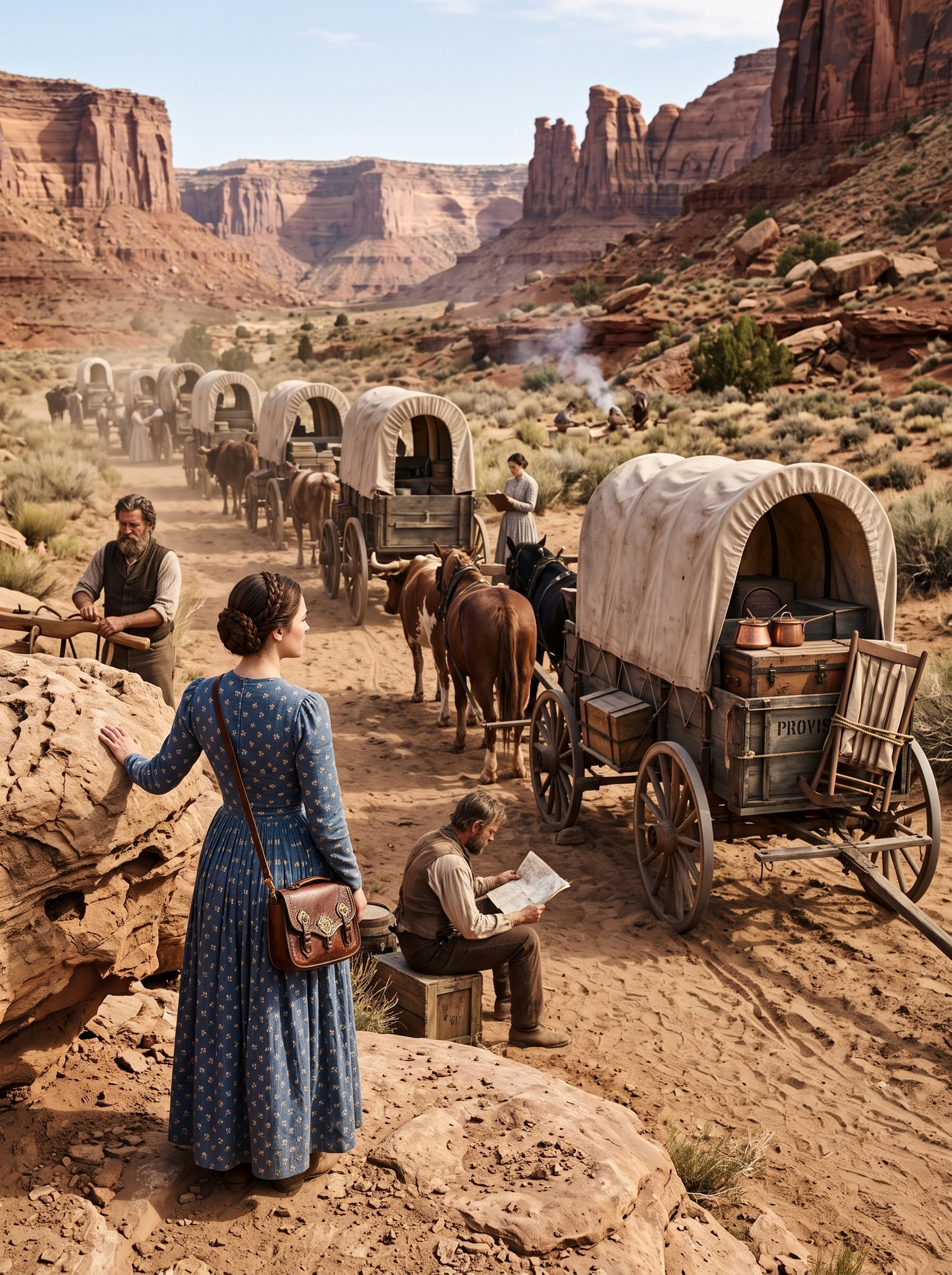
"Samuel?"
Margaret dropped to her knees.
Her brother's face emerged from the darkness beneath the stone.
He was thinner than she remembered. His cheeks were hollow, his lips cracked, and a dark bruise covered one side of his forehead.
But he was alive.
"Don't make a sound," Samuel whispered.
Margaret reached for him.
He caught her hand.
"Not yet. Help me move this."
Elizabeth knelt beside her daughter.
Together, they pushed the heavy stone aside.
A narrow opening appeared.
Samuel dragged himself through it, coughing as dust filled the chamber.
Elizabeth threw her arms around him.
"My boy."
Samuel closed his eyes.
"I'm all right, Ma."
But Margaret could see he was not.
His shirt was torn. His wrists were bruised. He moved as though every bone hurt.
She gave him her water flask.
He drank slowly.
Then he looked at her.
"You weren't supposed to come this far, Maggie."
Margaret almost laughed.
"You might have mentioned that before disappearing."
Samuel lowered his head.
"I tried."
"What happened?"
He looked toward the passage.
"Calder's men caught me outside Red Hollow. They knew I was supposed to take you north."
Elizabeth covered her mouth.
Samuel continued.
"They kept me in an old mining shed for two days. Then they brought me out here because they thought I knew where Grandfather had hidden the register."
"Did you?"
"No."
"Then how did you escape?"
Samuel gave a tired smile.
"Grandfather taught me a few things too."
He explained that he had slipped his bonds while his guards slept. He had fled into the hills and discovered the narrow underground passage by following a draft of cool air.
The passage connected several small chambers beneath the rocks.
One opened into the wash.
Another led farther west.
Margaret looked toward the dark opening.
"How far west?"
Samuel's expression changed.
"Far enough that I saw the black ridge."
Margaret felt her heartbeat quicken.
"Did you see the basin?"
Samuel nodded.
"And something else."
"What?"
He looked directly at her.
"Green trees, Maggie. Growing where there shouldn't be any."
They left the chamber through the underground passage.
Samuel led the way.
Margaret followed, carrying the notebook and the letters.
Elizabeth came last.
The tunnel was narrow and cool. Its walls were rough, and in several places they had to crawl.
Margaret could hear water dripping somewhere beneath the rock.
The sound filled her with hope.
After nearly half an hour, they reached a small opening concealed behind a fallen slab.
Samuel pushed through.
Margaret followed.
Sunlight struck her face.
She blinked.
Then she stopped.
Before her stretched a broad valley of pale sand.
At its western edge rose a long black ridge.
And below the ridge, tucked into a sheltered depression, stood a cluster of desert willows.
Their leaves shimmered in the morning light.
Margaret stared.
Look for green where green should not survive.
Her grandfather's words.
She had found the place.
Samuel pointed toward the trees.
"There's water beneath them."
Margaret walked forward.
She barely noticed the heat.
The ground sloped gently downward.
The sand grew darker.
Then she heard it.
A faint trickle.
Beneath the willows, water seeped from a narrow crack in the stone.
It collected in a shallow pool before disappearing beneath the sand.
Margaret knelt.
She dipped her fingers into the water.
Cool.
Clear.
Real.
She laughed.
Then she began to cry.
For years, Elias had described this place.
Her father had mocked him.
Her brothers had dismissed the stories.
Neighbors had called him a dreamer.
But the spring existed.
The willows existed.
And somewhere beneath the sand, the Silica Queen might exist too.
Margaret looked toward the black ridge.
Then she remembered the notebook.
The black ridge must stand behind the traveler.
She turned away from the ridge.
Facing east, she studied the basin.
The sand formed a series of low dunes.
Most appeared ordinary.
But one had a strange curve along its northern edge.
Margaret frowned.
She walked toward it.
Samuel called after her.
"Where are you going?"
She did not answer.
She was remembering another line.
The last road is beneath the moving ground.
Margaret reached the dune.
She knelt.
The sand was loose.
She brushed it aside.
At first, she found nothing.
Then her fingers struck something hard.
Wood.
Dark.
Dry.
She cleared more sand.
A curved surface appeared.
Then a metal band.
Margaret stopped breathing.
A wagon wheel.
Buried beneath the Mojave.
She stared at it.
Ninety years.
For ninety years, people had searched for the Silica Queen.
And now she was kneeling alone beside the first visible piece of it.
She pressed her hand against the wood.
"Grandfather," she whispered.
Then she looked toward the next dune.
A second shape lay beneath the sand.
Long.
Low.
Almost hidden.
Margaret stood.
She walked toward it.
Brushed away the sand.
And uncovered another iron-rimmed wheel.
Her heart began to pound.
She turned slowly.
The dunes formed a shallow arc.
One.
Two.
Three.
Four.
Five.
Six.
And at the far end, beneath the deepest drift, a seventh.
All seven wagons.
The Silica Queen.
She had found them.
Samuel reached her moments later.
He stared at the exposed wheel.
"Good Lord."
Margaret laughed through her tears.
"They're here."
Elizabeth approached slowly.
She looked across the dunes.
Then she pressed a hand against her mouth.
"Elias was right."
Margaret nodded.
"All those years."
She opened the notebook.
The final sketch showed seven rectangles arranged along a curved line.
The same arrangement.
She compared the drawing with the dunes.
Every mark matched.
Then she noticed the seventh wagon.
It lay nearest the black ridge.
A narrow section of its roof appeared to have been exposed years earlier.
Sand had filled the opening again.
Margaret looked toward Samuel.
"Grandfather said the register was inside."
Samuel nodded.
"Then we'd better find it."
They worked carefully.
Samuel used a flat piece of stone to loosen the sand.
Margaret cleared it away with her hands.
Elizabeth gathered broken branches to use as tools.
The work was slow.
The sun climbed.
Sweat ran down Margaret's back.
But the sand gradually yielded.
A wooden panel appeared.
Then an iron fitting.
Then the edge of a small door.
Margaret examined the lock.
It was brass.
Old.
Corroded.
She reached into her pocket.
The key Rusk had given her was still there.
Her hands trembled as she inserted it.
For a moment, nothing happened.
Then she turned it.
The lock clicked.
Margaret stared.
The key fit.
She pulled the door.
It resisted.
Samuel helped.
Together, they forced it open.
A breath of stale air escaped.
Inside was darkness.
Margaret waited until her eyes adjusted.
Then she saw wooden crates.
Broken harnesses.
Iron tools.
And a long metal chest beneath a collapsed shelf.
She crawled inside.
Samuel followed.
The wagon smelled of old wood and dust.
Margaret knelt beside the chest.
A second lock held it shut.
She remembered the pocket watch.
The watch marks the second.
She took out the watch from Rusk's saddle.
The hands remained stopped at three seventeen.
She examined the chest.
Its lock had no ordinary keyhole.
Instead, a small brass plate displayed several numbers.
Margaret studied them.
Then she understood.
Three.
One.
Seven.
She pressed the three numbered catches in sequence.
A spring released.
The chest opened.
Inside lay a leather-bound register.
Wrapped in oilcloth.
Beside it was a smaller packet.
Margaret carefully lifted the register.
The leather was cracked.
But the pages remained intact.
She opened it.
Names filled the first pages.
Freight workers.
Drivers.
Surveyors.
Payments.
Dates.
Then she reached the final section.
A signed statement.
Dated October 1852.
Margaret read slowly.
The wagon train had been diverted from its official route by men acting for a private land company.
The company wanted to prevent the survey records from reaching the settlement.
The original Margaret Cole held a claim to a valuable spring and surrounding land.
If the documents arrived, her ownership would be confirmed.
If they vanished, the company could claim the land was unoccupied and take possession.
Margaret turned the page.
The statement described the journey into the basin.
The wagons had become trapped after a sudden storm shifted the sand.
Several workers died.
Others escaped on foot.
But the men responsible for diverting the train concealed what had happened.
They accused the missing workers of theft.
And they kept the land.
Margaret felt sick.
Then she reached the signatures.
One belonged to Jonathan Vale.
Another belonged to a man named Nathaniel Calder.
Arthur Calder's grandfather.
The third signature belonged to a Cole.
Margaret stared.
Benjamin Cole.
A distant relative of the original Margaret Cole.
The man who had helped arrange the diversion.
The man whose name Elias had tried to clear from the family's history.
Margaret looked toward Samuel.
"Our family was involved."
Samuel read the page.
His expression darkened.
"But look here."
He pointed toward the next paragraph.
Margaret read.
Benjamin Cole had confessed before his death.
He admitted that he had been paid to guide the wagons away from the proper road.
But he also stated that he had tried to save the workers after realizing the company intended to abandon them.
He had helped several escape.
He had hidden the register inside the seventh wagon so that the truth might someday be recovered.
Margaret felt tears rise.
Her ancestor had done something terrible.
But he had also tried to make it right.
And his confession had survived.
For ninety years.
The smaller packet contained the original land claim.
It named Margaret Cole of 1852 as the rightful owner of the spring and surrounding acreage.
Attached were survey measurements.
Boundary descriptions.
And a sworn statement confirming the claim.
Margaret stared at the papers.
This was what Elias had searched for.
Not gold.
Not jewels.
Proof.
Proof that the land had been stolen.
Proof that innocent workers had been blamed.
Proof that her family's history was more complicated than anyone had admitted.
Samuel examined the documents.
"Calder's company owns land all along the old freight corridor."
Margaret nodded.
"If these records are accepted, his claims could be challenged."
Elizabeth looked toward the eastern hills.
"Then we need to get them to the authorities."
Margaret carefully wrapped the papers.
"Yes."
She looked around the wagon.
Then she noticed something beneath the collapsed shelf.
A small wooden box.
Not the one Calder carried.
Another.
Its lid was loose.
Margaret opened it.
Inside lay a bundle of letters.
The top one was addressed to Elias Cole.
Dated 1936.
Margaret recognized the handwriting.
Daniel Mercer.
The lawyer who had died after examining her grandfather's papers.
She unfolded the letter.
Mercer wrote that he had confirmed the legal importance of the original claim.
He believed the records could support a challenge to Calder Holdings' ownership.
But he warned Elias that Arthur Calder had learned of the investigation.
Margaret turned the page.
A second letter described threats.
A third mentioned a meeting arranged near the black ridge.
Then came a final note.
Written in Elias's hand.
Arthur Calder followed us into the basin. He demanded the register. During the struggle, he fell into the excavation beside the seventh wagon.
Thomas tried to save him.
Rusk helped pull him free.
But Arthur died before morning.
Margaret stopped.
She read the lines again.
Arthur Calder.
The fourth man.
The man buried near the ridge.
Her grandfather had not murdered him.
Her father had not murdered him.
He had died during a struggle over the records.
Elias had hidden the evidence because he feared Arthur's son would accuse them of killing him.
And because he knew the younger Calder would continue searching.
Margaret folded the letter.
At last, the mystery of the grave was clear.
They were preparing to leave the wagon when a voice came from outside.
"Bring the register out, Margaret."
Calder.
Margaret froze.
Samuel reached for her arm.
Elizabeth closed her eyes.
They had been followed.
Margaret looked toward the doorway.
Calder stood beside the exposed wheel.
Ben and Otis were behind him.
Thomas and Rusk stood nearby.
Both appeared exhausted.
But alive.
Calder held his rifle.
His eyes were fixed on the packet in Margaret's hands.
"Well done," he said.
Margaret stepped from the wagon.
She kept the register close to her chest.
"You knew we'd find it."
Calder smiled.
"I knew Elias left enough clues."
Thomas looked toward the exposed wagons.
His face filled with emotion.
"All seven."
Margaret nodded.
"Grandfather was right."
For a moment, Thomas seemed unable to speak.
Then Calder raised his rifle.
"Enough sentiment."
He pointed toward the register.
"Give it to me."
Margaret looked at him.
"No."
Calder's smile disappeared.
"Don't be foolish."
She held the papers tighter.
"They prove your family stole this land."
Calder's face hardened.
"They prove nothing until a court accepts them."
"Then we'll take them to court."
He laughed.
"You think I'll allow that?"
Margaret looked toward Otis.
The older rider stood uneasily beside his horse.
She turned toward Ben.
He avoided her eyes.
Then she looked at Calder.
"Your grandfather helped divert the wagons. Your father threatened the lawyer who investigated. And you tried to force my family to surrender the claim."
Calder stepped closer.
"Careful."
Margaret continued.
"Your father died here in 1936. Grandfather recorded what happened."
Calder froze.
She held up the letter.
"He wasn't murdered."
Thomas stepped forward.
"She's telling the truth."
Calder turned sharply.
"Shut up."
Rusk moved beside Thomas.
"I was there, Calder. Your father attacked Elias. He slipped into the excavation. We tried to pull him out."
Calder's face twisted.
"You're lying."
Rusk shook his head.
"No."
Margaret held out the letter.
"Read it."
Calder stared at the paper.
For a moment, she thought he might lower the rifle.
Instead, he lunged.
Margaret stumbled backward.
The register slipped from her hands.
Samuel caught it.
Calder seized Margaret by the arm.
"Give me those papers!"
Samuel stepped forward.
"Let her go."
Calder raised the rifle toward him.
Then Otis spoke.
"That's enough."
Everyone turned.
The older rider had drawn his revolver.
But he was not pointing it at Margaret.
He was pointing it at Calder.
Calder stared.
"What are you doing?"
Otis's face was grim.
"I signed on to find old freight wagons. Not to murder a family."
Ben hesitated.
Then slowly lowered his rifle.
Calder looked from one man to the other.
"You fools."
Otis stepped closer.
"Put the gun down."
Calder's eyes darted toward the horses.
Then toward the ridge.
He seemed to consider running.
But Otis did not move.
Finally, Calder lowered his rifle.
Samuel took it from him.
Margaret stepped away.
Her hands were shaking.
Thomas hurried toward her.
"Are you hurt?"
She shook her head.
"No."
He looked at the register.
Then at the wagons.
His eyes filled with tears.
"Your grandfather would have been proud."
Margaret looked toward the buried train.
For the first time, she believed him.
They returned to Red Hollow three days later.
The journey was slow.
Rusk needed rest.
The horses were tired.
And the documents had to be protected from heat and dust.
But they made it.
Walter Finch was standing outside his store when they arrived.
He stared at the group.
Then he saw Margaret.
"Miss Cole?"
She smiled.
"Mr. Finch."
He looked toward the packet in her arms.
"Did you find it?"
Margaret nodded.
"All seven wagons."
Finch removed his hat.
For a long moment, he said nothing.
Then he whispered, "Well, I'll be damned."
Margaret laughed.
It was the first easy laugh she had managed in days.
The sheriff took Calder into custody after hearing the family's account and examining the documents.
Otis and Ben gave statements about the threats and the attempted seizure of the register.
Rusk testified about the events of 1936.
Thomas confirmed the location of Arthur Calder's grave.
The sheriff arranged for the remains to be examined and the death investigated properly.
The old lawyer's letters were preserved as evidence.
And the original register was placed in secure custody pending a court hearing.
The case took months.
There were lawyers.
Surveyors.
Arguments over boundaries.
Questions about the validity of the original claim.
But the evidence was strong.
The register confirmed the old survey.
The letters supported Elias's investigation.
And the records of Calder Holdings showed that the company had acquired several disputed parcels while concealing the earlier claim.
Eventually, the court recognized the original Cole family interest in the spring and surrounding land.
Calder Holdings' competing claim was rejected.
The fraudulent transfer agreement was set aside.
And the family received compensation for property that had been wrongfully claimed.
The Silica Queen became a historical discovery.
Newspapers carried photographs of the seven wagons.
Historians traveled to the Mojave.
Surveyors documented the site.
And the names of the missing workers were finally recorded.
Their families learned what had happened.
The accusations of theft were corrected.
The truth Elias had spent his life pursuing was no longer buried.
By the following spring, the Cole farm had changed.
The land was still dry.
The old barn still needed repairs.
And the drought had left scars that would take years to heal.
But the family no longer faced eviction.
The compensation from the land claim had paid the remaining debts.
Thomas had bought back the property.
Samuel returned to work.
Henry helped rebuild the fences.
Elizabeth planted a small garden beside the kitchen.
And Margaret made a decision that surprised everyone.
She did not move back into her childhood bedroom.
Instead, she purchased a small house near Red Hollow.
It had a wide porch.
A sturdy roof.
And enough room for a desk beside the window.
She used part of her inheritance to establish a survey and mapping office.
Travelers came to her for advice.
Ranchers asked her to examine property boundaries.
Freight companies hired her to study old routes.
And people who had once laughed at Elias's stories began asking Margaret Cole to help them understand the desert.
She worked hard.
She made mistakes.
She learned.
And she never again allowed anyone to tell her that she had no future.
One evening, Thomas came to visit.
Margaret was sitting at her desk, studying a new map.
He stood awkwardly in the doorway.
"May I come in?"
She looked up.
"Of course."
He entered slowly.
For a moment, he examined the room.
The shelves.
The maps.
The compass hanging beside the window.
Then he looked at her.
"I brought something."
He placed a small wooden box on the desk.
Margaret opened it.
Inside lay Elias's old spectacles.
His pencil.
And a photograph of him standing beside the barn.
Margaret felt tears rise.
"Where did you find these?"
Thomas looked down.
"I kept them."
She touched the photograph.
Her grandfather was smiling.
His copper-haired granddaughter stood beside him, no older than twelve.
She was holding a map.
Thomas cleared his throat.
"I owe you an apology."
Margaret looked up.
He continued.
"I thought I was protecting you by keeping secrets. I thought if I pushed you away, you'd be safe."
His voice shook.
"But I hurt you."
Margaret said nothing.
Thomas looked directly at her.
"I was wrong."
The words were simple.
But she knew how difficult they had been for him to say.
She stood.
For a moment, they faced each other.
Then Margaret stepped forward and embraced him.
Thomas held her tightly.
"I'm proud of you," he whispered.
Margaret closed her eyes.
She had waited years to hear those words.
And now, at last, she believed them.
Later that summer, the family gathered at the farm for supper.
Elizabeth cooked beans.
Samuel brought fresh bread.
Henry repaired the porch steps.
Rusk arrived carrying a bottle of lemonade and complaining about the heat.
Walter Finch came with a newspaper containing another article about the Silica Queen.
Everyone laughed when he read the headline aloud.
Margaret sat beside her mother.
For a while, they watched the others.
Then Elizabeth reached for her hand.
"I should have spoken up that day."
Margaret looked at her.
"Yes."
Her mother nodded.
"I know."
Margaret squeezed her hand.
"But you came after me."
Elizabeth's eyes filled with tears.
"I would have gone anywhere."
Margaret smiled.
"I know that now."
Across the table, Thomas was arguing with Samuel about the best way to repair the old windmill.
Henry laughed.
Rusk shook his head.
Finch poured another glass of lemonade.
The house was noisy.
Warm.
Alive.
Margaret looked around.
For the first time in years, she felt that she belonged.
Not because someone had given her permission.
But because she had chosen to return.
At sunset, Margaret walked alone toward the barn.
The sky glowed orange above the fields.
A warm breeze moved through the dry grass.
She carried Elias's notebook.
Its cover was worn.
The pages were bent.
But every word remained precious.
She stopped beside the old fence.
Then she opened the final page.
The name Rusk was still visible beneath the crossed-out ink.
She smiled faintly.
So much had begun with that name.
A stranger in the darkness.
A rifle.
A hidden key.
A journey into the Mojave.
And seven wagons buried beneath the sand.
Margaret turned to the last blank page.
She took out her grandfather's pencil.
For a moment, she hesitated.
Then she wrote:
The Silica Queen was found.
All seven wagons.
The original register survived.
The truth was brought home.
She paused.
Then added:
And so was I.
Margaret closed the notebook.
She looked toward the farmhouse.
Light glowed through the kitchen windows.
She could hear laughter.
Her mother calling everyone to supper.
Her brothers arguing over who would wash the dishes.
Her father telling them both to stop.
Margaret smiled.
She slipped the notebook into her satchel.
The same canvas satchel she had carried when she left home with twenty dollars.
The money was still there.
She had never spent the last bill.
Instead, she had placed it inside a small frame above her desk.
Not as a reminder of what her father had given her.
But as a reminder of what she had done with it.
Twenty dollars.
A map.
A compass.
And the courage to keep walking when everyone told her to turn back.
Margaret looked toward the western horizon.
Beyond the hills lay the Mojave.
The black ridge.
The hidden spring.
And the seven wagons that had waited ninety years to be found.
Her grandfather's dream had finally come true.
But the greatest treasure had not been gold.
It had been the truth.
The truth about the missing workers.
The truth about the stolen land.
The truth about her family.
And the truth about herself.
Margaret turned toward the house.
She walked through the open gate.
Up the familiar path.
And into the warm light of the kitchen.
This time, nobody told her she did not belong.
This time, there was a place waiting for her at the table.
And when she sat down, her father smiled.
"Welcome home, Maggie."
Margaret smiled back.
"It's good to be here."
Outside, the sun disappeared beyond the fields.
Inside, the family began supper.
And Margaret Cole, the girl who had once been sent away with twenty dollars, finally understood that her future had never been something her father could give her.
It was something she had claimed for herself.






Comments 0