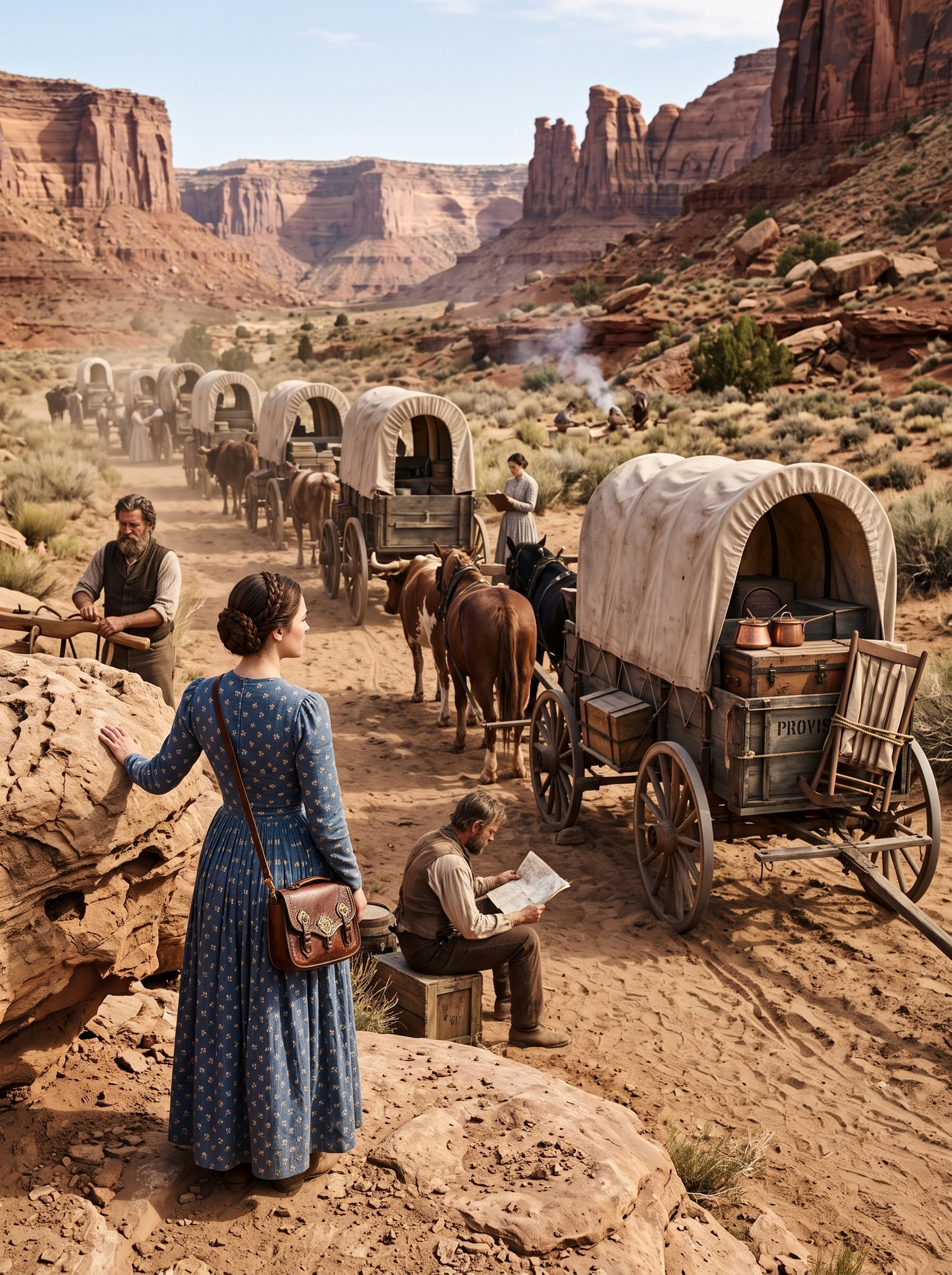
"Put that photograph down, Margaret."
Thomas Cole stood at the entrance to the narrow valley, his rifle resting across his arms.
Margaret stared at him.
For a moment, she could not speak.
Her father was supposed to be miles away, preparing to surrender the family farm to its new owner.
Instead, he stood in the desert, blocking her only visible way out.
And he was looking at the photograph in her hand as though it were something dangerous.
"How did you find me?" she whispered.
Thomas took a step forward.
"Put it down."
"Answer me."
"Margaret."
She recognized the warning in his voice.
It was the same tone he had used throughout her childhood whenever he wanted a conversation to end.
But something had changed.
She was no longer standing in his kitchen.
And he no longer controlled what she could know.
"That's you in the photograph," she said.
Thomas stopped.
"Give it here."
"You went into the desert with Grandfather."
His face tightened.
"That was a long time ago."
"You told me he went alone."
"I told you what you needed to know."
Margaret felt a sharp ache beneath her ribs.
"Why?"
Thomas glanced toward the horse.
Then toward the ridge behind her.
"Because some truths don't do anybody any good."
She looked down at the photograph.
Three men.
Elias Cole.
Reuben Rusk.
Thomas Cole.
Standing beside a wagon wheel that appeared to be buried halfway beneath the sand.
Her grandfather had found something.
Her father had seen it.
And for years, both men had allowed her to believe the Silica Queen remained nothing more than a mystery.
Margaret lifted the photograph.
"Who scratched out your face?"
Thomas did not answer.
She turned it over.
"Grandfather wrote that one of you never returned."
Her father's expression changed.
He looked suddenly older.
"Margaret, listen to me carefully."
She waited.
"You're coming home."
The words were so familiar that she almost laughed.
"Home?"
Thomas frowned.
"Don't start."
"You gave me twenty dollars and told me to leave."
"I was angry."
"You told me there was no place for me."
"Things were complicated."
"You watched me walk away."
Thomas looked toward the ground.
Margaret took one step closer.
"And now you followed me into the desert with a rifle."
"I'm trying to keep you alive."
"Then tell me the truth."
He raised his eyes.
For the first time, she saw something that resembled regret.
But regret was not an explanation.
And Margaret had traveled too far to accept another silence.
Thomas lowered the rifle.
He looked toward the darkening hills.
"We can't stay here."
Margaret folded the photograph.
"Why?"
"Because Calder's men are searching these roads."
"I know."
Thomas turned sharply.
"You've seen them?"
"One of them pointed a rifle at me last night."
Her father went pale.
"Did he hurt you?"
"No."
"Who was it?"
"A man named Calder."
Thomas closed his eyes.
Margaret watched him.
"You know him."
Thomas said nothing.
"Pa."
He opened his eyes again.
"His father was a dangerous man."
"And the son?"
"Worse."
Margaret thought of the rifle pointed across the creek bed.
She believed that part.
"Then why are they following me?"
Thomas looked toward the satchel.
"Because of what you're carrying."
"The notebook?"
"Yes."
"And the map?"
He hesitated.
"Both."
Margaret folded her arms.
"Then you know what's in them."
Thomas looked away.
"I know enough."
"Did Grandfather find the Silica Queen?"
Her father remained silent.
"Did you?"
The wind moved through the narrow valley.
A few grains of sand struck the rocks.
Thomas finally spoke.
"We found part of something."
Margaret felt her heartbeat quicken.
"What?"
He rubbed his forehead.
"An old wheel. Some broken timber. Iron fittings."
She looked down at the photograph.
"The wagon."
"Maybe."
"Pa, don't."
Thomas sighed.
"We believed it was one of the freight wagons."
Margaret stared at him.
For ninety years, the Silica Queen had been considered lost.
Her grandfather had spent years studying its disappearance.
And her father had known there was evidence.
Real evidence.
A wheel.
Timber.
Iron.
All buried in the desert.
"Why didn't you tell anyone?"
Thomas's jaw tightened.
"Because we didn't know what we'd found."
"That's not true."
"Margaret—"
"Grandfather marked the location. He drew the wheel. He wrote down the route."
Thomas looked at her sharply.
"You've read the notebook."
"Yes."
"How much?"
"Enough to know you've been lying."
He flinched.
Margaret had never seen him react that way.
She almost softened.
Then she remembered the twenty-dollar bill.
The silence at the kitchen table.
Her mother refusing to turn around.
And the years her father had spent treating Elias's work as a shameful family secret.
She held her ground.
"What happened out there?"
Thomas looked toward the west.
"Your grandfather believed the wagons had been buried by a massive sand movement. He thought a storm had pushed enough sand into the basin to cover them."
"And?"
"He found a wheel."
Margaret waited.
"He dug around it for two days. Rusk helped him. I helped when I could."
"Then why did you stop?"
Thomas swallowed.
"Because we found something else."
Margaret's breath caught.
"What?"
Her father looked at her.
"A grave."
Margaret stared at him.
"A grave?"
Thomas nodded.
"Near the wheel. Half-buried beneath a shelf of stone."
"Whose grave?"
"We didn't know."
"Was there a name?"
"No."
"Then how did you know it was a grave?"
Thomas looked uncomfortable.
"Because someone had placed stones around it. Carefully. In a rectangle."
Margaret imagined the scene.
An ancient wagon wheel protruding from a dune.
Broken timber beneath the sand.
And a grave nearby.
She felt a chill.
"Did you open it?"
Thomas shook his head.
"Your grandfather wanted to."
"But you didn't?"
"No."
"Why?"
"Because Rusk said we should leave."
Margaret frowned.
"Rusk?"
Thomas nodded.
"He became frightened after we found the wheel."
"Of what?"
"I don't know."
Margaret remembered Rusk's injured face.
His warnings.
His insistence that Elias had discovered something dangerous.
"Rusk told me he lied about the route."
Thomas looked sharply at her.
"You spoke to him?"
"Yes."
"Where is he?"
"I don't know."
Thomas stepped closer.
"Margaret, where did you see him?"
"At an abandoned freight stop."
"When?"
"This afternoon."
Her father's face drained of color.
"Was he alone?"
"At first."
Thomas looked toward the hills.
Margaret felt her stomach tighten.
"What aren't you telling me?"
He ignored the question.
"Did Rusk give you anything?"
She hesitated.
The brass key lay inside her pocket.
The folded note remained in her satchel.
The photograph was still in her hand.
She had no reason to trust her father with any of them.
"He gave me information."
"What information?"
"That you went into the desert with Grandfather."
Thomas looked away.
Margaret continued.
"He said Grandfather believed the wagons carried old land records."
Her father went still.
She noticed.
"That's true, isn't it?"
Thomas did not answer.
"Pa?"
He lowered himself onto a flat rock.
For several seconds, he stared at his hands.
Then he said, "Your grandfather believed the Silica Queen carried survey documents from the early settlement years."
"What kind of documents?"
"Property claims. Boundaries. Agreements between freight companies and landowners."
Margaret frowned.
"Why would those matter now?"
"Because some of those claims were never properly settled."
She thought of the farm.
The bank.
The sale.
The new owner.
A strange suspicion began to form.
"Did Grandfather believe those papers could help us?"
Thomas looked up.
"Yes."
Margaret felt a sudden rush of anger.
"Then why did you burn his maps?"
"Because he was wrong."
"How do you know?"
"Because we never found the records."
"You never finished searching."
Thomas stood.
"Because someone nearly died."
Margaret froze.
"Who?"
Her father looked away.
She took a step toward him.
"Who nearly died, Pa?"
Thomas's voice dropped.
"Me."
The confession silenced her.
Thomas sat down again.
He rested the rifle beside him.
Margaret waited.
Finally, he began to speak.
"It was the third day after we found the wheel. Your grandfather wanted to dig deeper. Rusk said the sand was unstable."
Margaret listened carefully.
"The dune looked solid, but it wasn't. Every time we removed a little sand, more slid down from above."
He rubbed his left shoulder.
"I was working beside the axle when the ground gave way."
Margaret remembered the scar beneath his shirt.
A long pale mark that ran across his shoulder.
He had always claimed it came from a farming accident.
"You were buried?"
"Partly."
Thomas nodded.
"Sand came down around my legs. A wooden beam shifted. It struck my shoulder."
Margaret swallowed.
"Grandfather pulled you out?"
"Rusk did most of it. Your grandfather helped."
He looked toward the darkening sky.
"I thought I was going to die."
Margaret had never heard her father speak so plainly about fear.
It unsettled her.
"After that," Thomas continued, "I wanted to leave. Rusk wanted to leave. But your grandfather refused."
"He stayed?"
"For another day."
"Alone?"
Thomas nodded.
"He said he had one more place to check."
Margaret felt her pulse quicken.
"Where?"
"I don't know."
"Did he find anything?"
Thomas hesitated.
"When he came back, he had a small wooden box."
Margaret remembered the brass key.
A box.
Rusk had mentioned a box near the black ridge.
"What was inside?"
Thomas looked directly at her.
"I never saw."
"Didn't you ask?"
"Of course I asked."
"And?"
"He said it wasn't time."
Margaret stared at him.
That sounded exactly like Elias.
Careful.
Patient.
Unwilling to speak until he was certain.
"What happened to the box?"
Thomas shook his head.
"I don't know."
Margaret slipped one hand into her pocket.
Her fingers closed around the brass key.
She did not take it out.
Not yet.
Night settled over the valley.
Thomas insisted they move to a more sheltered place.
Margaret refused to surrender the horse.
He did not argue.
They led the animal through a narrow passage between the rocks and stopped beneath a sandstone overhang.
The place offered protection from the wind.
It also concealed them from the main trail.
Margaret gathered a few dry branches.
Thomas built a small fire.
For several minutes, they worked without speaking.
It reminded her painfully of the farm.
The familiar rhythm of chores.
Two people performing tasks together while avoiding the words that mattered.
When the fire caught, Margaret sat across from him.
She took out the food her mother had packed.
Thomas noticed the handkerchief.
"Your mother gave you that?"
Margaret nodded.
"She left it by the stove."
He looked down.
"She was worried."
Margaret opened the parcel.
"She didn't say anything when you told me to leave."
Thomas stared into the fire.
"She was upset."
"So was I."
He said nothing.
Margaret broke a biscuit in half.
"Why did you do it?"
Thomas looked up.
"Do what?"
"Give me twenty dollars and send me away."
He rubbed his face.
"I thought it was the best thing."
"For whom?"
He did not answer.
Margaret continued.
"Samuel gets work. Henry gets work. You and Ma get to stay until spring. And I get told to leave."
Thomas looked ashamed.
"I didn't want you caught up in what was coming."
"What was coming?"
He stared at the fire.
"Calder."
Margaret felt her stomach tighten.
"What does Calder have to do with the farm?"
Thomas took a long breath.
"His family bought some of the old debts."
Margaret frowned.
"From the bank?"
"Yes."
"When?"
"Last winter."
She stared at him.
"Before the sale?"
Thomas nodded.
Margaret felt the pieces shifting again.
"Did Calder force you to sell?"
"No. The drought forced us to sell."
"But he was involved."
"His company bought the notes. They wanted payment."
"And you couldn't pay."
Thomas shook his head.
Margaret looked down at the twenty-dollar bill in her pocket.
For the first time, she wondered whether her father's cruelty had been connected to something more than disappointment.
"Did Calder threaten you?"
Thomas's silence answered.
Margaret felt anger rise.
"Why didn't you tell us?"
"Because I thought I could handle it."
"You couldn't."
"No."
The admission was barely audible.
She stared at him.
He had spent years insisting that strength meant never admitting weakness.
Now he sat before her, exhausted and frightened, confessing that he had lost control of everything.
Margaret wanted to feel sympathy.
Part of her did.
But another part remembered all the times he had made her feel small for asking questions.
"Did you send me away because Calder was coming?"
Thomas looked up.
"Partly."
"Partly?"
He swallowed.
"I thought if you were gone, he wouldn't look for you."
Margaret stared at him.
"Then why did you give me Grandfather's twenty-dollar bill?"
Thomas frowned.
"What?"
"The bill had writing on the back."
He looked confused.
Margaret took it out.
She unfolded it.
The words remained visible.
Whispering Winds Basin.
Thomas stared.
Then his face changed.
"I didn't write that."
"I know."
He took the bill carefully.
His hands trembled.
"Where did this come from?"
"You gave it to me."
"No. I mean before that."
Margaret frowned.
"Didn't you know?"
Thomas shook his head.
"It came from your grandfather's things. I kept it in a drawer."
Margaret looked at the writing.
Elias had marked the bill.
Perhaps years ago.
Perhaps deliberately.
But why?
Thomas turned it over.
Then he noticed something near the lower edge.
A tiny pencil mark.
He brought it closer to the fire.
Margaret leaned forward.
There were numbers.
Faint.
Almost invisible.
Seven digits separated by small dots.
Thomas whispered, "Coordinates."
Margaret felt her heartbeat quicken.
"To the basin?"
He shook his head.
"I don't know."
She took the bill back.
The numbers were too faded to read clearly.
But they were there.
Another clue.
Another piece of Elias's hidden route.
Margaret folded the money carefully.
Then she looked at her father.
"Grandfather planned this."
Thomas stared at her.
"What?"
"He knew someone might find the map. He hid the notebook. He left the compass with Mr. Finch. He gave Rusk the key."
Thomas's head snapped up.
"What key?"
Margaret froze.
She had said too much.
Thomas leaned forward.
"Margaret, what key?"
She hesitated.
Then she slowly removed the brass key from her pocket.
The firelight caught the worn metal.
Thomas stared.
His face drained of color.
"Where did you get that?"
"Rusk."
Thomas reached for it.
Margaret pulled her hand away.
"No."
"Margaret, give me the key."
"Tell me what it opens."
Thomas looked toward the darkness beyond the fire.
His breathing became shallow.
"That key shouldn't exist."
Margaret stared at him.
"What does that mean?"
He lowered his voice.
"Your grandfather told me he destroyed it."
"Why would he?"
Thomas looked at her.
"Because the box wasn't empty."
Margaret felt the night grow colder.
"What was inside?"
Thomas did not answer immediately.
He looked toward the horse.
Then toward the narrow entrance to the overhang.
Finally, he said, "I saw the box once."
Margaret leaned forward.
"When?"
"After we returned from the desert."
"You said you never saw inside."
"I didn't."
"Then what did you see?"
Thomas swallowed.
"Your grandfather opened it in his room. I was standing outside the door."
Margaret stared.
"He didn't know you were there?"
"No."
"What did he do?"
Thomas looked down.
"He took out a packet of papers."
Margaret felt excitement rise.
"The land records?"
"Maybe."
"Did you read them?"
"No."
"Then how do you know they mattered?"
Thomas's expression darkened.
"Because the next morning, he went to see a lawyer."
Margaret sat very still.
"A lawyer?"
Thomas nodded.
"In Red Hollow."
"Mr. Finch?"
"No. A man named Daniel Mercer."
Margaret had heard the name.
Mercer had been an attorney years ago.
He had died before she was old enough to remember him clearly.
"What happened?"
Thomas rubbed his forehead.
"Mercer told your grandfather the papers could cause trouble."
"What kind of trouble?"
"Property disputes. Claims against people who had owned land for decades."
Margaret looked at the key.
"Did Grandfather want to make those claims?"
"I don't know."
"Then why did he hide everything?"
Thomas stared into the fire.
"Because Mercer was found dead three weeks later."
Margaret felt her breath catch.
"Dead?"
Thomas nodded.
"They said it was a riding accident."
"Was it?"
He did not answer.
Margaret looked at him.
"Pa?"
Thomas's voice was barely audible.
"Your grandfather didn't believe it."
The fire cracked.
Margaret felt the weight of the words.
A lawyer.
Old land records.
A mysterious death.
And a box hidden somewhere near the black ridge.
She looked toward the darkness.
The desert suddenly seemed filled with things she could not see.
"Did Calder know about the lawyer?"
Thomas nodded.
"His father did."
Margaret's stomach tightened.
"Arthur Calder?"
"Yes."
"Was he involved?"
Thomas looked at her.
"I never proved anything."
Margaret sat back.
She had wanted answers.
Instead, every answer seemed to open another question.
They slept in turns.
Thomas insisted on taking the first watch.
Margaret lay beneath her blanket, listening to the wind.
She could not sleep.
Her father's confession replayed in her mind.
The wagon wheel.
The grave.
The box.
The lawyer.
The land records.
And the strange note hidden inside the pocket watch.
Thomas saw what happened.
He knows who buried them.
Margaret sat up.
Her father was sitting near the entrance, his rifle across his knees.
She watched him for a moment.
Then she spoke.
"Pa?"
He turned.
"Can't sleep?"
"No."
He nodded.
"Neither can I."
Margaret hesitated.
Then she took out the pocket watch.
Thomas saw it.
His face changed immediately.
"Where did you get that?"
"It was hidden in Rusk's saddle."
He stared.
Margaret opened the watch.
She showed him the photograph.
Then the hidden compartment.
Then the note.
Thomas read the words.
His expression collapsed.
For a moment, he looked as though he might be sick.
Margaret watched him carefully.
"Grandfather wrote that you knew who buried the wagons."
Thomas closed his eyes.
"Margaret—"
"Who was it?"
He shook his head.
"Please."
She had never heard him say that word to her before.
Not like that.
Not as a plea.
"Pa, I need to know."
Thomas looked toward the darkness.
Then he whispered, "It wasn't the desert."
Margaret felt a chill.
"What?"
"The wagons didn't disappear because of a storm."
She stared.
"But you said the sand buried them."
"It did."
"Then what are you saying?"
Thomas swallowed.
"Someone made sure they stayed buried."
Margaret's heart began to pound.
"Who?"
He looked at her.
His eyes were filled with something she had never seen before.
Shame.
"Your grandfather found evidence that the train had been deliberately diverted into the basin."
Margaret stared.
"By whom?"
Thomas shook his head.
"I don't know all of it."
"But you know something."
He nodded slowly.
"The men who sent the wagons into that basin knew the route was dangerous."
"Why would they do that?"
"Because the cargo wasn't supposed to reach its destination."
Margaret felt the words settle over her.
The Silica Queen had not simply become lost.
Someone had wanted it to vanish.
And ninety years later, the consequences were still reaching into her life.
She looked down at the watch.
Then she noticed something she had missed.
The hands had stopped at a particular time.
Three seventeen.
She remembered the numbers on the twenty-dollar bill.
Seven digits.
Separated by dots.
She took out the money.
She held it beside the watch.
The markings were faint, but one sequence stood out.
3.
17.
Margaret looked at her father.
"Grandfather used numbers as clues."
Thomas frowned.
"What?"
"The watch stopped at three seventeen. The bill has the same numbers."
He leaned closer.
Margaret unfolded the map.
She searched the margins.
Near the black ridge, Elias had written a small notation.
3:17—western face.
Her pulse quickened.
"That's not a time," she whispered.
Thomas stared at the map.
"What is it?"
Margaret traced the line with her finger.
"A direction."
She looked toward the west.
The black ridge lay somewhere beyond the dark hills.
And Elias had marked a specific face of it.
Perhaps a rock formation.
Perhaps a hidden entrance.
Perhaps the place where the box had been concealed.
She folded the map.
"We have to go there."
Thomas shook his head.
"No."
"Pa—"
"No. I've already lost too much to that desert."
Margaret looked at him.
"You haven't lost me."
His expression softened.
For one brief moment, she saw the father she remembered from childhood.
The man who had carried her across flooded fields.
The man who had taught her to ride.
The man who had once promised that she would always have a place at his table.
Then the moment passed.
Thomas looked away.
"That's what I'm afraid of."
Before dawn, Margaret woke to the sound of movement.
Her father was standing beside the horse.
He had packed his rifle.
His face was pale.
"Get up," he said.
Margaret sat upright.
"What happened?"
"We have to leave."
"Why?"
Thomas looked toward the eastern ridge.
"Someone's coming."
Margaret scrambled to her feet.
She listened.
At first, she heard nothing.
Then a faint sound reached her.
Hooves.
Several horses.
Moving slowly.
Thomas tightened the saddle strap.
"Take the notebook."
Margaret grabbed her satchel.
"What about you?"
"I'll follow."
She looked at him.
"You said that before."
Thomas stopped.
Margaret stared.
"You told me to leave the farm. You said it was for my own good. Now you're telling me to ride away again."
"Margaret, this isn't the time."
"Then when is the time?"
The hoofbeats grew louder.
Thomas looked toward the ridge.
He seemed torn between anger and fear.
Finally, he stepped close.
"Listen carefully. If you reach the black ridge, do not approach it from the east."
Margaret froze.
"Why?"
"Because the ground isn't safe."
"How do you know?"
Thomas hesitated.
Then he whispered, "Because that's where we buried him."
Margaret felt her blood turn cold.
"Buried who?"
Thomas's eyes filled with dread.
Before he could answer, a voice shouted from the ridge.
"Thomas Cole!"
Both turned.
A rider appeared against the pale morning sky.
Then another.
And another.
Margaret recognized the man in front.
Calder.
He held a rifle.
Thomas stepped between him and Margaret.
"Get on the horse," he whispered.
Margaret did not move.
Calder raised his weapon.
"Step away from the girl, Thomas."
Thomas lifted his rifle.
"Leave her out of this."
Calder laughed.
"You should have thought of that before you let her find the notebook."
Margaret felt her heart pounding.
Thomas took one step forward.
"She doesn't know anything."
Calder looked directly at her.
"Oh, I think she knows quite a lot."
He reached into his coat.
Then he withdrew a small object wrapped in cloth.
Margaret stared.
It was a wooden box.
Old.
Dark.
Bound with rusted iron.
A brass lock hung from the front.
Thomas made a sound she had never heard from him before.
A broken, frightened whisper.
"No."
Calder smiled.
"Recognize it?"
Margaret's hand moved instinctively toward her pocket.
The brass key.
The key Rusk had given her.
The key her grandfather had supposedly destroyed.
Calder looked from her face to her hand.
His smile widened.
"Well, Miss Cole," he said softly, "I believe you have something that belongs to me."
Margaret stepped backward.
Thomas raised his rifle.
Calder did not flinch.
Instead, he placed the box on a flat stone.
Then he reached for the lock.
Margaret's father shouted.
"Don't open it!"
Calder looked up.
"Why not, Thomas?"
Thomas's face had gone white.
His voice shook.
"Because if she sees what's inside, she'll know what we did."
Margaret stared at her father.
Calder slowly turned the box toward her.
The brass lock was already broken.
The lid lifted a fraction.
Inside, beneath a layer of faded cloth, something pale became visible.
Margaret leaned forward.
It was a folded document.
Across its upper edge, written in dark ink, was a name.
Her name.
Margaret Cole.
And beneath it was a date.
1852.
Calder looked at her.
Then he said, "Your grandfather didn't leave you a map, Margaret. He left you proof."
He lifted the lid.
Thomas lunged forward.
And Margaret saw the first line of the document.






Comments 0