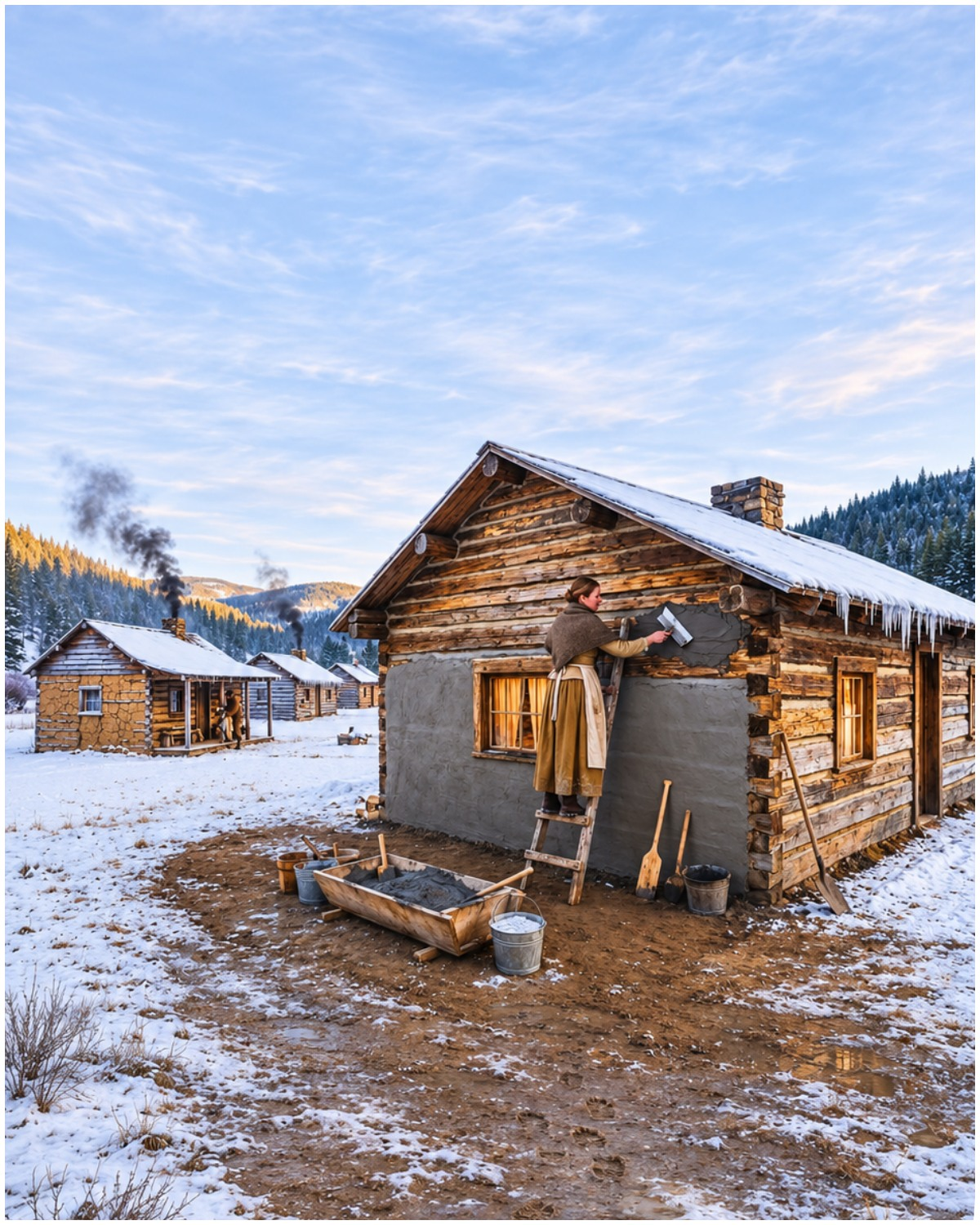
"Open this door, Vogel, or I'll have your claim reviewed before sunrise!"
Mr. Davies struck the cabin door with the brass handle of his walking stick.
Carl stood motionless beside the stove.
Annelise sat at the kitchen table, staring at the yellowed letter in her father's handwriting.
The name at the bottom was unmistakable.
Davies.
Nine years earlier, her father had written about an American engineer named Malcolm MacLeod and the man who had financed his attempt to discredit a new heating method.
Now a land agent bearing that same surname stood outside her home, threatening to take away everything her family owned.
Carl reached for the door.
Annelise caught his wrist.
"Wait."
He looked at her.
"What?"
"Don't let him see the letter."
Carl glanced at the paper.
Then at his wife.
"Why?"
"Because we don't know what he knows."
Another knock shook the door.
"Vogel!"
Annelise folded the letter and slipped it beneath her father's notebook.
Then she stood.
"Open it."
Carl lifted the wooden bar.
The door swung inward.
Cold wind rushed across the floor.
Davies stood on the porch wearing a black overcoat and a dark felt hat. Snow clung to his shoulders. His leather satchel hung from one hand, and his expression suggested he had already decided how the conversation would end.
"Mr. Vogel."
Carl did not step aside.
"Mr. Davies."
"I have official business."
"At this hour?"
"The matter is urgent."
Annelise moved beside her husband.
"What matter?"
Davies looked past them into the cabin.
His eyes traveled over the gray plaster.
Then toward the stove.
Then toward the table where her father's notebook lay.
"The condition of your dwelling."
Carl folded his arms.
"You inspected it already."
"That inspection raised concerns."
"Concerns based on a statement that may have been altered."
Davies's expression tightened.
"I beg your pardon?"
"Ewan MacLeod says the complaint doesn't reflect what he agreed to."
For the first time, Davies seemed genuinely surprised.
Only for a moment.
Then his face became smooth again.
"Mr. MacLeod is entitled to reconsider his professional judgment."
"He says he never made the complaint."
"That is a matter between him and the office receiving the report."
Annelise watched Davies carefully.
He was not behaving like a man who had come to discuss a construction problem.
He was behaving like a man who needed a decision.
Tonight.
Before someone else could interfere.
"What exactly do you want?" she asked.
Davies opened his satchel.
He removed a folded document tied with red string.
"A voluntary acknowledgment."
Carl stared.
"Of what?"
"That the dwelling has been altered using an unverified building material and that its suitability remains subject to review."
Annelise held out her hand.
"May I read it?"
Davies hesitated.
Then gave her the paper.
She untied the string.
The first paragraph concerned the plaster.
The second concerned possible moisture damage.
The third contained language about the family's responsibility for maintaining a suitable residence.
But the fourth paragraph made her stop.
She read it twice.
Then looked up.
"This says we agree not to contest an adverse determination concerning the improvements."
Davies adjusted his gloves.
"It is standard language."
"No."
His eyes narrowed.
"No?"
"We will not sign away our right to challenge a decision that has not even been made."
Carl stepped closer.
"Is that what this is?"
Davies raised his chin.
"It is an opportunity to resolve the matter without unnecessary difficulty."
Annelise folded the paper.
"Then we decline."
Davies stared at her.
"Mrs. Vogel, I strongly advise you to reconsider."
"We have."
"You may be risking your family's entire claim."
She returned the document.
"Then put your concerns in writing and allow us to respond through the proper authorities."
Davies did not take the paper immediately.
For several seconds, he looked at her as though trying to understand why she was not frightened.
Then he accepted it.
"Your confidence may prove expensive."
Annelise met his eyes.
"So may your mistakes."
Carl turned toward his wife.
He had never heard her speak to an official that way.
Not angrily.
Not disrespectfully.
But with a certainty that left no room for intimidation.
Davies closed his satchel.
"You have until tomorrow afternoon to reconsider."
"Under whose authority?" Carl demanded.
Davies looked toward him.
"Mine, for the purpose of this preliminary review."
"Then show us the written authority."
Silence.
Davies's jaw tightened.
Annelise watched him.
The land agent had expected a frightened immigrant family.
He had expected confusion.
Perhaps desperation.
Instead, he had found two people asking him to explain exactly what he was entitled to demand.
He stepped backward onto the porch.
"I'll return."
Carl reached for the door.
"Come during daylight."
He shut it.
The wooden bar dropped into place.
Only then did Annelise allow herself to breathe deeply.
Carl turned toward her.
"What was that?"
"A document we should never sign."
He stared at the closed door.
"He came here in the dark to make us give up our rights."
"That is how it appeared."
Carl looked toward the table.
"And your father's letter?"
Annelise retrieved the yellowed page.
She spread it beside the lantern.
"Look."
Carl leaned closer.
The final paragraph contained the name Davies.
But now that the immediate danger had passed, Annelise noticed something she had missed.
The name was followed by an initial.
R.
R. Davies.
Carl frowned.
"Our Davies never told us his first name."
"No."
"Could be Richard. Robert. Anything."
"Yes."
Annelise examined the line above it.
Her father had written that Malcolm MacLeod's work had been financed by an English-speaking merchant who sought exclusive control over a building technique.
The merchant's surname was Davies.
But the letter did not say whether he was American or British.
It did not identify his home.
And it did not establish any connection to the land agent who had just left their porch.
Carl looked disappointed.
"So we still don't know."
"No."
"But someone with that name tried to discredit your father."
"According to his letter."
"And now someone with that name is trying to discredit your work."
Annelise nodded.
The similarity was difficult to ignore.
Yet she knew how dangerous it would be to accuse a man solely because he shared a surname with someone from an old dispute.
She folded the letter.
"We need more than this."
Carl sat down.
"What do we do tomorrow?"
"Visit the sheriff. Ask about Davies's authority. Find out where the complaint was filed."
"And the railroad map?"
"We show him that too."
Carl looked toward the stove.
The fire was burning steadily.
Outside, the wind had grown stronger.
A branch scraped against the roof.
He listened.
Then frowned.
"Do you notice something?"
Annelise looked up.
"What?"
"The room."
She waited.
"It's quiet."
Annelise smiled faintly.
"Yes."
He glanced toward the north wall.
Last November, wind had pushed through the logs so fiercely that they sometimes heard it whistling beneath the windows.
Tonight, the wind was stronger.
But the familiar whistle was gone.
Carl stood and placed his hand near the wall.
No draft.
He looked back at his wife.
"Maybe you were right."
Annelise shook her head.
"Maybe we're learning."
The next morning, Carl rode into town before sunrise.
Annelise remained at the cabin with the children.
She had promised Liesl they would finish the last section near the sleeping area.
The little girl stood beside the plaster trough, carefully measuring sand with a wooden cup.
Jakob carried small bundles of horsehair.
He had decided that every handful needed a name.
"This one is Thunder," he announced.
Annelise looked down.
"Thunder?"
"Because it came from a horse."
"Did you ask the horse?"
"No."
"Then how do you know?"
Jakob considered this.
"Because Thunder is a good horse name."
Liesl laughed.
For a moment, Annelise forgot the threatening note.
The complaint.
The railroad map.
The man who had stood outside their door demanding signatures.
She watched her children work.
Their cheeks were pink from the cold.
Their boots were muddy.
Their laughter filled the small room.
Everything she was doing was for them.
Not to prove Ewan wrong.
Not to embarrass Silas.
Not to defeat Davies.
She wanted her children to sleep without freezing air slipping beneath their blankets.
She wanted Carl's firewood to last.
She wanted their cabin to become a home that could withstand the winter.
She wanted the life they had crossed an ocean to build.
Liesl looked up.
"Mama?"
"Yes?"
"Are we going to lose our land?"
Annelise stopped mixing.
"Who told you that?"
"I heard Papa talking."
She looked toward the sleeping area.
Jakob was still arranging his bundles of horsehair.
Annelise crouched beside her daughter.
"Some people are questioning things about our cabin."
"Because of the plaster?"
"Yes."
"Then why don't we take it off?"
The question was simple.
And painful.
Annelise touched her daughter's cheek.
"Because I believe it is helping us."
"But if taking it off makes them stop being angry..."
Annelise looked into her eyes.
"Sometimes people ask you to give up something good because they don't understand it."
Liesl frowned.
"Then you explain."
"Yes."
"And if they still don't understand?"
"Then you show them."
Liesl thought about that.
"Like the candle boxes?"
"Exactly."
The girl nodded.
Then she picked up another cup of sand.
"Then we should make more boxes."
Annelise smiled.
"Perhaps we should."
In town, Carl found Sheriff Walter Briggs standing outside his office.
The sheriff was speaking with Ewan MacLeod.
Both men turned when Carl approached.
"Vogel," Briggs said. "We were just discussing your complaint."
Carl dismounted.
"Davies came to our cabin last night."
Ewan frowned.
"At night?"
"He wanted us to sign a paper."
"What kind of paper?" Briggs asked.
Carl explained.
The sheriff listened carefully.
When Carl reached the paragraph about waiving the right to contest an adverse determination, Briggs's expression hardened.
"Did you sign it?"
"No."
"Good."
Carl felt a small measure of relief.
"Can Davies do that?"
"He can ask for acknowledgment of an inspection concern. He cannot personally decide whether you keep a federal homestead claim."
Ewan folded his arms.
"Then why is he acting like he can?"
Briggs looked toward the street.
"That's what I intend to ask him."
Carl reached into his coat.
He removed the railroad map Thomas had brought.
"And there's this."
Briggs unfolded it.
His eyes narrowed.
"Where did you get this?"
"Thomas."
"Who gave it to him?"
"A survey worker."
The sheriff studied the line crossing the Vogel property.
Then he looked toward Ewan.
"Have you seen this route?"
Ewan leaned closer.
His expression changed.
"Not this exact drawing."
"But something similar?"
"Years ago. There were discussions about access through the eastern creek."
Carl stared at him.
"Years ago?"
Ewan nodded.
"Nothing official came of it."
Briggs examined the map again.
"This doesn't prove a railroad has acquired any rights."
"I know," Carl said.
"But it shows why someone might want the land."
The sheriff folded the paper.
"Possibly."
Ewan looked toward Carl.
"There's something else."
Carl turned.
"What?"
"I sent a letter yesterday asking about Malcolm MacLeod."
Annelise's father's notebook flashed through Carl's mind.
"To whom?"
"An old acquaintance in Helena. He worked with survey crews years ago."
"Has he answered?"
"Not yet."
Ewan looked troubled.
"But I remembered something last night."
Carl waited.
"Malcolm wasn't always working for the railroad."
"What else did he do?"
"He helped private investors identify land before routes were announced."
Briggs looked up sharply.
"Speculation?"
Ewan nodded.
"Sometimes legitimate. Sometimes not."
Carl felt his stomach tighten.
"Did he ever work with a man named Davies?"
Ewan was silent.
Then he said, "I don't remember."
Carl studied him.
"Are you sure?"
"No."
The admission seemed to cost Ewan something.
He removed his hat.
"I'm beginning to think there are things I should have paid more attention to."
Sheriff Briggs accompanied Carl to Davies's office.
The office occupied two rooms beside the general store.
A small brass plate beside the entrance read:
R. DAVIES — LAND AND RAILROAD BUSINESS.
Carl stopped.
The initial.
R.
The same initial in his father-in-law's letter.
Briggs noticed his expression.
"Something wrong?"
Carl hesitated.
Then shook his head.
"Not yet."
Inside, Davies sat behind a wooden desk.
A large map of Montana Territory hung on the wall.
Several ledgers were stacked beside an inkstand.
When he saw the sheriff, his expression became guarded.
"Mr. Briggs."
"Mr. Davies."
Carl remained near the door.
Briggs placed the complaint on the desk.
"We need to discuss this."
Davies glanced at it.
"I've already explained my concerns."
"Then explain why Mr. MacLeod says the document doesn't reflect his statement."
Davies leaned back.
"Mr. MacLeod signed the report."
"Did he read it?"
"That is his responsibility."
Briggs placed Ewan's notebook beside the complaint.
"The wording is substantially different."
Davies looked at the page.
Then at the sheriff.
"Professional opinions are often summarized."
"Not into accusations the professional denies making."
Davies's expression hardened.
"Are you suggesting misconduct?"
"I'm asking questions."
The land agent stood.
"I have conducted inspections for years without complaint."
"Then answering should be simple."
Carl watched Davies's hands.
They were resting on the desk.
One finger tapped against the wood.
Slowly.
Repeatedly.
Briggs continued.
"Who prepared the final document?"
"My clerk."
"Name?"
"Edmund Price."
"Where is he?"
"Working elsewhere today."
"Where?"
Davies hesitated.
Then said, "At the survey camp."
Briggs nodded.
"I'll speak with him."
Davies's tapping finger stopped.
The sheriff noticed.
So did Carl.
Briggs gathered the papers.
"One more thing."
Davies looked irritated.
"What?"
"Did you visit the Vogel property last night?"
"Yes."
"Why?"
"To deliver a preliminary acknowledgment."
"Why after dark?"
"I had other business."
"Did you threaten to have their claim reviewed before sunrise?"
Davies's face reddened.
"I informed them of the seriousness of their situation."
Briggs stared at him.
"Do not confuse a preliminary inspection with authority over a federal land claim."
Davies said nothing.
The sheriff turned toward the door.
Carl followed.
But before they left, Davies spoke.
"Mr. Vogel."
Carl stopped.
Davies looked directly at him.
"Your family would be wise to consider whether remaining on that property is worth the trouble."
Carl felt anger rise.
He wanted to cross the room.
He wanted to demand what Davies meant.
Instead, he remembered Annelise.
Her steady voice.
Her refusal to be intimidated.
He turned.
"We're not leaving."
Then he walked out.
By afternoon, the news had spread.
Sheriff Briggs had questioned Davies.
Ewan MacLeod was disputing the complaint.
Carl Vogel had refused to sign a document.
And Annelise was still plastering the walls.
At the general store, Silas Croft listened to the rumors with growing irritation.
He had expected the Vogels to surrender.
Instead, people were beginning to ask questions.
Martha Bell had told two neighbors that the Ash Palace felt warmer than her own cabin.
A farmer had asked Ewan about sealing drafts.
Another man had requested a demonstration of Annelise's plaster mixture.
The laughter had not disappeared.
But it was no longer unanimous.
That bothered Silas.
He stood behind the counter, watching customers discuss the Vogel cabin.
Then Davies entered.
Silas immediately stopped smiling.
The land agent approached the counter.
"We need to speak."
Silas glanced toward the customers.
"About what?"
"Privately."
Silas led him into the storeroom.
He closed the door.
Davies placed a folded map on a crate.
"The sheriff is asking questions."
Silas folded his arms.
"Then answer them."
Davies stared at him.
"Don't be foolish."
Silas's expression hardened.
"You told me the family would leave."
"They still might."
"You said the complaint would be enough."
"It should have been."
Silas looked toward the closed door.
"What about MacLeod?"
"He's becoming a problem."
"And the woman?"
Davies's face tightened.
"She is the problem."
Silas gave a short laugh.
"She's a housewife with a bucket of ash."
Davies leaned closer.
"Then why hasn't she stopped?"
Silas had no answer.
Davies folded the map.
"Because she believes the cabin will survive winter. If it does, the inspection argument becomes much harder to sustain."
Silas looked uneasy.
"What do you want me to do?"
Davies's voice dropped.
"Make sure the town keeps doubting her."
Silas stared at him.
"That's all?"
"For now."
The words hung between them.
Silas looked toward the storeroom door.
For the first time, he wondered whether he had involved himself in something far more serious than a few jokes about a strange gray house.
That evening, Annelise received an unexpected visitor.
Martha Bell arrived carrying a small bundle wrapped in cloth.
Her face was pale.
"May I come in?"
"Of course."
Annelise led her toward the stove.
Martha sat down.
For several seconds, she said nothing.
Then she unwrapped the bundle.
Inside was a small piece of dried gray plaster.
Annelise examined it.
"Where did you get this?"
"From our cabin."
Annelise looked surprised.
"You made some?"
Martha nodded.
"My husband helped. We tried a small patch near the north window."
"How did it behave?"
"Better than we expected."
Annelise smiled.
"That's encouraging."
Martha did not smile back.
"Silas came by this morning."
Annelise's expression changed.
"What did he say?"
"He told my husband to remove it."
"Why?"
"He said Davies might inspect our property too."
Annelise felt anger rise.
Martha continued.
"He said anyone copying your method could be considered negligent."
"That's not how an inspection works."
"I know."
Martha looked down at the plaster.
"But my husband is frightened."
Annelise sat beside her.
"Has the patch caused any problems?"
"No."
"Then keep watching it. Check for dampness. Don't cover any area where water is entering."
Martha nodded.
Then she reached into her coat.
"I brought something else."
She removed a small folded paper.
Annelise took it.
It was a handwritten notice.
Several lines warned settlers against using unapproved wall coverings.
At the bottom was a signature.
R. Davies.
Annelise read the notice carefully.
Then she noticed something.
The handwriting was familiar.
Not the formal script of the complaint.
The uneven letters of the threatening note.
She held the two papers side by side.
The capital L.
The backward curve.
The heavy downward strokes.
Her pulse quickened.
"Martha."
"Yes?"
"Where did Silas get this notice?"
"He said Davies gave it to him."
"Did you see Davies?"
"No."
Annelise looked at the signature again.
Then at the threatening note.
The handwriting was not identical.
But several letters shared the same unusual shape.
Enough to raise suspicion.
Not enough to prove anything.
She folded the notice.
"May I keep this?"
Martha nodded.
"Of course."
Annelise looked toward the door.
Carl would return soon.
She needed to show him.
And the sheriff.
Because the threatening note might not have been written by an angry neighbor.
It might have come from someone working directly with the land agent.
That night, Carl returned with news from town.
The sheriff had located Edmund Price.
Davies's clerk.
But Price had left the survey camp before Briggs arrived.
No one knew where he had gone.
Carl placed his hat on the table.
"Briggs thinks someone warned him."
Annelise showed him the notice Martha had brought.
Carl examined the handwriting.
Then the threat.
His expression darkened.
"Do you think Price wrote both?"
"I don't know."
"But someone did."
"Yes."
Carl looked toward the stove.
The fire was burning low.
He added another piece of wood.
Then he turned toward his wife.
"How much longer until the walls are finished?"
"Two days."
"And after that?"
"We let them dry. We keep checking for cracks and dampness."
Carl nodded.
Then he looked toward the window.
Snow was falling again.
He listened to the wind.
The cabin remained quiet.
For the first time, he began to believe that Annelise's work might truly make the difference she had promised.
But belief did not erase fear.
Someone wanted their land.
Someone had threatened them.
Someone had altered a complaint.
And now the clerk who might explain everything had disappeared.
Carl sat beside his wife.
"We need to be careful."
Annelise nodded.
"We will."
The following morning, Ewan arrived before breakfast.
He was carrying a letter.
His face was grim.
Carl met him outside.
"What happened?"
Ewan held up the envelope.
"My contact in Helena answered."
Carl felt his pulse quicken.
"About Malcolm?"
"Yes."
Annelise stepped onto the porch.
Ewan looked at her.
"Mrs. Vogel, I think you should hear this too."
They went inside.
Ewan placed the letter on the table.
He unfolded it carefully.
"My acquaintance remembered Malcolm MacLeod. He worked on several surveys in the late 1860s."
Annelise leaned forward.
"Did he travel to Germany?"
Ewan nodded.
"Yes."
Her breath caught.
"He was sent overseas in 1869 to examine heating and construction methods that might be useful in cold territories."
Carl stared.
"Then he could have met her father."
"Yes."
Ewan continued.
"According to the letter, Malcolm returned with several reports. One concerned a German stove builder whose method he described as unreliable."
Annelise felt her stomach tighten.
"My father."
"Possibly."
Ewan looked down.
"There's more."
He turned the page.
"The reports were commissioned by a private investor."
Carl leaned forward.
"Who?"
Ewan hesitated.
Then read the name.
"Richard Davies."
Annelise closed her eyes.
The initial.
The surname.
The warning in her father's letter.
Now the connection was real.
Carl looked toward the window.
"Is Richard Davies the man who inspected our cabin?"
Ewan shook his head.
"I don't know. My contact says Richard Davies was already a middle-aged investor in 1869. Our land agent appears younger."
Annelise opened her eyes.
"Then perhaps they're related."
"Perhaps."
Ewan folded the letter.
"But there's one more thing."
Carl looked at him.
"What?"
"The investor's company later acquired interests in western land surveys."
Annelise felt cold.
"Railroad surveys?"
Ewan nodded.
"Yes."
Silence filled the cabin.
Then Ewan looked directly at her.
"Mrs. Vogel, I think someone may have been trying to profit from your father's work long before you ever came to Montana."
Annelise stared at him.
"And now?"
Ewan's expression hardened.
"Now someone may be trying to profit from your land."
That afternoon, Annelise finished the last section of plaster.
Carl stood beside her.
Liesl and Jakob watched from the doorway.
The final stroke of the trowel smoothed a narrow gap beneath the window.
Annelise stepped back.
She examined the wall.
The surface was dark gray.
Uneven in places.
Far from beautiful by the standards of the settlement.
But solid.
The drafts had diminished.
The room felt still.
And the cabin was ready for the next stage of testing.
Carl looked at his wife.
"Finished?"
"For now."
He smiled.
"Then we should celebrate."
Liesl clapped.
Jakob shouted, "The Ash Palace is done!"
Annelise laughed softly.
For the first time in weeks, the name did not sound like an insult.
It sounded like something their family had claimed for itself.
Carl lifted Jakob into his arms.
Liesl hugged her mother.
Outside, the first heavy winter clouds gathered over Clearwater Valley.
The mountains disappeared behind a wall of gray.
The temperature began to fall.
But inside the cabin, the stove burned steadily.
And the Vogel family allowed themselves one quiet evening of hope.
Just after midnight, Annelise woke to the sound of a horse.
She sat up.
Carl was already awake.
"Did you hear that?"
"Yes."
They listened.
The horse stopped outside.
Then came hurried footsteps.
A fist struck the door.
Three times.
Carl reached for the lantern.
"Who is it?"
A man's voice answered.
Weak.
Breathless.
"Please... open."
Carl looked at Annelise.
She pulled on her shawl.
"Ask his name."
Carl moved closer to the door.
"Who's there?"
The voice came again.
"Edmund Price."
Carl froze.
Davies's missing clerk.
The man the sheriff had been searching for.
Carl lifted the wooden bar.
The door opened.
A young man stood on the porch, his coat torn and his face streaked with blood.
He clutched a leather satchel against his chest.
Behind him, his horse trembled in the snow.
Price stumbled forward.
Carl caught him before he fell.
"Who did this to you?"
Price grabbed Carl's sleeve.
His eyes were wide with terror.
"Don't let Davies know I'm here."
Annelise stepped closer.
"What happened?"
Price looked at her.
Then at the gray plastered walls.
His expression changed.
He seemed to recognize something.
Something he had been told about.
Something he had never expected to see.
With trembling hands, he opened his satchel.
Inside was a thick envelope sealed with red wax.
Across the front were three words.
VOGEL LAND TRANSFER.
Carl stared.
Annelise felt her breath catch.
Price pushed the envelope toward her.
"They've already sold your claim."
Carl went pale.
"To whom?"
Price tried to answer.
But before he could speak, a gunshot cracked through the darkness.
The cabin window shattered.
The lantern fell from Carl's hand.
And from outside, a man shouted—
"PRICE! COME OUT WITH THE PAPERS!"






Comments 0