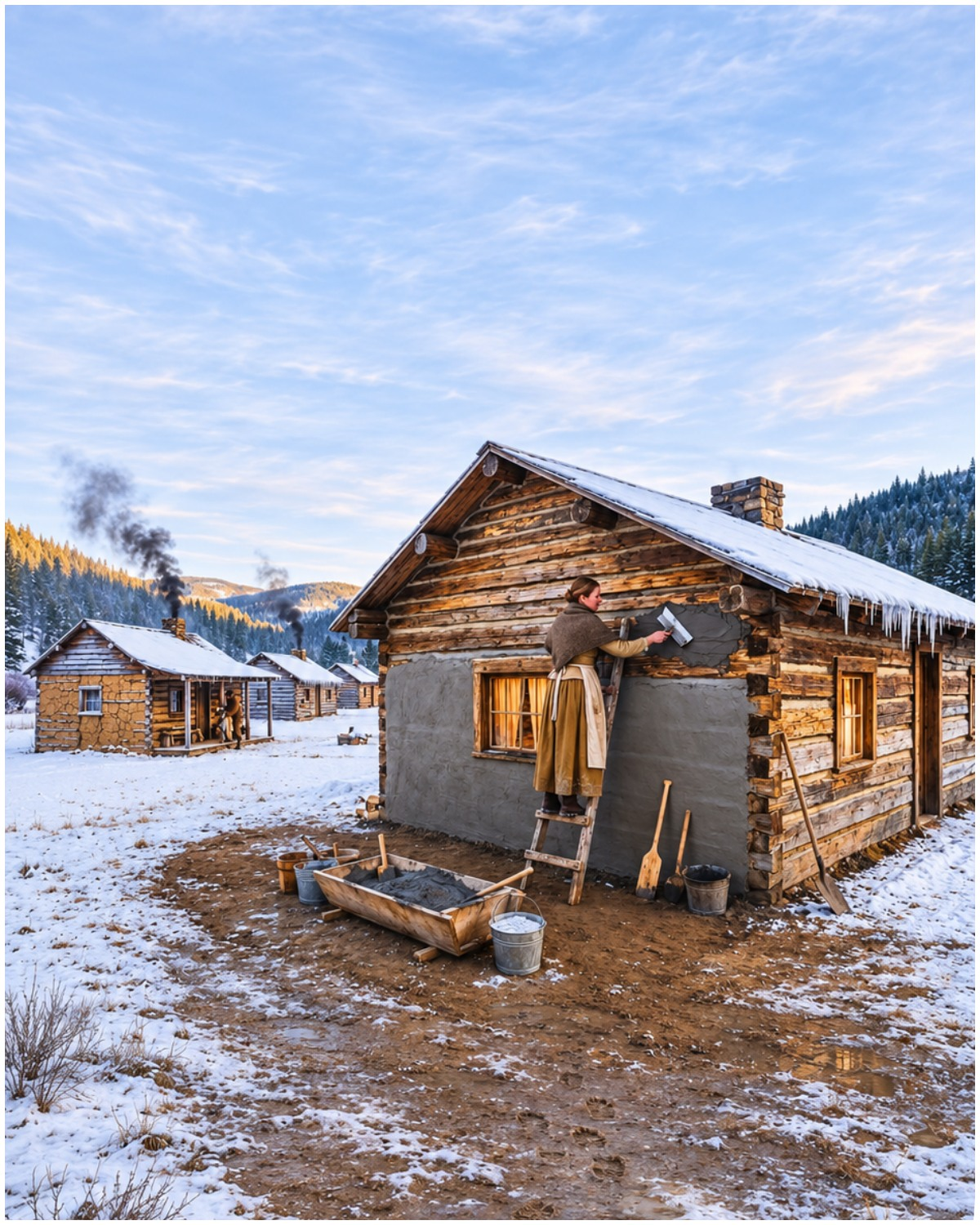
"Get down from that ladder before you ruin your husband's cabin!"
Ewan MacLeod stood beneath Annelise Vogel, holding a broken piece of gray plaster.
On its underside, four shallow lines had been scratched into the mixture.
He rubbed his thumb across them.
Then he looked up at her.
For the first time in thirty years of building homes, Ewan MacLeod wasn't certain he understood what he was looking at.
"Did you put these marks here?" he demanded.
Annelise glanced down from her ladder.
"Yes."
"Why?"
"Because the wall must be able to dry."
Ewan stared at the plaster again.
That answer was not what he expected.
And Annelise had no intention of explaining everything.
Not yet.
She turned back toward the cabin wall and pressed another layer of dark gray plaster between the pine logs.
The metal trowel made a soft scraping sound.
Behind her, Clearwater Valley stretched toward the snow-covered mountains of Montana Territory.
It was October 1878.
Winter was coming early.
And the Vogel family had just become the most talked-about household in the settlement.
Not because they were wealthy.
Not because they had done anything criminal.
But because Annelise Vogel was putting fireplace ash on the walls of her home.
To the people of Clearwater Valley, it was madness.
To Annelise, it was the only sensible thing she could do.
"Mrs. Vogel."
Ewan's voice hardened.
"I'm speaking to you."
"I heard you."
"Then come down here."
Annelise smoothed the plaster beneath the window frame.
"One moment."
Ewan removed his felt hat.
He was fifty-seven years old, with a thick gray beard and hands permanently scarred by decades of construction work.
He had built cabins for miners, barns for ranchers, and storehouses for merchants across Montana Territory.
People trusted his judgment.
When Ewan said a wall was sound, men slept comfortably behind it.
When he said a roof was unsafe, families moved out before the next storm.
He was accustomed to being listened to.
Annelise's refusal to stop working irritated him more than he cared to admit.
"You're covering perfectly good pine with mud," he said.
"Clay, sand, ash, and horsehair," she corrected.
"That doesn't make it better."
"It makes it different."
"Different doesn't mean good."
Annelise finally lowered her trowel.
She climbed down carefully.
Her dark leather boots settled into the muddy snow.
At twenty-eight, she was younger than most of the women Ewan knew who managed frontier households.
Her copper-red hair was arranged in a practical braided crown.
A few loose strands had escaped around her temples.
Her forest-green wool dress was faded at the elbows, and her cream linen apron carried so many gray stains that its original color was becoming difficult to recognize.
She looked tired.
She had been working since sunrise.
But there was nothing uncertain about the way she stood.
"Ewan," she said, "what happens when warm air escapes through a crack in the wall?"
"It goes outside."
"And what replaces it?"
"Cold air."
"Exactly."
He frowned.
"That's why we use chinking."
"Yes. But the chinking moves. The wood settles. Small openings return."
"That's the nature of a log cabin."
"It doesn't have to be the nature of ours."
Ewan gave a short, humorless laugh.
"You think you can improve on thirty years of building experience?"
"No."
"Then what are you doing?"
"Using something my father taught me."
Ewan glanced at the gray wall.
"Your father built cabins?"
"Stoves."
"Stoves?"
"Large ceramic heating stoves. In southern Germany."
Ewan looked almost relieved.
At last, he thought he understood.
"Well, there's your mistake. A stove isn't a house."
"No," Annelise agreed. "But heat doesn't care what kind of wall it escapes through."
For a moment, neither spoke.
The wind moved through the nearby pines.
Smoke rose from the chimneys of three distant cabins.
Somewhere across the settlement, an axe struck a chopping block.
Ewan studied her face.
She was not mocking him.
That made the conversation even more frustrating.
"Listen carefully," he said. "Wood needs a way to release moisture. Cover it carelessly, and you'll trap dampness against the logs. By spring, you could have rot where you can't even see it."
"I know."
"You know?"
"That is why I prepared the mixture properly. And why I'm watching where water can enter."
She gestured toward the cabin roof.
"The roof keeps rain and melting snow away from most of this wall. Carl repaired the flashing around the chimney. We cleared the ground beside the foundation. I am sealing the drafts, not pretending the wood has become stone."
Ewan looked toward the eaves.
He could see that the roof projected well beyond the wall.
He could also see the drainage channel Carl had dug along the uphill side of the cabin.
The work was careful.
That bothered him.
A foolish project would have been easier to dismiss if everything about it looked foolish.
"Your mixture still isn't proven," he said.
"Then winter will test it."
"And if you're wrong?"
Annelise glanced toward the warm window.
Inside, two small faces appeared behind the glass.
Liesl, eight years old, pressed her nose against the pane.
Jakob, six, stood beside her, holding a wooden horse his father had carved.
Annelise looked back at Ewan.
"Then I will have been wrong about something that matters very much."
Her answer was so simple that he found himself without a reply.
He replaced his hat.
"Don't say nobody warned you."
"I won't."
Ewan turned and walked toward the settlement.
He did not look back.
But before he reached the road, he muttered something beneath his breath.
Annelise couldn't hear the words.
She didn't need to.
By supper, everyone in Clearwater Valley would know that Ewan MacLeod had condemned the Vogel cabin.
And by morning, the story would be worse.
Carl Vogel returned from the woodpile shortly after sunset.
He was thirty-three, broad-shouldered, with a quiet face and the patient movements of a man accustomed to working with his hands.
His dark wool coat was dusted with sawdust.
A fresh stack of split pine stood beside the shed.
He had been preparing firewood for nearly three weeks.
The pile was growing.
But so was his concern.
He found Annelise washing her trowel beside the water barrel.
"MacLeod came by," he said.
She didn't look surprised.
"I know."
"He stopped me at the mill."
"What did he say?"
Carl hesitated.
"He said you're making a mistake."
Annelise rinsed the last gray streak from the blade.
"That is his opinion."
"He said you might ruin the logs."
"I explained the moisture problem."
"He said you didn't listen."
Annelise looked at her husband.
"Did he tell you what I said?"
Carl's silence answered the question.
She set the trowel aside.
"Come inside. Supper is ready."
But Carl didn't move.
"Annelise."
Something in his voice made her stop.
He looked toward the wall she had spent the afternoon covering.
The plaster was still dark with moisture.
Beside the window, the exposed pine logs showed the careful joinery he had worked so hard to achieve.
He had selected every timber.
Cut every notch.
Lifted every log with help from neighbors who had accepted little more than meals and promises of future labor.
The cabin was the greatest thing he had ever built.
And now half its exterior looked as though someone had covered it with river mud.
"Do you think people believe I built a bad house?" he asked.
Annelise felt the weight behind the question.
Carl was not vain.
He rarely spoke about his own abilities.
But she knew how much pride he took in his craftsmanship.
She stepped closer.
"Your joinery is excellent."
"Then why cover it?"
"Because excellent joinery cannot stop every draft when the wood shrinks."
He rubbed his hands together.
"Thomas says people are laughing."
"Thomas worries about what people think."
"He's my brother-in-law."
"That doesn't make him right."
Carl sighed.
"Silas Croft told three men at the store that we're building a house out of fireplace sweepings."
Annelise almost smiled.
Almost.
"At least he noticed the ash."
Carl did not laugh.
She reached for his hand.
"Listen to me. I am not covering your work because it is poor. I'm protecting it because it is good. I want this cabin to last."
He looked at her plaster-stained fingers.
"And if MacLeod is right?"
"Then we will find out. We will watch for dampness, repair anything that fails, and learn."
She paused.
"But I don't believe he is right about the drafts."
Carl studied her.
There had been a time when he would have mistaken her quiet confidence for stubbornness.
That was before they crossed the Atlantic together.
Before they spent nearly everything they owned traveling west.
Before he watched her deliver Jakob during a storm that trapped them miles from the nearest doctor.
Annelise was not a woman who made careless decisions.
But even a careful person could be wrong.
And they had very little room left for mistakes.
Their homestead claim covered 160 acres.
The land was good.
The timber was plentiful.
A narrow creek crossed the eastern boundary.
If they could establish themselves, improve the property, and satisfy the requirements of their claim, they could build a future there.
If they failed, they might lose everything they had worked for.
Carl squeezed her hand.
"Tell me again why the ash matters."
Annelise's expression softened.
"After supper."
Inside the cabin, the children were arguing over a wooden spoon.
Jakob insisted it belonged to him.
Liesl insisted she needed it to stir imaginary soup.
Neither seemed interested in surrendering.
"Enough," Carl said gently.
Both children stopped.
Liesl looked toward her mother.
"Did Mr. MacLeod say our house was bad?"
Annelise froze.
"Who told you that?"
"He was loud."
Jakob held his wooden horse against his chest.
"Is the house going to fall down?"
"No," Carl said immediately.
"Will the walls melt?" Jakob asked.
Annelise crouched beside him.
"Why would they melt?"
"Because you put mud on them."
Liesl rolled her eyes.
"It's not mud. It's ash plaster."
Jakob considered that.
"Will the ash burn?"
"No," Annelise said. "The ash has already been through the fire."
He looked impressed.
"Then it's stronger than fire?"
"Not exactly."
"Can it stop a bear?"
Carl laughed.
"Let's hope we never need to find out."
The children returned to their game.
Annelise watched them for a moment.
They had grown accustomed to uncertainty.
New countries.
New roads.
New neighbors.
A home that smelled of fresh-cut pine and sometimes leaked cold air around the window frames.
She wanted them to have something permanent.
Something that would not disappear because winter became cruel.
That evening, after the children went to bed, she brought a small wooden bowl to the table.
Inside was a handful of pale gray ash.
Carl sat opposite her.
She placed a lump of dried clay beside it.
Then a little sand.
Then several strands of horsehair.
"My father used different mixtures for different purposes," she began. "Some held heat. Some protected surfaces. Some helped seal gaps."
Carl examined the ingredients.
"And the ash?"
"It changes the texture of the plaster. It can help make the mixture easier to work. But the clay is what binds much of it together."
She picked up a small dried sample.
"I tested several batches before I began. Some cracked too much. Some crumbled. This one held together better."
Carl turned the sample over.
He noticed shallow lines on the back.
"Why the scratches?"
"To remember which batch it came from."
He looked up.
"That's all?"
"Four marks for the fourth mixture."
Carl smiled faintly.
"You've been experimenting."
"Since August."
"You never told me how many."
"Because the first three were terrible."
This time, he laughed.
Annelise joined him.
For a few seconds, the tension lifted.
Then Carl grew serious again.
"What if the wall stays damp?"
"We stop. We remove what is failing. We don't ignore it."
"And if it works?"
She glanced toward the stove.
The fire had burned low.
Yet the room felt noticeably more comfortable than it had the previous October.
Not warm enough to remove their shawls.
Not warm enough to forget winter was approaching.
But different.
Still.
"The wind won't carry away so much of what we burn," she said.
Carl looked toward the sleeping children.
"Then finish the walls."
Annelise reached across the table.
"Are you certain?"
"No."
He held her hand.
"But I trust you."
The next morning, Silas Croft arrived before breakfast.
Silas owned the general store and had a talent for making other people's problems sound entertaining.
He was a narrow-faced man with a pointed beard and a voice that traveled farther than it needed to.
He stopped beside the Vogel cabin.
Looked at the plaster.
And laughed.
"Well, I'll be damned."
Carl stood near the shed, carrying an armful of firewood.
"Morning, Silas."
Silas pointed at the wall.
"Is that the famous German mud?"
Annelise continued stirring the plaster.
"Good morning."
Silas walked closer.
"Looks like somebody scraped the bottom of a stove and smeared it on your house."
"There's clay in it too," Annelise said.
Silas laughed harder.
"Clay! Well, that changes everything."
Carl lowered the firewood.
"Did you need something?"
"Just passing through."
"Then keep passing."
Silas looked amused.
"No need to be touchy."
He turned toward the road.
"I've got to tell the boys about this. We ought to give the place a name."
Carl's face tightened.
Silas snapped his fingers.
"I've got it."
He looked back at the gray wall.
"The Ash Palace."
He laughed at his own invention.
Then he walked away.
By noon, three men had repeated the name.
By evening, five more had heard it.
And before the week ended, children passing the Vogel property were calling out, "Long live the Ash Palace!"
Annelise never answered them.
She kept working.
But Carl heard every word.
One afternoon, he drove his axe into a chopping block so hard that the handle vibrated.
Annelise watched from the ladder.
"That wood did nothing to deserve your anger."
Carl pulled the axe free.
"Neither did you."
She descended one step.
"Words won't change the plaster."
"They can change how people treat us."
"Then let them speak."
"You make it sound easy."
"It isn't."
Carl looked up.
She wiped a loose strand of copper hair from her cheek.
"I hear them too."
His anger faded.
"Then why don't you say something?"
"Because every hour I spend defending this wall is an hour I cannot spend finishing it."
He looked toward the mountains.
The snowline had moved lower.
"How much longer?"
"Two weeks if the weather holds."
"And if it doesn't?"
Annelise looked at the unfinished section beside the rear window.
"Then we work faster."
Three days later, Thomas arrived.
He was Annelise's brother-in-law through her older sister, who had settled farther east.
Thomas had helped the Vogels find their land.
He had also lent Carl money for nails and a pair of draft animals.
He was not an unkind man.
But he believed reputation mattered almost as much as survival.
He inspected the cabin without removing his gloves.
"This looks worse than Silas described."
Carl stood beside him.
"Good to see you too, Thomas."
Thomas ignored the remark.
He pressed his thumb against a dry section of plaster.
"People are talking."
"They always talk," Annelise said.
"They're saying you don't trust Carl's workmanship."
Carl's shoulders stiffened.
Annelise noticed.
She set down her trowel.
"That isn't true."
"Then why hide the logs?"
"Because we're trying to reduce the drafts."
Thomas shook his head.
"MacLeod says you're risking rot."
"MacLeod has not examined my test samples."
"MacLeod has built thirty cabins."
"And I have lived through winters he has never experienced."
Thomas looked offended.
"You're in Montana now, Annelise. Not Germany."
"I know where I live."
"Then perhaps you should listen to people who know this country."
Carl stepped forward.
"That's enough."
Thomas turned toward him.
"I'm trying to help."
"Then help us carry the sand."
Thomas stared.
Carl gestured toward the buckets.
"We've got work to finish."
For a long moment, Thomas said nothing.
Then he shook his head.
"You'll both regret being so proud."
He left without touching a bucket.
Annelise watched him disappear down the road.
Carl stood beside her.
"That could have gone better."
"Yes."
"Are you angry?"
"A little."
"At Thomas?"
"At the idea that listening only counts when I agree."
Carl looked at her.
Then he picked up a bucket.
"Where do you want this?"
She pointed toward the trough.
"Beside the ladder."
He carried it without another word.
By the end of October, the lower walls had begun to dry.
The gray surface hardened.
The worst drafts near the sleeping area diminished.
Annelise checked the plaster every morning.
She examined the corners.
Pressed her fingers against suspicious spots.
Looked for new cracks.
She refused to assume that success in one place guaranteed success everywhere.
When a small section near the north window began to separate, she removed it and prepared the surface again.
When Carl noticed, he frowned.
"Is something wrong?"
"That patch didn't bond well."
"Does it mean MacLeod was right?"
"It means I must repair it."
She worked until sunset.
The next morning, the replacement held.
But the incident reminded her that confidence was not the same as certainty.
The cabin was an experiment.
A careful one.
A necessary one.
And winter was approaching faster than anyone wanted.
One evening, Liesl sat beside the stove watching her mother mend a torn mitten.
"Mama?"
"Yes?"
"Why does everyone laugh at our house?"
Annelise kept sewing.
"Because it looks different."
"Is different bad?"
"No."
"Then why do they laugh?"
Annelise considered her answer.
"Sometimes people laugh when they don't understand something. Sometimes they laugh because other people are laughing."
Liesl looked toward the window.
"Silas says we live in a palace."
"Then perhaps we should ask him to send us a queen's dinner."
Liesl giggled.
But her smile faded.
"What if he's right?"
"About what?"
"What if our house really is silly?"
Annelise set down the mitten.
She pulled her daughter close.
"A house isn't good because people admire it."
"Then what makes it good?"
"It keeps the people inside safe."
Liesl thought about that.
"Will ours?"
Annelise kissed her forehead.
"I'm doing everything I know to make sure it does."
Outside, the wind struck the north wall.
For the first time since the previous winter, no sharp stream of cold air slipped through the gap beside Liesl's bed.
Annelise noticed.
She said nothing.
But she held her daughter a little closer.
On the first Monday of November, a black carriage stopped outside the Vogel homestead.
Carl was splitting firewood.
Annelise was repairing a narrow crack beneath the eastern window.
The carriage door opened.
A thin man in a dark overcoat stepped into the snow.
He carried a leather satchel and a bound ledger.
Carl recognized him immediately.
"Mr. Davies."
The man nodded.
"Mr. Vogel."
Mr. Davies was a railroad land agent whose reports could influence the paperwork and inspections connected with local land claims.
He was not a man who enjoyed surprises.
His eyes moved toward the gray wall.
Then toward the buckets.
Then toward Annelise.
"I received a rather unusual report about this property."
Carl set down his axe.
"What kind of report?"
Davies opened his ledger.
"An alteration to the dwelling. An experimental interior sheathing, according to the description."
Annelise climbed down from the ladder.
"That is not entirely accurate."
Davies examined the plaster.
"Then perhaps you can explain."
She told him about the clay.
The ash.
The sand.
The horsehair.
The drafts.
The test samples.
She spoke clearly.
Without exaggeration.
Without pretending the method was guaranteed to succeed.
Davies listened.
Then he tapped the wall with his fingernail.
"This isn't in any construction manual I've consulted."
"That doesn't mean it cannot work."
"It means I cannot certify it as a proven improvement."
Carl stepped forward.
"Are you saying our cabin doesn't count as a dwelling?"
"I'm saying its condition may require further review."
He opened his ledger to a marked page.
"The homestead claim is for 160 acres, correct?"
"Yes," Carl answered.
"And you've invested substantially in this property?"
"Everything we have."
Davies looked toward the unfinished wall.
"Then I strongly recommend you avoid unnecessary risks."
Annelise felt her stomach tighten.
But she kept her voice steady.
"What exactly are you recording?"
Davies dipped his pen into a small ink bottle.
"An observation."
"What observation?"
"That the dwelling has been modified using an unverified technique."
Carl looked at his wife.
For the first time, real fear crossed his face.
The laughter at the general store had been unpleasant.
Ewan's warnings had been frustrating.
Thomas's criticism had been painful.
But this was different.
This man carried a ledger.
And a ledger could become a letter.
A letter could become an official objection.
An official objection could threaten everything they had built.
Davies closed the book.
"I will return after the first severe weather. I expect the dwelling to remain sound."
Annelise nodded.
"It will."
Davies studied her.
"You sound very certain, Mrs. Vogel."
"No," she said. "I sound prepared."
He did not answer.
Instead, he returned to the carriage.
Carl watched the wheels disappear down the frozen road.
Then he turned toward Annelise.
"What happens if he decides the cabin isn't acceptable?"
She looked at the gray wall.
Then at the woodpile.
Then at the mountains.
"We show him that it is."
Carl swallowed.
"And if winter proves us wrong?"
Annelise had no comforting answer.
So she told him the truth.
"Then we will have to face that together."
A long silence followed.
Carl picked up his axe.
Annelise climbed back onto the ladder.
Neither spoke again until dusk.
That night, after the children were asleep, Annelise heard footsteps outside.
She looked up from the table.
Carl was checking the stove.
"Did you hear that?"
He stopped.
Another sound came from beyond the north wall.
A faint scrape.
Then silence.
Carl reached for the lantern.
"Probably an animal."
Annelise stood.
The sound came again.
This time, it was unmistakable.
Someone was touching the wall.
Carl opened the door.
Cold air rushed inside.
He raised the lantern.
"Who's there?"
No answer.
Annelise stepped beside him.
The yard was empty.
But near the north window, fresh boot prints marked the snow.
They led directly to the plastered wall.
Carl approached.
He held the lantern higher.
A small section of plaster had been scraped away.
Not by weather.
Not by an animal.
By a tool.
Annelise knelt beside the damaged area.
The marks were fresh.
Someone had deliberately cut into the wall.
Carl's voice dropped.
"Who would do this?"
Annelise examined the exposed timber.
Then she noticed something caught beneath the edge of the damaged plaster.
A folded piece of paper.
She pulled it free.
There were only seven words written across it.
She read them once.
Then again.
Carl saw her expression change.
"What does it say?"
Annelise slowly turned the paper toward the lantern.
The handwriting was unfamiliar.
But the message was clear.
"Stop now, or you'll lose the land."
Carl stared at the words.
Then, from the darkness beyond the woodpile, someone spoke.
"That's the only warning you'll get."






Comments 0