"That name was written before I ever came to Montana."
Annelise Vogel held the charcoal rubbing beneath the lantern.
Carl stood beside her, staring at the dark letters that had appeared on the paper.
MacLeod.
The same name as the man who had publicly condemned their cabin.
The same man whose signature appeared on the complaint threatening their homestead.
The same man who had recently begun helping them investigate the mysterious warning.
Carl reached for the paper.
"Are you certain this came from your father's notebook?"
"Yes."
"And he wrote it nine years ago?"
"The impression was made on the inside of the cover. I found it beneath his last letter."
Carl examined the faint marks.
"Could it be another MacLeod?"
"It could."
"But you don't believe that."
Annelise looked toward the window.
Outside, the first heavy snow of November was falling across Clearwater Valley.
"I don't know what to believe."
Carl lowered the paper.
"Then tomorrow we ask him."
Annelise shook her head.
"Not yet."
"Why?"
"Because I want to know what the rest of the warning says."
She turned the notebook over.
The worn leather cover had begun separating from its stitching.
Inside, several shallow impressions remained visible beneath the charcoal rubbing.
The name was clear.
The words above it were not.
Carl leaned closer.
"Can you make out anything else?"
Annelise held the paper toward the flame.
A few letters emerged.
Then a number.
1869.
And beneath it, two words written in German.
Falscher Bericht.
Carl watched her expression change.
"What does that mean?"
She swallowed.
"False report."
He stared at her.
"Your father wrote about a false report involving someone named MacLeod?"
"That is what it appears to say."
Carl sat down heavily.
For several seconds, neither spoke.
Then he looked at the complaint lying on the table.
"Annelise, someone filed a false report about our cabin."
"I know."
"And now we find the same words in your father's papers."
She closed the notebook carefully.
"That doesn't prove the two things are connected."
"But it is strange."
"Very."
Carl rubbed his forehead.
"How could your father have known Ewan MacLeod?"
Annelise had no answer.
Her father had spent most of his life in southern Germany.
Ewan had told them he had worked across Montana Territory for decades.
Their worlds seemed impossibly distant.
Yet the name remained.
She looked at the letter again.
There is one mistake you must never repeat.
The missing page suddenly felt more important than anything else in the room.
Someone had removed it.
Perhaps years ago.
Perhaps before the notebook ever reached her.
But without it, she could not know what her father had intended to warn her about.
Carl reached across the table.
"We'll find out."
Annelise nodded.
But she did not sleep much that night.
By morning, Clearwater Valley had turned white.
Snow covered the cabin roof.
Long icicles hung from the eaves.
The distant mountains disappeared behind low clouds.
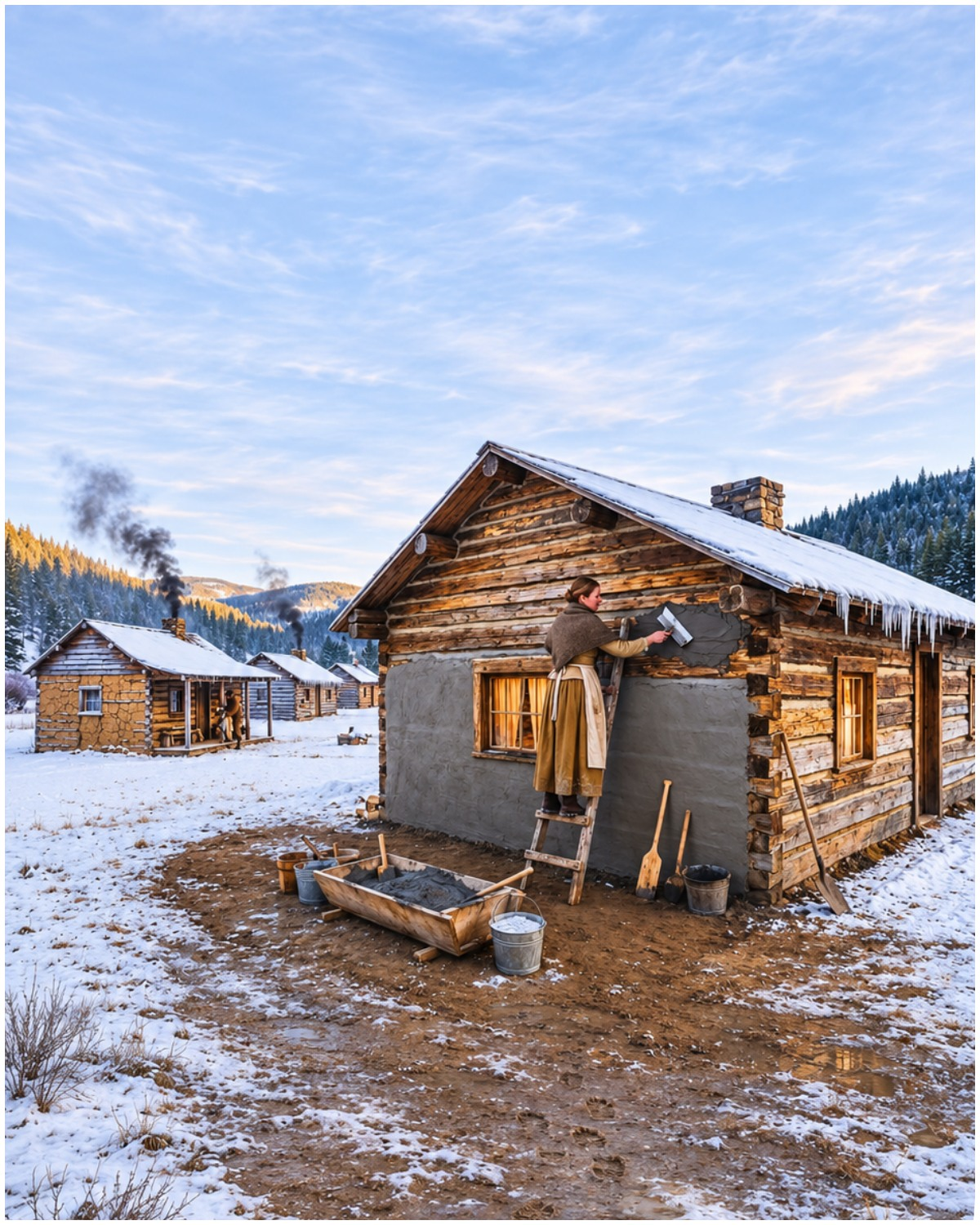
Carl cleared a path from the door to the woodpile while Annelise checked the plastered walls.
The mixture had dried into a firm gray surface.
Near the north window, the repaired section remained sound.
There were no new cracks.
No visible dampness.
No sharp draft cutting across the floor.
She pressed her palm against the wall.
Cool.
But not icy.
The difference mattered.
Last winter, cold air had slipped through the gaps between the logs so fiercely that Jakob's blanket sometimes moved in the wind.
Now the room felt still.
The stove burned at a steady pace.
Annelise had begun recording how much wood they used each day.
She wanted evidence.
Not guesses.
Not pride.
Not stories told at the general store.
Evidence.
She marked another line in her notebook.
Carl entered carrying an armful of split pine.
"How does it look?"
"Good so far."
"Any moisture?"
"Nothing unusual in the places I've checked."
He stacked the wood beside the stove.
"Then perhaps we should invite Davies to inspect it again."
Annelise looked up.
"Not until we understand the complaint."
Carl nodded reluctantly.
He knew she was right.
But the uncertainty was wearing him down.
Every day brought another rumor.
Every visit to town became an argument.
Every time someone passed their property, he wondered whether they were looking at the cabin or judging the family inside.
He wanted the matter settled.
Annelise wanted the same thing.
But she had learned from her father that rushing to prove a point could be more dangerous than waiting for the right evidence.
At the general store, Silas Croft had found a new audience.
Three farmers stood beside the counter.
A railroad worker warmed his hands near the stove.
Thomas sat on a wooden chair, waiting for a sack of flour.
Silas leaned forward.
"Have you heard what the Vogels are doing now?"
One farmer shook his head.
"What?"
"They're keeping records of their firewood."
The men laughed.
Silas spread his hands.
"Apparently Mrs. Vogel intends to prove that her mud walls can defeat winter itself."
Thomas looked up.
"That's not what she's doing."
Silas turned.
"Oh? Then what is she doing?"
"Trying to keep her children warm."
The store became quieter.
Silas smiled thinly.
"Well, nobody objects to warm children."
"Then stop making a joke of it."
One of the farmers shifted uncomfortably.
Silas rested his elbows on the counter.
"Thomas, your sister-in-law is turning a perfectly respectable cabin into a gray cave. People are entitled to an opinion."
"An opinion is one thing."
"And laughter is another?"
"Threatening a family's land is another."
Silas's expression hardened.
"I haven't threatened anyone."
Thomas looked directly at him.
"I didn't say you had."
For a moment, neither man moved.
Then Silas turned toward the railroad worker.
"See what I mean? The whole family has become touchy."
The worker said nothing.
He kept his hands near the stove.
But Thomas noticed something.
When Silas mentioned the Vogel claim, the railroad worker glanced toward a folded map lying behind the counter.
It was only a moment.
A quick movement of the eyes.
Then the man looked away.
Thomas remembered it.
He said nothing.
Not yet.
That afternoon, Ewan MacLeod arrived at the Vogel cabin.
He came on foot, carrying his notebook and a small canvas bag.
Carl met him outside.
"We need to talk."
Ewan stopped.
"About the complaint?"
"About something else."
Carl led him inside.
Annelise stood beside the table.
Her father's notebook lay open beneath the lantern.
Ewan removed his hat.
"Mrs. Vogel."
"Mr. MacLeod."
She gestured toward the chair.
"Please sit."
He looked from her to Carl.
"What's happened?"
Annelise placed the charcoal rubbing before him.
"Do you recognize this name?"
Ewan leaned closer.
His eyes narrowed.
"MacLeod."
"Yes."
He looked up.
"That's my name."
"I know."
"Where did you get this?"
"From my father's papers."
Ewan stared at her.
"Your father?"
"Johann Friedrich Bauer. He was a master stove builder in southern Germany."
The old builder's expression changed.
Not dramatically.
Not enough for Carl to be certain.
But Annelise saw it.
A slight tightening around the eyes.
A pause before he answered.
"Never heard of him."
She watched him carefully.
"Are you sure?"
"Yes."
She turned the notebook toward him.
"The impression is dated 1869."
Ewan looked at the date.
Then at the words above it.
"What language is that?"
"German."
"What does it say?"
"False report."
The old man's face became still.
Carl leaned forward.
"Do you know anything about it?"
Ewan shook his head.
"No."
Annelise studied him.
"Have you ever worked outside America?"
"Not as a builder."
"Have you ever traveled to Germany?"
"No."
"Do you have relatives there?"
Ewan frowned.
"Not that I know of."
Carl crossed his arms.
"Then why is your name in her father's notebook?"
Ewan looked irritated.
"MacLeod isn't a rare name where I come from."
"Perhaps not," Annelise said.
She turned another page.
"But my father rarely wrote names without a reason."
Ewan looked at the notebook.
"May I see it?"
Annelise hesitated.
Then handed it to him.
He turned several pages.
Studied the drawings.
Examined the measurements.
His expression gradually changed.
The irritation faded.
In its place came something closer to professional curiosity.
"These are stove plans?"
"Yes."
"Interesting."
He examined a cross-section.
"Very interesting."
Annelise watched him.
"Why?"
Ewan pointed toward a narrow passage in the drawing.
"Your father understood how to guide hot gases through a masonry structure."
"Yes."
"And how to store heat in the mass."
"Yes."
He turned another page.
"This is careful work."
Annelise said nothing.
Ewan looked up.
"I can see why you trusted him."
For a moment, the room felt less hostile.
Then Carl spoke.
"That still doesn't explain the name."
Ewan closed the notebook.
"No."
He placed it on the table.
"But I can tell you something."
Annelise waited.
"In 1869, I was working near Fort Benton. A Scottish engineer named Malcolm MacLeod came through with a survey party."
Carl leaned forward.
"Related to you?"
"Distantly. We shared a grandfather."
Annelise felt her pulse quicken.
"What happened to him?"
Ewan looked toward the window.
"He left the territory that winter. I heard he traveled east. After that, I lost track of him."
"Did he ever go to Europe?"
"I don't know."
"Was he involved in construction?"
"Surveying. Engineering. Sometimes inspection work."
Carl looked at Annelise.
The coincidence was no longer quite so impossible.
But it raised more questions than it answered.
"Did Malcolm ever mention Germany?" she asked.
Ewan thought for a moment.
"Not to me."
"Did he write reports?"
"Constantly."
"What kind?"
"Survey reports. Structural assessments. Recommendations for roads and buildings."
Annelise looked down at the words.
False report.
A cold sensation moved through her.
Ewan followed her gaze.
"Mrs. Vogel, I don't know whether that name refers to Malcolm. But if it does, your father may have encountered him somewhere."
Carl asked, "Is Malcolm still alive?"
Ewan's expression darkened.
"I haven't heard from him in years."
"Can you find out?"
"I can try."
Annelise closed the notebook.
"Then please do."
Ewan nodded.
But as he rose to leave, he paused.
"There's something else."
Carl looked at him.
"What?"
"Malcolm had a habit of working for men who wanted land."
Annelise felt her stomach tighten.
"What kind of men?"
"Railroad investors. Mining companies. Speculators."
Ewan put on his hat.
"He was good at making a piece of property look valuable to one man and worthless to another."
The room fell silent.
Then Ewan added, "And he was very good at writing reports."
After Ewan left, Carl paced the kitchen.
"Do you think Malcolm is involved?"
"We don't know whether he's even alive."
"But the name."
"Yes."
"And the false report."
"Yes."
"And now Davies is questioning our claim."
Annelise sat at the table.
The connections were troubling.
But she refused to turn suspicion into certainty.
"Someone may be using a similar method," she said. "That doesn't mean the same person is behind it."
Carl stopped pacing.
"How can you stay so reasonable?"
"Because we cannot afford to accuse the wrong man."
He looked at her.
She continued.
"If we make a mistake, the person threatening us may use it against us."
Carl sat down.
He knew she was right.
But he was beginning to hate the feeling of being watched.
He had built the cabin with his own hands.
He had cleared the land.
Dug the drainage channels.
Raised the roof.
Planted the first small garden.
And now strangers were discussing whether his family deserved to remain there.
He looked toward the sleeping area.
Liesl and Jakob were playing quietly.
Their voices drifted through the curtain.
Carl lowered his voice.
"I won't let anyone take this place from them."
Annelise reached for his hand.
"Neither will I."
The following Sunday, the Vogel family attended the settlement's small church.
They had missed the previous service because of the plaster work.
Annelise hoped the morning would provide a few hours away from the arguments.
Instead, she discovered that the Ash Palace had become more than a joke.
It had become a reason for people to avoid them.
When she entered the church, two women stopped talking.
One moved her shawl from an empty section of bench.
Another glanced at Annelise's apron, even though it was freshly washed.
Carl noticed.
He placed a hand at the small of his wife's back.
They sat near the rear.
Liesl folded her hands carefully.
Jakob stared at the wooden beams above them.
The service began.
The minister spoke about charity.
Patience.
The duty neighbors owed one another.
Annelise listened.
But she could feel eyes turning toward her whenever the minister mentioned pride.
Afterward, outside the church, a woman named Martha Bell approached.
Martha was the wife of a farmer who lived two miles east of the settlement.
She had three children.
Her youngest had been ill during the previous winter.
"Mrs. Vogel," Martha said quietly.
"Good morning."
Martha glanced around.
"May I ask you something?"
"Of course."
"Is it true your cabin doesn't have drafts anymore?"
Annelise hesitated.
"Not entirely. But we've reduced several of the worst ones."
Martha looked toward her husband, who was speaking with another farmer.
"Our youngest sleeps near the north wall. Last winter, the wind came through so badly that we hung blankets over the logs."
Annelise nodded.
"We did the same."
"Did your plaster help?"
"Yes, in the sections we've finished. But we're still checking how it behaves as the weather changes."
Martha looked relieved.
"Could you show me?"
Annelise smiled.
"Of course."
Before she could say more, Silas Croft approached.
"Careful, Martha. Next thing you know, you'll be living in an Ash Palace too."
Several people laughed.
Martha's cheeks reddened.
Annelise turned toward Silas.
"Good morning."
Silas smiled.
"Morning, Your Majesty."
Carl stepped forward.
"That's enough."
Silas raised both hands.
"Just a joke."
"Then find a new one."
The laughter stopped.
Silas's smile disappeared.
For a moment, the two men faced each other.
Then the minister approached.
"Gentlemen."
Carl stepped back.
Silas adjusted his coat.
"No trouble here."
He walked away.
Martha looked embarrassed.
"I'm sorry."
Annelise shook her head.
"You have nothing to apologize for."
Martha glanced toward the road.
"Could I come tomorrow?"
"Yes."
"After breakfast?"
"That would be fine."
Martha nodded gratefully.
Then she hurried away.
Carl watched her go.
"At least someone is interested."
Annelise looked toward the church.
"Someone who needs help."
Martha arrived the next morning carrying a small basket of eggs.
She came alone.
Annelise welcomed her inside.
The woman stopped just beyond the doorway.
She looked around.
Then frowned.
"It's quieter than I expected."
Annelise closed the door.
"What do you mean?"
"The wind."
Martha listened.
Outside, gusts struck the cabin.
Inside, the air remained relatively still.
She moved toward the north wall.
"May I?"
"Of course."
Martha placed her hand near the window.
Then along the lower logs.
She looked surprised.
"I can hardly feel anything."
"That section is sealed."
Martha turned.
"How much wood do you burn?"
Annelise showed her the record book.
She explained that they had only a short period of observations and that the weather had not yet reached its worst.
Martha listened carefully.
Then Annelise demonstrated the two wooden boxes.
She lit a candle.
Held it near the open gap.
The flame bent.
Then she moved it toward the sealed box.
The flame remained steadier.
Martha stared.
"That's what happens in our bedroom."
Annelise nodded.
"The air moves through the cracks."
"And the stove has to keep warming the air that replaces it."
"Exactly."
Martha looked at the gray wall.
"Could I make this plaster?"
"With the right materials and preparation, perhaps. But first we'd need to examine your wall and see where the water goes."
Martha nodded.
"I don't want to damage the house."
"Neither do I."
The two women shared a small smile.
Then Martha said something that made Annelise's expression change.
"Silas told my husband your plaster was dangerous because it had already failed in another settlement."
Annelise stared.
"What?"
"He said a family near Helena used something similar. Their walls rotted."
"Did he say who?"
"No."
"When?"
"He didn't say."
Annelise felt anger rise.
She kept her voice controlled.
"Has he seen that house?"
"I don't know."
"Then he shouldn't be telling people it failed."
Martha looked uncomfortable.
"I thought you should know."
"Thank you."
Martha reached for her basket.
"I brought eggs."
Annelise smiled.
"You didn't need to."
"I know."
She placed the basket on the table.
"But you were kind to me when everyone else was laughing."
Annelise looked at the eggs.
Then at Martha.
For the first time in weeks, she felt something like hope.
Not because the town had changed.
It hadn't.
But because one person had chosen to ask questions instead of repeating rumors.
That afternoon, Annelise went to the general store.
Carl offered to accompany her.
She refused.
"I can speak for myself."
He looked uncertain.
"Silas enjoys provoking people."
"Then he may be disappointed."
She walked into town carrying one of the wooden demonstration boxes.
The store was busy.
Several men stood near the stove.
Two women examined cloth.
Silas looked up from behind the counter.
"Well, well. The queen herself."
Annelise placed the box on the counter.
"Good afternoon, Mr. Croft."
Silas glanced at it.
"What's that?"
"A demonstration."
"Of what?"
"Air movement."
One of the men laughed.
Silas leaned forward.
"Are you selling mud now?"
"No."
"Then what do you want?"
"I understand you've been telling people my plaster failed in another settlement."
The store became quiet.
Silas's smile faded.
"People talk."
"Did you see the house?"
"No."
"Did you speak with the family?"
"No."
"Do you know what mixture they used?"
Silas frowned.
"What's your point?"
"My point is that you're presenting a rumor as a fact."
A farmer near the stove shifted his weight.
Silas folded his arms.
"Are you calling me a liar?"
"I'm asking you to be accurate."
The words were calm.
Almost gentle.
That made them harder to dismiss.
Silas glanced at the men around him.
"Everyone knows you can't cover logs with mud and expect miracles."
"I don't expect miracles."
"Then what do you expect?"
"Less moving air."
She opened the wooden box.
Several customers leaned closer.
Annelise explained the gap.
The sealed joint.
The candle.
She demonstrated how the flame responded.
The men watched.
No one laughed.
Silas looked irritated.
"That doesn't prove your house won't rot."
"No," Annelise said. "It doesn't."
The admission surprised everyone.
She continued.
"It shows why drafts matter. Moisture is a separate concern, and I'm checking that carefully."
One farmer stepped forward.
"My north wall leaks air badly."
Annelise nodded.
"Then you should find where the air enters."
"Would your mixture help?"
"Possibly. But first you need to make sure water isn't getting into the wood."
Another man asked about the ash.
A woman asked about the horsehair.
Within minutes, the conversation had changed.
People were asking practical questions.
Silas watched his audience slip away.
Then he struck the counter with his palm.
"Enough!"
Everyone turned.
He pointed toward Annelise.
"This woman is making fools of you."
Annelise remained still.
Silas continued.
"She comes here with a little box and a candle, and suddenly you think she's smarter than every builder in Montana."
"No," Annelise said quietly.
Silas leaned forward.
"Then what are you saying?"
"I'm saying you can look for yourself."
The room fell silent.
Silas stared at her.
For the first time, he seemed to understand that ridicule was no longer working.
He had expected embarrassment.
He had expected anger.
He had expected her to retreat.
Instead, she had brought evidence.
And people were listening.
Annelise left the store shortly before sunset.
The sky had turned pale gray.
Snow drifted across the road.
She carried the demonstration box beneath one arm.
As she passed the blacksmith's shop, she heard footsteps behind her.
She turned.
Thomas was approaching.
His expression was serious.
"Annelise."
"Thomas."
"I heard what happened at the store."
"Then you heard Silas was unhappy."
Thomas did not smile.
"There's something you need to see."
He held out a folded sheet of paper.
Annelise took it.
It was a rough copy of a map.
A line crossed Clearwater Valley.
It followed the eastern creek.
Then curved directly through the Vogel property.
Annelise stared at it.
"Where did you get this?"
"From a man who works with the survey crew."
"Is it official?"
"Not yet."
She looked at the line again.
It crossed the land where Carl had planted their first garden.
It passed close to the cabin.
It continued toward the narrow passage through the hills.
Thomas lowered his voice.
"Someone wants a railroad access route through your claim."
Annelise felt her chest tighten.
"Who?"
"I don't know."
"Does Davies know?"
Thomas looked away.
"Annelise, Davies may be the one helping them."
She stared at him.
The threat.
The complaint.
The rumors.
The pressure to stop improving the cabin.
Suddenly, the pieces seemed to fit together.
But one question remained.
Why would anyone care whether she finished the plaster?
Thomas seemed to read her thoughts.
"If the cabin is declared unsuitable, they may argue your improvements don't satisfy the claim requirements."
Annelise looked toward the mountains.
The sun had nearly disappeared.
"Then they could challenge our claim."
"Yes."
"And if they succeed?"
Thomas swallowed.
"Someone else could try to acquire the land."
Annelise folded the map.
Her hands were steady.
But her heart was pounding.
"Does Carl know?"
"Not yet."
She looked toward the road leading home.
"Then we need to tell him."
Thomas nodded.
"I'll come with you."
They reached the Vogel cabin after dark.
Carl was standing outside with a lantern.
He looked relieved when he saw them.
"Where have you been?"
"At the store," Annelise said.
Thomas dismounted.
"We need to talk."
Inside, Annelise spread the map across the table.
Carl leaned over it.
His expression changed as he followed the line.
"That's our creek."
"Yes."
"And that's our cabin."
"Yes."
He looked up.
"Who drew this?"
Thomas explained what he knew.
Carl listened.
Then he sat down.
For several seconds, he said nothing.
Finally, he looked at Annelise.
"They want the land."
"It appears someone may."
"All this time, I thought they were laughing because of the plaster."
"Some of them probably were."
"But someone else may have been using it."
Annelise nodded.
Carl stared at the map.
His face hardened.
"Then we're not stopping."
"No."
"We finish the walls."
"Yes."
"And we keep every record."
"Every one."
Carl looked toward the sleeping area.
The children were quiet.
The stove burned steadily.
Outside, the wind struck the cabin.
But no cold draft slipped through the north wall.
Carl reached for his wife's hand.
"We built this home together."
Annelise squeezed his fingers.
"And we'll protect it together."
Later that night, after Thomas had gone, Annelise returned to her father's notebook.
She opened it to the page containing the name MacLeod.
The charcoal rubbing lay beside the railroad map.
She studied both.
A false report in 1869.
A questionable complaint in 1878.
A surveyor named Malcolm MacLeod.
A land agent named Davies.
A railroad route crossing their property.
The connections were troubling.
But they were still incomplete.
She turned the notebook over.
Then examined the loose stitching near the back cover.
Something caught her eye.
A thin strip of paper protruded from beneath the leather.
She had not noticed it before.
Carefully, she lifted the damaged edge.
The paper moved.
It was folded tightly.
Hidden inside the binding.
Annelise reached for a small knife.
She slipped the blade beneath the stitching.
One thread broke.
Then another.
The folded paper came free.
It was old.
Yellowed.
Covered in her father's handwriting.
She opened it beneath the lantern.
At the top was a date.
March 1869.
Below it, a heading in German.
Bericht über den amerikanischen Ingenieur.
Report concerning the American engineer.
Annelise felt her pulse quicken.
She began reading.
The first paragraph described a man who had visited her father's workshop.
A man who wanted to purchase the rights to a heating method.
A man who claimed he could introduce the technique to wealthy investors overseas.
Her father had refused.
The next paragraph described a dispute.
A false inspection report.
An attempt to discredit the method.
Then came a warning.
Annelise leaned closer.
The final lines were difficult to read.
She brought the lantern nearer.
The handwriting became clearer.
Her father had written the engineer's full name.
Not Ewan MacLeod.
Malcolm MacLeod.
And beneath it, one final sentence.
Annelise translated the words silently.
Her hands began to tremble.
The sentence did not warn her about the engineer's methods.
It warned her about the person who had financed him.
She read the name once.
Then again.
Outside, a horse stopped beside the cabin.
Footsteps crossed the porch.
Someone knocked three times.
Carl rose from his chair.
"Who is it?"
A man's voice answered from the darkness.
"Mr. Vogel. This is Davies. Open the door."
Annelise looked down at the name in her father's letter.
Then toward her husband.
Her face went white.
Because the name written beneath Malcolm MacLeod's was—
Davies.






Comments 0