"You signed a complaint against my family?"
Carl Vogel slammed the folded document onto Ewan MacLeod's workbench.
The old builder looked up from the wooden window frame he was repairing.
For a moment, he said nothing.
Then his eyes settled on the signature at the bottom of the page.
His expression changed.
"Where did you get that?"
"Answer me."
Ewan set down his plane.
Carl stepped closer.
"Yesterday, you told my wife you wanted to understand her work. You stood beside our children and promised to help if someone threatened us again."
Ewan reached for the document.
Carl pulled it away.
"And now you're trying to take our land?"
The old builder's jaw tightened.
"I didn't file a complaint against your land."
"Your name is on it."
"I can see that."
"Then explain it."
Ewan held out his hand.
"Let me read the whole thing."
Carl hesitated.
Then he pushed the paper across the bench.
Ewan read slowly.
His weathered face grew darker with every paragraph.
When he reached the final line, he stopped.
He examined the signature.
Then he looked at Carl.
"This isn't what I signed."
Carl gave a bitter laugh.
"Of course it isn't."
"I'm telling you the truth."
"Then whose signature is that?"
"Mine."
Carl stared at him.
Ewan continued before he could speak.
"I signed a statement three weeks ago. Davies asked whether I'd inspected the Vogel cabin. I told him I'd seen the plaster and had concerns about moisture. I said the method needed examination before anyone could call it proven."
"And?"
"And that was all."
Carl pointed at the document.
"This says our dwelling may be unsafe. It asks for an official review of our claim."
Ewan's eyes narrowed.
"I never requested that."
"Then somebody changed your statement."
"Or attached my signature to something I never agreed to."
The workshop fell silent.
Outside, a gust of wind rattled the barn door.
Carl looked at the document again.
He wanted to believe the old builder.
But believing people had become difficult.
First came the laughter.
Then the threat.
Then the damage to the cabin.
Now a formal complaint bearing the signature of the most respected builder in Clearwater Valley.
Every incident seemed to push the Vogel family toward the same conclusion.
Stop working.
Admit defeat.
Abandon the strange gray plaster.
Carl folded the paper.
"Why should I trust you?"
Ewan looked at him for a long moment.
"You shouldn't trust anyone merely because he asks you to."
He reached beneath his workbench and opened a narrow drawer.
Inside were carpenter's pencils, measuring cords, receipts, and several folded papers.
He searched until he found a small notebook.
Then he turned to a marked page.
"Look."
Carl leaned closer.
The page contained a handwritten record dated October 16.
Vogel residence. Unusual ash-and-clay wall covering. Moisture concerns. Further observation recommended.
Beneath it was Ewan's signature.
Nothing about an unsafe dwelling.
Nothing about removing the family from its land.
Nothing about an official complaint.
Carl examined the writing.
"Is this your copy?"
"My record of what I told Davies."
"Can you prove it?"
Ewan's face hardened.
"I've kept records of every structure I've inspected for twenty years."
"That doesn't prove what Davies filed."
"No."
Ewan closed the notebook.
"But it gives us somewhere to begin."
Carl looked toward the window.
He had arrived expecting an argument.
Perhaps even a fight.
Instead, he was leaving with a more frightening possibility.
Someone was using the authority of Ewan MacLeod to make the Vogel family appear unfit to keep its homestead.
And that person might have access to official documents.
"Come with me," Carl said.
"Where?"
"To my wife."
Ewan put on his coat.
For once, he did not argue.
Annelise was standing beside the kitchen stove when the two men entered.
She had spent the morning repairing a section of plaster near the rear window.
Her forest-green dress was dusted with ash.
A pale streak of dried clay crossed her cheek.
Liesl sat at the table practicing letters on a slate.
Jakob was building a small cabin from scraps of wood.
When he saw Ewan, he immediately looked toward his mother.
"Is he here to tell us the walls are bad again?"
Ewan stopped.
Carl looked embarrassed.
Annelise glanced at her son.
"Mr. MacLeod has come to discuss something important."
Jakob considered that.
"Will he be loud?"
Ewan removed his hat.
"No, young man."
"Good."
Jakob returned to his wooden blocks.
Ewan watched him for a moment.
Then he looked at Annelise.
"Mrs. Vogel, I owe you an explanation."
She folded her arms.
"About the complaint?"
"Yes."
Carl placed the document on the table.
Ewan showed her his notebook.
He explained the statement he had signed.
The concerns he had expressed.
The words he insisted had been added without his knowledge.
Annelise listened without interrupting.
When he finished, she examined the two documents side by side.
The signatures were similar.
But not identical.
On the notebook page, Ewan's final letter ended with a long downward stroke.
On the complaint, the same letter ended abruptly.
She leaned closer.
"Mr. MacLeod."
"Yes?"
"Did you sign the original statement in Davies's office?"
"No. At the general store."
Annelise looked up.
"Who was present?"
"Davies. Silas Croft. Two customers, I believe."
"Did Davies write the statement?"
"Yes."
"Did you read it?"
Ewan hesitated.
Carl noticed.
"Did you?"
"Not every word."
Annelise said nothing.
Ewan's face reddened.
"He summarized it. I read the final paragraph and signed."
"Then you don't know exactly what was on the page."
"I know what we discussed."
"That is not the same thing."
Ewan looked away.
For the first time, the old builder seemed genuinely ashamed.
Annelise touched the complaint.
"This paper may have been altered. Or you may have signed something different from what you believed. We need to know which."
Carl nodded.
"And we need to know why."
Annelise studied the handwriting.
The letters were carefully formed.
The language was formal.
But one phrase caught her attention.
Failure to maintain a suitable dwelling may compromise the validity of the family's improvements.
She had heard similar language before.
Davies had used it during his inspection.
She remembered the way he had opened his ledger.
The way he had tapped the plaster.
The way he had asked how much money they had invested.
At the time, she had assumed he was merely cautious.
Now she was less certain.
"Mr. MacLeod," she said, "would you be willing to tell the sheriff exactly what you told us?"
Ewan straightened.
"Yes."
"And Davies?"
"Yes."
"And anyone else who asks?"
He met her eyes.
"Yes."
She nodded.
"Then we have a place to start."
Carl looked at his wife.
"You believe him?"
"I believe we have enough reason to investigate."
Ewan lowered his gaze.
It was not forgiveness.
But it was more than he had expected.
That afternoon, Annelise returned to her work.
Carl wanted her to rest.
She refused.
The weather had turned colder.
A thin crust of ice covered the water barrel each morning.
The wind had begun to whistle through the pines with a sharper sound.
They had no time to waste.
Carl stood beneath the ladder, holding a bucket of plaster.
"You're still thinking about Davies."
"Yes."
"Do you think he wrote the threat?"
"I don't know."
"Silas?"
"I don't know that either."
Carl sighed.
"You keep saying that."
"Because it is true."
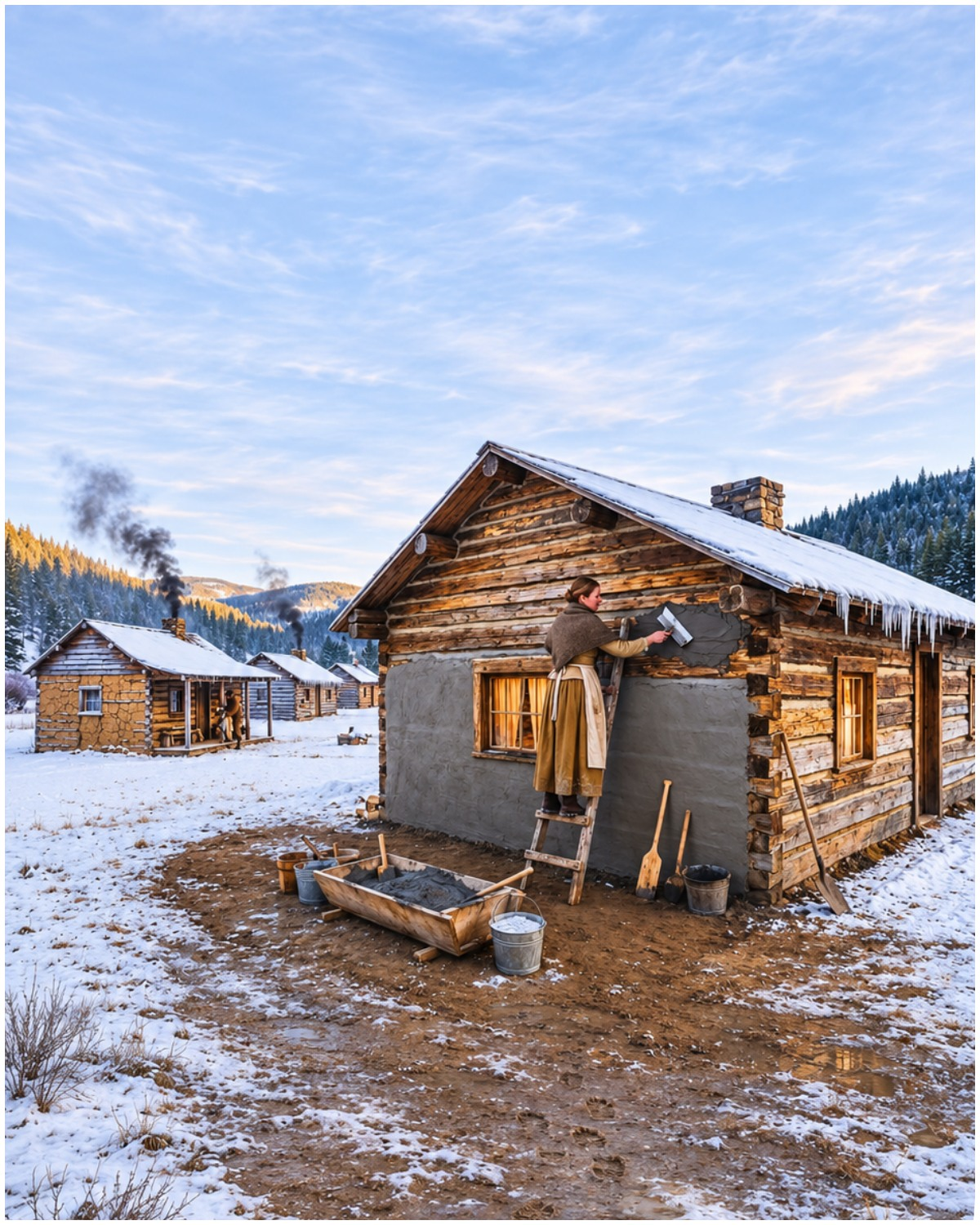
She pressed the trowel against the wall.
A narrow ribbon of gray plaster spread between the logs.
Carl watched her work.
"How can you be so calm when we don't know who is trying to hurt us?"
Annelise stopped.
She looked down.
"Because I know what I can do today."
"And what is that?"
"Finish this wall."
Carl shook his head.
"Sometimes I wish you would get angry."
"I do get angry."
"I've hardly ever seen it."
She climbed down one step.
"Anger is not always loud, Carl."
He looked at her.
She continued.
"When I think about someone threatening our children, I feel angry. When I think about losing the land because another person wants to frighten us, I feel angry."
"Then why don't you show it?"
"Because the wall doesn't care how angry I am."
Carl stared at her.
Then, despite everything, he laughed.
Annelise gave him a tired smile.
"Now hand me the plaster."
He lifted the bucket.
She returned to work.
That evening, after supper, Liesl found a small wooden box beneath her mother's bed.
It was dark brown, with worn brass corners and a simple iron latch.
She carried it into the kitchen.
"Mama, what's this?"
Annelise turned.
The moment she saw the box, her expression softened.
"Where did you find it?"
"Under your bed."
"Bring it here."
Liesl placed it on the table.
Carl looked up from sharpening his axe.
"I haven't seen that in years."
Annelise touched the lid.
"It belonged to my father."
Jakob hurried over.
"Is there treasure inside?"
"In a way."
She opened the latch.
Inside lay several folded sheets of paper, a small measuring rule, a carpenter's pencil, and a piece of pale ceramic tile.
There was also a thin notebook bound in cracked brown leather.
Annelise lifted it carefully.
The pages had yellowed.
The corners were worn.
Some were stained with soot.
Across the first page, written in German, were the words:
Wärme bleibt, wo die Luft stillsteht.
Liesl leaned closer.
"What does it say?"
Annelise translated.
"Warmth remains where the air is still."
Carl set down his axe.
"Your father's words?"
"Yes."
She turned the page.
There were drawings of ceramic heating stoves.
Cross-sections of walls.
Notes about clay mixtures.
Measurements.
Small sketches showing how warm air moved through a room.
Liesl pointed at one drawing.
"Is that a chimney?"
"Part of a stove."
"Why is it so big?"
"Because my father built stoves that could hold heat for a long time."
Jakob looked impressed.
"Longer than ours?"
"Much longer, if they were built and fired properly."
Carl moved closer.
He had heard Annelise speak about her father's work many times.
But he had never examined the notebook closely.
The pages contained more than memories.
They contained a lifetime of experiments.
Some successful.
Some crossed out.
Some marked with warnings.
Annelise turned to a page near the middle.
There was a drawing of a timber wall with a layer of plaster applied across its interior.
Beside it, her father had written several notes.
She read them aloud in English.
"Seal the movement of air. Protect the timber from water. Never mistake a warm surface for a dry wall."
Carl frowned.
"What's that last part mean?"
Annelise pointed to the drawing.
"A wall can feel warm on the inside while moisture remains trapped somewhere you cannot see. My father warned me not to trust comfort alone."
Ewan's concern returned to Carl's mind.
"Then MacLeod wasn't entirely wrong."
"No."
Carl looked surprised.
Annelise continued.
"He is right that moisture can damage timber. He is wrong to assume every plastered wall must trap it."
She turned another page.
"This is why I have been so careful."
Carl studied the notes.
"Did your father teach you all this?"
"Some of it. The rest I learned by watching."
She smiled faintly.
"When I was little, he let me carry sand. Later, he let me mix clay. By the time I was twelve, I could tell when a plaster mixture was too wet by the way it fell from a trowel."
Liesl looked at her mother with new admiration.
"Could I learn?"
Annelise brushed a strand of hair from her daughter's forehead.
"Of course."
Jakob raised his hand.
"Me too?"
"Yes."
"Even if I spill it?"
Carl laughed.
"Especially then."
The children began asking questions.
For a little while, the threat hanging over the family seemed distant.
But as Annelise turned another page, her smile faded.
Near the back of the notebook was a section she had not read in years.
The writing was smaller.
More hurried.
Several words had been underlined.
She stared at the page.
Carl noticed.
"What is it?"
Annelise did not answer immediately.
She remembered her father's workshop.
The smell of hot ceramic.
The heavy wooden tables.
The winter mornings when frost covered the windows.
And one particular afternoon when he had called her away from her chores.
She had been fifteen.
He had been working on a large heating stove for a wealthy family.
The owner wanted the stove to hold more heat.
He wanted the room warmer.
He wanted the fire to burn less wood.
Her father had warned that the surrounding wall needed careful attention.
The owner dismissed him.
A cheaper builder completed the work.
Months later, the wall behind the stove had been opened.
The timber was damp.
Dark stains had spread across the surface.
Her father had shown Annelise the damage.
"Remember this," he told her.
"Warmth is not proof of safety."
She had never forgotten.
Now, looking at the notebook, she understood why he had written the warning so carefully.
Carl touched her shoulder.
"Annelise?"
She looked up.
"My father made mistakes too."
Carl sat beside her.
"Everyone does."
"Yes. But he wrote them down."
She turned the notebook toward him.
"That is why I trust what he taught me. Not because he was always right. Because he was willing to discover when he was wrong."
Carl looked at the page.
Then at his wife.
For the first time, he understood that her confidence was not blind faith in an old family method.
It was the result of years spent learning how to question it.
The next morning, Ewan returned.
He arrived carrying a small leather bag.
Annelise met him outside.
"Good morning."
"Mrs. Vogel."
He held up the bag.
"I brought something."
"What?"
"A moisture probe. A simple one."
He removed a narrow metal instrument with a wooden handle.
"I use it when checking timber in old barns. It isn't perfect, but it can help us find suspicious spots."
Annelise examined it.
"You want to test the wall?"
"With your permission."
She nodded.
"Yes."
Ewan looked surprised.
He had expected resistance.
Instead, she led him toward the north wall.
"Start near the window," she said. "That section has been repaired."
He tested the exposed timber at the edge of the plaster.
Then another section.
Then a third.
He frowned.
"What is it?" Annelise asked.
"Nothing unusual so far."
She nodded.
"Good."
He moved toward the lower corner.
There, the timber gave him a different result.
He tested again.
Then looked at her.
"This spot is more damp than the others."
Annelise crouched beside him.
The corner lay close to the ground.
Snow had collected against the foundation during the previous storm.
She examined the area.
Then she noticed a narrow channel where melting snow could run toward the wall.
"Water from outside," she said.
"Possibly."
She stood.
"Carl!"
Her husband appeared from behind the shed.
"What happened?"
"We need to improve the drainage here."
Carl looked at the ground.
"I can dig another channel."
"And move the snow away from the wall."
Ewan nodded.
"That would be wise."
Annelise looked at him.
"Thank you."
The old builder seemed uncomfortable.
"For what?"
"For checking."
He cleared his throat.
"Don't thank me yet. We haven't seen what happens after a hard freeze."
"Then we'll check again."
Ewan studied her.
He had expected stubbornness.
He had found caution.
He had expected pride.
He had found patience.
And the more he examined her work, the more he realized how little he had understood about her methods.
He looked toward the gray wall.
"Your father taught you this?"
"Much of it."
"Was he a builder?"
"A master stove builder."
Ewan nodded.
"I'd like to hear more about him sometime."
Annelise glanced toward the cabin.
"Perhaps after winter."
The old man gave a faint smile.
"Fair enough."
Later that day, Carl rode into town with Ewan.
They went directly to the sheriff.
The sheriff, a heavyset man named Walter Briggs, listened as they explained the altered complaint.
He examined Ewan's notebook.
Then the official document.
He compared the signatures.
Finally, he leaned back in his chair.
"You're saying Davies changed your statement?"
"I'm saying the document doesn't reflect what I agreed to," Ewan answered.
Briggs looked at Carl.
"And you believe this is connected to the threat at your cabin?"
"I don't know. But someone wants us to stop working."
The sheriff rubbed his chin.
"Have you spoken with Davies?"
"Not yet."
"Then that's where we start."
He stood.
"I'll ask him to produce the original statement."
Carl felt a small measure of relief.
At least someone was taking the matter seriously.
Then Briggs added, "But understand something. A complaint about a building isn't the same as a threat. We need evidence before we connect them."
Carl nodded.
"I understand."
Ewan looked toward the window.
"What about the brass button?"
Briggs opened a drawer.
He removed the button Carl had given him.
"I asked around."
Carl leaned forward.
"Did anyone recognize it?"
"Not exactly."
"What does that mean?"
Briggs turned the button between his fingers.
"The star design resembles buttons used on certain work coats supplied to railroad crews. But it isn't enough to identify a man."
Carl frowned.
"Railroad crews?"
"Yes."
Ewan's expression changed.
He looked at Carl.
Then at the sheriff.
"Mr. Davies works with railroad interests."
Briggs nodded.
"He does."
Carl felt a cold sensation move through his chest.
The button.
The complaint.
The threat.
The land.
He had been thinking of each as a separate problem.
Now they seemed to form the outline of something larger.
But he had no proof.
And without proof, an accusation could make their situation worse.
That night, Annelise sat alone at the table.
Carl had gone to check the animals.
The children were asleep.
The stove burned quietly.
Her father's notebook lay open before her.
She had been translating several passages into English.
Some were familiar.
Others had become difficult to read.
The ink had faded.
The handwriting changed from page to page.
Near the back, she found a folded sheet tucked between two pages.
It was smaller than the others.
She carefully opened it.
A drawing appeared.
Not of a stove.
Not of a wall.
But of a small cabin.
The shape was simple.
A pitched roof.
A stone chimney.
Two windows.
A timber foundation.
Annelise stared at it.
The drawing resembled the kind of cabins she had seen in Montana.
But her father had never traveled to America.
She turned the paper over.
There was a date.
March 1869.
And beneath it, a short paragraph in German.
She began translating.
For a house built far from the old country, remember that warmth is not merely a gift of fire. It is also the result of keeping the wind from stealing what the fire has made.
Annelise felt tears rise unexpectedly.
Her father had written those words years before she married Carl.
Years before she crossed the Atlantic.
Years before she stood on a ladder in Montana, defending a gray wall against the judgment of an entire settlement.
She read the passage again.
Then she noticed another line beneath it.
The ink was darker.
Added later.
If the method is challenged, do not argue from memory. Show the test.
Annelise frowned.
What test?
She turned the paper toward the lantern.
There was a small diagram at the bottom.
Two wooden boxes.
A narrow opening.
A candle.
A line of smoke.
She studied it carefully.
Then she understood.
Her father had designed a simple demonstration.
Not a perfect scientific experiment.
But a way to show how moving air could carry warmth away.
One box would have an open gap.
The other would be sealed.
A candle would reveal the movement of air.
And the difference could be seen.
Annelise sat back.
For weeks, she had tried to explain invisible drafts with words.
Now she had something better.
She could show them.
The next morning, Carl found her in the shed.
She had placed two small wooden boxes on the workbench.
Both were made from leftover boards.
One had a narrow gap along the side.
The other had the same gap filled with a small strip of dried plaster.
Carl stared.
"What are you doing?"
"Building a demonstration."
"For whom?"
"Anyone who wants to understand."
She showed him the drawing.
He examined it.
"Your father's?"
"Yes."
Carl smiled.
"He was clever."
"He was careful."
She lit a small candle.
Then held it near the gap in the first box.
The flame bent sharply.
She moved it toward the sealed box.
The flame remained steadier.
Carl leaned closer.
"That's remarkable."
"It's simple."
"Sometimes simple things are remarkable."
Annelise looked at him.
"Will you help me make another?"
"Of course."
They worked together through the morning.
By noon, the boxes were ready.
Annelise planned to show them to Ewan.
Then perhaps the sheriff.
Then, if necessary, Mr. Davies.
She knew a demonstration would not prove every claim about moisture or long-term durability.
But it could show why sealing drafts mattered.
And perhaps it would finally make people listen.
That afternoon, Thomas returned.
He brought a sack of flour and a troubled expression.
Annelise met him at the door.
"Is something wrong?"
Thomas hesitated.
"There's talk in town."
"There's always talk."
"This is different."
Carl appeared behind her.
"What now?"
Thomas stepped inside.
He placed the flour on the table.
"Silas says Davies has received instructions from the railroad office."
Carl's face tightened.
"What instructions?"
"To review several claims along the valley."
"Why?"
Thomas looked at Annelise.
"Because the railroad may want a new access route."
Silence filled the cabin.
Annelise felt her stomach tighten.
Their land lay near the eastern creek.
A narrow passage through the hills connected the valley to a larger route used by freight wagons.
If a railroad interest wanted access through that corridor, the Vogel property could become valuable.
Very valuable.
Carl stared at Thomas.
"Are you saying someone wants our land?"
"I'm saying people are talking about a route."
"Who told you?"
"Silas."
Annelise looked toward the window.
The gray plaster had dried smoothly around the frame.
For weeks, she had believed the criticism was about her unusual building method.
Perhaps some of it was.
Perhaps Ewan's concerns were genuine.
Perhaps the neighbors simply enjoyed laughing at something different.
But the threat in the darkness had never felt like ordinary ridicule.
Stop now, or you'll lose the land.
The words returned to her.
She looked at Carl.
"We need to see the claim records."
Thomas nodded.
"I think you do."
After Thomas left, Annelise returned to her father's notebook.
She needed to finish translating the remaining pages.
She needed to prepare the demonstration.
She needed to repair the drainage near the north wall.
But her thoughts kept returning to the possibility that the cabin itself was being used as an excuse.
If someone could convince officials that the dwelling was unsafe, perhaps they could challenge the improvements connected with the homestead.
And if the family lost its claim, someone else might benefit.
She turned another page.
Then stopped.
A narrow envelope had been tucked into the back cover.
She had never noticed it before.
The paper was brittle.
The edges were yellow.
Across the front, written in her father's handwriting, were three German words.
Für meine Annelise.
For my Annelise.
Her hands trembled.
She opened the envelope carefully.
Inside was a single folded letter.
She recognized the date.
It had been written shortly before her father's death.
She unfolded the page.
The first lines were familiar.
He wrote about her childhood.
About the workshop.
About the pride he felt when she learned to measure carefully and question what she was told.
Then the tone changed.
My daughter, there is something I have not explained about the work I did during the winter of 1869.
Annelise leaned closer.
The method was not accepted when I first demonstrated it. Men with greater titles than mine dismissed it. But when the cold came, the results forced them to look again.
She swallowed.
The next sentence had been underlined twice.
There is one mistake you must never repeat.
Annelise turned the page.
But the letter ended there.
The remaining sheet was missing.
She searched the envelope.
Nothing.
She checked the notebook.
Nothing.
Then she noticed a faint impression on the inside of the back cover.
Someone had written on a sheet of paper while it rested against the leather.
The pressure had left shallow marks.
Annelise lifted the cover toward the lantern.
She could barely make out the letters.
A name.
A place.
And what looked like a warning.
She reached for a piece of charcoal.
Carefully, she rubbed it across a thin sheet of paper laid over the impression.
Dark lines began to appear.
First one word.
Then another.
Then a name she had not expected to see.
Annelise stopped breathing.
She read it again.
The name belonged to a man who had visited their cabin only days earlier.
A man who had examined the plaster.
A man whose signature appeared on the complaint against their homestead.
She heard the front door open.
Carl stepped inside.
"Annelise?"
She did not look up.
He approached the table.
"What is it?"
She slowly turned the charcoal rubbing toward him.
Carl leaned closer.
His face went pale.
At the bottom of the page, beneath her father's faded warning, stood a name written more than nine years earlier.
MacLeod.






Comments 0