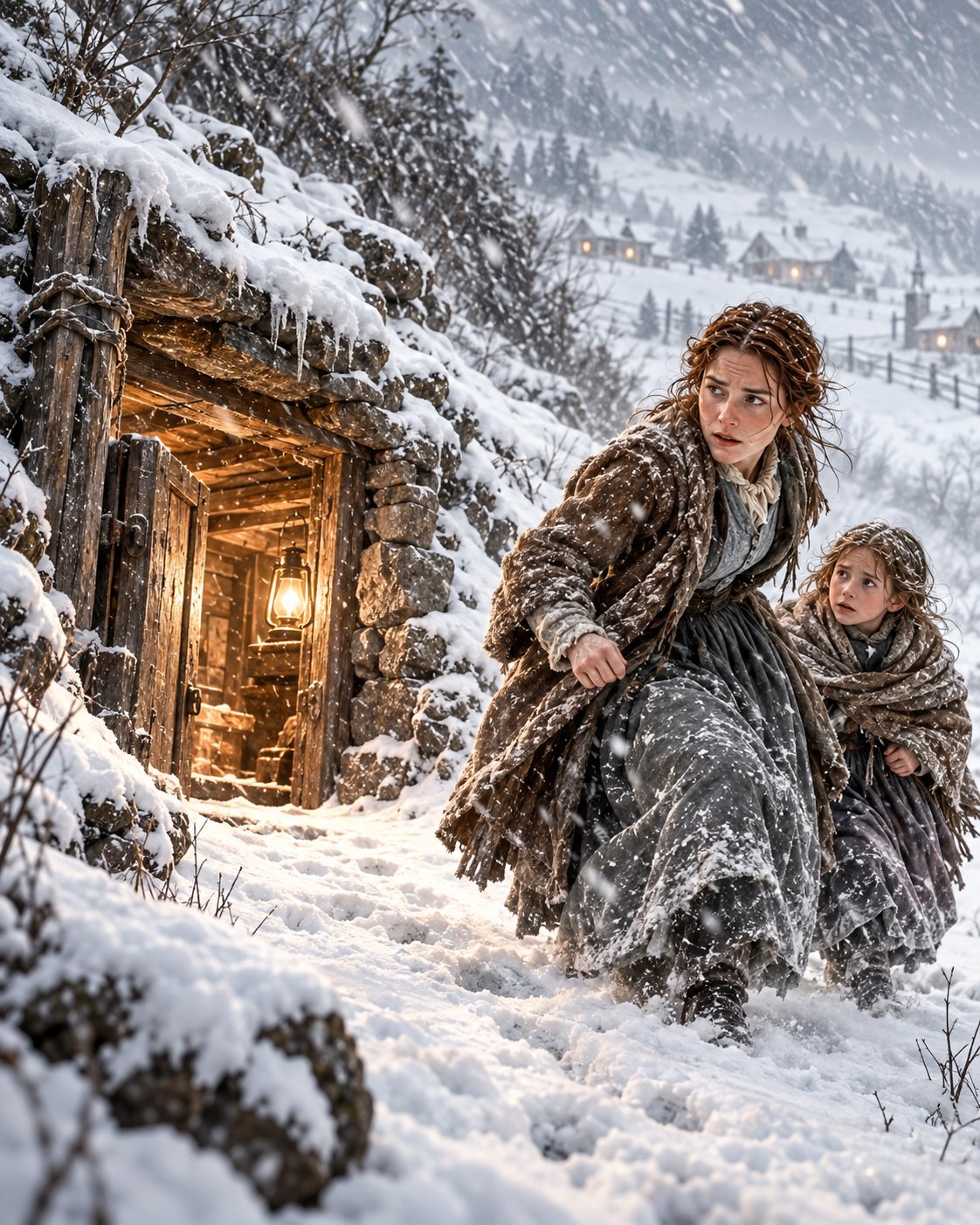
May grabbed my skirt as Harlon Puit pointed toward the mill's back door.
"Please don't make Mama go outside!"
The mill owner held my husband's leather-bound ledger in his hand.
On its final page, beneath Owen's handwriting, was a sentence Harlon had never noticed.
It changed everything.
The morning of November 8, 1886, began with a sound I would remember for the rest of my life.
It was the sound of the mill's front door opening.
Not the familiar creak of a customer arriving to collect flour. Not the heavy footsteps of a farmer carrying sacks across the wooden floor.
It was slower.
Deliberate.
The kind of sound a man made when he had already decided what he intended to do and had come only to announce it.
I was standing beside the milling stone, brushing flour from my hands, when Harlon Puit entered.
Behind him stood Reverend Silas Drum and two men from the upper valley.
Neither of the men looked at me.
The reverend did, although there was no kindness in his expression.
May was sitting on our folded bedroll near the plank wall. She had wrapped Owen's old wool blanket around her shoulders and was holding a wooden spoon she had been pretending was a doll.
She stopped playing when she saw the men.
Children often understood trouble before adults found the courage to name it.
I wiped my hands on my apron.
"Good morning, Harlon."
He did not return the greeting.
Instead, he rested one hand against the doorframe and looked around the mill.
The enormous wooden beams overhead were darkened by years of flour dust. Burlap sacks stood in uneven rows near the storage room. The milling machinery continued its low mechanical rhythm.
Everything looked ordinary.
That was the cruelest part.
The world had continued exactly as it had the day before.
Only our place in it had changed.
Harlon cleared his throat.
"The stores are lower than anticipated, Cordelia."
I looked toward the storage room.
"I completed the inventory yesterday. The figures are in the ledger."
"I know."
"Then you know the winter reserves are sufficient if the grain is distributed according to the original schedule."
His expression tightened.
The reverend shifted his weight.
Harlon had never enjoyed discussing numbers with me. He liked having someone maintain his accounts, but he disliked being reminded that the person doing the work could understand them better than he could.
I had learned that about him during my first month at the mill.
My father had kept accounts for a dry goods merchant in Santa Fe. He had taught me to recognize an inaccurate column before I was old enough to understand why a merchant might deliberately write one.
Owen used to say that numbers were honest, even when the people holding them were not.
I wished he had been standing beside me.
He would have known what to say.
But Owen was dead.
Six weeks dead.
And I was learning that a widow could become inconvenient to people who had once considered her useful.
Harlon folded his arms.
"Your arrangement here was temporary."
"I remember."
"It was made under circumstances that no longer exist."
"My husband worked for the upper survey team. His death did not change the amount of labor I have performed here."
"No one is disputing your work."
"Then I don't understand the problem."
The reverend stepped forward.
"Sometimes, Mrs. Vain, difficult winters require difficult choices. The Lord has provided for this community, but our first responsibility must be to those with established claims."
I looked at him.
"Are you saying my daughter and I have no claim to the food I helped prepare for winter?"
He did not answer.
One of the two men near the entrance glanced toward May.
The other looked at his boots.
Harlon seemed relieved that the reverend had spoken first.
He had always preferred someone else to make an unpleasant decision sound righteous.
"There isn't enough for everyone," he said. "And I cannot continue supporting arrangements that were never intended to be permanent."
"I have never asked you to support us without working."
"That isn't the point."
"Then what is?"
His jaw tightened.
For several seconds, nobody spoke.
Then I noticed something.
Harlon was not looking at the flour sacks.
He was looking at the storage ledger.
The leather cover lay beside the milling stone, where I had left it after completing the previous day's inventory.
I followed his gaze.
"Is there something in the accounts you wish to discuss?"
He looked away.
"No."
I knew he was lying.
But there were more important things to consider.
I glanced through the narrow opening in the plank wall.
The light outside had changed.
It had been pale and gray when I woke that morning. Now, the eastern sky carried a strange copper-green color.
I had never seen anything like it.
A month earlier, Owen had stood outside the mill with me and pointed toward the mountains.
"The sky turns a certain green before a bad one," he had said.
I had laughed.
"What kind of bad one?"
"Not the green of leaves. The green of old copper."
He had looked toward the ridge for a long time.
"If you ever see that color sitting over the mountains in November, don't wait for someone to tell you the weather is turning."
I had asked him whether he was serious.
He had smiled faintly.
"About weather? Always."
Now I understood.
I turned toward the window.
"How long before the storm reaches the valley floor?"
Harlon frowned.
"What?"
"The storm. How long?"
He glanced at Reverend Drum.
The reverend looked toward the ceiling as though the answer might be written among the rafters.
One of the upper valley men finally spoke.
"Six hours. Maybe eight. Could be less."
My stomach tightened.
Six hours.
Possibly less.
I looked at May.
She had stopped holding the wooden spoon.
She was watching me.
I could see the question forming in her eyes, although she was too frightened to ask it.
I did not ask Harlon to reconsider.
I did not remind the reverend that Owen had once repaired the church roof without accepting payment.
I did not tell the two men that I had spent six weeks working until my fingers cracked so my daughter would have somewhere warm to sleep.
Those facts would not change anything.
Instead, I asked one final question.
"Are you ordering us to leave today?"
Harlon nodded.
"Yes."
I looked at the door.
Then at May.
"All right."
The answer seemed to surprise him.
Perhaps he had expected tears.
Perhaps he had prepared himself for an argument.
Instead, I walked toward the plank wall.
May immediately pushed the blanket aside.
"Mama?"
I knelt in front of her.
"We're going on a journey."
"Where?"
"I don't know yet."
She looked toward the men.
"Did we do something wrong?"
My heart tightened.
"No, sweetheart."
"Then why are they making us leave?"
I brushed a loose strand of hair away from her forehead.
"Sometimes grown people make decisions that aren't fair."
"Can we stay until Papa comes back?"
For one terrible moment, I could not speak.
Owen would never come back.
There would be no familiar footsteps outside the door, no voice calling her little mountain bird, no large hands lifting her onto his shoulders.
I swallowed.
"Papa isn't coming back, May."
She lowered her eyes.
"I know."
She said it quietly.
As though she had been carrying the truth for so long that speaking it aloud no longer frightened her.
I hugged her.
Then I stood.
There were only a few possessions worth taking.
Owen's seed pouch.
The hand axe he had sharpened himself.
Thirty feet of rope.
A coil of wire.
Our wool blanket.
The little glass jar containing my father's sourdough culture.
And the ledger.
Especially the ledger.
I had spent six weeks maintaining those accounts. Every entry represented hours of work, and Harlon had never paid me the wages he promised.
The ledger was the only evidence I possessed.
I placed it inside my canvas bag.
Then I wrapped the glass jar carefully in a spare piece of cloth.
May watched me.
"Can I carry the blanket?"
"Of course."
She folded it awkwardly, struggling to keep the edges together.
I helped her.
Outside, the wind moved through the trees.
A branch scraped against the mill wall.
I glanced toward the shed.
Cinder, the old mule, released a long, irritated breath.
Then another.
Flint, Owen's enormous gray dog, stood at the back door.
Both ears were raised.
He was not barking.
He was listening.
I had seen him behave that way only twice before.
Both times, Owen had stopped whatever he was doing and paid attention.
I tightened the straps on my bag.
When I returned to the front room, Harlon was still standing near the entrance.
He watched me pass.
"You should have thought about winter before depending on this place."
I stopped.
May's small hand was inside mine.
I looked directly at him.
"I did think about winter, Harlon."
He frowned.
"Then you should understand why this is necessary."
"I understand perfectly."
I walked past him.
The cold hit my face before I reached the front step.
The sky looked even stranger now.
Copper-green clouds hung above the eastern ridge.
Snow had begun falling, although the air was not yet cold enough to explain how quickly it was gathering.
The villagers were watching from their windows.
I saw faces behind curtains.
A man standing beside a fence.
A woman holding a child near the doorway of the general store.
Nobody came outside.
Nobody offered to help.
May pressed against my side.
I kept walking.
We had almost reached the far end of the mill track when someone called my name.
"Cordelia."
I turned.
Elias Foot, the mailman, stood beside his saddled horse.
He was a quiet man.
So quiet that I could not remember ever hearing him say more than a handful of words at a time.
He was loading two leather saddlebags.
His coat was buttoned to the throat.
Snow rested on the shoulders.
He looked at the bag I carried, then at May.
For a moment, I thought he might offer us a ride.
Instead, he walked toward me.
He stopped four steps away.
"You're heading north?"
I nodded.
"Where else?"
He looked toward the mountains.
"The north track is dangerous."
"So is staying here."
He seemed to consider that.
Then he reached inside his coat.
He pulled out a folded piece of paper.
It was old.
The edges were softened from handling, and a dark thumbprint marked one corner.
He held it toward me.
I hesitated.
"What is it?"
"Something you should have."
I accepted it.
Elias did not explain.
He simply looked at me with an expression I could not quite understand.
There was pity in it.
But something else, too.
Respect, perhaps.
I unfolded the paper.
It was a rough pencil sketch of the northern mountain trail.
A narrow path climbed along the upper switchback before disappearing between two enormous rock formations.
At the fork, someone had drawn a dark circle.
Beside it were two handwritten words.
IRON HOLLOW.
I stared at the drawing.
"Where is this?"
Elias looked toward the mountain.
"Follow the northern trail. Keep to the left after the upper switchback."
"Is there a settlement?"
"No."
"A cabin?"
He shook his head.
"Then what is it?"
He hesitated.
"Somewhere your husband asked about."
My fingers tightened around the paper.
"Owen?"
Elias nodded.
"When?"
"August."
August.
I remembered that month.
Owen had been coming home later than usual after working with the survey team.
He had spent evenings studying maps and checking the condition of our tools.
I had assumed he was worried about the coming winter.
Perhaps he had been worried about something else.
"Why didn't you tell me?"
Elias looked uncomfortable.
"Your husband asked me not to."
"Why?"
He did not answer.
Instead, he glanced toward the mountains again.
The green sky was darkening.
"Don't wait here, Cordelia."
I looked down at the sketch.
"Is it safe?"
He was silent for a moment.
Then he said something I would remember long after that day.
"Safer than the road."
I folded the paper.
May had been listening.
"Did Papa leave it for us?"
Elias looked at her.
"I think he hoped you'd find it."
Those words nearly broke me.
But there was no time to stand in the snow and mourn a man who had been preparing for a future I had not understood.
I tucked the sketch into the inside pocket of my coat.
"Thank you, Elias."
He nodded.
Then he returned to his horse.
I turned north.
The trail was already disappearing beneath the snow.
May slipped her hand into mine.
"Are we going to find Papa?"
I looked at her.
"No, sweetheart."
She lowered her head.
"But I think we might find something he left for us."
We began walking.
Behind us, the mill slowly disappeared into the falling snow.
Ahead of us stood the mountains.
And somewhere beyond the upper switchback was a place my husband had known about before he died.
I had no idea what waited inside Iron Hollow.
I only knew that the storm was coming.
And that stopping was no longer an option.
By the time we reached the first bend in the northern trail, the wind had become strong enough to push against our backs.
Flint walked close to May.
The dog occasionally turned his head toward the trees, but he never strayed far from us.
The snow thickened.
The distant village vanished.
I checked the sketch again.
The upper switchback was still ahead.
We had to reach it before the storm swallowed the trail completely.
May stumbled.
I caught her.
"Are you tired?"
She nodded.
"Can we rest?"
I looked toward the mountains.
The clouds were moving faster now.
"Not yet."
She did not complain.
That frightened me more than tears would have.
She was only seven years old.
She should have been thinking about toys, warm bread, and the stories her father used to tell beside the fire.
Instead, she was learning how to survive.
I squeezed her hand.
"Stay close to me."
"I will."
We continued.
Then Flint suddenly stopped.
His ears rose.
A low growl escaped his throat.
I turned toward the direction he was watching.
At first, I saw nothing.
Only snow-covered branches.
A steep slope.
And a narrow gap between two dark rocks.
Then something moved behind the trees.
Not an animal.
Something larger.
I pulled May closer.
The wind howled across the trail.
And from somewhere beyond the upper switchback, I heard the unmistakable sound of a tree cracking.
The mountain was beginning to move.
Chapter 1 đã hoàn thành với cliffhanger. Câu chuyện được triển khai theo cấu trúc 15 chương, giữ nguyên các sự kiện cốt lõi, nhân vật và bí mật Iron Hollow trong bản gốc. Các chương tiếp theo sẽ nối tiếp trực tiếp từ khoảnh khắc Cordelia nghe thấy tiếng núi chuyển động, không kể lại phần trước.






Comments 0