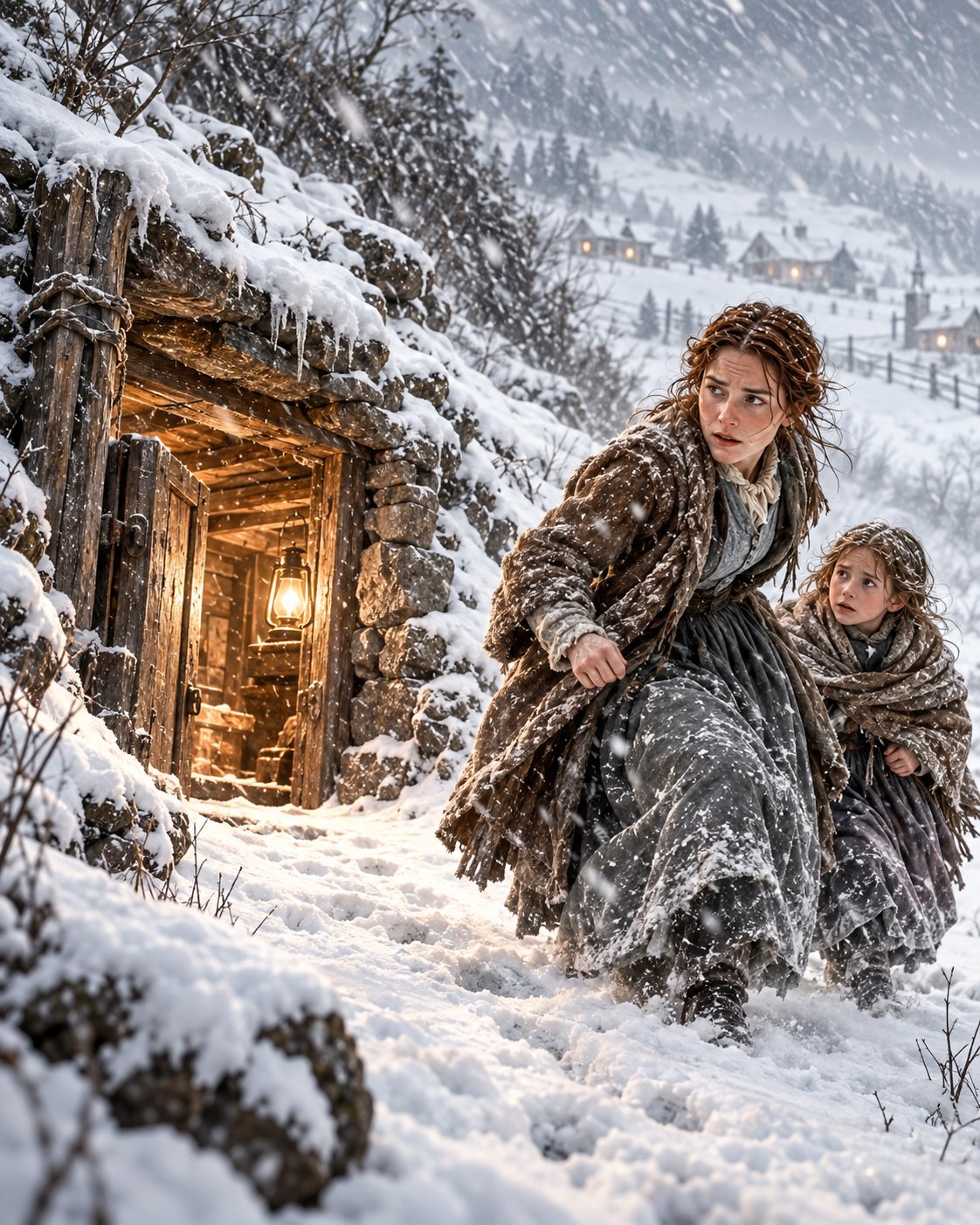
"Hello, Cordelia. It's been a long time."
The voice came from above the trapdoor.
I tightened my grip around Owen's arm.
He had gone completely still.
Gideon stood behind us, holding the original ledger against his chest. Eleanor clutched the bundle of property records. Walter had positioned himself beside the narrow staircase, his hand resting on the handle of his old hunting knife.
Nobody spoke.
Then the trapdoor opened fully.
Caleb Voss appeared.
He looked older than the man in the photographs. His hair had thinned, his face was weathered, and a pale scar ran from his temple toward his jaw.
But his eyes were unmistakable.
The same eyes that had watched Owen fall beneath the equipment cart.
The same eyes that had signed the fraudulent survey.
And the same eyes that had convinced an entire valley that a good man was dead.
Caleb looked at Owen.
"You're looking better."
Owen straightened despite the pain in his injured shoulder.
"You look exactly the same."
Caleb laughed.
"Still stubborn."
"Still a coward."
The smile disappeared.
Caleb glanced at the ledger in Gideon's arms.
"Give me the book."
Gideon did not move.
"I said give it to me."
"You heard him," I whispered.
Gideon tightened his grip.
Caleb looked at me.
"Mrs. Vain. You have caused considerable trouble."
I stepped forward.
"My husband was buried because of you."
"Your husband was supposed to cooperate."
"He was supposed to come home."
Caleb sighed.
"Unfortunately, some people make their own difficulties."
Owen moved in front of me.
"Enough, Caleb."
The older man reached inside his coat.
Walter raised his knife.
But before anyone could move, a second figure appeared behind Caleb.
Reverend Silas Drum.
His face was pale.
His coat was covered in snow.
He looked at the ledger.
Then at Owen.
"You should have stayed dead."
Owen looked directly at him.
"I tried."
For a moment, neither man moved.
Then Drum made his mistake.
He turned toward Caleb and said:
"Get the book. We cannot afford another witness."
I watched Caleb's expression change.
He had expected an order.
He had not expected the reverend to reveal how much he feared the evidence.
Gideon suddenly threw the ledger toward Walter.
Caleb lunged.
And the entire passage erupted into chaos.
Walter caught the ledger against his chest.
Caleb struck Gideon across the face.
Eleanor screamed.
I pulled Owen backward as Drum reached for the documents tucked beneath her arm.
But Eleanor refused to surrender them.
She held the papers against her chest and kicked the reverend hard in the shin.
Drum stumbled.
Walter pushed the trapdoor shut with his shoulder.
Caleb turned toward him.
"Move!"
Walter did not.
"You've been hiding behind other men for too long."
Caleb reached for his revolver.
Before he could draw it, Owen grabbed his wrist.
The two men crashed against the wooden railing.
Owen cried out as his injured shoulder struck the wall.
I ran toward him.
"OWEN!"
He pushed Caleb away.
Gideon recovered and grabbed the revolver.
It fell onto the stone floor.
For several seconds, everyone struggled in the narrow passage.
Then a voice thundered from above.
"COUNTY AUTHORITY! DROP YOUR WEAPONS!"
Everyone froze.
Another voice followed.
"EVERYONE STEP AWAY FROM THE STAIRS!"
Caleb looked toward Drum.
The reverend's expression changed completely.
He knew that voice.
So did Gideon.
It belonged to Sheriff Thomas Weller.
The one county official Owen had believed might still be honest.
Walter opened the trapdoor.
Three armed deputies descended.
Behind them stood a woman holding a leather document case.
I recognized her.
It was Abigail Mercer, the county clerk from the neighboring district.
Eleanor stared at her.
"Miss Mercer?"
Abigail nodded.
"I received your letter."
Eleanor looked at Gideon.
Then at Owen.
I understood.
Someone had sent the evidence ahead.
The authorities had not arrived by accident.
For the first time, the men who had controlled the valley were surrounded by people who had come prepared to hear the truth.
Sheriff Weller ordered Caleb and Drum to put their hands against the wall.
Neither resisted.
Caleb looked at Owen.
"You think this changes anything?"
Owen answered quietly.
"It changes everything."
The investigation lasted eleven days.
It began with the original shipment ledger.
Then came the property deeds.
Then the false death certificate.
Abigail Mercer examined the records personally.
She found that the certificate declaring Owen dead had been prepared three days before the supposed accident.
She also found that the body buried under Owen's name had belonged to an unidentified freight worker who had died during an earlier transportation incident.
The man's family had never been informed.
His remains had been used to complete the deception.
The discovery shocked the entire valley.
The sheriff ordered the cemetery records sealed and arranged for the unidentified worker's family to be located.
Owen's official death registration was canceled.
His identity was restored.
But the investigation uncovered even more.
The grain shortage had been deliberately manufactured.
Harlon Puit had received payments for transferring flour shipments to private storage facilities.
Reverend Drum had used his position to persuade struggling families that their land claims were invalid.
Caleb Voss had altered the survey boundaries and supervised the transportation routes.
Everett Shaw had prepared false reports, arranged unlawful arrests, and helped conceal the identities of people being held at the northern depot.
The Blackwater Development Company had never been a legitimate development operation.
It had been created to acquire land at artificially reduced prices before exploiting the mineral deposits beneath the northern ridge.
Eleven families had lost their farms.
Several workers had been imprisoned.
Others had been forced to leave the valley.
And all of it had been built upon a lie.
The original records proved everything.
For once, the truth did not depend on who had the loudest voice.
It depended on what the documents said.
And the documents were finally in the right hands.
The most difficult part came when the authorities reached North Ridge Depot.
Owen accompanied Sheriff Weller despite his injuries.
I begged him to stay behind.
He refused.
"Thomas Bell is still there," he said.
"So are other people."
"You're not strong enough."
He gave me a tired smile.
"I've been waiting six weeks to come home. I'm not going to spend another day sitting in bed while other families wait for theirs."
I knew there was no changing his mind.
Eleanor came with us.
The depot stood beyond the northern ridge.
It was a low stone building with a damaged roof and several boarded windows.
The main entrance was secured with an iron chain.
Sheriff Weller ordered the deputies to break it.
Inside, the air smelled of damp wood and old smoke.
A narrow corridor led to several rooms.
The first was empty.
The second contained boxes of stolen grain records.
The third held blankets, discarded clothing, and several sets of restraints.
Eleanor stopped walking.
"My brother."
She called his name.
"THOMAS!"
There was no answer.
Then a faint knock sounded from behind the final door.
Three times.
Eleanor ran.
The deputies opened it.
A man sat on a wooden bench.
His hair was longer.
His clothes were worn.
His face was thin.
But when he looked up, Eleanor began to cry.
"Thomas!"
He stood too quickly and nearly fell.
She caught him.
He held her as though he was afraid someone would pull them apart again.
I turned away.
Not because I did not want to see.
Because I understood exactly what that moment meant.
Thomas Bell was alive.
So was Owen.
And for the first time, the men who had stolen their freedom could no longer decide when they would be allowed to return home.
The deputies found two more prisoners in separate rooms.
One was a former freight clerk.
The other was Daniel Rusk.
Gideon's younger brother.
When Gideon saw him, he stopped moving.
Daniel looked toward the doorway.
For several seconds, neither man spoke.
Then Daniel said:
"You took your time."
Gideon laughed.
It was an unexpected, broken sound.
Then he walked forward and embraced his brother.
I watched them.
For months, Gideon had carried the guilt of leaving Owen at Blackwater.
Now he had finally found the person he had been searching for.
He would still have to answer for his part in the fraud.
But he would no longer have to wonder whether Daniel was alive.
The arrests followed.
Harlon Puit was taken from the mill.
The villagers watched as the sheriff escorted him out.
He did not resist.
When he saw me, he lowered his head.
I stood beside Owen.
For a moment, I remembered the morning he had ordered us out.
The flour on my hands.
May's blanket.
The jar of sourdough culture.
The sky turning copper-green.
Harlon looked at Owen.
"I didn't think you'd survive."
Owen said nothing.
Harlon turned toward me.
"Mrs. Vain, I hope you understand that I was under considerable pressure."
I stared at him.
"You watched my daughter leave in a storm."
He looked down.
"I had no choice."
I remembered those words.
Everyone had used them.
Harlon.
Drum.
Shaw.
Caleb.
Even Gideon, when he had tried to explain why he kept the truth from me.
But there had always been choices.
They had simply chosen themselves.
I took May's hand.
"Let's go."
Harlon called after me.
"Cordelia!"
I did not turn.
There was nothing left for him to explain.
The evidence had already spoken.
The trial began in early spring.
It lasted several weeks.
The courtroom was filled with families from across the valley.
Some had traveled for days.
Others had walked through snow to be there.
Eleanor testified about her brother's imprisonment.
Thomas described the fraudulent land transfers.
Walter explained the hidden freight routes.
Daniel produced copies of the original company accounts.
Gideon admitted his involvement in the survey and explained how he had later helped Owen recover the records.
His testimony was difficult.
He did not pretend to be innocent.
He admitted signing the shipment documents.
He admitted accepting money.
He admitted knowing that the land transfers were wrong.
But he also provided the names of the men who had ordered the operation.
Sheriff Weller presented the false death certificate.
Abigail Mercer presented the original registration records.
And Owen testified about the accident.
He explained how Caleb had deliberately failed to secure the equipment cart.
He described the fall, the injuries, and the men who had taken him to Blackwater.
He told the court how Reverend Drum had demanded the original survey.
He explained how Shaw had prepared the false death report before the accident even occurred.
When the prosecutor asked why Owen had refused to sign the revised documents, he answered simply.
"Because the land did not belong to them."
The courtroom fell silent.
Then the prosecutor asked why he had risked his life for families who were not his own.
Owen looked toward me.
Then toward May.
"Because I knew what it meant to have a home."
The verdict came several days later.
Silas Drum was convicted of conspiracy, unlawful imprisonment, fraud, and his role in concealing the transportation scheme.
Caleb Voss was convicted of attempted murder, fraud, and conspiracy.
Everett Shaw was convicted of falsifying official records and unlawful detention.
Harlon Puit was convicted of fraud and the theft of grain supplies.
The company was dissolved.
Its property was placed under court supervision.
The stolen land was returned to its rightful owners wherever the original deeds could be verified.
And the families who had been forced out were given the opportunity to reclaim their homes.
For the first time in years, the valley belonged to the people who lived there.
Gideon faced a separate hearing.
He lost his surveying license.
He was ordered to repay the money he had received and perform several years of supervised public service.
He accepted the judgment.
Before leaving the courthouse, he approached Owen.
"I don't expect you to forgive me."
Owen looked at him.
"You helped me find the truth."
"I also helped them create the lie."
"Yes."
Gideon lowered his head.
"I should have told Cordelia everything."
"Yes."
"I should have brought you home."
"Yes."
Gideon looked toward May.
She was standing beside me, holding Flint's lead.
"I am sorry."
Owen considered him for a long moment.
Then he said:
"Make sure Daniel never has to wonder where you are again."
Gideon nodded.
It was not forgiveness.
Not yet.
But it was a beginning.
He left the courthouse with his brother.
And for the first time, he did not look back.
By the time the snow began melting, the mill had reopened.
But it was no longer owned by Harlon Puit.
The county appointed a temporary management committee, and the farmers agreed to operate it cooperatively.
Each family contributed grain according to its harvest.
The flour was distributed fairly.
No one was allowed to alter the records without the approval of the committee.
Owen helped restore the original accounting system.
I became responsible for the books.
The villagers remembered how carefully I had kept the mill ledger even when nobody wanted to listen.
This time, they listened.
I insisted that every shipment be recorded in duplicate.
One copy stayed at the mill.
The other was kept at the county office.
I also made sure that widows and families without land received fair access to flour during the winter.
No one would ever again be told that their survival depended on the generosity of one man.
May returned to school.
At first, she was quiet.
She stayed close to me and Owen.
She disliked sudden noises.
Whenever someone knocked at the door, she looked toward us before answering.
We never forced her to forget what had happened.
Instead, we gave her time.
Owen repaired her wooden dollhouse.
I taught her to read the numbers in the ledger.
Flint followed her everywhere.
And slowly, the little girl who had once sat behind the mill's plank wall began laughing again.
Iron Hollow became our permanent home.
The cave had saved our lives during the blizzard.
But it was no longer simply a hiding place.
Owen repaired the wooden entrance.
Walter helped reinforce the overhang.
Gideon, under supervision, helped survey the surrounding land and identify safe access routes.
Eleanor and Thomas visited often.
They eventually reclaimed their farm.
Daniel found work maintaining the freight equipment.
The old northern route was closed until the county could make it safe.
The mineral deposits were placed under public protection.
No private company would be permitted to take the land without the consent of the families who owned it.
As for the iron marker, Owen removed it from the entrance.
He did not want it to remain a symbol of secrecy.
Instead, he placed it beside the small wooden sign we made together.
IRON HOLLOW.
Beneath the name, May insisted on adding another line.
A SAFE PLACE FOR EVERYONE.
Owen laughed when he saw it.
"That's a rather big promise."
May put her hands on her hips.
"Then we have to keep it."
He looked at me.
I smiled.
For the first time in months, there was no reason to hide our happiness.
On the first Sunday of June, we returned to the cemetery.
The grave beneath Owen's name had been officially corrected.
The unidentified worker who had been buried there was given a proper memorial after his family was located.
Owen stood beside me.
May held his hand.
We placed fresh flowers on the small stone.
There was no grand ceremony.
No speech.
Just a quiet moment of respect for a man whose family had been denied the chance to mourn him.
May looked at the flowers.
"Is this where Papa was supposed to be?"
I nodded.
She looked up at Owen.
"But you're here now."
He knelt beside her.
"Yes, sweetheart."
She wrapped her arms around his neck.
"Don't disappear again."
Owen held her tightly.
"I won't leave without telling you."
She seemed satisfied with that answer.
Then she ran toward Flint, who was waiting near the gate.
Owen stood beside me.
He took my hand.
"I'm sorry for everything."
I looked at him.
"I know."
"I thought I was protecting you."
"You were trying to protect us."
He nodded.
"But I should have trusted you with the truth."
I looked toward May.
She was laughing as Flint chased a loose ribbon through the grass.
"Next time," I said, "we face things together."
Owen kissed my forehead.
"Together."
Summer arrived.
The valley changed.
The farmers returned to their fields.
The mill produced flour again.
The roads were repaired.
Children played near the creek.
And the copper-green sky became nothing more than a memory of the morning our lives had been turned upside down.
One afternoon, I found Owen sitting beneath the sandstone overhang.
He was holding the old survey notebook.
The same notebook that had once threatened to destroy us.
I sat beside him.
"What are you reading?"
He closed it.
"The first map I ever made of Iron Hollow."
I leaned against his shoulder.
"Was it accurate?"
"Mostly."
"Mostly?"
He smiled.
"There was a mistake in the eastern boundary."
I laughed softly.
"After everything that happened, you are still worried about a boundary?"
"Especially after everything that happened."
I took his hand.
For a while, we watched the afternoon light move across the canyon.
Then May appeared at the entrance.
"Mama! Papa!"
She was holding a small wooden box.
"What is it?" Owen asked.
She opened it.
Inside were several seeds.
The ones Owen had carried in his pouch when we left the mill.
He looked at them with surprise.
"I thought we had lost those."
"I found them in your old coat," May said.
Owen took the box.
The seeds had survived the journey.
So had we.
He looked at me.
"Do you think we should plant them?"
I nodded.
"Somewhere with good soil."
May pointed toward a small patch of earth near the overhang.
"Here."
Owen examined the ground.
"That's actually a very good place."
Together, we planted them.
May pressed the soil gently around each seed.
I brought water.
Owen placed a small wooden marker beside the patch.
On it, he wrote three names.
Cordelia.
Owen.
May.
Then, beneath them, he added one sentence.
We came here to survive. We stayed to live.
Years later, people in the valley would still tell the story of the widow who had been driven into a deadly blizzard with her little girl.
Some remembered the stolen grain.
Others remembered the false death certificate.
A few remembered the courtroom and the men who finally answered for their crimes.
But May remembered something different.
She remembered her father returning.
She remembered the first night they all slept beneath the same roof.
She remembered her mother's hands planting seeds in the spring soil.
And she remembered that the place which had once been their only refuge eventually became their home.
Cordelia never forgot the morning Harlon had ordered them out.
She never forgot the men who had watched from the mill windows.
But those memories no longer controlled her life.
She had a husband beside her.
A daughter growing stronger every year.
Friends who had stood with her when the truth mattered.
And a valley where no widow would again be forced to beg for the right to survive.
One evening, as the sun disappeared behind the mountains, Owen placed another log on the fire.
May was reading beside the window.
Flint slept at her feet.
Cordelia sat beside her husband and rested her head against his shoulder.
Outside, the wind moved gently through the canyon.
It was not the screaming wind of November.
It was only the evening breeze.
Owen took her hand.
"Are you happy here?"
She looked around the room.
At the fire.
At their daughter.
At the life they had nearly lost.
Then she answered.
"Yes. I finally am."
And this time, when the door closed against the cold, nobody was left outside.






Comments 0