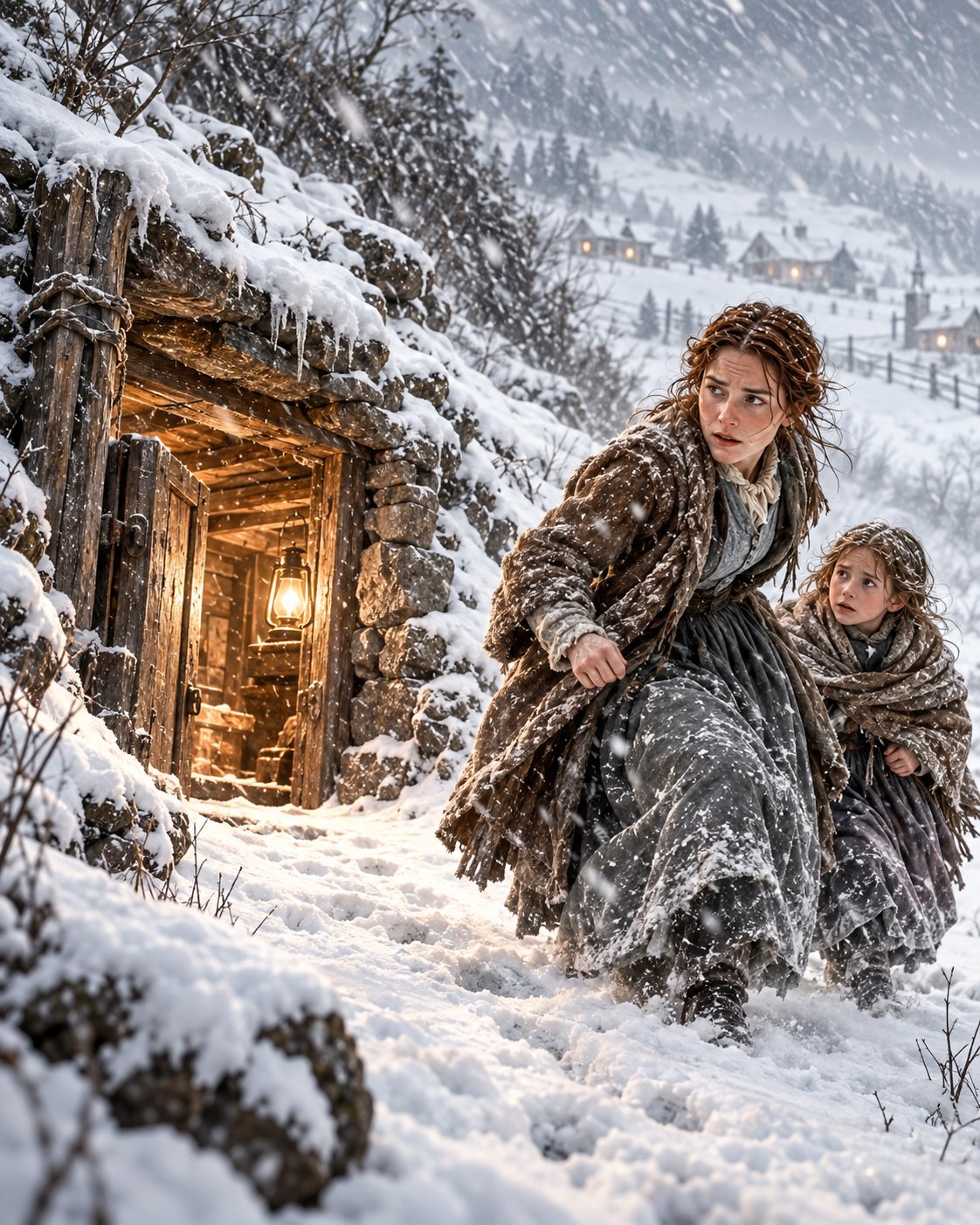
"Mama, don't open it until you know who the other person is."
I spun around so quickly that the lantern flame nearly went out.
May stood at the entrance to the passage.
Her small hands were wrapped around the edges of Owen's old wool blanket. Flint stood beside her, his gray ears raised and his body perfectly still.
For several seconds, I could only stare at her.
"May?"
She looked frightened.
"Did you say that?"
She nodded.
I lowered the brass nameplate.
"Why?"
She pointed toward the wooden door.
"It says two people can go inside."
I looked at the inscription again.
AUTHORIZED ACCESS: C. VAIN AND ONE OTHER.
May stepped closer.
"Papa wouldn't let you go somewhere dangerous alone."
My throat tightened.
She was right.
Owen had never allowed her to wander near the river without someone watching. He checked the stable doors before bed and inspected the stove every evening.
He was careful about everything that concerned us.
If he had built this room for our family, he would have considered the possibility that I might arrive with May.
I crouched in front of her.
"Did you see anything else?"
She shook her head.
"Only the words."
"Are you sure?"
She nodded.
Then she looked toward the door.
"Maybe Papa wanted us both to open it."
I looked at the little brass key.
For six weeks, I had believed my husband's story had ended on a mountain road beneath a survey cart.
Now I was beginning to understand that I had known only the part of his life he had chosen to share with me.
I placed the nameplate beside the wooden box.
Then I took May's hand.
"All right, sweetheart. We won't open it yet."
She looked relieved.
I turned toward the passage.
"But we're going to find out what he left us."
The first thing I noticed was the temperature.
The farther we moved from the entrance, the warmer the air became.
It was not the comfortable warmth of a kitchen beside a burning stove.
It was something different.
The mountain itself seemed to hold heat.
I raised the lantern and examined the walls.
The stone had been cut in places.
Not roughly, as someone might do while searching for shelter, but with deliberate precision.
Narrow channels ran along the lower sections of the walls.
Some were covered by wooden panels.
Others disappeared into the darkness.
I touched one of the panels.
It felt dry.
The wood had not swollen from moisture.
Owen had once explained that certain mountain formations contained natural air currents.
He had said that a properly positioned opening could draw cold air from one side and release warmer air through another.
I had listened while sewing.
I had not understood much of it.
Now I wished I had asked more questions.
"Why is it warm here?" May asked.
"I think the mountain protects this place."
"Like a blanket?"
I smiled faintly.
"Something like that."
She looked toward the ceiling.
"Does the mountain have a fire inside?"
"I don't think so."
"Then where does the warmth come from?"
I studied the stone.
"I intend to find out."
Flint moved ahead.
His paws made almost no sound on the dry earth.
He stopped beside a narrow opening in the wall and sniffed.
I followed.
The opening was covered by a wooden grille.
Behind it, I could hear a faint rushing sound.
Air.
Moving through the mountain.
I held the lantern near the grille.
The flame leaned inward.
Then it straightened.
I remembered the strange movement of the fire near the entrance.
This was what Owen had meant.
Iron Hollow was not simply a cave.
It had been designed to breathe.
I looked at the walls again.
Someone had studied this place.
Someone had understood how to make it useful.
And my husband had known where to find it.
We returned to the wooden door.
I placed the brass nameplate on a flat stone.
Then I examined the lock.
There were two separate keyholes.
The first was positioned near the handle.
The second was smaller, almost hidden beneath an iron plate.
I had not noticed it before.
I tried the brass key in the first lock.
It turned easily.
A small bolt withdrew.
Then I inserted it into the second.
It did not fit.
I tried turning the key in the opposite direction.
Nothing.
May watched carefully.
"Maybe there are two keys."
I looked at her.
"That's possible."
"Where is the other one?"
I examined the wooden box.
There had been only one brass key inside.
The leather strip.
The letter.
And the box itself.
I opened the box again.
This time, I removed everything and examined the bottom.
There was a thin piece of fabric lining the interior.
I pressed against it.
Something moved beneath the cloth.
My heart began beating faster.
I carefully lifted one corner.
A narrow wooden compartment appeared.
Inside lay a small iron key.
It was much darker than the brass one.
And it had a number engraved on its handle.
Seven.
I looked at the first key.
Eight.
Seven and eight.
I placed both keys on the stone.
May leaned closer.
"Papa hid two keys?"
"Yes."
"Why?"
"I don't know."
I turned the smaller key beneath the lantern.
Its teeth were unusually shaped.
It appeared to belong to an older lock.
I looked at the door again.
Two keyholes.
Two keys.
Two authorized people.
Perhaps Owen had intended for both of us to participate.
I inserted the smaller key into the second lock.
It fitted perfectly.
I turned it.
A sharp metallic click sounded from inside the door.
The handle shifted.
Then something heavy moved behind the wood.
May stepped closer to me.
I gently moved her behind my shoulder.
"Stay here."
She obeyed.
I turned the brass key once more.
A second bolt withdrew.
Then a third.
The door was still closed.
I placed my hand against the wood.
It did not move.
I tried the handle.
It remained locked.
I looked down.
There was a small metal plate near the bottom.
It contained a narrow slot.
I had seen something similar on the wooden mechanism beside the second survey marker.
Perhaps the keys had only released the upper bolts.
There was another mechanism.
I took the hand axe from my bag.
Not to break the door.
To examine the metal fittings.
I used the edge of the axe to clear away the dust.
Beneath it, I discovered a small circular dial.
There were twelve notches around its edge.
The numbers from Owen's ledger returned to me.
Twelve.
Four.
Three.
I looked at the dial.
Then at the keys.
I had no idea what order to follow.
I could have forced the door.
But something stopped me.
Owen had taken great care to leave instructions.
I was certain that he would not have wanted me to destroy what he had spent months preparing.
I stepped away.
"We'll wait."
May frowned.
"But it's open."
"Not yet."
I touched the door.
"Your father wanted us to understand something before entering."
She looked at the two keys.
"Maybe he wanted us to find the other key first."
I looked at her.
Then I glanced at the wooden box.
The number eight.
The number seven.
And the twelve notches.
Perhaps the answers were not separate.
Perhaps they belonged together.
I returned to the main shelter and opened the ledger.
The pages were beginning to curl from the damp air near the entrance, so I placed a flat stone over the cover.
I searched for the August entries.
Owen's handwriting was unusually precise.
He had recorded measurements beside several dates.
August 19.
August 22.
August 27.
September 3.
September 21.
I compared the figures.
The first entry contained twelve.
The second contained four.
The third contained three.
The final entry contained eight and seven.
I stared at the numbers.
They were not measurements.
They were instructions.
I turned the ledger sideways.
Along the margin, Owen had drawn a small circle divided into twelve sections.
Four of the sections were marked.
Three were crossed out.
Eight was written near the top.
Seven was written beneath it.
I followed the markings with my finger.
There was a pattern.
The first mark indicated the starting position.
The second showed the direction.
The third indicated how many turns to make.
I looked toward the wooden door.
The dial had twelve notches.
I returned to it.
The lantern illuminated the small numbers engraved around the edge.
I counted them.
One through twelve.
I placed my hand on the dial.
The first mark was at twelve.
I turned it clockwise four notches.
It clicked.
Then I turned it back three.
Another click.
I stopped.
The mechanism remained still.
I tried the brass key.
The first bolt moved.
Then the smaller iron key.
The second bolt moved.
A low sound traveled through the door.
Something released.
I stepped back.
May held my hand.
The wooden door shifted outward by less than an inch.
A line of darkness appeared between the frame and the door.
Warm air moved through the opening.
It carried a smell I recognized immediately.
Dry wood.
Oil.
Old paper.
And something else.
Bread.
I looked at May.
She looked at me.
"Is there food inside?"
"I think so."
I pulled the door carefully.
It opened another few inches.
The hinges groaned.
Beyond the opening, I could see a narrow stone room.
A wooden table.
Several shelves.
A lantern hanging from a hook.
And against the far wall, a large object covered with canvas.
I stepped inside.
The air was warm and dry.
Not merely protected from the wind.
Warm.
I held the lantern higher.
There were supplies everywhere.
The first thing I found was flour.
Several sealed sacks stood against the left wall.
They were arranged carefully on raised wooden platforms, away from the stone floor.
Beside them were containers of dried beans, salt, oats, and preserved vegetables.
There were barrels of water.
A stack of firewood.
Several boxes of candles.
A small collection of tools.
And blankets.
More blankets than I had ever seen stored in one place.
May entered behind me.
Her eyes widened.
"Mama."
I turned.
She was staring at the shelves.
"There's food."
I nodded.
"Yes."
"Lots of food."
I looked around.
There was enough to feed us for weeks.
Perhaps longer.
The room was not luxurious.
It was practical.
Everything had been placed where it could be reached easily.
The supplies were labeled.
The containers were sealed.
A small notebook rested on the table.
I opened it.
The first page contained an inventory.
The handwriting was Owen's.
He had recorded the amount of flour, grain, salt, dried meat, lamp oil, and firewood.
There were columns for dates and quantities.
I turned several pages.
The most recent entry was dated September 18.
Three days before his death.
My fingers tightened around the notebook.
He had been here only three days before the accident.
I looked toward the shelves.
The sacks were still neatly arranged.
The water barrels were sealed.
The blankets were folded.
He had prepared this place for us.
Not in some distant future.
He had been preparing it while I was still sleeping beside him, believing we had an ordinary life ahead.
I sat down.
For a moment, I could not look at anything.
May approached.
"Did Papa put all this here?"
"I think he did."
She touched a folded blanket.
"Did he know we would come?"
I looked at the notebook.
"I think he hoped we would."
May hugged the blanket.
Then she looked toward the covered object against the far wall.
"What is that?"
I followed her gaze.
The canvas was dark with age.
A thick rope secured it to the wall.
I approached slowly.
The object beneath it was large.
Much larger than a chest.
I pulled the canvas away.
It revealed a wooden cabinet.
Its doors were reinforced with iron.
A small brass plate had been fixed to the front.
There were two words engraved on it.
WINTER RESERVE.
I tried the handle.
It was locked.
I searched the surrounding shelves.
There was no key.
Only a small note attached to the cabinet.
I removed it.
Owen had written:
For the day when the valley forgets what it owes you.
I stared at the sentence.
The words seemed strangely bitter.
Owen had never been a bitter man.
He believed people could be selfish, but he rarely spoke badly about anyone.
Why had he written that?
I folded the note.
Then I noticed a second line beneath it.
Do not open until Cordelia has checked the accounts.
I looked toward the ledger.
The accounts.
Harlon's accounts.
The missing grain.
The unexplained shortages.
The damaged roof.
Suddenly, the room seemed less like a simple refuge and more like something Owen had prepared for a reason.
I returned to the table.
There were several papers beneath the notebook.
I lifted them.
The first contained a rough map of the mill.
The second showed the storage room.
The third was a list of dates and quantities.
I compared the figures with the inventory I had completed before being expelled.
They were identical.
But the numbers in Owen's papers did not match the figures Harlon had reported.
Not even close.
I looked at the final sheet.
At the bottom was a handwritten sentence.
If the mill owner claims there is no grain left, check the north wall.
I felt my stomach tighten.
The north wall.
The same wall that contained the hidden mechanism.
The same direction Owen had marked in the ledger.
I turned toward the cabinet.
For the first time, I wondered whether the supplies in Iron Hollow were only part of what he had left behind.
May had discovered a small wooden stool beside the shelves.
She sat on it and watched me.
"Are we going to stay here?"
I looked around.
The room was warm.
The food was dry.
The floor was solid.
For the first time since leaving the mill, I could imagine sleeping without worrying about snow covering our blanket.
"Yes," I said.
May's face softened.
"Can Flint come?"
I glanced toward the entrance.
The dog was lying just outside the room.
"Of course."
She smiled.
Then she stood and approached the table.
"What's that?"
She pointed toward a small folded piece of paper tucked beneath the notebook.
I had not noticed it.
I removed it carefully.
It was a letter.
The outside contained only two words.
For May.
My heart stopped.
I looked at my daughter.
"Come here, sweetheart."
She approached slowly.
I sat beside her and unfolded the paper.
The handwriting was unmistakable.
My little mountain bird,
If your mother has brought you here, then I am proud of her.
Listen to her.
Help her when she asks.
And remember that being brave does not mean you are never frightened.
It means you keep going even when you are.
I stopped reading.
May's eyes were fixed on the page.
I continued.
I wanted to build you a place where you could grow without being afraid of the weather, the cold, or the people who think they own everything around them.
Your mother knows how to make a home from almost nothing.
Trust her.
She is stronger than she knows.
I folded the letter.
May touched it.
"Did Papa write that for me?"
"Yes."
She read the first line again, moving her finger beneath the words.
Then she pressed the paper against her chest.
I pulled her into my arms.
For a long time, neither of us spoke.
When she finally lifted her head, her eyes were wet.
"Do you think Papa knew he was going to die?"
I looked at her.
I did not want to lie.
"I don't know, sweetheart."
"Then why did he make all this?"
I glanced around the room.
"Maybe he knew winter could be dangerous."
She looked at the letter.
"Maybe he wanted us to be safe."
I kissed her forehead.
"Yes."
That was the only answer I could give.
The storm continued outside.
I spent the next hour checking the supplies.
The flour sacks were dry.
The beans were stored in sealed containers.
The firewood was stacked near a small iron stove.
There was even a simple cooking arrangement built into the stone wall.
A narrow pipe carried smoke toward a vent above the overhang.
Owen had thought of everything.
I found a small washbasin.
Several clean cloths.
A sewing kit.
A spare pair of children's boots.
And a wool coat in a size that would fit May.
I held it up.
It was dark blue.
The sleeves were slightly long, but otherwise it looked almost new.
May touched the fabric.
"Is that mine?"
"I think so."
She slipped her arms into it.
The coat fit.
I turned away for a moment.
There were things a mother could endure without breaking.
Hunger.
Cold.
Exhaustion.
The humiliation of being turned away from a place she had worked to maintain.
But discovering that her dead husband had prepared clothing for their daughter, knowing she might need it someday, was something else.
I pressed my fingers against my eyes.
Then I heard a sound.
A heavy thud.
It came from the far side of the room.
I turned.
Flint had risen.
His body was rigid.
His ears pointed toward the northern wall.
I moved toward him.
"What's wrong?"
He sniffed the floor.
Then he scratched once against a wooden panel.
I knelt.
The panel was almost invisible beneath the shelf.
I moved a sack of oats aside.
A narrow iron handle appeared.
I pulled it.
The panel did not move.
I examined the surrounding stone.
There was another crossed survey mark.
I brushed away the dust.
Beneath it was a small metal plate.
Three words had been engraved on the surface.
BELOW THE RESERVE.
I looked toward the large cabinet.
Then back at the floor.
There was something beneath this room.
Something Owen had not mentioned in his letter.
I pressed the metal plate.
A faint click sounded.
A narrow line appeared between two sections of the floor.
I placed my fingers into the gap and lifted.
The wooden panel moved upward.
Beneath it was a steep stone staircase.
Cold air rose from the darkness.
I raised the lantern.
The steps descended farther than I could see.
May approached.
"What's down there?"
"I don't know."
Flint growled.
Not loudly.
But with a warning I had never heard from him before.
I looked at the staircase.
Then I noticed something on the first step.
A fresh footprint.
Not Owen's old boot mark.
Not mine.
The snow around its edge was still damp.
Someone had been down there recently.
I looked toward the wooden door.
It was still open.
The supplies were untouched.
The room was empty.
But the footprint was unmistakable.
I took the hand axe from my belt.
"May, stay behind me."
She gripped the back of my coat.
I lowered the lantern toward the staircase.
The light reached the third step.
Then the fourth.
Then the fifth.
At the bottom, something reflected the flame.
Metal.
I took one careful step downward.
Then another.
The air grew colder.
A faint smell of damp earth rose from below.
I stopped at the sixth step.
There was a small object resting against the wall.
A folded piece of paper.
I reached for it.
The paper was not old.
It was fresh.
The ink had not faded.
I unfolded it.
There was only one sentence.
Cordelia, if you have found this room, Harlon already knows you survived.
My fingers went numb.
I looked toward May.
Then I heard a horse outside.
Not the distant sound of an animal moving through the storm.
A horse stopping directly beneath the stone overhang.
Flint began barking.
I extinguished the lantern for one second, then raised it again.
Through the narrow entrance, I could see a shadow moving across the snow.
Someone had reached Iron Hollow.
And then a man's voice called from outside.
"Cordelia Vain?"
I recognized it immediately.
It was Harlon Puit.
He had found us.






Comments 0