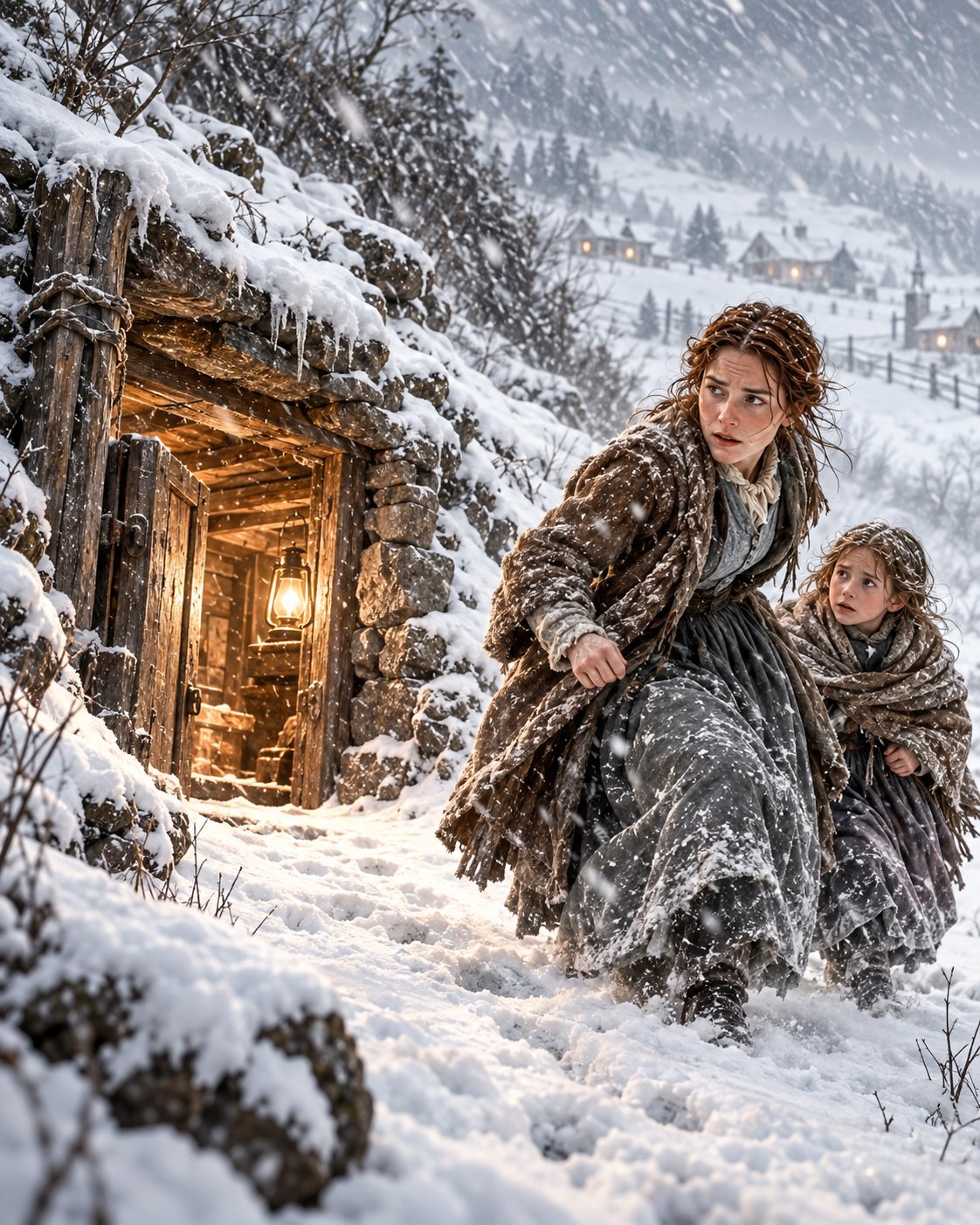
The rider was coming toward us.
I recognized the dark-blue coat before I could see the man's face.
Reverend Silas Drum.
The same man who had stood beside Harlon Puit when they ordered my daughter and me out of the mill.
The same man who had spoken about Christian duty while a seven-year-old child watched her mother lose the only home she had left.
And now he was riding toward the place my husband had prepared for us.
Gideon grabbed my arm.
"Mrs. Vain, listen carefully."
I looked at him.
"Who is he?"
"The man who signed the false survey."
"I know that."
"No. You don't understand. He wasn't simply involved in the operation. He designed it."
I looked toward the approaching horse.
The reverend was riding slowly, as though he had all the time in the world.
"Why is he coming here?"
"Because he knows we found the documents."
I glanced at the photograph in Gideon's hand.
Owen stood between Harlon and Reverend Drum.
All three men were looking toward the camera.
But Owen was the only one who appeared uncomfortable.
I turned the photograph over.
The warning was still there.
If Drum comes to Iron Hollow, the second door must remain closed.
I looked at Gideon.
"What is the second door?"
He did not answer.
"Mr. Rusk."
His expression tightened.
"Something your husband discovered beneath the lower chamber."
"What?"
"An older passage. It connects Iron Hollow to the northern freight route."
I stared at him.
"And what is inside?"
Gideon looked toward the rider.
"Evidence that could destroy everything Drum has built."
The reverend was now close enough for us to hear the sound of his horse's hooves.
Gideon folded the photograph and placed it inside his coat.
"Whatever happens, do not tell him what we found."
I tightened my grip on the survey documents.
Then Reverend Drum stopped his horse directly in front of us.
He removed his gloves.
And smiled.
"Well," he said, looking at the papers in my hands. "It seems Owen's widow has finally found what she was never supposed to see."
I did not answer.
Reverend Drum dismounted.
His movements were slow and practiced.
He tied his horse to a nearby tree and brushed snow from his coat.
He looked exactly as I remembered him.
Clean-shaven.
Carefully dressed.
His dark hair was combed neatly beneath his hat.
There was nothing obviously threatening about him.
That was what made him dangerous.
He had the appearance of a man people trusted with their children, their money, and their secrets.
He had stood beside grieving families.
He had prayed over graves.
He had delivered flour to the poor.
And according to Owen's documents, he had helped arrange the theft of the winter grain.
"Mrs. Vain," he said pleasantly.
"Reverend."
"I heard you had found shelter in the mountains."
"News travels quickly."
"Small communities have long memories."
I looked at Gideon.
He remained silent.
Drum noticed.
"Mr. Rusk. It has been some time."
"Not long enough."
The reverend chuckled.
"Still carrying old grudges, I see."
Gideon did not respond.
Drum turned toward me.
"I was concerned when I learned that you and your daughter had been sent away from the mill."
I stared at him.
"You stood beside Harlon when he ordered us out."
"Those were difficult circumstances."
"You knew the storm was coming."
"Of course."
"And you allowed a seven-year-old child to walk into it."
His smile faded slightly.
"I did not order you to leave, Mrs. Vain."
"No. You simply agreed that it was necessary."
He removed his hat.
"Sometimes a community must make difficult decisions."
I had heard those words before.
They sounded no more honest now than they had that morning.
I stepped closer.
"Where did the missing grain go?"
His expression did not change.
"What missing grain?"
"The grain listed in Owen's records."
Drum looked toward Gideon.
Then he laughed softly.
"Your husband was a talented surveyor. Unfortunately, he became confused about the boundaries between his work and the affairs of others."
"Did he?"
"Yes."
"Then why is your name on the original survey?"
For the first time, the reverend stopped smiling.
Only for a second.
But I saw it.
He looked at the papers in my hand.
Then at the iron marker.
"May I see those documents?"
"No."
His eyes returned to mine.
"Mrs. Vain, I believe you are making a serious mistake."
I folded the papers.
"Perhaps you should tell me what the mistake is."
He looked toward the valley.
Then he said quietly:
"Believing that the dead leave behind the whole truth."
Gideon stepped between us.
"That's enough, Drum."
The reverend sighed.
"Must you always turn every conversation into a confrontation?"
"Must you always turn every crime into a sermon?"
Drum's expression hardened.
He reached inside his coat.
Gideon immediately raised one hand.
"Don't."
The reverend stopped.
Then he slowly removed a folded document.
He held it toward me.
"This is a legal notice."
I did not take it.
"What does it say?"
"That Iron Hollow and the surrounding northern land belong to the Blackwater Development Company."
I looked at the document.
"Who owns the company?"
"Investors."
"Names?"
"That information is not relevant."
I almost laughed.
"Everything seems irrelevant when you don't want to answer."
His eyes narrowed.
"The land has been purchased legally."
"From whom?"
"Several previous claim holders."
"Did they know what was beneath the mountain?"
He paused.
Then he said:
"That is not a matter for you."
I looked at Gideon.
He was watching the reverend carefully.
I understood.
Drum had come to claim the land.
Not because he needed shelter.
Not because he was concerned about the storm.
He wanted Iron Hollow.
He wanted the papers.
And he wanted to make sure nobody discovered what Owen had hidden beneath it.
I looked at the legal notice again.
There was a signature at the bottom.
Silas Drum.
Not as a witness.
As the authorized representative of the company.
I raised my eyes.
"You signed the purchase."
"I facilitated it."
"Did you also arrange the missing grain?"
His face became cold.
"Be very careful, Mrs. Vain."
I held his gaze.
"I have been careful for six weeks."
He seemed surprised by the answer.
I continued.
"Careful enough to keep my daughter alive. Careful enough to carry the records you wanted destroyed. And careful enough to remember every word you said when you sent us into that storm."
The reverend said nothing.
For the first time, he looked at me as though he was seeing someone he had not expected to encounter.
We returned to Iron Hollow shortly before noon.
Drum followed us.
I had not invited him.
He simply walked behind us, leading his horse.
Gideon remained close.
I kept the survey documents beneath my coat.
The entrance to the shelter was partially covered with snow.
Flint barked as soon as we approached.
May appeared behind the wooden door.
"Mama!"
She ran toward me.
I dropped to one knee and hugged her.
"Are you all right?"
She nodded.
"Mr. Rusk kept the fire burning."
I looked at Gideon.
He gave a small nod.
Then May noticed the reverend.
Her expression changed.
She stepped behind me.
Drum removed his hat.
"Hello, May."
She did not answer.
He smiled.
"I hope you have been comfortable."
May looked at the floor.
I placed my hand on her shoulder.
"Go inside, sweetheart."
She obeyed.
Drum watched her disappear.
Then he looked at the entrance.
"This place has been maintained better than I expected."
I turned.
"How do you know Iron Hollow?"
He ignored the question.
"Your husband spent a considerable amount of time here."
"How much?"
"More than you realize."
I studied his face.
"You were here with him."
Drum glanced at Gideon.
"On one occasion."
"August twenty-seventh?"
He said nothing.
I removed the photograph from my coat.
The three men stood together.
Owen.
Harlon.
Silas Drum.
I held it up.
"Tell me what happened that day."
The reverend examined the photograph.
Then he gave a quiet sigh.
"Your husband was a difficult man to reason with."
"What happened?"
"He discovered the mineral deposits."
"And?"
"He refused to cooperate."
"What did you want him to do?"
"Correct the survey."
I stared at him.
"You wanted him to change the land boundaries."
"Only to reflect the actual ownership agreements."
"Those agreements were false."
His jaw tightened.
"That is your interpretation."
"Did you threaten him?"
The reverend looked toward the lower chamber.
Then back at me.
"I warned him."
"About what?"
"About the consequences of standing in the way of progress."
I felt my blood turn cold.
"Is that what you call killing a man?"
Drum's expression changed.
For a moment, he looked genuinely offended.
"I did not kill your husband."
"Then why did Elias say he was alive after the accident?"
The reverend became completely still.
Gideon moved closer.
I watched Drum's face.
He had not expected that question.
"Who told you that?"
"Elias."
The reverend slowly replaced his hat.
"Then Elias has become a problem."
The words hung in the room.
Gideon stepped toward him.
"Where is Owen?"
Drum looked at him.
"I don't know."
"You know more than you're admitting."
"I know that your friend made a serious mistake."
"Which one?"
"Believing that a few papers could bring down men who have spent years building this valley."
I looked at him.
"Did you see Owen after the accident?"
Drum did not answer.
I moved closer.
"Did you?"
He looked toward the entrance.
Then he said:
"I saw him at Blackwater Station."
My heart stopped.
"Alive?"
Drum looked at me.
"Yes."
I felt the floor shift beneath my feet.
May was in the next room.
The fire was burning.
The mountain was silent.
But I could no longer hear anything except that one word.
Alive.
"How long after the accident?"
"Several hours."
"What happened to him?"
Drum removed his gloves.
"He was injured."
"Was he conscious?"
"At times."
"Did he speak?"
The reverend looked down.
"He asked for you."
I pressed my hand against the table.
For six weeks, I had believed that Owen's final moments had been spent beneath a broken cart.
Now I was being told he had been somewhere else.
He had been alive.
He had asked for me.
And someone had kept that knowledge from his wife and daughter.
"Why didn't you tell me?"
Drum looked at me.
"Because there were matters that needed to be settled."
"What matters?"
"The survey documents."
I stared at him.
"You held my husband while he was injured and demanded the papers?"
He did not deny it.
I felt something inside me harden.
"Where is he now?"
Drum looked toward the floor.
Then he said:
"I don't know."
Gideon struck the table with his palm.
"You're lying."
The reverend stepped back.
"Control yourself."
"Where did you take him?"
"I told you. I don't know."
Gideon moved closer.
"Who was with him?"
Drum looked at him.
Then he spoke a name.
"Caleb Voss."
Gideon went pale.
I had never heard the name before.
But Gideon clearly had.
He stepped away from the table and sat down.
For several seconds, he looked as though he had forgotten how to speak.
I turned toward him.
"Who is Caleb Voss?"
Gideon rubbed his forehead.
"An old survey foreman."
"Was he at the accident?"
"Yes."
"Did he help Owen?"
Gideon looked toward Drum.
"Caleb was the man responsible for securing the equipment cart."
I looked at the reverend.
"Then he caused the accident."
Drum did not answer.
Gideon stood.
"Where is he now?"
"Dead," Drum replied.
The word landed heavily.
"When?"
"Three weeks ago."
"How?"
"A fall."
I looked at Gideon.
His expression had become unreadable.
Then he said:
"That's convenient."
Drum ignored him.
He returned his attention to me.
"Mrs. Vain, I came here to offer you an opportunity."
I stared at him.
"What opportunity?"
"The company is willing to compensate you for leaving Iron Hollow."
I almost laughed.
"Compensate me?"
"A generous payment. Enough to purchase a small property elsewhere. Enough to provide for your daughter."
I looked toward the shelves.
The flour.
The blankets.
The carefully prepared supplies.
Owen had built this place because he believed we might need it.
Now the reverend was offering money to make us disappear.
"How much?"
Drum named a figure.
It was more money than I had ever seen.
Enough to live comfortably for years.
Enough to buy a small farm.
Enough to give May a secure future.
For one brief moment, I understood why desperate people might accept.
Then I remembered the villagers.
The missing grain.
The false records.
The families who had been forced to sell their homes.
And Owen.
I looked at the reverend.
"No."
He blinked.
"Think carefully."
"I have."
"You would be refusing a considerable sum."
"I know."
"You could give your daughter a better life."
I stepped closer.
"She already has a better life than the one you planned for her."
Drum's face darkened.
"Your husband made the same mistake."
The reverend left shortly afterward.
He did not threaten us.
He did not raise his voice.
He simply put on his gloves, collected the legal notice, and walked toward his horse.
Before mounting, he turned.
"Mrs. Vain, the storm will return."
I said nothing.
"The mountains are dangerous. The northern trail is dangerous. People disappear in these places every winter."
I looked at him.
"Are you warning me?"
"I'm reminding you that no one is beyond reach."
He mounted.
Then he rode away.
I watched until the dark-blue coat disappeared into the snow.
Gideon remained beside me.
Neither of us spoke.
Finally, I turned.
"Tell me about Caleb Voss."
Gideon looked exhausted.
"He was the foreman who supervised the survey team. He knew the upper canyon better than anyone."
"Was he a good man?"
Gideon took a long breath.
"I thought he was."
"Did Owen trust him?"
"Yes."
"Then why would he help arrange the accident?"
Gideon looked toward the mountains.
"Because he was paid."
I felt sick.
"By Drum?"
"Probably."
I studied his face.
"You said you helped Owen."
"I did."
"Then why didn't you stop them?"
Gideon looked at me.
For a long time, he said nothing.
Then he answered.
"Because I wasn't there when the cart went over."
"Where were you?"
"At Blackwater."
"Doing what?"
He lowered his eyes.
"Waiting for Owen."
I stared at him.
"You knew something was going to happen."
"I suspected."
"Then why didn't you warn him?"
His face tightened.
"I tried."
"Not hard enough."
He accepted the accusation without defending himself.
That frightened me more than an argument would have.
That evening, May sat beside me while I checked the supplies.
She had been unusually quiet since the reverend's visit.
I knew she had heard enough to understand that something terrible had happened to her father.
She held Owen's letter in both hands.
"Mama?"
"Yes, sweetheart?"
"Did Papa get hurt?"
I stopped counting the flour sacks.
"Yes."
"At the mountain?"
I nodded.
"Was it very bad?"
I sat beside her.
"I think so."
She looked down.
"Did he call for you?"
My throat tightened.
"Yes."
She pressed the letter against her chest.
"Then he wanted you."
I kissed her forehead.
"He wanted both of us."
She remained quiet for a moment.
Then she asked:
"Will we find him?"
I looked toward the dark passage.
I thought of the old survey station.
The hidden documents.
The photograph.
The name of the man who had been responsible for the equipment cart.
And the second door.
"I think we will find the truth."
May lowered her eyes.
"That's not the same."
"No," I whispered.
"It isn't."
She leaned against me.
I held her.
I could not promise that Owen would return.
But I could promise that I would not stop looking.
Later that night, I returned to the lower chamber.
The warning on the photograph had not left my mind.
If Drum comes to Iron Hollow, the second door must remain closed.
I examined the map again.
The second passage was marked beneath the winter reserve.
There were measurements beside it.
A narrow line.
A circular symbol.
And a small note.
Only after the original survey is recovered.
I looked toward the cabinet.
The locked winter reserve.
The one Owen had warned me not to open until I checked the accounts.
I had not opened it.
But I was beginning to understand that the cabinet contained more than food.
I examined the lock.
There was a small brass plate beneath the handle.
A number had been engraved into it.
Twenty-one.
I opened the ledger.
September 21.
The day before Owen died.
His final entry contained a sentence I had overlooked.
The reserve is ready. The original survey is beneath the second door.
I looked toward the lower staircase.
The second door.
The original survey.
Everything was connected.
I returned to the cabinet.
There was a narrow slot beside the lock.
I tried the brass key.
Nothing.
I tried the iron key.
Nothing.
Then I noticed a small circular indentation.
It was the same size as the brass instrument Gideon had brought.
I retrieved it from the table.
The instrument was damaged, but the metal ring around its face was still intact.
I placed it against the indentation.
It fitted.
I turned it slowly.
A faint click came from inside the cabinet.
The handle moved.
I pulled.
The cabinet opened.
Inside were several bundles of papers, a small leather pouch, and a metal cylinder.
I removed the first bundle.
It contained property deeds.
The second contained grain shipment records.
The third contained the original survey.
I unfolded it.
The northern valley was drawn in precise lines.
The mineral deposits were clearly marked.
But something was wrong.
The land boundaries on this map did not match the official records.
Several farms had been moved onto land listed as company property.
The changes had been made in different ink.
Someone had altered the original survey.
I turned the page.
A second document was attached.
It contained signatures.
Harlon Puit.
Silas Drum.
Caleb Voss.
And one more.
A signature I recognized immediately.
Elias Foot.
I stared at it.
The mailman had not merely carried messages.
He had signed the agreement.
My hands began to tremble.
Then I opened the leather pouch.
Inside was a small photograph.
It showed Owen standing beside a wooden wagon.
He was alive.
His face was bruised.
His left arm was wrapped in a bandage.
And beside him stood a man wearing the uniform of the county marshal.
I turned the photograph over.
The date was September 22.
The day of his death.
Beneath it, Owen had written:
If this photograph reaches Cordelia, tell her the marshal was not there to rescue me.
I looked toward the entrance.
Gideon was standing in the doorway.
He had seen the photograph.
His face had gone completely white.
"Mrs. Vain," he whispered.
I turned toward him.
"What is it?"
He looked at the man in the photograph.
Then he said something that made my blood run cold.
"That is not the county marshal."
I stared at him.
"Then who is he?"
Gideon slowly closed the door behind him.
And whispered:
"He's the man who officially declared your husband dead."






Comments 0