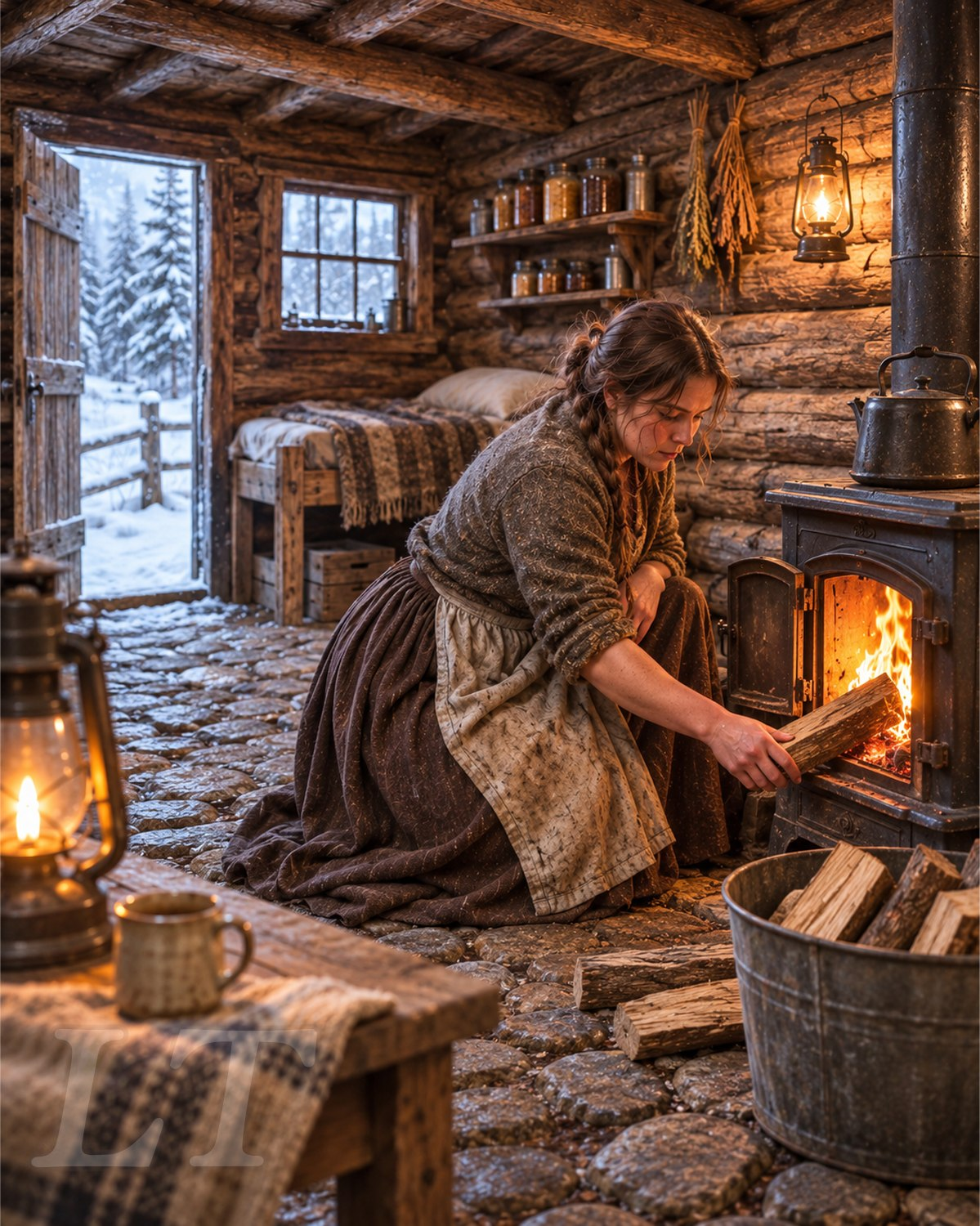
A little girl slept peacefully in her mother's arms while a man stood frozen in the doorway.
"Your stove is dead!" Jedediah Croft whispered.
He had brought enough firewood to save two lives.
But the cabin was warmer than his own home.
And the floor beneath his boots was made of river stones.
Three months earlier, he had called the woman who built it a fool.
Now he couldn't explain what he was feeling.
Elspeth MacLeod stepped aside to let him enter.
"Come in, Mr. Croft. You're letting the cold inside."
The old carpenter did not move.
His eyes traveled from the young widow's face to the sleeping infant tucked against her shoulder. Then they shifted toward the iron stove standing against the far wall.
The stove was dark.
There was no orange glow behind its iron door. No crackling wood. No smoke curling from the chimney.
Yet the air inside the cabin carried a comfortable warmth that seemed almost offensive compared with the frozen world outside.
Jedediah removed one glove.
His fingers trembled.
"How long?" he asked.
Elspeth understood his question.
"Since before midnight."
He looked toward the stove again.
"That's impossible."
She said nothing.
The old man slowly stepped inside. Snow fell from his boots onto the stone floor, melting into small dark spots.
He had spent forty years building houses in Sweetwater Valley. He knew how heat behaved. He knew how quickly a cabin cooled when the fire died. He knew the difference between a warm room and one that merely felt warmer after standing in the snow.
This was something else.
"Where is your firewood?" he asked.
Elspeth glanced toward the corner.
"There isn't much left."
"Then how are you keeping this place warm?"
She looked down at the floor.
Jedediah followed her gaze.
For several seconds, neither spoke.
The stones were gray, brown, and reddish in color. Hundreds of them covered the cabin floor, fitted together with a patience that seemed almost unreasonable.
He recognized them immediately.
River stones.
The same stones he had once warned her against using.
He bent down and touched one.
His hand stopped.
The stone was warm.
Not hot. Not freshly heated.
Warm.
He pressed his palm against it again, as if the second touch might contradict the first.
It didn't.
"Elspeth," he whispered, "what have you done?"
She adjusted the blanket around her daughter.
"Something my father taught me."
Jedediah looked up.
And for the first time since he had known the young widow, he had no criticism ready.
But to understand why that moment mattered, one had to understand what had happened before the first stone was ever carried into the cabin.
Three months earlier, Elspeth MacLeod had been a woman whom almost everyone in Sweetwater Valley pitied.
Some respected her.
Some avoided her.
Others believed she had lost her judgment.
She was nineteen years old, newly widowed, and responsible for an infant daughter.
Her husband, Tom, had been dead for only a few months.
And the cabin that had once represented their future together had become a reminder of everything she had lost.
Tom had built it himself.
He had chosen the thickest logs he could find, cut the timber carefully, and fitted each piece with the stubborn determination that made him good at nearly everything he attempted.
He had even saved for months to purchase their cast-iron stove.
When he finally brought it home, he stood in the middle of the unfinished cabin with his hands on his hips.
"Now that's a stove," he had said proudly.
Elspeth had laughed.
"It looks big enough to cook an entire horse."
"Then we'll never go hungry."
He had turned toward her and kissed her forehead.
"It'll keep us warm, Ellie. Whatever winter throws at us, we'll face it together."
She had believed him.
Why wouldn't she?
Tom was strong, practical, and endlessly optimistic.
He knew how to repair a wagon, build a fence, split timber, and stretch a small supply of food farther than anyone thought possible.
When their daughter Sarah was born in January, he had been the happiest man in Montana.
He had stood beside the cradle for hours, watching the baby sleep.
"Look at her," he whispered one night. "She's got your eyes."
Elspeth smiled.
"She's got your stubbornness."
"That's a useful quality."
He laughed softly.
Then winter tightened its grip.
The first serious cold arrived earlier than expected. Snow covered the trails, the creek froze along its edges, and the wind began finding every weakness in the cabin.
Tom fed the stove every two hours.
Sometimes every hour.
He stacked wood beside the hearth and kept a kettle simmering whenever there was enough water.
Still, ice formed inside the windows.
The water bucket froze overnight.
Cold air crept through the spaces between the wooden floorboards.
Elspeth remembered waking before dawn and finding Sarah's blanket damp with condensation near the window.
She carried the baby closer to the stove.
Tom immediately rose from his bed.
"I'll put more wood on."
"You've barely slept."
"I can sleep in spring."
He smiled, but she noticed the exhaustion around his eyes.
That winter, they burned eight cords of firewood.
Eight.
And it was never enough.
By March, Tom had developed a terrible cough.
At first, he dismissed it as the result of working outdoors.
Then he began waking at night, struggling to breathe.
By April, the cough had become pneumonia.
The local doctor visited twice, but medicine was scarce, and the weather had made travel difficult.
Elspeth stayed beside her husband.
She heated water, changed his blankets, and held his hand whenever his coughing became unbearable.
One evening, Tom asked her to bring Sarah closer.
The baby was sleeping in her cradle.
Elspeth lifted her gently and placed her in his arms.
Tom looked at their daughter for a long time.
"She's going to be strong," he whispered.
"She already is."
He smiled faintly.
Then his expression changed.
"Ellie, promise me something."
She felt her throat tighten.
"Anything."
"Whatever happens to me, keep our little girl safe."
Elspeth pressed his hand against her cheek.
"I promise."
Tom died three days later.
He was twenty-six.
The funeral was small.
The ground was hard, the sky was gray, and the people who attended spoke in quiet voices.
Jedediah Croft helped carry the coffin.
Martha, Tom's sister-in-law, brought food and stayed with Elspeth after the neighbors left.
But when the cabin finally became quiet, Elspeth understood something she had not allowed herself to consider.
There would be no one to put more wood in the stove at midnight.
No one to repair the shutters.
No one to carry water when the creek froze.
No one to hold Sarah while she worked.
She was alone.
And winter would return.
That thought frightened her more than the funeral had.
For several nights, she barely slept.
She sat beside Sarah's cradle, listening to the wind push against the shutters.
The cabin still smelled faintly of Tom's work clothes.
His boots stood near the door.
His tools remained arranged beneath the workbench.
His unfinished wooden stool sat beside the stove.
Everything looked as though he might walk through the door at any moment.
But he never did.
One afternoon, while cleaning the shelves, Elspeth found an old piece of folded cloth containing several small objects from Scotland.
Among them was a smooth stone.
She held it in her palm.
It brought back a memory she had not thought about in years.
Her father.
He had been a stonemason, a quiet man who spent much of his life working near the great lime kilns.
When Elspeth was a little girl, she often followed him around the worksite.
She remembered the enormous stone structures, the heat, and the strange smell of burning limestone.
But what fascinated her most was what happened after the fires went out.
The surrounding air could grow cold.
The workers could leave.
Yet the stones remained warm.
One afternoon, she had pressed her little hand against a large stone wall.
"Papa, why doesn't it get cold when the fire goes out?"
Her father had smiled.
"Because stone has a long memory for fire, lass."
She had frowned.
"A memory?"
"Aye. Wood gives up its warmth quickly. Stone holds what it's given and returns it slowly."
She had never forgotten those words.
Now, standing alone in a Montana cabin, Elspeth looked toward the cast-iron stove.
The previous winter had nearly consumed eight cords of wood.
The next winter would bring only five.
Five cords.
She knew how little that was.
She also knew what happened when a baby spent too many nights in a freezing cabin.
Her eyes moved toward Sarah.
The child was sleeping peacefully.
Elspeth placed the Scottish stone on the table.
Then she looked down at the wooden floor.
For the first time, she wondered whether the problem had never been the stove.
Perhaps the problem was that the cabin had nowhere to keep the heat.
The stove warmed the air.
The air escaped.
The floor remained cold.
And the firewood disappeared.
She remembered her father's words.
Stone holds what it's given.
Slowly, an idea began to form.
What if the floor could absorb some of the stove's heat?
What if the warmth could be stored beneath the room instead of escaping so quickly?
It was only a thought.
She had no guarantee it would work.
No engineer to consult.
No book explaining how to construct such a floor.
But she had a memory, a little girl, and a promise she could not afford to break.
Outside, the autumn wind rattled the shutters.
Elspeth walked toward the workbench.
Tom's iron pry bar rested beside his hammer.
She picked it up.
For a long moment, she stood over the wooden floor.
Then she knelt and pushed the iron tip beneath the first oak plank.
The wood resisted.
She leaned harder.
A sharp crack broke the silence.
The first board lifted.
Elspeth stared at the exposed darkness beneath it.
Her hands were already beginning to ache.
But she did not stop.
She pulled the board free and placed it against the wall.
Then she moved to the next one.
And the next.
By evening, the first section of her floor was gone.
She had no idea that the following morning, someone would arrive at her cabin and tell her she had just made the worst decision of her life.






Comments 0