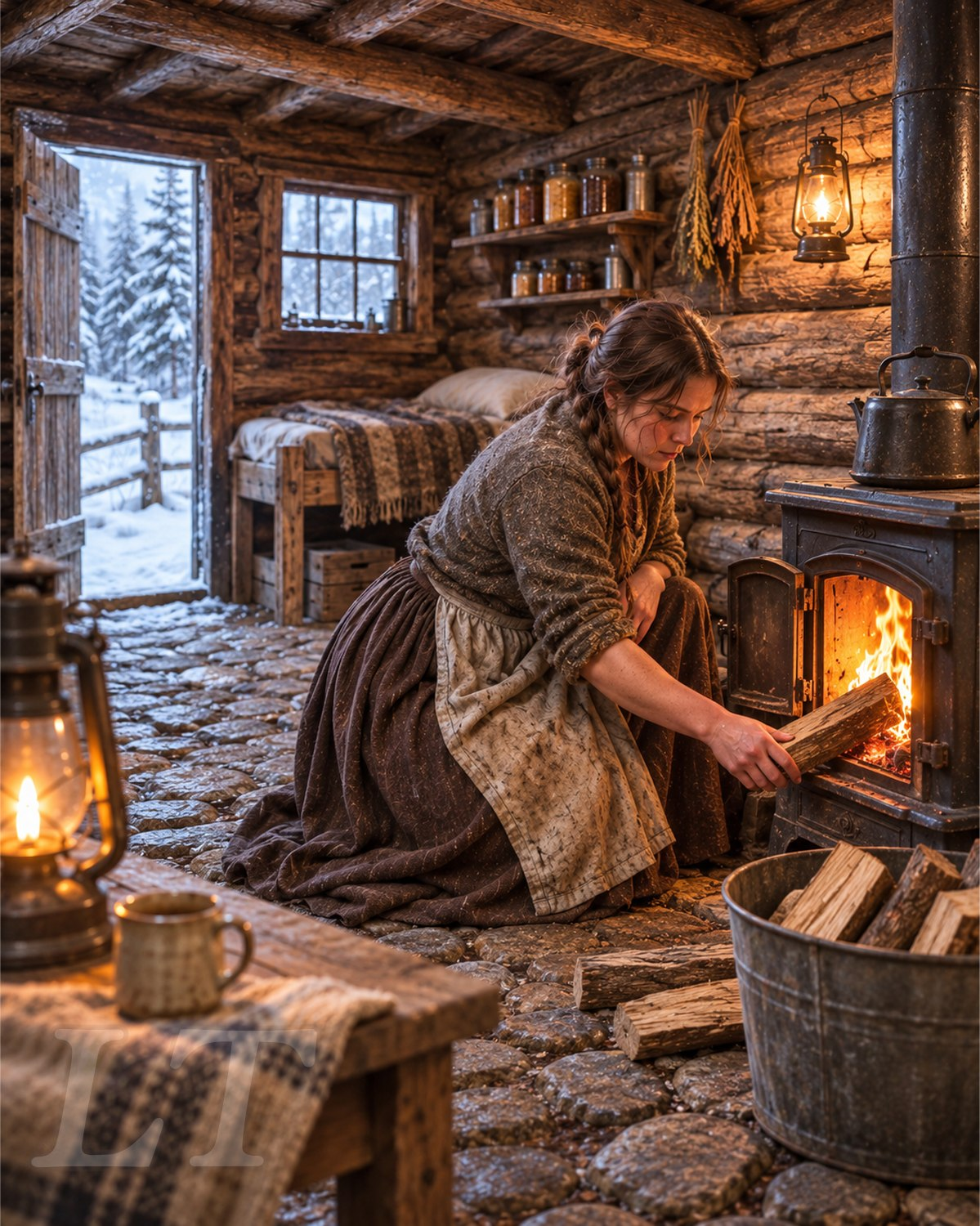
The knock came just after sunrise.
Elspeth was kneeling beside the exposed section of floor, trying to loosen another oak plank, when she heard it.
Three hard strikes.
She stopped.
Sarah was sleeping in a basket near the hearth, wrapped in a wool blanket.
Elspeth wiped her hands against her skirt and walked toward the door.
When she opened it, Martha stood outside holding a covered basket.
Tom's sister-in-law had brought bread, dried apples, and a small jar of preserved berries.
But her expression changed the moment she looked inside.
"What happened to your floor?"
Elspeth glanced over her shoulder.
"I'm taking it out."
Martha stared at her.
"Taking it out?"
"Yes."
"All of it?"
"That's the plan."
For several seconds, Martha appeared unable to decide whether to laugh or become angry.
Then she stepped inside.
The exposed earth beneath the removed planks was dark and uneven. Several boards leaned against the wall. Elspeth's iron pry bar rested near the workbench.
Martha placed the basket on the table.
"Ellie, tell me you're not planning to leave the ground exposed."
"I'm not."
"Then what are you planning?"
Elspeth hesitated.
She had been thinking about her father's words all night. The idea seemed reasonable when she was alone, but explaining it aloud made it sound considerably less sensible.
"I'm going to replace the wood with stone."
Martha blinked.
"Stone?"
"River stones."
A long silence followed.
Then Martha shook her head.
"Have you lost your senses?"
Elspeth looked toward Sarah.
"No."
"Do you understand what you're doing? You're removing the only thing separating your home from frozen ground."
"The wooden floor never kept the cabin warm."
"That doesn't mean you should remove it!"
Martha's voice rose.
"Tom spent weeks putting those boards down. He built this place for you. For Sarah. And now you're tearing it apart?"
Elspeth felt the words strike somewhere deep.
She looked at the boards stacked against the wall.
Tom had chosen each one.
He had cut them himself.
For a moment, she considered explaining that she missed him every time she looked at them.
Instead, she took a breath.
"I remember how cold the floor was last winter."
Martha folded her arms.
"We all remember."
"We burned eight cords of wood."
"And?"
"We still froze."
Martha looked toward the open section of the floor.
Elspeth continued.
"I don't have eight cords this year. I have five. Maybe less if the roads become impassable."
"Then you should save every board Tom left you."
"Wood isn't going to save Sarah if we run out of firewood."
Martha's expression softened slightly.
She looked at the sleeping baby.
"Your daughter needs a mother who makes sensible decisions."
Elspeth lowered her eyes.
"I know."
"Then promise me you'll think carefully before doing anything else."
"I will."
But she did not promise to stop.
And Martha understood that.
Before leaving, she approached the basket and gently touched Sarah's cheek.
"Your mother is stubborn," she whispered.
Elspeth almost smiled.
"She gets that from her father."
Martha turned toward the door.
"That's what worries me."
After she left, Elspeth stood in the middle of the cabin for a long time.
The bread remained untouched.
The exposed earth seemed darker than before.
She knew Martha had not come to hurt her.
The older woman was frightened.
Everyone was frightened.
But fear could make people cling to familiar things even when those things were failing them.
Elspeth returned to the workbench.
She picked up Tom's iron pry bar.
And continued.
By the end of the third day, the wooden floor had disappeared.
The entire cabin floor was exposed.
Her hands were blistered. Her back ached. Dirt had worked its way beneath her fingernails.
But now she could see the ground beneath the home.
She examined it carefully.
Her father had taught her that stone alone was not enough.
Moisture could destroy a foundation.
Water trapped beneath timber could invite rot. Freezing water could damage masonry.
If she was going to do this, she had to think beyond warmth.
She needed drainage.
She needed a dry foundation.
She needed a stable surface.
And she needed to get the stones before the creek froze completely.
The following morning, she wrapped Sarah securely and carried her outside.
The air was sharp.
The creek ran through a narrow section of the valley, its edges already covered with ice.
Smooth stones rested beneath the shallow water.
Some were gray.
Others were brown, reddish, or almost black.
Elspeth crouched beside the bank.
She picked one up.
It was heavy.
She turned it in her hand.
For a moment, she remembered Scotland.
Her father's large hands.
The lime kilns.
The warmth of stone long after the flames had disappeared.
"That's it, Papa," she whispered.
Then she placed the stone in the empty wheelbarrow.
The first trip was difficult.
The second was worse.
By the fifth, her shoulders burned.
By the tenth, her boots were soaked.
She returned to the cabin after sunset with a small collection of stones and barely enough strength to prepare supper.
Sarah began crying.
Elspeth immediately abandoned the wheelbarrow.
She warmed milk, checked the blanket, and held her daughter close.
"I'm sorry, sweetheart."
The baby quieted against her chest.
Elspeth looked toward the stones.
There were so many still waiting at the creek.
She had underestimated the amount of work.
But she had also underestimated how much she could endure.
The next morning, she started again.
People noticed.
At first, they watched from a distance.
Then they began making comments.
A ranch hand passing along the trail stopped his horse.
"What are you doing with those rocks, Mrs. MacLeod?"
"Building a floor."
He laughed.
"That's a new one."
Elspeth continued loading the wheelbarrow.
"Have a good day."
By the following week, the story had reached the trading post.
A widow was filling her cabin with stones.
Not a few stones around the hearth.
Not a decorative border.
Hundreds.
The story became more ridiculous with every retelling.
Some said she planned to sleep on the rocks.
Others claimed she believed the stones would keep her warm without a fire.
Silas Black, a trapper known for his loud opinions, turned the entire thing into entertainment.
"Maybe the river witch thinks she's building herself a mountain."
The men laughed.
But Elspeth did not hear the joke.
She was too busy carrying another load.
Meanwhile, the work inside the cabin was becoming more complicated.
She excavated the earth carefully, creating space for the foundation layers.
She brought in gravel for drainage and spread sand to help level the surface.
She remembered her father's warnings about moisture and made sure the base would not simply trap water against the timber.
The shallow stone-lined passages were another challenge.
She wanted warmth from the stove to spread through the surrounding stone mass rather than remain concentrated in one corner.
She had no modern diagrams or engineering instructions.
She relied on observation, patience, and the lessons she remembered from childhood.
Some evenings, she sat beside the unfinished floor with a piece of charcoal and drew arrangements on scraps of paper.
She crossed out one design.
Then another.
She measured.
She reconsidered.
Sometimes she stared at the drawings until the lantern burned low.
The hardest part was not the physical labor.
It was the uncertainty.
What if she had misunderstood her father?
What if the stones became damp?
What if the floor failed to retain enough heat?
What if Sarah became sick before the work was finished?
One night, Elspeth woke to find her daughter coughing.
She immediately sat up.
Sarah's tiny face was flushed.
Elspeth touched her forehead and listened carefully to her breathing.
For a terrible moment, she remembered Tom lying beneath the blankets, struggling for air.
She held Sarah close until the coughing stopped.
Then she sat beside the cradle until morning.
At sunrise, she looked at the unfinished floor.
There was no room for failure.
Not because she wanted to prove anything to the neighbors.
Not because she wanted to embarrass Jedediah Croft.
Not even because she wanted to demonstrate that her father had been right.
She simply could not bear the thought of losing another person she loved to the cold.
A few days later, Jedediah himself appeared.
He stood in the doorway, looking at the excavation.
His heavy boots rested on the remaining wooden threshold.
"What happened here?"
Elspeth straightened.
"Good morning, Mr. Croft."
He did not return the greeting.
Instead, he walked slowly into the cabin.
His eyes moved over the exposed ground, the gravel, and the growing collection of stones.
"You've removed the entire floor."
"Yes."
"Why?"
"I want to build a stone floor."
He looked at her as if he had misheard.
"A stone floor?"
"Yes, sir."
Jedediah removed his hat.
He was a tall man with silver hair and a thick beard. His hands were rough from decades of working timber.
He had built barns, cabins, bridges, and several of the strongest houses in the valley.
People listened when he spoke.
Elspeth knew that.
"Listen carefully, girl," he said. "I have spent forty years learning what happens when moisture gets into a foundation."
"I understand."
"No, I don't think you do."
He pointed toward the exposed earth.
"Stone can hold water. Water freezes. Frozen water damages foundations. You could ruin the entire cabin."
"I have prepared a gravel bed."
"Gravel?"
"For drainage."
Jedediah looked down.
Then he looked back at her.
"You've taken a perfectly good wooden floor and turned your home into an experiment."
Elspeth said nothing.
He shook his head.
"Where did you get this idea?"
"My father was a stonemason."
"Your father isn't here."
The words landed heavily.
Elspeth looked toward Sarah's basket.
"No," she replied quietly. "He isn't."
Jedediah seemed to realize he had gone too far.
But instead of apologizing, he put his hat back on.
"I strongly advise you to stop before you make things worse."
Elspeth stood beside the unfinished floor.
"Thank you for your concern."
He turned toward the door.
Then stopped.
"One more thing. If that floor becomes damp, don't expect me to repair the damage for free."
"I wouldn't ask you to."
He left.
Elspeth watched him disappear down the trail.
Then she returned to her work.
That afternoon, she carried another wheelbarrow of stones into the cabin.
She had no idea that Jedediah would soon repeat his warning to half the valley.
And the next person to arrive would not be offering advice.
It would be someone who believed Elspeth was no longer capable of caring for her own child.
Tiếp theo: Chapter 3 sẽ đi sâu vào ký ức Scotland của Elspeth, bài học của người cha về khả năng giữ nhiệt của đá và cách cô biến ký ức ấy thành kế hoạch thực tế cho căn cabin.






Comments 0